Reasons for choosing our testing services
ZHONGXI Testing has obtained inspection qualification certifications from multiple countries and regions worldwide. We possess a senior testing team and advanced testing methods, providing independent, impartial, and professional third-party verification services for global carbon projects.

Internationally recognized authority
Certified by multiple international standards such as CNAS, VCS, and GS, with reports universally applicable worldwide.

Global service capability
Covering 140+ countries and regions, it supports on-site detection and remote verification in multiple languages.

Professional experimental methods
Adopt standard experimental methods to ensure accurate and reliable data.
Ultra-Precise Ferrous Sulfate Monohydrate (FeSO₄·H₂O) Analysis – Full Quality Assurance for Feed, Water Treatment & Industrial Applications
When you search for ferrous sulfate monohydrate detection, you are likely preparing to qualify your FeSO₄·H₂O material – whether for use as a feed additive (source of bioavailable iron), a coagulant in wastewater treatment, a reducing agent in chemical synthesis, a precursor for iron oxide pigments, or a soil amendment. Ferrous sulfate monohydrate offers a stable, non‑hygroscopic form of iron(II) with high iron content. Its performance depends critically on total iron (Fe²⁺) content, sulfate purity, moisture level (free water vs. water of hydration), heavy metal impurities (especially arsenic, lead, cadmium), particle size distribution, and resistance to oxidation (Fe³⁺ content). Our testing service delivers the deepest, most actionable characterisation available – enabling you to meet feed regulations (e.g., EU 1831/2003, FDA), industrial specifications, and end‑user performance requirements with absolute confidence.
Our Comprehensive Ferrous Sulfate Monohydrate Testing Capabilities – From Iron Assay to Oxidation Stability
We deploy a multi‑technique platform specifically optimised for ferrous (iron(II)) salts, including strict measures to prevent air oxidation during sample preparation and analysis:
1. Total Iron & Ferrous Iron Content – Titrimetric & Spectrophotometric Methods (ISO 6685, USP): The core value of ferrous sulfate monohydrate is its iron(II) content, but some oxidation to iron(III) may occur. We quantify total iron by ICP‑OES after complete digestion, accuracy ±0.05% absolute. For ferrous iron (Fe²⁺) specifically, we perform potentiometric titration with cerium(IV) sulfate (or dichromate) under inert atmosphere, following ISO 6685:1982 – detection limit 0.01% Fe²⁺, repeatability ±0.02%. We also use visible spectrophotometry (1,10‑phenanthroline complex) for lower detection (0.0005% Fe²⁺). The trivalent iron content (Fe³⁺) is calculated by difference. We report FeSO₄·H₂O purity (anhydrous basis) to ±0.1% absolute, and provide an oxidation index (% Fe³⁺ / total Fe).
2. Sulfate (SO₄²⁻) Content – Gravimetric & Ion Chromatography (ISO 2487, IC): Sulfate content confirms stoichiometry and detects dilution by inert fillers. Following ISO 2487:1973, we precipitate and weigh BaSO₄ – accuracy ±0.05% absolute SO₄²⁻. For rapid verification, we use ion chromatography (IC) with suppressed conductivity, achieving repeatability ±0.02% and detection of other anions (Cl⁻, NO₃⁻, PO₄³⁻) down to 0.001%. Combined with iron analysis, we calculate the Fe:SO₄ molar ratio (theoretical 1:1) to confirm correct salt formation and detect adulteration.
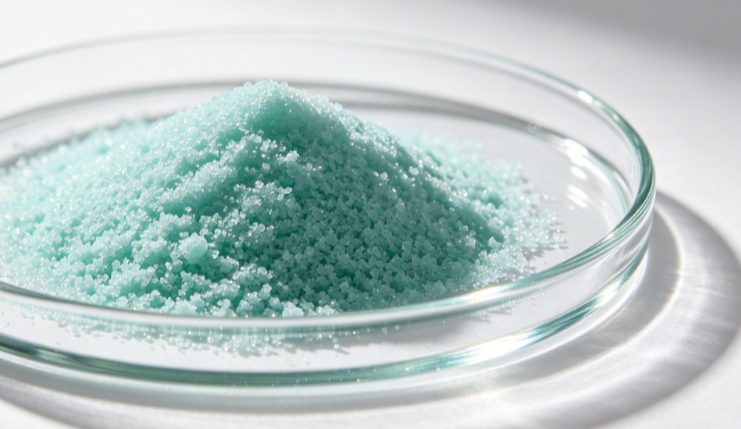
3. Water of Hydration & Free Moisture – Karl Fischer, Loss on Drying & TGA‑DSC: Ferrous sulfate monohydrate (FeSO₄·H₂O) contains exactly one mole of water of crystallisation (~9.9% H₂O). Excess free moisture leads to caking and promotes oxidation. Our coulometric Karl Fischer titration in a dry glovebox (H₂O < 0.5 ppm) measures total water (crystal + free) to ±0.02%. To distinguish free water from hydration water, we perform loss on drying at 105 °C (free moisture) vs. 400 °C (total volatiles). Simultaneous TGA‑DSC (25–600 °C) under nitrogen resolves: endothermic dehydration of monohydrate to anhydrous FeSO₄ (~150 °C), followed by decomposition to Fe₂O₃ and SO₂/SO₃ (~500–600 °C). We report bound water content ±0.02% to confirm the correct hydrate form.
4. Heavy Metals & Toxic Trace Elements – Pb, As, Cd, Hg, Ni, Cr, Zn (ICP‑MS, ICP‑OES, AFS): For feed and food‑contact grades, strict limits apply (e.g., EU: As < 2 ppm, Pb < 5 ppm, Cd < 1 ppm). Our ICP‑MS (inductively coupled plasma mass spectrometry) with collision/reaction cell and ISO‑5 cleanroom digestion (HNO₃/H₂O₂) achieves detection limits: As 0.02 ppm, Pb 0.01 ppm, Cd 0.005 ppm, Hg 0.002 ppm, Ni 0.05 ppm, Cr 0.05 ppm, Zn 0.1 ppm. For arsenic speciation (toxic inorganic vs. less toxic organic), we offer HPLC‑ICP‑MS. For mercury, cold vapor atomic fluorescence spectroscopy (CV‑AFS) provides sub‑ppb detection for the most demanding environmental and food safety standards.
5. Insoluble Matter (Gravimetric & Residue Analysis): Water‑insoluble residues (sand, silicates, unreacted raw materials) cause abrasion in pumps and poor dissolution. We dissolve 50 g in dilute H₂SO₄ (pH 2), filter through a 0.45 µm membrane, dry, and weigh – achieving detection limit 0.002% with ±0.0005% repeatability. Residues are further analysed by FTIR and XRD to identify SiO₂, aluminosilicates, or iron oxyhydroxides.
6. Particle Size Distribution & Morphology (Laser Diffraction, Sieve Analysis, SEM): For consistent blending in feed premixes or dissolution in water treatment, particle size matters. Our laser diffraction (Malvern Mastersizer 3000) with dry powder feeder (Aero S) measures D10, D50, D90 from 0.1 µm to 2 mm with repeatability < 1% on D50. Complementary rotary sieve analysis (ASTM E11) provides mass fractions on #40, #60, #100, #200 meshes. Field‑emission scanning electron microscopy (FE‑SEM) visualises crystal habit (rhombic prisms of monohydrate) and detects surface oxidation or agglomeration.
7. pH & Acidity (1% Solution – ISO 787‑9): A 1% aqueous solution of ferrous sulfate monohydrate is acidic (pH 3–4). Using a calibrated glass electrode at 25.0 ± 0.1 °C, we measure pH to ±0.02 units. For free acid (H₂SO₄) determination, we perform potentiometric titration with NaOH from initial pH to pH 7.0 – free acid down to 0.005%.
8. Crystalline Phase & Hydrate Verification (XRD, TGA‑DSC, FTIR): The monohydrate phase (FeSO₄·H₂O, monoclinic, space group P2₁/c) must be distinguished from the heptahydrate (FeSO₄·7H₂O) or tetrahydrate. Our high‑resolution X‑ray diffraction (HR‑XRD) with Rietveld refinement identifies the exact hydrate and quantifies any mixed phases (down to 0.5 wt%). Fourier‑transform infrared spectroscopy (FTIR) in ATR mode shows characteristic O–H stretching (hydration water ~3400 cm⁻¹) and S–O stretching (~1100 cm⁻¹, 980 cm⁻¹). We also use Raman microspectroscopy to monitor oxidation markers (Fe³⁺‑O bands).
9. Oxidation Resistance & Accelerated Stability Studies (Isothermal Calorimetry, Oven Ageing at 40 °C/75% RH): Ferrous sulfate monohydrate gradually oxidises to Fe³⁺ species, reducing bioavailable iron. We perform accelerated ageing in climate chambers (40 °C, 75% RH for 2, 4, 6 weeks) and measure Fe²⁺ loss (%) at each interval. Using isothermal microcalorimetry at 40 °C, we measure the heat flow from oxidation – predicting long‑term stability in just 3–5 days. We also provide DSC oxidation onset temperature under air (heating rate 5 °C/min) – a rapid screening tool for coating effectiveness (e.g., anti‑caking agents like stearates or silica).
10. Bulk Density, Tap Density & Flowability (ASTM D7481, Angle of Repose): For automatic bagging, blending, or pneumatic conveying, we measure loose bulk density (g/cm³), tapped density (500 taps), and calculate Hausner ratio and Carr index (precision ±0.5%). Angle of repose (fixed funnel, 1 cm nozzle) with ±0.5° accuracy predicts flow behaviour – important for feed mill handling.
11. Chloride, Fluoride & Other Anions (IC): Chloride accelerates corrosion of stainless steel equipment. Using ion chromatography, we quantify Cl⁻, F⁻, NO₃⁻, PO₄³⁻ down to 0.001% (10 ppm) with ±0.0002% repeatability.
12. Bioavailable Iron (In Vitro Simulated Gastrointestinal Extraction) – For Feed & Food Supplements: For animal feed or human supplementation, total iron does not equal bioavailable iron. We perform simulated gastric fluid (SGF) extraction (0.07 M HCl, pH 1.2, with pepsin, 37 °C, 2 h) followed by simulated intestinal fluid (SIF) extraction. The soluble iron fraction is measured by ICP‑MS and reported as % bioaccessibility. This service supports product labelling and regulatory dossiers.
All handling of ferrous sulfate monohydrate is performed under low‑humidity, low‑oxygen conditions (glovebox or flowing N₂) when required for ferrous‑sensitive analyses. Our lab follows ISO 17025:2017 and FAMI‑QS (Feed Additives and Premixtures Quality System) guidelines.
Why Our Ferrous Sulfate Monohydrate Testing Service Excels – Precision, Oxidation Control & Feed Industry Expertise
We understand that ferrous sulfate monohydrate is a high‑volume commodity where even slight oxidation, moisture variation, or heavy metal contamination can cause product rejection, animal health issues, or process corrosion. Our advantages are built on decades of iron chemistry experience and rigorous quality systems:
▶ Unmatched Accuracy in Fe²⁺ vs. Fe³⁺ Speciation: Many labs only report total iron, missing the critical oxidation state. Our cerimetric titration under inert atmosphere achieves Fe²⁺ quantitation to ±0.02% absolute – essential for determining true reducing power and bioavailability. We also provide Mössbauer spectroscopy (upon request) for precise Fe²⁺/Fe³⁺ ratio and mineral phase identification.
▶ Ultra‑Low Heavy Metal Detection for Global Feed Compliance: Our SF‑ICP‑MS with matrix‑matched calibration achieves As detection limit 0.02 ppm, Pb 0.01 ppm, Cd 0.005 ppm – more than 100× below typical feed limits. We also perform speciation of arsenic (inorganic AsIII/AsV vs. organic) by HPLC‑ICP‑MS, crucial for EU feed safety (inorganic As < 2 ppm).
▶ Hydrate Verification by Combined TGA‑XRD: Distinguishing monohydrate from heptahydrate or anhydrous forms is critical for dosage calculations. Our simultaneous TGA‑DSC measures the exact water loss (9.9% for monohydrate), while HR‑XRD confirms the crystal structure. We also detect amorphous or partially hydrated phases that affect dissolution rate.
▶ Oxidation Stability Predictions – Not Just a Snapshot: A single batch may pass initial Fe²⁺ specifications but oxidise rapidly during storage. Our accelerated ageing (40 °C/75% RH for up to 8 weeks) and isothermal microcalorimetry provide a realistic shelf‑life prediction (e.g., Fe²⁺ retention >95% after 12 months). This is invaluable for feed manufacturers and long‑distance exporters.
▶ Rapid Turnaround with Regulatory‑Ready Documentation: A standard quality panel (Fe²⁺, total Fe, sulfate, moisture, heavy metals, particle size) is completed in 3–5 business days. For urgent shipment release, we offer 24‑hour express service (Fe²⁺, moisture, Pb/As only within 24 h). Reports include raw titration curves, ICP‑MS spectra, TGA/DSC thermograms, XRD diffractograms, and a clear pass/fail summary against your specification (e.g., EU 1831/2003, FCC, or customer‑specific).
▶ Compliance with International Feed & Food Additive Standards: We follow ISO 6685 (iron determination), ISO 2487 (sulfate), AOAC 965.09 (heavy metals in feeds), and EU Regulation 1275/2013 (ferrous sulfate monohydrate as feed additive). Our ISO/IEC 17025:2017 accreditation ensures certificates are accepted by FAMI‑QS, GMP+, FDA, and major feed safety schemes (e.g., QS, UFAS).
▶ Global Logistics with Anti‑Oxidation Packaging: Ferrous sulfate monohydrate is non‑hazardous (not classified under UN) but can oxidise in humid air. We provide food‑grade, moisture‑barrier aluminium bags with oxygen absorber sachets and nitrogen flushing. For long‑distance shipments, we offer desiccant packs and sealed inner liners. International shipments are fully documented with MSDS, commercial invoice, and customs declaration – no dangerous goods restrictions.
▶ Expert Consultation for Process Optimisation & Troubleshooting: Our team has extensive experience in ferrous sulfate production (pickle liquor recovery, titanium dioxide co‑product, direct synthesis). We help you: identify the source of Fe³⁺ formation (oxidation during drying, insufficient cooling, or pro‑oxidant impurities), optimise particle size to minimise caking, select effective anti‑caking coatings (silica, starch, stearates) without harming bioavailability, and benchmark competitors. A free 30‑minute technical consultation is included with every project.
▶ Cost‑Effective for High‑Volume QC & R&D: We serve large‑scale feed mills, water treatment chemical distributors, and iron salt producers. Our automated titration systems, ICP‑MS with 300‑position autosampler, and robotic XRD enable volume discounts for recurring testing (≥ 30 batches/month). Academic and non‑profit pricing is available.
In summary, we deliver the most comprehensive, accurate, and application‑focused ferrous sulfate monohydrate analysis available worldwide – from Fe²⁺ assay and heavy metal safety to hydration state and shelf‑life prediction. Whether you need to certify a shipment for animal feed, qualify a new source for water treatment, or troubleshoot an oxidation problem, our data gives you absolute confidence.
Ready to test your ferrous sulfate monohydrate? Contact our inorganic salts team. We will send you a prepaid, moisture‑barrier sample kit and a custom test plan within one business day. A no‑obligation technical discussion is always free. Let us help you ensure every batch of FeSO₄·H₂O delivers consistent, bioavailable iron – from production to final use.