Reasons for choosing our testing services
ZHONGXI Testing has obtained inspection qualification certifications from multiple countries and regions worldwide. We possess a senior testing team and advanced testing methods, providing independent, impartial, and professional third-party verification services for global carbon projects.

Internationally recognized authority
Certified by multiple international standards such as CNAS, VCS, and GS, with reports universally applicable worldwide.

Global service capability
Covering 140+ countries and regions, it supports on-site detection and remote verification in multiple languages.

Professional experimental methods
Adopt standard experimental methods to ensure accurate and reliable data.
High‑Precision Testing Services for Antimony Trioxide (Sb₂O₃)
If you are searching for antimony trioxide testing, you are likely using Sb₂O₃ as a flame retardant synergist in plastics and textiles, as a catalyst for PET polymerization, or in specialty glass, ceramics, or electronic materials. Quality control of antimony trioxide is critical because even minor variations in purity, particle size, oxidation state, or trace metal impurities can significantly affect flame retardancy efficiency, catalyst activity, or final product color and stability. We understand that your need for testing is driven by incoming material verification, process optimization, regulatory compliance (e.g., RoHS, REACH), or troubleshooting product defects. Our laboratory offers a complete, high‑depth analytical suite for antimony trioxide – from primary purity to advanced crystalline phase and surface characterization.
What We Can Do for Your Antimony Trioxide Samples
We provide comprehensive testing for all grades of antimony trioxide, including technical grade, high‑purity grade (≥99.8%), and nano‑Sb₂O₃. Our core capabilities include:
- Purity assay (Sb₂O₃ content) by redox titration (iodometric method) and difference calculation (100% – total impurities – loss on ignition) with an accuracy of ±0.1% absolute.
- Trace metal impurities (Pb, As, Fe, Cu, Cd, Ni, Zn, etc.) using ICP‑MS (detection limits down to 0.01 ppm) and ICP‑OES (sub‑ppm for major trace elements). Special attention to arsenic (often regulated <100 ppm) and lead (<50 ppm for many specifications).
- Loss on ignition (LOI) at 850 °C – 950 °C to distinguish Sb₂O₃ from Sb₂O₄ or Sb₂O₅. We also quantify antimony pentoxide (Sb₂O₅) content by selective dissolution or TGA/DSC.
- Particle size distribution by laser diffraction (0.01–2000 µm range, wet or dry dispersion) – critical for dispersion in polymer melts.
- Specific surface area (BET, N₂ adsorption) – especially important for nano‑Sb₂O₃ and flame retardant performance.
- Crystalline phase analysis by X‑ray diffraction (XRD) – identification of senarmontite (cubic), valentinite (orthorhombic), or mixed phases, plus detection of crystalline impurities (e.g., Sb₂O₄, SiO₂, Fe₂O₃).
- Whiteness index (CIE L*a*b* values) via spectrophotometer – Sb₂O₃ purity directly correlates with whiteness (typical L* >96 for high‑grade).
- Moisture content by Karl Fischer oven method or gravimetric loss at 105 °C.
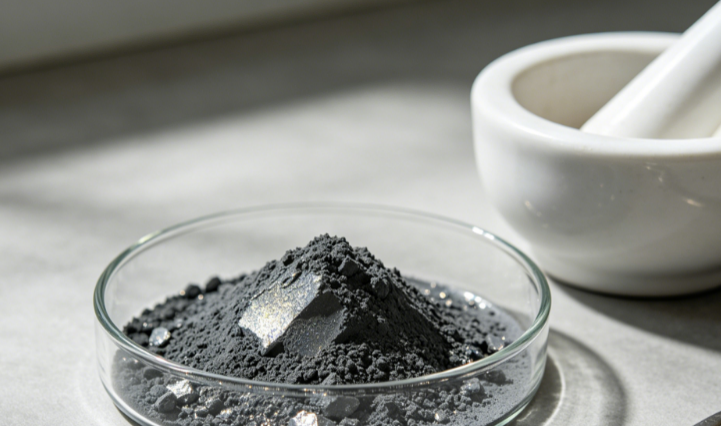
How Deep Our Characterization Goes
We go far beyond basic “purity and particle size”. Our advanced methods address the specific challenges of antimony trioxide – including oxidation state control, trace arsenic speciation, and surface reactivity. Examples of our technical depth:
- Simultaneous TGA‑DSC‑FTIR‑MS from 50 °C to 1200 °C in air or inert gas: quantify the oxidation of Sb₂O₃ to Sb₂O₄ (exothermic peak ~450–550 °C) and further to Sb₂O₅ (~800 °C). Detect evolved H₂O, CO₂, and any volatile antimony species – essential for predicting thermal stability during polymer compounding.
- Arsenic speciation (As³⁺ vs. As⁵⁺) by hydride generation‑ICP‑MS (HG‑ICP‑MS) after selective extraction – critical because As³⁺ is far more toxic and regulated. Detection limit <0.1 ppm As.
- Surface chemistry analysis by X‑ray photoelectron spectroscopy (XPS) – determine Sb 3d and O 1s binding energies to identify surface oxidation states, hydroxyl groups, and carbonate contamination (common after air exposure).
- Scanning electron microscopy (SEM) with EDS for morphology: visualize primary particle shape, agglomeration state, and elemental mapping to detect heterogeneous impurities (e.g., silica, iron oxide inclusions).
- Chloride and sulfate anions by ion chromatography after alkaline fusion – sub‑ppm sensitivity; high Cl⁻ can cause corrosion during flame retardant processing.
- Trace mercury and selenium by ICP‑MS with collision cell technology – detection limits <0.01 ppm, meeting strict electronics industry standards (e.g., IEC 62321).
- Dispersion stability test in typical polymer matrices (e.g., PP, PVC) via sedimentation analysis and dynamic light scattering (DLS) – predictive of in‑process agglomeration.
Why Our Laboratory Is the Right Choice for Antimony Trioxide Testing
Many general analytical labs treat Sb₂O₃ as a simple white powder, missing critical parameters like arsenic speciation, oxidation state control, or crystalline phase effects. Our advantages are built on decades of experience in flame retardant material analysis and ISO 17025 accredited methods:
➤ Specialized handling for hygroscopic and static‑prone powders – Sb₂O₃ fine powders can absorb atmospheric CO₂ forming surface carbonates. We perform all sample preparation under controlled humidity (<20% RH) and use anti‑static devices for particle size analysis, ensuring representative results.
➤ Matrix‑optimized digestion for ICP‑MS – Antimony trioxide is resistant to conventional acid digestion. We use microwave digestion with H₂SO₄/HCl or alkaline fusion followed by ICP‑MS analysis, achieving complete recovery and sub‑ppb detection limits even for refractory impurities like silica.
➤ Crystalline purity analysis by Rietveld refinement – Quantify senarmontite/valentinite ratio with ±1% absolute accuracy. Detect as little as 0.2 wt% Sb₂O₄ (an indicator of overheating during production).
➤ Rapid turnaround and transparent reporting – Standard purity + trace metals + particle size + LOI completed within 3‑5 business days. You receive a certificate of analysis with raw data, method detection limits, and uncertainty budgets. Expedited 24‑hour service available for emergencies.
➤ Global regulatory compliance support – We provide test results formatted for RoHS, REACH, and California Proposition 65 declarations. Our data is accepted by major certification bodies and global supply chain auditors.
➤ One‑on‑one technical consultation – Our inorganic chemists help you correlate test results with end‑use performance (flame retardancy efficiency, catalyst activity, color stability). We troubleshoot batch inconsistencies and advise on quality improvement measures.
Ready to Get Your Antimony Trioxide Tested?
Whether you are qualifying a new supplier, investigating a production batch that failed flame retardant testing, or certifying a high‑purity grade for electronics, our laboratory delivers the most comprehensive, accurate, and actionable characterization of antimony trioxide available. Contact our flame retardant materials analysis team with your required specification limits (purity, particle size, arsenic, etc.) and application – we will return a custom test plan and competitive quote within 24 hours.