Reasons for choosing our testing services
ZHONGXI Testing has obtained inspection qualification certifications from multiple countries and regions worldwide. We possess a senior testing team and advanced testing methods, providing independent, impartial, and professional third-party verification services for global carbon projects.

Internationally recognized authority
Certified by multiple international standards such as CNAS, VCS, and GS, with reports universally applicable worldwide.

Global service capability
Covering 140+ countries and regions, it supports on-site detection and remote verification in multiple languages.

Professional experimental methods
Adopt standard experimental methods to ensure accurate and reliable data.
Precision Testing Services for Zirconium Oxychloride Crystals (ZrOCl₂·8H₂O & Related Hydrates)
If you are searching for zirconium oxychloride crystal testing, you are likely using this material as a key precursor for high‑purity zirconia (ZrO₂), as a catalyst support or crosslinking agent, or in ceramic pigments, optical coatings, and specialized adsorbents. Zirconium oxychloride octahydrate (ZrOCl₂·8H₂O) and its partially hydrated forms require rigorous characterization of hydration state, trace impurities (especially hafnium, iron, and titanium), chloride content, and crystalline phase purity – because even minor variations directly affect downstream conversion to zirconia, catalytic activity, or final product performance. We understand that your need for testing is driven by raw material qualification, process optimization, impurity control (e.g., Hf removal for nuclear grade), or compliance with specifications (e.g., reagent grade, electronics grade). Our laboratory delivers the most comprehensive, high‑depth analytical suite for zirconium oxychloride crystals, from hydration stoichiometry to ultra‑trace elemental profiling and crystallinity assessment.
What We Can Do for Your Zirconium Oxychloride Crystal Samples
We provide complete testing tailored to all forms of zirconium oxychloride – including anhydrous ZrOCl₂, octahydrate (ZrOCl₂·8H₂O), and partially dehydrated products. Our core capabilities include:
- Hydration state and water of crystallization determination by thermogravimetric analysis (TGA) combined with differential scanning calorimetry (DSC) – quantify total water content (crystalline + adsorbed) and distinguish dehydration steps with resolution down to 0.05% mass change.
- Stoichiometric verification (Zr : O : Cl ratio) via ICP‑OES for zirconium, chloride titration (mercurimetric or argentometric), and inert gas fusion for oxygen (or difference calculation).
- Trace elemental impurities (Hf, Fe, Ti, Al, Ca, Mg, Na, K, Cu, Pb, etc.) using high‑resolution ICP‑MS – detection limits as low as 0.01 ppm for hafnium (critical for nuclear‑grade Zr chemicals) and 0.1 ppm for most transition metals.
- Hafnium content (Hf/Zr ratio) by ICP‑MS with matrix matching – essential for zirconium intended for nuclear reactors (spec typically Hf < 0.01% relative to Zr). We achieve accuracy ±2% relative down to 10 ppm Hf in Zr matrix.
- Anion impurities (Cl⁻ excess, sulfate, nitrate, phosphate) by ion chromatography after controlled dissolution – detection limits sub‑ppm. Excess chloride can indicate incomplete hydrolysis or corrosion risk.
- Crystalline phase identity & purity by X‑ray diffraction (XRD) – confirm the expected hydrate phase (octahydrate vs. other hydrates), detect amorphous content, and identify crystalline byproducts (e.g., ZrO₂, HCl‑hydrates).
- pH of saturated solution (2% w/v) – indicators of free acid (HCl) from synthesis residues.
- Particle size distribution (laser diffraction, dry or wet dispersion) and crystal morphology (SEM) – critical for dissolution rate and powder handling.
- Loss on ignition (LOI) at 950 °C – converts ZrOCl₂·8H₂O to ZrO₂; LOI value directly reflects hydration and purity.
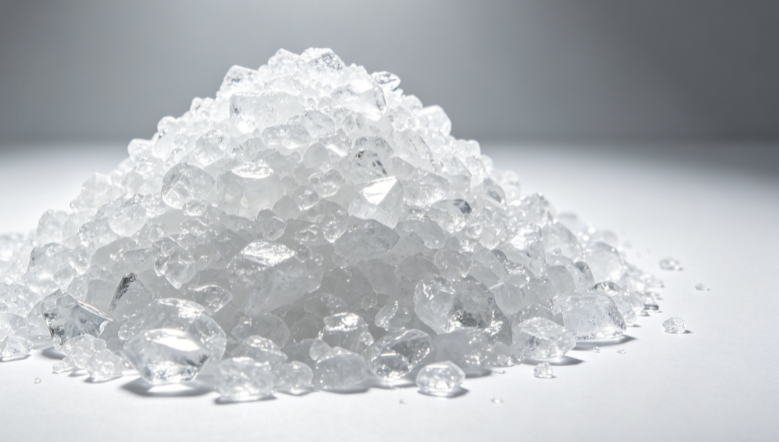
How Deep Our Characterization Goes
We go far beyond routine “purity and water content”. Our advanced methods address the specific challenges of zirconium oxychloride – including hafnium separation verification, trace halide speciation, and thermal decomposition kinetics. Examples of our technical depth:
- Simultaneous TGA‑DSC‑FTIR‑MS from 30 °C to 1100 °C in flowing air or nitrogen: resolve distinct dehydration steps (loss of coordinated water, dehydroxylation, and final conversion to ZrO₂). Identify evolved gases (H₂O, HCl, Cl₂) with mass resolution – essential for understanding decomposition hazards and residual chloride.
- Hafnium isotope dilution ICP‑MS (ID‑ICP‑MS) for highest‑accuracy Hf quantification – uses 179Hf spike to achieve ±0.5% relative uncertainty, even at 5 ppm Hf/Zr. Meets ASTM and ISO standards for nuclear‑grade zirconium chemicals.
- Trace sulfur and phosphorus by ICP‑MS after microwave digestion (with reaction/collision cell) – detection limits <0.1 ppm. These elements are often overlooked but can poison catalysts or affect optical transparency in coatings.
- Residual free HCl quantification via potentiometric titration (with silver electrode) or ion‑selective electrode – differentiate from bound chloride. High free HCl accelerates container corrosion and alters solution pH in downstream processes.
- Single‑crystal XRD (if suitable crystals provided) – absolute structure determination, hydrogen bonding network, and thermal displacement parameters. Confirms exact hydration number and crystal system (tetragonal or monoclinic variants).
- Surface analysis by X‑ray photoelectron spectroscopy (XPS) – detect surface hydrolysis products (Zr‑OH, Zr‑O‑Zr) or adventitious carbon – important for aging studies.
- Microwave digestion protocols optimized for ZrOCl₂ – complete decomposition for ICP‑MS analysis using HF/HNO₃/H₃BO₃ neutralization, preventing ZrF₄ precipitation and ensuring full recovery of all trace elements including Hf, Ti, and rare earths.
Why Choose Our Laboratory for Zirconium Oxychloride Crystal Testing
Many general analytical labs treat zirconium oxychloride as a simple salt, missing critical parameters like hafnium quantification accuracy, free acid content, or dehydration fingerprinting. Our advantages are built on decades of experience in refractory metal chemistry and ISO/IEC 17025 accredited methods:
➤ Specialized handling for hygroscopic and slightly deliquescent crystals – ZrOCl₂·8H₂O loses water of crystallization on exposure to warm, dry air and can absorb atmospheric moisture. We perform all sample preparation (grinding, splitting, loading for TGA and XRD) in a controlled environment (22 ± 2 °C, 40–50% RH) or inside a glovebox when specified, ensuring representative hydration data.
➤ Matrix‑matched calibration for Zr‑rich ICP‑MS analysis – Zirconium forms polyatomic interferences (e.g., ZrO⁺ on 95Mo⁺, 91Zr⁺H⁺ on 92Mo⁺). We use high‑resolution magnetic sector ICP‑MS (HR‑ICP‑MS) and/or collision/reaction cell technology to resolve interferences, achieving sub‑ppb detection limits even in concentrated Zr matrices (up to 1000 ppm Zr).
➤ Quantitative hydration profiling by TGA‑DSC – We report exact moles of H₂O per mole ZrOCl₂ from the mass loss steps, with a typical uncertainty of ±0.1 H₂O. Our method distinguishes surface moisture (<105 °C), coordinated water (105–250 °C), and dehydroxylation water (>250 °C) – critical for batch‑to‑batch consistency.
➤ Rapid turnaround and transparent reporting – Standard full characterization (hydration, Zr purity, trace metals including Hf, Cl content, and LOI) completed within 4‑6 business days. Expedited 48‑hour service available for urgent QC needs. You receive a certificate of analysis with raw thermograms, chromatograms, mass spectra, and full uncertainty budgets.
➤ Global logistics compliance – Zirconium oxychloride is classified as UN 3264 (corrosive solid, acidic, inorganic). We provide compliant packaging (UN‑certified bottles with overpack), safety data sheets, and assistance with international shipping documentation to over 50 countries.
➤ One‑on‑one technical consultation – Our inorganic and materials chemists help you interpret results, troubleshoot hydration discrepancies (e.g., partial efflorescence during storage), correlate trace Hf or Fe levels with final product performance (e.g., zirconia translucency or catalyst poisoning), and advise on recrystallization or purification steps.
Ready to Get Your Zirconium Oxychloride Crystals Tested?
Whether you are qualifying a supplier for nuclear‑grade zirconium, optimizing the conversion to high‑purity ZrO₂ for dental ceramics, or troubleshooting crystallization consistency in catalyst precursor batches, our laboratory delivers the deepest, most accurate characterization of zirconium oxychloride crystals available in the industry. Contact our refractory materials analysis team with your target hydration level, maximum allowed hafnium or iron content, and intended application – we will return a custom test plan and competitive quote within 24 hours.