Reasons for choosing our testing services
ZHONGXI Testing has obtained inspection qualification certifications from multiple countries and regions worldwide. We possess a senior testing team and advanced testing methods, providing independent, impartial, and professional third-party verification services for global carbon projects.

Internationally recognized authority
Certified by multiple international standards such as CNAS, VCS, and GS, with reports universally applicable worldwide.

Global service capability
Covering 140+ countries and regions, it supports on-site detection and remote verification in multiple languages.

Professional experimental methods
Adopt standard experimental methods to ensure accurate and reliable data.
High‑Precision Analytical Testing for Magnesium Chloride (MgCl₂) Granules
If you are searching for magnesium chloride granule testing, you are likely using this material in dust control and de‑icing, magnesia cement production, water treatment, hydrogen storage media, drilling fluids, or as a precursor for high‑purity magnesium chemicals. Magnesium chloride granules are typically produced as MgCl₂·6H₂O (hexahydrate), anhydrous MgCl₂, or partially hydrated forms. Their performance depends critically on parameters such as purity and major cation/anion content, hydration state, trace impurities (especially Ca, K, Na, SO₄²⁻, Br⁻, and toxic metals like Pb, As, Cd), hygroscopicity, particle size distribution, and pH of solution. Even small deviations can alter the setting time of magnesia cement, cause corrosion in dust control applications, or introduce unwanted ionic contaminants into water treatment systems. We understand that your need for testing is driven by raw material qualification, process control, regulatory compliance (e.g., drinking water standards, REACH), or troubleshooting product performance. Our laboratory offers the most comprehensive, high‑depth analytical suite for magnesium chloride granules – from basic purity and hydration state to ultra‑trace impurities, crystallinity, and functional properties such as deliquescence behavior.
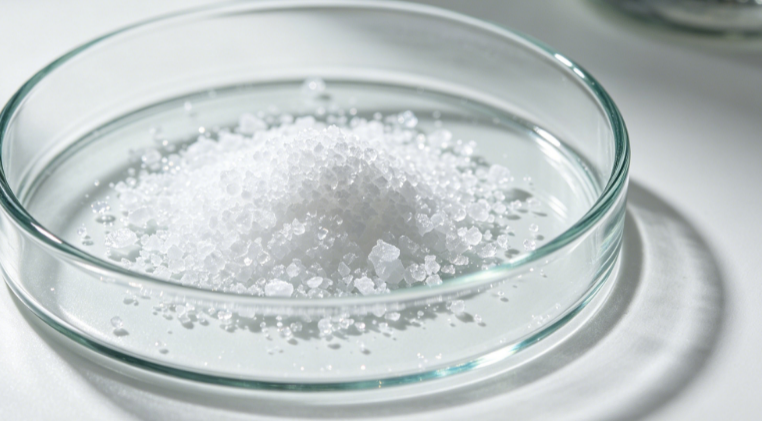
What We Can Do for Your Magnesium Chloride Granule Samples
We provide complete testing for all grades of MgCl₂ granules: industrial grade, technical grade, food/pharmaceutical grade, and anhydrous/hydrated forms. Our core capabilities include:
- Magnesium content (Mg²⁺) by complexometric titration (EDTA) or ICP‑OES after dissolution – accuracy ±0.3% relative.
- Chloride content (Cl⁻) by titration with AgNO₃ (Mohr or potentiometric method) or ion chromatography – detection limit 0.01% Cl.
- Hydration state verification (water of crystallization) by Thermogravimetric Analysis (TGA) – determine exact moles of H₂O per mole MgCl₂ (e.g., distinguishing hexahydrate from tetrahydrate or anhydrous). Resolution 0.05% mass change.
- Trace cationic impurities (Na, K, Ca, Fe, Al, Ba, Sr, Cu, Ni, Zn, Pb, Cd, As, Cr, Mn, etc.) using high‑resolution ICP‑MS (HR‑ICP‑MS) with matrix‑matched calibration. Detection limits as low as 0.01 ppm for most metals, and 0.001 ppm for Pb, Cd, As – essential for food/pharmaceutical compliance.
- Anion impurities (sulfate, nitrate, bromide, fluoride, phosphate) by ion chromatography after appropriate sample preparation. Detection limits: SO₄²⁻ <0.5 ppm, NO₃⁻ <0.1 ppm, Br⁻ <0.2 ppm.
- Insoluble matter content (ASTM D632) – filtration of dissolved granules through 0.45 µm filter, gravimetric determination.
- pH of 5% aqueous solution – typical range 5.5–7.5; deviations indicate free acid or alkali/basic magnesium salts.
- Particle size distribution (PSD) by sieve analysis (mechanical or air jet) or laser diffraction (0.01–3000 µm) – provide D10, D50, D90, uniformity coefficient.
- Bulk density (loose and tapped) per ASTM D7481 – critical for transport, storage, and mixing.
- Moisture content (surface/adsorbed water) by Karl Fischer titration (oven method, 200 °C) – differentiates from crystalline water.
- Crystalline phase identification by X‑ray diffraction (XRD) – confirm hexahydrate (MgCl₂·6H₂O, monoclinic) vs. anhydrous (MgCl₂, rhombohedral) or lower hydrates. Detect crystalline byproducts (e.g., Mg(OH)Cl, MgO).
How Deep Our Characterization Goes
We go far beyond routine “purity and moisture” packages. Our advanced methods address the specific challenges of magnesium chloride – including extreme hygroscopicity, hydration state variability, and ultra‑trace determination of bromine and toxic metals. Examples of our technical depth:
- Simultaneous TGA‑DSC‑FTIR‑MS from 30 °C to 800 °C under dry nitrogen: resolve distinct dehydration steps (6H₂O → 4H₂O → 2H₂O → 1H₂O → anhydrous) and detect any hydrolysis to Mg(OH)Cl or MgO. Evolved gases (H₂O, HCl) monitored by MS – critical for understanding decomposition behavior during high‑temperature processing. Quantify each water loss step with ±0.05 H₂O accuracy.
- High‑resolution ICP‑MS (sector field, R > 10 000) to resolve matrix‑based interferences (e.g., 24Mg35Cl⁺ on 59Co⁺, 24Mg37Cl⁺ on 61Ni⁺, 26Mg35Cl⁺ on 61Ni⁺) using medium resolution. Achieve sub‑0.01 ppm detection for Ni, Co, Cu, Zn even in concentrated MgCl₂ matrix (1% w/w Mg).
- Trace bromine and iodine quantification by ion chromatography with amperometric detection or ICP‑MS after alkaline digestion – detection limits Br⁻ <0.05 ppm, I⁻ <0.01 ppm. High Br⁻ affects electrochemical properties and indicates source of magnesium (e.g., seawater vs. brine).
- Oxygen/nitrogen content for anhydrous MgCl₂ (for specialty applications) by inert gas fusion (LECO) – MgO and Mg(OH)Cl are common impurities in anhydrous material. Detection limit for O <0.05 wt%, N <0.005 wt%.
- Deliquescence behavior and critical relative humidity (CRH) by dynamic vapor sorption (DVS) at 25 °C, 40 °C, and 60 °C over 5–95% RH. Determine CRH value (typically ~33% RH for MgCl₂·6H₂O) and predict caking/storage stability.
- Crystal habit and surface morphology by SEM (with EDS elemental mapping) – detect surface impurities, efflorescence, or deliquescent droplets. Measure primary particle size and agglomeration degree.
- Residual organic solvents or processing aids by GC‑MS headspace or solid‑phase microextraction – detection limit <1 ppm for common organics (e.g., anti‑caking agents).
- Trace mercury and arsenic speciation (As³⁺ vs. As⁵⁺) by HPLC‑ICP‑MS – detection limits Hg <0.01 ppm, As total <0.01 ppm with speciation sensitivity <0.005 ppm – required for USP/EP pharmaceutical grades.
Why Our Laboratory Is the Right Choice for Magnesium Chloride Granule Testing
General analytical labs often struggle with MgCl₂ due to its aggressive hygroscopicity, chloride‑induced spectral interferences, and the need to distinguish hydration states correctly. Our advantages are built on specialized halogenated salt handling, ISO/IEC 17025 accredited methods, and deep expertise in deliquescent materials:
➤ Strict humidity‑controlled sample preparation – MgCl₂ granules rapidly absorb moisture from air, changing hydration state and mass. We perform all weighing, grinding (if needed), and loading for TGA, Karl Fischer, and XRD inside a dry glovebox (RH <5% at 25 °C) or using a sealed nitrogen purge. Hydration results are accurate and batch‑repeatable.
➤ Matrix‑optimized digestion protocols for ICP‑MS – High chloride concentrations can suppress ICP signals and cause deposits on cones. We use matrix matching with internal standards (Sc, Y, Rh) and a dilution factor >500× combined with collision/reaction cell technology. Our method achieves recoveries of 95–105% for all trace elements, validated with spiked MgCl₂ reference materials.
➤ Quantitative hydration step analysis by TGA‑MS – We provide not only the total water content but also the stepwise water loss temperatures and corresponding hydrated species. This distinguishes true MgCl₂·6H₂O from mixtures of lower hydrates or partially hydrolyzed products – critical for evaluating feedstock for electrolytic magnesium production.
➤ Comprehensive “Specification‑Grade Certificate” – We combine assay (MgCl₂ by difference), trace metals (30+ elements), anions (Cl⁻, SO₄²⁻, Br⁻, etc.), hydration state, pH, PSD, bulk density, and insoluble matter into a single report. A clear pass/fail summary against your chosen specification (e.g., ASTM D632, USP, FCC, industrial standard) is included.
➤ Fast turnaround and transparent reporting – Standard full characterization (purity, trace metals, anions, hydration, PSD) completed within 3‑5 business days. Expedited 48‑hour service available. You receive raw thermograms, chromatograms, ICP‑MS data, particle size histograms, and full uncertainty budgets (expanded uncertainty, k=2).
➤ Global logistics for hygroscopic granules – We provide double‑sealed, moisture‑proof containers with desiccant and nitrogen headspace. For hazardous shipments (anhydrous MgCl₂ can be reactive), we supply UN‑certified packaging and assist with dangerous goods declarations (UN 1759, corrosive solid).
➤ One‑on‑one technical consultation from inorganic materials chemists – We help you interpret anomalies: e.g., why the hydration number is lower than 6 (partial dehydration during shipping), why sulfate is elevated (source brine contamination), or why pH is acidic (formation of HCl due to hydrolysis). We also advise on storage conditions to prevent caking and on re‑hydration procedures for consistent processing.
Ready to Get Your Magnesium Chloride Granules Tested?
Whether you are qualifying a new de‑icing salt batch for airport runways, certifying food‑grade MgCl₂ for tofu coagulant, or troubleshooting inconsistent setting in magnesia cement, our laboratory delivers the most thorough, actionable characterization of magnesium chloride granules available. Contact our inorganic analysis team with your granule grade (e.g., hexahydrate, anhydrous, industrial), target purity and impurity limits, and intended application – we will return a custom test plan and competitive quote within 24 hours.