Reasons for choosing our testing services
ZHONGXI Testing has obtained inspection qualification certifications from multiple countries and regions worldwide. We possess a senior testing team and advanced testing methods, providing independent, impartial, and professional third-party verification services for global carbon projects.

Internationally recognized authority
Certified by multiple international standards such as CNAS, VCS, and GS, with reports universally applicable worldwide.

Global service capability
Covering 140+ countries and regions, it supports on-site detection and remote verification in multiple languages.

Professional experimental methods
Adopt standard experimental methods to ensure accurate and reliable data.
Comprehensive Testing Services for Activated Kaolin Powder
If you are searching for activated kaolin powder testing, you are likely using this high‑performance material as a catalyst or catalyst support (FCC, hydroprocessing), a reactive pozzolan in cement and geopolymers, a paper coating pigment, a rubber reinforcing filler, or an adsorbent for heavy metals and organics. Activation – either by thermal treatment (metakaolin formation) or chemical leaching (acid‑activation) – dramatically enhances the specific surface area, surface acidity, and pozzolanic reactivity compared to natural kaolin. However, performance is governed by critical parameters: degree of dehydroxylation (metakaolin conversion), amorphous content, reactive silica/alumina availability, specific surface area (BET), particle morphology, acid‑soluble aluminum, surface acidity (Brønsted/Lewis sites), cation exchange capacity (CEC), and trace impurities (Fe₂O₃, TiO₂, K₂O, etc.). Even slight variations in activation temperature or leaching conditions can yield material with poor reactivity, unacceptable color (iron staining), or inconsistent catalytic activity. We understand that your need for testing is driven by raw material qualification, production quality control, developing new activated grades, or troubleshooting performance failures in end‑use applications. Our laboratory delivers the most advanced, multi‑technique characterization of activated kaolin powders – from bulk chemical and mineralogical analysis to surface chemical mapping, high‑resolution pore architecture, and quantitative reactivity indices.
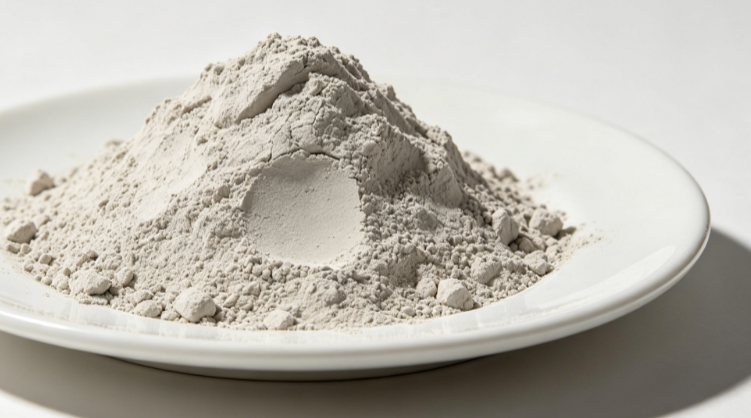
What We Can Do for Your Activated Kaolin Powder Samples
We provide complete testing for all types of activated kaolin: metakaolin (calcined at 600–900 °C), acid‑activated (leached with H₂SO₄, HCl or organic acids), and hybrid chemically‑thermally activated materials. Our core capabilities include:
- Degree of dehydroxylation / metakaolin conversion by combined Thermogravimetric Analysis (TGA) and X‑ray diffraction (XRD). Determine residual kaolinite (via characteristic mass loss at 450–600 °C) and quantify amorphous metakaolin content by internal standard method.
- Bulk oxide composition (SiO₂, Al₂O₃, Fe₂O₃, TiO₂, K₂O, Na₂O, CaO, MgO, P₂O₅, MnO) by X‑ray fluorescence (XRF) on fused beads or ICP‑OES after lithium metaborate fusion – accuracy ±0.2% absolute for major oxides.
- Trace heavy metals (Pb, Cd, As, Hg, Cr, Ni, Cu, Zn, Co, V) using high‑resolution ICP‑MS (HR‑ICP‑MS) after microwave‑assisted acid digestion (HF/HNO₃/H₃BO₃). Detection limits: 0.05 ppm for most elements, 0.01 ppm for Pb, Cd, As – essential for activated kaolin used in animal feed additives or food contact materials.
- Reactive silica and reactive alumina (acid‑soluble fractions) by selective leaching in 5N HCl (or 1M NaOH) – a key index for pozzolanic activity (ASTM C618). Express as % of total SiO₂/Al₂O₃ that dissolves.
- Specific surface area (BET, N₂ adsorption) – range from 5 m²/g (raw kaolin) to >300 m²/g (optimal metakaolin) and even 500 m²/g for acid‑activated. Multi‑point BET, precision ±2% RSD. Also measure micropore area and volume (t‑plot or αs‑method).
- Pore size distribution (PSD) via N₂ adsorption at 77 K using DFT (Density Functional Theory) model for slit‑shaped pores (typical of layered silicates). Provide pore volume in micropores (<2 nm), mesopores (2–50 nm), and macropores (>50 nm).
- Mineral phase identification & quantification by XRD with Rietveld refinement – quantify residual kaolinite, mica/illite, quartz, anatase, hematite, and amorphous (metakaolin) content. Detection limit 0.5 wt% for crystalline phases.
- Particle size distribution (laser diffraction, wet dispersion with sodium hexametaphosphate) – provide D10, D50, D90, and span. Also measure aspect ratio (by SEM image analysis) for plate‑like particles.
- Colorimetry (CIE L*a*b*) and whiteness index – critical for pigment, paper, and cosmetic applications. Detect subtle discoloration due to iron or organic residues.
- pH of aqueous suspension (10% w/w) – typical range 5–9 for metakaolin, 3–5 for acid‑activated.
- Cation exchange capacity (CEC) by ammonium acetate method (pH 7) – measures surface negative charge, important for adsorption applications.
- Loss on ignition (LOI) at 1000 °C – includes dehydroxylation water, residual carbonates, and organic matter.
How Deep Our Characterization Goes
We go far beyond routine “oxide, BET and XRD”. Our advanced methods are specifically designed to resolve the unique features of activated kaolin – including short‑range ordering, surface acidity, and reactivity kinetics. Examples of our technical depth:
- Solid‑state 27Al and 29Si MAS NMR at ultra‑high field (20 T) – quantify the relative amounts of Al(IV), Al(V), Al(VI) and Q³, Q⁴ Si environments in metakaolin. This directly measures the disruption of the kaolinite structure and formation of reactive penta‑coordinate Al – an indicator of pozzolanic activity. For acid‑activated samples, NMR detects removal of octahedral Al and formation of amorphous silica.
- High‑resolution transmission electron microscopy (HR‑TEM) with selected area electron diffraction (SAED) and EELS – visualize the transition from ordered kaolinite to disordered metakaolin at atomic scale. Measure the average coherence length of remaining stacking domains. Detect nano‑sized iron and titanium phases not seen by XRD.
- Surface acidity measurement by pyridine‑FTIR (Brønsted vs. Lewis acid sites) and ammonia temperature‑programmed desorption (NH₃‑TPD) – quantify total acid sites (µmol/g) and acid strength distribution. Critical for activated kaolin used as catalyst support or acidic adsorbent.
- Reactivity index by Chapelle test (pozzolanic activity) – measure fixed lime (Ca(OH)₂) consumption at 70 °C over 7–28 days, expressed as mg Ca(OH)₂/g metakaolin. We can also perform accelerated test at 50 °C and 90 °C to generate kinetic parameters (activation energy).
- Selective chemical extractions to differentiate iron phases – dithionite‑citrate‑bicarbonate (DCB) for free iron oxides, oxalate for amorphous iron, and pyrophosphate for organically bound iron. Total iron by ICP; results help predict color stability and catalytic side reactions.
- In‑situ high‑temperature XRD (up to 1200 °C) – monitor the transformation sequence of activated kaolin to mullite and cristobalite. Quantify the onset temperature of mullite formation (typically 950–1000 °C) and the amount of glass phase after firing – critical for refractory applications.
- Specific surface area by krypton adsorption (for ultra‑low surface areas <1 m²/g) – sometimes needed for fully dehydroxylated, sintered samples. Detection limit 0.01 m²/g.
- Dynamic water vapor sorption (DVS) at 25 °C and 50 °C, 0–95% RH – determines moisture uptake and hysteresis, important for predicting storage stability and processing in humid environments.
- Trace organic contaminants (PAHs, phthalates, residual activation agents) by GC‑MS after Soxhlet extraction – detection limits <0.1 ppm. Essential for activated kaolin destined for pharmaceutical, cosmetic, or food contact uses.
Why Our Laboratory Is the Right Choice for Activated Kaolin Powder Testing
General mineral labs often treat activated kaolin like any clay, missing crucial parameters like NMR coordination, acid site distribution, and short‑range amorphicity. Our advantages are built on dedicated clay mineralogy and surface chemistry expertise, ISO/IEC 17025 accredited methods, and a full suite of complementary techniques:
➤ Quantitative amorphicity analysis by combined XRD + Rietveld + internal standard – We provide the true amorphous content (metakaolin + amorphous silica + glass) with an accuracy of ±2% absolute. This directly correlates with pozzolanic reactivity and is a primary QC parameter for cement‑grade metakaolin.
➤ Comprehensive reactive phase quantification via selective leaches and NMR – We don’t just report total Al₂O₃; we tell you how much is in reactive 5‑coordinated (NMR Al(V)) vs. inert 6‑coordinated phases. For acid‑activated kaolin, we distinguish amorphous silica from residual crystalline quartz.
➤ Surface acidity mapping using multiple probe molecules (pyridine, NH₃, CO₂) – Our in‑situ FTIR cell and TCD‑TPD allow differentiation of Lewis vs. Brønsted sites, total acid density, and acid strength distribution. This is essential for predicting catalytic cracking activity or heavy metal adsorption capacity.
➤ Custom “Activation Quality Index (AQI)” – We combine degree of dehydroxylation (from TGA/XRD), BET surface area, Chapelle reactivity index, and surface acidity into a single score. This helps you quickly compare batches, optimize activation parameters, or certify product to customer specifications.
➤ Fast turnaround and transparent reporting – Standard full characterization (oxide composition, XRD, BET, particle size, LOI, pH, Chapelle test) completed within 5‑7 business days. Expedited 48‑hour service available. You receive raw diffractograms, NMR spectra, TGA/DSC traces, BET isotherms, pore size tables, and full uncertainty budgets (expanded uncertainty, k=2).
➤ Global logistics and safe handling – Activated kaolin is generally non‑hazardous but can be dusty. We provide anti‑static, resealable bags and rigid containers, MSDS, and customs clearance support. For acid‑activated material (pH<4), we comply with corrosive solids shipping regulations (UN 3260).
➤ One‑on‑one technical consultation from clay mineralogists and catalyst engineers – We help you interpret why a metakaolin batch shows poor reactivity (e.g., incomplete dehydroxylation due to short calcination time, or re‑hydroxylation during storage). For acid‑activated samples, we diagnose loss of surface area caused by excessive leaching or washing. We also recommend activation temperature ramps or post‑milling steps to achieve target BET and particle size.
Ready to Get Your Activated Kaolin Powder Tested?
Whether you are developing a high‑reactivity metakaolin for low‑carbon cement, optimizing acid activation for dye adsorbents, qualifying a catalytic support for hydrotreatment, or troubleshooting strength loss in geopolymer formulations, our laboratory delivers the most thorough, technically advanced characterization of activated kaolin powder available. Contact our clay and catalyst analysis team with your activation method (calcined, acid‑leached, or hybrid), target application, and critical quality parameters – we will return a custom test plan and competitive quote within 24 hours.