Reasons for choosing our testing services
ZHONGXI Testing has obtained inspection qualification certifications from multiple countries and regions worldwide. We possess a senior testing team and advanced testing methods, providing independent, impartial, and professional third-party verification services for global carbon projects.

Internationally recognized authority
Certified by multiple international standards such as CNAS, VCS, and GS, with reports universally applicable worldwide.

Global service capability
Covering 140+ countries and regions, it supports on-site detection and remote verification in multiple languages.

Professional experimental methods
Adopt standard experimental methods to ensure accurate and reliable data.
Advanced Testing Services for Soluble Silicates (Sodium, Potassium & Lithium Silicates)
If you are searching for soluble silicate testing, you are likely manufacturing or using sodium silicate (water glass), potassium silicate, or lithium silicate in industries such as detergents and soaps, paper and pulp, water treatment, precision investment casting, refractory binders, silica gel production, corrosion inhibitors, or cement and concrete admixtures. Soluble silicates are complex polymeric anions of silicon and oxygen balanced by alkali cations. Their performance depends critically on SiO₂/alkali oxide ratio (weight ratio or molar modulus), solids content, viscosity, heavy metal impurities (e.g., Fe, Pb, As, Cd), water insolubles, pH, and anionic contaminants (chloride, sulfate). Even small variations in modulus can drastically affect binding strength, film formation, or compatibility with other formulation components. We understand that your need for testing is driven by incoming raw material qualification, process optimization for detergent or binder production, regulatory compliance (e.g., REACH, NSF/ANSI 60 for water treatment), or troubleshooting product defects. Our laboratory offers the most comprehensive, high‑depth analytical suite for soluble silicates – from basic modulus and solids determination to advanced trace impurity profiling, silica speciation, particle size, and long‑term stability assessment.
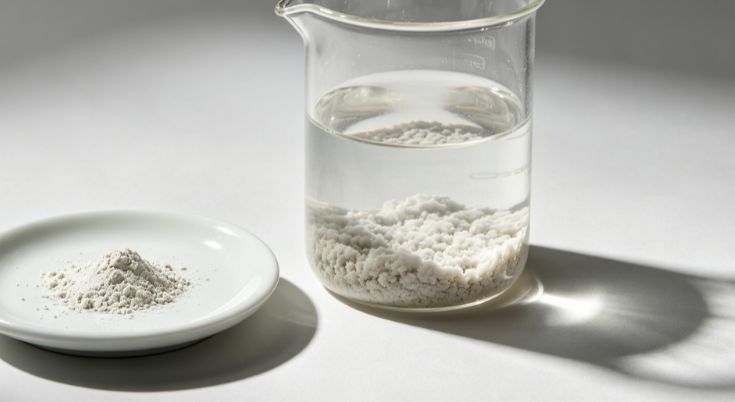
What We Can Do for Your Soluble Silicate Samples
We provide complete testing for all grades and forms of soluble silicates: liquids (various viscosities, concentrations), solids (lumps, beads, powder), and anhydrous or hydrated glassy flakes. Our core capabilities include:
- Total silica (SiO₂) and total alkali oxide (Na₂O, K₂O, Li₂O) content – By gravimetric analysis (SiO₂ after dehydration) and by ICP‑OES/ICP‑MS after hydrofluoric acid digestion and appropriate neutralization. Accuracy ±0.3% absolute for SiO₂, ±0.2% for alkali oxides. The weight ratio (SiO₂/Na₂O) or molar modulus (moles SiO₂ / moles Na₂O) is calculated with typical precision ±0.05.
- Concentration (total solids) and water content – By gravimetric drying at 105 °C and 400 °C (to remove water and volatile species) and by Karl Fischer titration for liquid silicates.
- Trace metal impurities (Fe, Al, Ca, Mg, Cr, Ni, Cu, Zn, Pb, As, Cd, Hg, V, Ti, etc.) using high‑resolution ICP‑MS (HR‑ICP‑MS) with matrix matching and internal standards. Detection limits as low as 0.01 ppm for most elements, 0.001 ppm for Pb, As, Cd, Hg – essential for water treatment chemicals (NSF/ANSI 60) and electronic‑grade applications.
- Anion impurities (chloride, sulfate, nitrate, phosphate, fluoride) by ion chromatography after sample dilution and appropriate filtration – detection limits Cl⁻ <0.1 ppm, SO₄²⁻ <0.5 ppm.
- Water insolubles and suspended matter – Filtration through 0.45 µm membrane, gravimetric determination after washing and drying at 105 °C. Typical limit for high‑purity silicate solutions <0.1% w/w.
- Density, viscosity, and pH – Density at 20 °C and 40 °C (hydrometer or oscillating U‑tube), dynamic viscosity (rotational or capillary viscometer, shear rate sweep), and pH at 25 °C (calibrated with precision buffers).
- Alkalinity and buffer capacity – Titration with standardized HCl to a phenolphthalein endpoint (carbonate + hydroxide) and to bromocresol green endpoint (total alkalinity).
- Specific gravity and solids volume – For concentrated silicate solutions, essential for shipping and reactor loading calculations.
- Colloidal silica content and particle size (if partially colloidal) – By dynamic light scattering (DLS) and silica determination before and after filtration through 50 nm filter. Distinguish truly dissolved silicate from colloidal species.
- Loss on ignition (LOI) at 1000 °C – For solid silicate samples: determines total volatiles (water, carbon dioxide, organic residues).
How Deep Our Characterization Goes
We go far beyond routine “SiO₂, Na₂O and modulus”. Our advanced methods resolve subtle but critical parameters such as silicate anion distribution (monomer, dimer, higher oligomers), trace organic residues, long‑term stability, and ultra‑trace heavy metals. Examples of our technical depth:
- Silicate speciation by 29Si NMR (liquid state) at high field (≥ 16.4 T) – Quantify the relative concentrations of Q⁰ (monosilicate), Q¹ (end of chain), Q² (middle of chain), Q³ (branching), and Q⁴ (three‑dimensional cross‑linked) silicon environments in the silicate solution. This directly determines the degree of polymerization, which correlates with binding strength and film formation. Detection limit for individual species ~0.5 mol%. Also measure average chain length and calculate the equilibrium constant for silicate polymerization.
- Trace arsenic and selenium speciation (As³⁺/As⁵⁺, Se⁴⁺/Se⁶⁺) by HPLC‑ICP‑MS – detection limits <0.01 ppb for each species, critical for NSF/ANSI 60 compliance for drinking water treatment chemicals.
- Elemental silicon speciation (colloidal vs. dissolved) by ultrafiltration (10 kDa – 0.1 µm) followed by ICP‑OES analysis of each fraction – essential for predicting long‑term stability, fouling behavior, and compatibility with other formulation ingredients.
- Dynamic viscosity at shear rates from 0.1 to 1000 s⁻¹ (flow curve) – Determine Newtonian or shear‑thinning behavior of silicate solutions, crucial for pump sizing, spray drying, or coating processes. Also measure temperature‑dependent viscosity (10–60 °C) to predict winter/summer performance.
- Thermal stability and crystallization behavior of solid soluble silicates by simultaneous TGA‑DSC‑FTIR‑MS up to 1200 °C – identify dehydration, dehydroxylation, loss of CO₂ from residual carbonates, and phase transitions (e.g., amorphous to crystalline metasilicate).
- High‑temperature X‑ray diffraction (HT‑XRD) from 25–1000 °C – monitor the crystallization of sodium metasilicate (Na₂SiO₃) or disilicate (Na₂Si₂O₅) phases from amorphous glassy beads. Determine the onset temperature of crystallization and the phases formed.
- X‑ray photoelectron spectroscopy (XPS) of solid silicate surfaces – Measure the Na/Si atomic ratio on the top 2–5 nm, detect surface enrichment of alkali or silica, and identify surface contamination (carbon, chlorine, fluorine).
- Residual organic carbon (TOC) in liquid silicate samples – By combustion/NDIR method, detection limit 0.5 ppm. High TOC indicates degradation of organic additives or contamination from processing equipment.
- Stability testing (accelerated aging) at 45 °C, 50 °C, and 60 °C for up to 12 weeks – Monitor changes in modulus, viscosity, pH, insolubles, and silica speciation to predict shelf‑life and to detect gelation, precipitation, or phase separation.
Why Our Laboratory Is the Premier Choice for Soluble Silicate Testing
General chemical testing labs often treat soluble silicates as simple “alkaline solutions”, missing the polymer chemistry and speciation that govern performance. Our advantages are built on decades of expertise in silicate chemistry, ISO/IEC 17025 accredited methods, and a unique suite of speciation and stability testing:
➤ 29Si NMR speciation for true quality control of modulus and polymer distribution – Unlike labs that only report bulk SiO₂/Na₂O ratio, we use quantitative 29Si NMR with a relaxation reagent (e.g., Cr(acac)₃) and a known internal standard to determine the fraction of silicate present as Q⁰ (monomer), Q¹ (dimer/end groups), Q² (chains), and higher oligomers. This provides a “fingerprint” of the silicate solution and directly predicts its reactivity, binding strength, and film‑forming properties. Our method has been validated against model silicate solutions and reference materials.
➤ Ultrafiltration + ICP‑MS for colloidal/dissolved silica differentiation – Using membrane filters of 0.1 µm, 50 kDa, 10 kDa, and 3 kDa, we separate colloidal silica from true dissolved silicate and analyze each fraction by ICP‑MS. This is critical for applications where colloidal silica causes haze or scaling (e.g., in wafer cleaning, water treatment membranes, or detergent formulations).
➤ Ultra‑trace elemental analysis in high‑pH, high‑silica matrices – Soluble silicates are notoriously difficult for ICP‑MS due to their high total dissolved solids, high pH, and Si‑based polyatomic interferences (e.g., 28Si⁺ on 28Si⁺, 29Si¹⁶O⁺ on 45Sc⁺). We use HR‑ICP‑MS (sector field, R > 10 000) with matrix dilution (≥500×), reaction/collision cell (NH₃ or H₂ gas), and matrix‑matched calibration with internal standards (Sc, Y, Rh). Achieve sub‑ppb detection limits for all regulated toxic elements (As, Pb, Cd, Hg, Cr, Ni, Cu, Zn) even at 40% total solids. Our recoveries for spiked samples are 95–105%.
➤ Comprehensive regulatory compliance packages – We provide test reports formatted specifically for:
– NSF/ANSI Standard 60 (Drinking water treatment chemicals – Corrosion & Scale Control) – including SiO₂, Na₂O/K₂O, heavy metals (As, Pb, Cd, Cr, Se, Hg), fluoride, and chloride limits.
– ASTM D501 (Test methods for alkaline detergents – includes soluble silicates) – modulus, total solids, alkalinity, and active Na₂O.
– REACH Annex XVII (restrictions on silicates in consumer products) – heavy metal leaching in simulated use conditions.
– Food contact regulations (EU 10/2011, FDA 21 CFR 175.300) – complete extraction and analysis of heavy metals from soluble silicate coatings.
➤ Strict sample handling and preparation for unstable silicate solutions – Soluble silicates can polymerize over time, especially at high concentrations or after dilution. We perform all measurements (viscosity, density, pH, modulus by titration) on fresh, un‑aged samples within 2 hours of container opening. For speciation (NMR), we quickly dilute to <10% solids and add chelating agents to freeze the distribution. For long‑term stability studies, we sample under controlled conditions and seal in argon‑purged vials.
➤ Custom “Performance‑Grade Certification” for soluble silicates – We combine bulk modulus, viscosity, solids, silicate speciation (NMR), colloidal‑dissolved silica fraction, trace heavy metals, and accelerated aging data into a single report. A “Stability Index” and a “Reactivity Index” (based on Q⁰/Q¹ ratio) are calculated to directly compare batches for your specific process (e.g., high‑reactivity for inorganic binder, low‑reactivity for stable coatings).
➤ Fast turnaround and transparent reporting – Standard full characterization (modulus, solids, viscosity, density, pH, heavy metals by ICP‑OES, insolubles) completed within 3‑5 business days. 29Si NMR, speciation by ultrafiltration, and accelerated aging require an additional 3‑7 business days. You receive raw NMR spectra, chromatograms, viscosity curves, particle size distribution data, and full uncertainty budgets (expanded uncertainty, k=2).
➤ Global logistics for liquid and solid silicates – Soluble silicate solutions are corrosive (pH 11–13) and classified as UN 3266 (corrosive liquid, basic, inorganic). We provide UN‑certified HDPE containers with pressure‑relief closures, absorbent packaging, and fully compliant dangerous goods shipping documentation. For solid silicates (UN 3262), we use moisture‑proof, impact‑resistant bags and drums. Customs clearance assistance and MSDS provided.
➤ One‑on‑one technical consultation from silicate chemistry experts – Our scientists help you interpret speciation changes, e.g., why a fresh batch of sodium silicate has a higher fraction of Q² (chain) than previous batches – indicating a higher degree of polymerization that could cause gelling in your formulation. We advise on adjusting the concentration, temperature, or aging to achieve desired performance. We also troubleshoot causes of high water insolubles (e.g., incomplete fusion of raw sand and soda ash) or heavy metal contamination (e.g., from worn grinding media or reactor linings).
Ready to Get Your Soluble Silicate Tested?
Whether you are qualifying a sodium silicate batch for high‑performance detergent use, certifying a potassium silicate for refractory binder applications, troubleshooting gelling or precipitation in a water treatment system, or validating a lithium silicate for corrosion‑resistant coatings, our laboratory delivers the most thorough, technically advanced characterization of soluble silicates available. Contact our silicate analysis team with your product form (liquid, solid, glassy), target modulus and solids, and any specific regulatory or application requirements – we will return a custom test plan and competitive quote within 24 hours.