Reasons for choosing our testing services
ZHONGXI Testing has obtained inspection qualification certifications from multiple countries and regions worldwide. We possess a senior testing team and advanced testing methods, providing independent, impartial, and professional third-party verification services for global carbon projects.

Internationally recognized authority
Certified by multiple international standards such as CNAS, VCS, and GS, with reports universally applicable worldwide.

Global service capability
Covering 140+ countries and regions, it supports on-site detection and remote verification in multiple languages.

Professional experimental methods
Adopt standard experimental methods to ensure accurate and reliable data.
total viable count (TVC) / Aerobic Plate Count Testing Services: Quantifying Microbial Contamination in Products & Environments
As an independent third-party testing service provider, we offer comprehensive total viable count (TVC) – also known as aerobic plate count (APC), standard plate count (SPC), or heterotrophic plate count (HPC) – testing for a wide range of samples. TVC is the most fundamental microbiological test, measuring the total number of viable (living) aerobic or facultatively anaerobic bacteria, yeasts, and moulds in a sample. This test serves as a key indicator of hygiene, product quality, shelf‑life, and safety across industries such as food & beverage, pharmaceuticals, cosmetics, water treatment, healthcare, and environmental monitoring. Our accredited laboratory follows international standards (ISO 4833, ISO 21149, USP <61>, EP 2.6.12, AOAC, GB 4789.2) to deliver accurate, reproducible, and legally defensible colony‑forming unit (CFU) counts. This article outlines our total viable count testing capabilities – including scope, key test items, and standard test methods – to help manufacturers, quality assurance teams, and regulatory bodies assess microbial load and ensure compliance.
1. Our Testing Scope for total viable count (TVC)
We cover virtually all sample types and industries where microbial enumeration is required:
By sample matrix: Food & beverages (raw meat, dairy, seafood, fruits, vegetables, ready‑to‑eat meals, soft drinks, juices, bottled water); Cosmetics & personal care (creams, lotions, shampoos, toothpaste, makeup); Pharmaceutical & medical devices (non‑sterile product testing, raw materials, intermediates, finished products, packaging); Water (drinking water, purified water, process water, cooling water, wastewater, swimming pool water); Environmental monitoring (air – active or passive air sampling, surface swabs, personnel hand swabs, equipment rinse); Animal feed & pet food; Industrial raw materials (preservatives, thickeners, natural extracts); Hygiene validation (CIP rinse, cleaning swabs).
By organism detected: Total aerobic bacteria; Total yeasts and moulds (combined or separate); Specific indicator organisms (when required, but TVC is non‑selective).
By detection method: Traditional pour plate method; Spread plate method; Surface swab and contact plate; Membrane filtration (for water / low‑Bioburden samples); Automated enumeration (spiral plater, colony counter).
By industry regulation: Food safety (Codex Alimentarius, FDA, EFSA); Cosmetic (ISO 21149, USP <61>); Pharmaceutical (USP <61>, EP 2.6.12, JP 4.05); Water quality (ISO 6222, EPA 1600).
2. Key Test Items & Measurements We Perform
Our total viable count testing services produce quantitative results in colony‑forming units per gram (CFU/g), per millilitre (CFU/mL), per swab, per plate, or per cubic metre of air (CFU/m³).
2.1 Aerobic Plate Count (APC) – Bacteria Only
Standard aerobic bacteria enumeration – using non‑selective media (e.g., Plate Count Agar – PCA, Tryptone Soya Agar – TSA, Standard Methods Agar – SMA). Incubation at 30°C ± 1°C or 35°C ± 2°C for 48‑72 hours (depending on standard).
Psychrotrophic bacteria count – incubated at 20°C ± 1°C for 72‑120 hours (for refrigerated foods).
Thermophilic bacteria count – incubated at 55°C for 48 hours (for hot‑fill or canned products).
2.2 Yeast & Mould Count (Combined or Separate)
Total yeasts and moulds – using selective media (e.g., Sabouraud Dextrose Agar – SDA, Potato Dextrose Agar – PDA, Dichloran Rose Bengal Chloramphenicol – DRBC). Incubation at 25°C ± 1°C for 5‑7 days.
Yeast / mould differentiation – morphological colony characteristics (smooth, creamy yeast vs. fuzzy, filamentous mould).
Osmophilic yeast (for high‑sugar products) – using high‑sugar media (e.g., Malt Extract Agar with 40% glucose).
2.3 Sample Preparation & Dilution
Solid samples (homogenisation) – stomacher or blender with buffered peptone water (BPW) or maximum recovery diluent (MRD). Typical initial dilution: 1:10.
Liquid samples – direct plating or membrane filtration.
Surface swabs – swab moistened with neutralising buffer (e.g., Letheen broth, D/E neutralising broth) to inactivate any disinfectant residues.
Air samples – active impaction (e.g., MAS‑100, SAS) onto agar plates, or passive settle plates (exposed for 1‑4 hours).
Membrane filtration (water / low Bioburden) – filter sample volume (100 mL, 250 mL, 1 L) through 0.45 µm membrane, then transfer to agar plate.
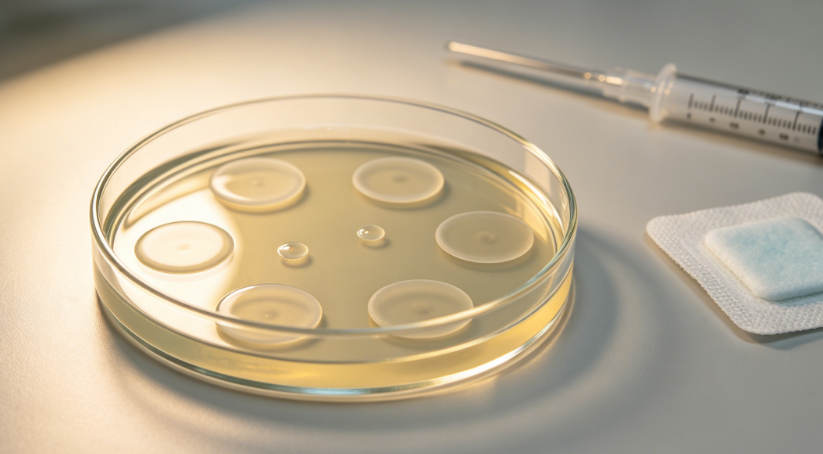
2.4 Enumeration & Result Reporting
Colony counting – manually or using automated colony counter (colony detection limit: 30‑300 CFU per plate for accuracy).
Calculation of CFU per unit – CFU/g = (colony count × dilution factor) / (plated volume or sample weight).
Reporting limit – typically <10 CFU/g for solid samples, <1 CFU/mL for membrane filtered water.
Spreading / swarming colonies – overgrown plates are reported as “spreader” or “TNTC” (too numerous to count).
2.5 Specialised Modifications
Neutralisation of antimicrobial residues – addition of lecithin, polysorbate 80, histidine, or sodium thiosulfate to the diluent (for samples containing preservatives, disinfectants).
Heat shock / resuscitation – for stressed or injured microorganisms (e.g., pasteurised products).
Anaerobic (optional) – incubated in anaerobic chamber for specific project requirements.
3. Standard Test Methods We Apply
All tests are performed according to internationally recognised standards. Our laboratory is ISO/IEC 17025 accredited and equipped with biological safety cabinets, incubators, colony counters, stomachers, membrane filtration units, and air samplers.
3.1 Food & Beverage Standards
ISO 4833‑1 (horizontal method for enumeration of microorganisms – colony count at 30°C by pour plate technique).
ISO 4833‑2 (surface spread plate method).
GB 4789.2 (China – aerobic plate count in foods).
AOAC 966.23 (aerobic plate count in foods).
FDA BAM (Bacteriological Analytical Manual) Chapter 3 – Aerobic Plate Count.
3.2 Cosmetic Standards
ISO 21149 (cosmetics – enumeration of aerobic mesophilic bacteria).
ISO 16212 (cosmetics – enumeration of yeast and mould).
USP <61> (microbiological examination of non‑sterile products – microbial enumeration tests).
EP 2.6.12 (European Pharmacopoeia – microbial enumeration).
JP 4.05 (Japanese Pharmacopoeia – microbial limit test).
3.3 Water & Environmental Standards
ISO 6222 (water quality – enumeration of culturable microorganisms – colony count by nutrient agar or PCA).
EPA 1600 (heterotrophic plate count for drinking water – membrane filtration).
Standard Methods 9215 (heterotrophic plate count – pour plate, spread plate, or membrane filtration).
ISO 11731 (Legionella – not TVC, but our lab also offers).
3.4 Surface & Air Monitoring (Environmental Monitoring)
ISO 14698‑1 (cleanrooms – biocontamination control – general principles).
PDA TR 13 (surface swab and contact plate methods for pharmaceutical manufacturing).
GB 15982 (China – hygiene standard for hospital surfaces).
USP <61> / EP 2.6.12 / JP 4.05 (non‑sterile product testing).
ISO 11737‑1 (sterile medical devices – enumeration of microorganisms).
GB 15979 (disposable sanitary products – bacterial count).
4. Why Choose Our Third‑Party total viable count Testing Services?
As an independent laboratory with broad microbiological expertise, we provide accurate, reproducible, and regulation‑ready data. Our advantages include:
ISO/IEC 17025 accreditation – CNAS/CMA certified, regularly participating in proficiency testing (e.g., UK NEQAS, APLAC, NIL).
Low detection limits – <1 CFU/sample for membrane filtration, <10 CFU/g for solid samples.
Neutralisation capability – validated neutralisers for preservatives, disinfectants, and antimicrobial residues.
High throughput – multiple incubators (up to 300 plates/day capacity).
Fast turnaround – typical TVC results (bacteria) in 2‑3 business days; yeast & mould in 5‑7 business days.
Comprehensive reporting – includes plate images, raw colony counts, calculation formulas, and clear pass/fail conclusions against customer specifications or regulatory limits.
Confidentiality – full protection of your product formulation and proprietary information.
Consultative support – our microbiologists help interpret high counts, identify potential contamination sources, and recommend corrective actions.
Whether you need to release a batch of non‑sterile pharmaceuticals, verify hygiene of food processing equipment, monitor drinking water quality, or assess the preservation efficacy of a cosmetic product, our total viable count testing experts are ready to deliver reliable, actionable microbial enumeration data.
Get Started with Your total viable count Testing Project
Contact our team with your sample type (solid, liquid, swab, air), expected microbial load, applicable standard (e.g., USP <61>, ISO 4833, GB 4789.2), and any special requirements (neutralisation, anaerobic incubation). We will provide a detailed quotation, sample submission guidelines (including preservation and transport conditions), and a testing schedule. Let us help you quantify microbial contamination accurately and maintain product quality & safety.
This article provides an overview of our total viable count (TVC) testing capabilities. For specific test methods, sample quantity, and pricing, please request a tailored service proposal.