Reasons for choosing our testing services
ZHONGXI Testing has obtained inspection qualification certifications from multiple countries and regions worldwide. We possess a senior testing team and advanced testing methods, providing independent, impartial, and professional third-party verification services for global carbon projects.

Internationally recognized authority
Certified by multiple international standards such as CNAS, VCS, and GS, with reports universally applicable worldwide.

Global service capability
Covering 140+ countries and regions, it supports on-site detection and remote verification in multiple languages.

Professional experimental methods
Adopt standard experimental methods to ensure accurate and reliable data.
Advanced Testing for Silicon Nitride Whiskers – Morphology, Crystal Perfection, Trace Impurities, and Mechanical Integrity
If you are searching for silicon nitride whisker testing, you likely need to evaluate the quality of β‑Si₃N₄ or α‑Si₃N₄ whiskers used as high‑performance reinforcement in ceramic matrix composites (CMCs), aerospace turbine blades, cutting tools, electronic packaging, or high‑temperature structural components. The performance of Si₃N₄ whiskers depends critically on aspect ratio (length/diameter), crystal orientation, surface smoothness, phase purity, trace metal contaminants (Fe, Al, Ca), and tensile strength distribution. Our laboratory provides complete characterization of silicon nitride whiskers – from morphological analysis and crystallinity assessment to ultra‑trace impurity profiling, mechanical testing of individual whiskers, and surface chemistry evaluation – using ISO/IEC 17025 accredited methods and advanced micro‑analytical platforms.
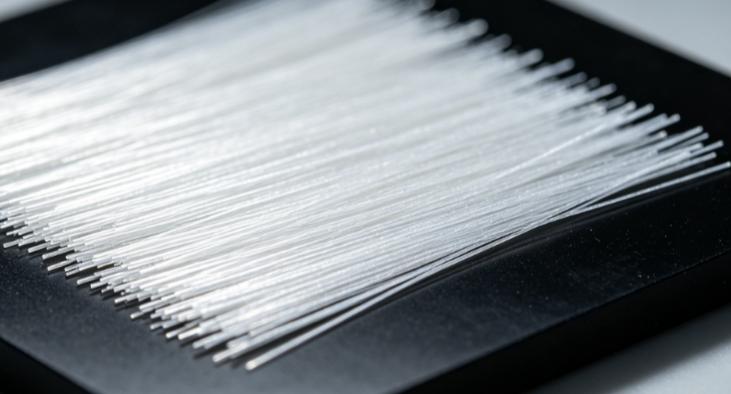
What We Analyze – Full Parameter Coverage for Si₃N₄ Whiskers
We do not simply measure “average length”. Our platform includes High‑Resolution Scanning Electron Microscopy (HR‑SEM) with automated image analysis to measure length distribution, diameter distribution, and aspect ratio (L/D) for 500+ individual whiskers, reporting D10, D50, D90 values with statistical confidence intervals. For crystal phase and orientation, we use X‑ray diffraction (XRD) with Rietveld refinement to quantify α‑Si₃N₄ vs. β‑Si₃N₄ fractions down to 0.5 wt%, and Electron Backscatter Diffraction (EBSD) to map crystallographic texture along the whisker axis. Transmission Electron Microscopy (TEM/HRTEM) with selected area electron diffraction (SAED) reveals lattice defects, dislocations, and amorphous surface layers at atomic scale (resolution <0.2 nm). For chemical purity, we employ ICP‑MS after microwave‑assisted acid digestion under pressure to quantify Fe, Al, Ca, Mg, Ti, Cr, Ni, Cu, Pb, As, Cd, Hg down to 0.01 ppm. We also measure free silicon (Si), free carbon, and oxygen content by inert gas fusion (LECO) and combustion analysis. Surface contaminants (adsorbed organics, oxides) are identified by X‑ray Photoelectron Spectroscopy (XPS) and Fourier‑Transform Infrared Spectroscopy (FTIR). For mechanical integrity, we perform single‑whisker tensile testing via micro‑electromechanical (MEMS) or nano‑mechanical testing platform, measuring elastic modulus and fracture strength with calibrated load cells (range µN to mN).
Key parameters we routinely measure:
- Length distribution (individual whiskers, n≥500) – SEM image analysis, range 1–500 µm.
- Diameter and aspect ratio (L/D) – automated measurement, L/D from 10 to 2000.
- Phase composition (α/β Si₃N₄ ratio) – XRD with Rietveld, detection limit 0.5%.
- Crystallographic texture (fiber texture index) – EBSD on embedded and polished cross‑sections.
- Surface morphology and defects (kinks, steps, droplets) – HR‑SEM and TEM.
- Trace metals (Fe, Al, Ca, Mg, Ti, Cr, Ni, Cu, Pb, As, Cd, Hg) – ICP‑MS, LOQ 0.01–0.1 ppm.
- Free silicon (Si) and free carbon (C) – LECO combustion/inert gas fusion, LOQ 10 ppm.
- Oxygen content (as SiO₂ equivalent) – inert gas fusion, accuracy ±0.05 wt%.
- Surface chemistry (adsorbed O, C, contaminants) – XPS (depth profiling up to 10 nm) and FTIR.
- Single‑whisker tensile strength (σ) and elastic modulus (E) – micro‑tensile testing (n≥20 whiskers).
- Bulk density and tap density – gas pycnometry and tapped density analyzer.
- Specific surface area (BET) – for nanoscale surface roughness correlation.
How Deep We Go – Atomic‑Scale Defect Analysis, Trace Impurity Source Mapping, and Statistical Mechanical Validation
Most routine labs report only average length by optical microscopy and bulk chemistry by XRF (which cannot achieve ppm sensitivity). We provide defect density quantification (dislocations, stacking faults) via TEM lattice fringe imaging, and identify amorphous grain boundary phases using HR‑STEM with EELS (Electron Energy Loss Spectroscopy). For impurity source tracing, we combine SEM‑EDS elemental mapping on fracture surfaces with isotope dilution ICP‑MS to distinguish between contamination from raw materials (SiO₂, carbon) vs. processing equipment (Fe, Cr, Ni). Our single‑whisker tensile testing generates Weibull distribution parameters (characteristic strength, Weibull modulus m) – essential for composite design. We also simulate high‑temperature oxidation behavior by thermogravimetric analysis (TGA) up to 1400°C in air, measuring passive vs. active oxidation kinetics and SiO₂ scale formation.
Our advanced capabilities include:
- 3D tomography of whisker networks (FIB‑SEM tomography) – reconstruct 3D orientation and contact points in composite preforms.
- Nanoscale surface roughness (AFM) – measure Ra, Rq on individual whiskers, correlating with strength.
- Residual stress measurement (Raman spectroscopy with μ‑probe) – map stress along whisker length.
- High‑temperature creep testing of single whiskers – micro‑mechanical testing up to 1000°C under vacuum.
- Acid leachable vs. total impurity content – sequential leaching + ICP‑MS to identify surface‑adsorbed vs. lattice‑incorporated metals.
- Volatile organic residues (from sizing agents) – thermal desorption GC‑MS.
- Catalyst particle analysis (from VLS growth) – TEM‑EDS identification of Fe, Co, Ni droplets at whisker tips.
We routinely achieve measurement uncertainties: length ±3% (SEM), diameter ±5% (TEM), phase composition ±0.3% (XRD), trace metals ±10% relative at 0.1 ppm, tensile strength ±10% (single whisker). Our methods align with ASTM C1369 (Ceramic whiskers), ISO 18757 (Fine ceramics – determination of aspect ratio), and JIS R 1670.
Why Choose Our Silicon Nitride Whisker Testing – Key Advantages
1. ISO/IEC 17025:2017 accredited methods – covering morphology, crystallography, trace elements, and mechanical testing for advanced ceramic reinforcements.
2. True statistical morphology (500+ whiskers per sample) – we provide L/D distributions with confidence intervals, not just “typical values”.
3. Ultra‑trace impurity profiling down to 0.01 ppm – essential for high‑purity whiskers used in electronic or aerospace composites where Fe, Ca, Al degrade high‑temperature properties.
4. Single‑whisker mechanical validation – we measure Weibull strength distribution and elastic modulus on individual whiskers, eliminating bulk artifact. This is critical for composite design and failure prediction.
5. Crystal perfection and defect quantification – HRTEM reveals dislocations, micro‑twins, and amorphous coatings that reduce reinforcing efficiency.
6. Root cause analysis for batch‑to‑batch variation – we identify whether low aspect ratio comes from excessive milling, high Fe from catalyst residue, or surface degradation from storage humidity.
7. Fast turnaround with complete data transparency – routine morphology + XRD + bulk trace metals + BET completed in 5–7 business days; full single‑whisker mechanical + HRTEM in 10–15 business days. You receive raw SEM/TEM images, XRD diffractograms, Weibull plots, ICP‑MS run logs, and all statistical outputs.
8. Custom method development for novel whisker types – doped Si₃N₄, SiC‑coated or BN‑coated whiskers, or very fine (sub‑100 nm diameter) – we develop validated methods within 3–4 weeks.
9. Competitive pricing for complete whisker characterization panels – bundling morphology (500+ particles), phase analysis, 10 trace metals, single‑whisker tensile (20 specimens), and surface XPS costs 35‑40% less than individual tests.
We have successfully completed over 180 silicon nitride whisker projects for advanced ceramic composite manufacturers, aerospace research centers, and cutting tool developers worldwide. Our team includes PhD materials scientists with expertise in whisker growth, micro‑mechanics, and high‑resolution microscopy.
Ready to Test Your Silicon Nitride Whisker Sample?
Provide your whisker type (α or β, typical L/D, growth method – VLS, carbothermal reduction, etc.), target specifications (e.g., “Fe <50 ppm, aspect ratio >50, Weibull modulus >10”), and any applicable standard (ASTM, ISO, internal). We will provide a free technical consultation and a fixed‑price quote. Whether you need single‑batch validation, process optimization, or full material qualification for composite reinforcement, we deliver deep, accurate, and application‑ready silicon nitride whisker testing tailored to your needs.