Reasons for choosing our testing services
ZHONGXI Testing has obtained inspection qualification certifications from multiple countries and regions worldwide. We possess a senior testing team and advanced testing methods, providing independent, impartial, and professional third-party verification services for global carbon projects.

Internationally recognized authority
Certified by multiple international standards such as CNAS, VCS, and GS, with reports universally applicable worldwide.

Global service capability
Covering 140+ countries and regions, it supports on-site detection and remote verification in multiple languages.

Professional experimental methods
Adopt standard experimental methods to ensure accurate and reliable data.
UAV Performance Testing in Various Weather Conditions: Wind, Rain, Temperature, Humidity & Sand/Dust
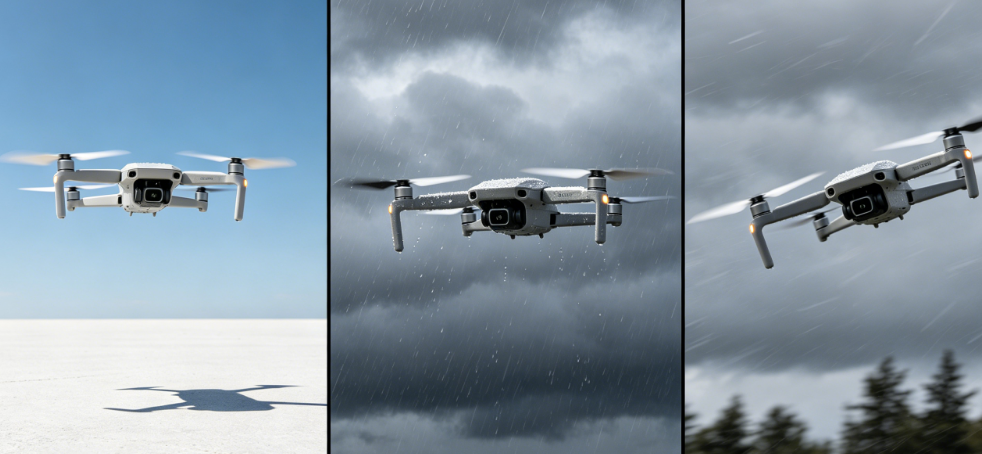
As an independent third-party testing service provider, we offer comprehensive weather‑related performance testing for unmanned aerial vehicles (UAVs / drones). Real‑world operations often expose drones to challenging weather – strong winds, heavy rain, snow, extreme temperatures, high humidity, sandstorms, and icing conditions. These environmental factors can significantly degrade flight stability, endurance, sensor performance, and structural integrity. Our accredited laboratory combines environmental chambers, wind tunnels, rain/dust test rigs, and outdoor test fields to evaluate UAV behaviour under controlled and simulated weather conditions. We follow international standards (ASTM, ISO, MIL‑STD, RTCA DO‑160, EN). This article outlines our weather‑specific UAV testing capabilities – including scope, key test items, and standard test methods – to help manufacturers, operators, and certification bodies validate drone reliability in any climate.
1. Our Testing Scope for Weather‑Affected UAV Performance
We cover all common weather stressors and UAV types:
By weather condition: Wind (steady, gusts, crosswind, headwind, tailwind); Rain (drizzle, moderate, heavy, wind‑driven rain); Snow and ice (snowfall, freezing rain, in‑flight icing); Temperature (extreme high, extreme low, thermal shock); Humidity (condensing, non‑condensing); Sand and dust (blowing sand, dust ingress, abrasive wear); Salt fog (coastal/marine environments); Solar radiation (UV exposure, thermal loading).
By UAV type: Multi‑rotor (quadcopter, hexacopter, octocopter); Fixed‑wing (conventional, flying wing, VTOL); Hybrid VTOL; Micro / nano drones; Industrial inspection drones; Agricultural spray drones; Delivery drones; Maritime drones.
By performance metric: Flight stability (position hold, attitude deviation); Endurance and range (battery life under stress); Propulsion efficiency (thrust reduction); Navigation accuracy (GPS/GNSS, barometer, IMU drift); Sensor performance (camera, LiDAR, thermal, payload); Structural integrity (no cracks, delamination, water ingress); Ground control link quality (signal fade, packet loss).
2. Key Test Items We Perform
Our weather‑based UAV testing services are organised by environmental stressor.
2.1 Wind Performance Testing
Maximum wind speed capability – threshold for stable hover and safe flight (gusts and sustained).
Wind resistance rating (Beaufort scale) – e.g., up to Beaufort 6 (40 km/h) or higher.
Position hold accuracy (horizontal & vertical) under wind – with GPS and visual positioning.
Crosswind landing and take‑off stability.
Wind‑induced power consumption increase (endurance penalty).
Gust response (max attitude excursion, recovery time).
Fixed‑wing UAV: stall speed shift, ground speed maintenance, crosswind landing envelope.
2.2 Rain & Water Ingress Testing
IP rating verification (IEC 60529) – IPX1 to IPX9K for water ingress protection.
Rain intensity simulation – light to heavy rain (e.g., 5 mm/h to >50 mm/h) with controlled droplet size.
Wind‑driven rain (angled spray) – simulating oblique rain.
Effect on flight performance – weight increase (water absorption), propeller efficiency change, sensor vision degradation (camera lens water film).
Electrical safety – no short circuit or power loss after exposure.
Post‑rain drying and restart capability.
2.3 Snow & Icing Performance Testing
Snowfall simulation (dry snow, wet snow) – accumulation on rotors, fuselage, and sensors.
Freezing rain / glaze ice accretion – on leading edges, propellers, and control surfaces.
In‑flight icing (cold chamber + spray rig) – ice shape, ice weight, lift/drag penalty, rotor imbalance.
De‑icing / anti‑icing system validation (if equipped).
Low temperature + snow combination – battery performance, servo response, material brittleness.
Propeller ice shedding and vibration measurement.
2.4 Temperature & Thermal Shock Testing
high temperature operation (up to +70°C) – battery overheating, motor efficiency drop, sensor drift.
Low temperature operation (down to -40°C) – battery voltage sag, reduced endurance, lubricant thickening, boot‑up reliability.
Temperature cycling (thermal shock) – rapid transition between cold and hot to simulate transport or weather changes.
Storage temperature testing (non‑operating).
Start‑up at low temperature – ability to arm and take off from cold soak.
Thermal camera performance (calibration drift).
2.5 Humidity & Condensation Testing
Humidity resistance (steady state) – e.g., 95% RH at 40°C for days/weeks.
Condensation (cyclic humidity) – internal moisture on electronics, corrosion risk.
Effect on barometer and IMU (moisture ingress into sensors).
Mould growth on coatings / enclosures.
2.6 Sand & Dust Testing
Blowing sand (abrasive) – MIL‑STD‑810 method 510 – tests abrasion of propellers, bearings, and lens coatings.
Blowing dust (non‑abrasive) – ingress into motors, connectors, and vents.
IP5X / IP6X dust‑tight certification (IEC 60529).
Engine air filter efficiency (for combustion‑engine UAVs – rare).
Camera lens sand erosion (image quality degradation).
2.7 Salt Fog (Marine Environment) Testing
Salt spray exposure (ASTM B117, ISO 9227) – for coastal or ship‑based drone operations.
Corrosion evaluation – after 48, 96, 240 hours – check pitting, rust on fasteners, PCB corrosion, connector contact resistance.
Electrical insulation degradation.
Gimbal motor corrosion.
2.8 Solar Radiation (UV) & Thermal Load Testing
Xenon arc / UV exposure (ISO 4892-2) – for external materials (hull, propeller composites, paint, seals).
Colour fading and mechanical property change.
Solar heating effect – internal temperature rise, camera sensor dark current increase.
2.9 Combined Weather Effects
Cold + wind + snow – simulated arctic mission.
Hot + sand + low humidity – desert operation.
Rain + wind – coastal storm conditions.
High altitude (low pressure) + low temperature – mountain environment.
3. Standard Test Methods We Apply
All tests are performed according to recognised standards. Our laboratory is equipped with environmental chambers, rain/snow simulators, sand/dust tunnels, salt spray chambers, and wind tunnels (open‑circuit, up to 25 m/s).
3.1 Wind Performance Standards
Wind resistance test – ASTM F3322 (small UAS – flight performance), ISO 21384-3 (flight test procedures).
Gust response – custom profile (e.g., 10 m/s step).
Crosswind landing – internal procedure based on DO‑160 operational shock.
3.2 Rain & Water Ingress Standards
IP Code (IEC 60529) – IPX1 to IPX9K.
Rain test (wind‑driven) – MIL-STD-810 Method 506.8, RTCA DO‑160 Section 10.
Water spray for aircraft surfaces – ISO 20653 (road vehicles, adapted).
3.3 Snow & Icing Standards
In‑flight icing – DO‑160 Section 24 (icing test, for airborne equipment). For UAVs, we adapt using cold chamber + water spray.
Snowfall simulation – no specific ISO; we use custom snow generation (ice pellets).
3.4 Temperature & Humidity Standards
High / low temperature (operating, storage): DO‑160 Sections 4 & 5, MIL-STD-810 Methods 501.7 & 502.7, IEC 60068-2-1/-2.
Temperature cycling (thermal shock): DO‑160 Section 5, MIL-STD-810 Method 503.7.
Humidity (steady state): DO‑160 Section 6, IEC 60068-2-78.
Condensation (cyclic humidity): DO‑160 Section 6, IEC 60068-2-30.
3.5 Sand & Dust Standards
Blowing sand & dust: MIL-STD-810 Method 510.7, DO‑160 Section 12.
IP5X / IP6X (dust‑tight): IEC 60529, GB/T 4208.
3.6 Salt Fog Standards
Salt spray test: ASTM B117, ISO 9227, DO‑160 Section 14, MIL-STD-810 Method 509.7.
3.7 Solar Radiation Standards
Xenon arc exposure: DO‑160 Section 26 (solar radiation), MIL-STD-810 Method 505.7, ISO 4892-2.
3.8 Combined Environment Standards
Temperature / altitude / humidity combinations: DO‑160 Section 4, MIL-STD-810 Method 520.6 (combined environments).
Wind + rain (driving rain): ASTM E331 (building products, adapted for UAV).
4. Why Choose Our Third‑Party Weather‑Based UAV Testing Services?
As an independent laboratory, we provide unbiased, repeatable, and certified weather performance data. Our strengths include:
ISO/IEC 17025 accreditation – for environmental test methods, accepted by aviation authorities and insurance underwriters.
Dedicated weather simulation assets – controlled‑rate wind tunnel (0‑25 m/s), rain simulator (10‑200 mm/h), sand/dust blower, salt fog chamber, thermal chambers (-70°C to +150°C), icing spray rig.
Real‑time telemetry – we record flight controller logs, motor RPM, battery voltage, GPS position, and attitude throughout weather exposure.
Safety – all tests conducted with tether or in safety net enclosure for extreme wind/icing.
Fast turnaround – standard weather tests (wind, rain, temperature) within 1‑2 weeks; long‑duration salt spray / humidity (240 hours) scheduled accordingly.
Detailed reporting – video recordings, telemetry graphs (position drift, power consumption, motor currents), post‑test inspection (water ingress, corrosion, damage).
Certification support – we help you declare wind resistance rating, IP rating, and environmental operating limits for product datasheets and regulatory submissions.
Confidentiality – full protection of your UAV design and flight algorithms.
Whether you are a drone manufacturer seeking to publish verified weather ratings, a commercial operator needing to qualify a drone for a specific climate (offshore, desert, arctic, tropical), or a certification body validating compliance, our weather performance testing team is ready to deliver actionable data.
Get Started with Your UAV Weather Performance Testing Project
Contact our team with your UAV specifications (weight, dimensions, propulsion type), intended operating environment, and target weather conditions (wind speed, rain intensity, temperature range, etc.). We will propose a custom test plan, provide a quotation, and schedule the required facility time. Let us help you ensure that your drone can safely and reliably fly through the worst weather nature can offer.
This article provides an overview of our UAV weather performance testing capabilities. For specific test protocols, sample size, and pricing, please request a tailored service proposal.