Reasons for choosing our testing services
ZHONGXI Testing has obtained inspection qualification certifications from multiple countries and regions worldwide. We possess a senior testing team and advanced testing methods, providing independent, impartial, and professional third-party verification services for global carbon projects.

Internationally recognized authority
Certified by multiple international standards such as CNAS, VCS, and GS, with reports universally applicable worldwide.

Global service capability
Covering 140+ countries and regions, it supports on-site detection and remote verification in multiple languages.

Professional experimental methods
Adopt standard experimental methods to ensure accurate and reliable data.
Polydimethylsiloxane (PDMS) Testing – Identification, Purity, Volatiles, and Material Compliance
If you are searching for polydimethylsiloxane (PDMS) testing, you likely need to verify the identity, viscosity, molecular weight, residual siloxane monomers/cyclic oligomers (D3, D4, D5, D6), extractables, or thermal stability of PDMS used in medical devices (implants, tubing), cosmetics (silicone oils, elastomers), industrial lubricants, antifoams, electronic coatings, or food contact materials. PDMS is a versatile silicone polymer, but its performance and safety depend on polymer chain length, crosslinking density, and residual low‑molecular‑weight species. Our laboratory provides comprehensive PDMS characterization – from routine viscosity and volatile content to high‑resolution GC‑MS for cyclic siloxanes, GPC for molecular weight distribution, NMR for structure verification, and extractables studies – following ISO, USP, and FDA guidance.
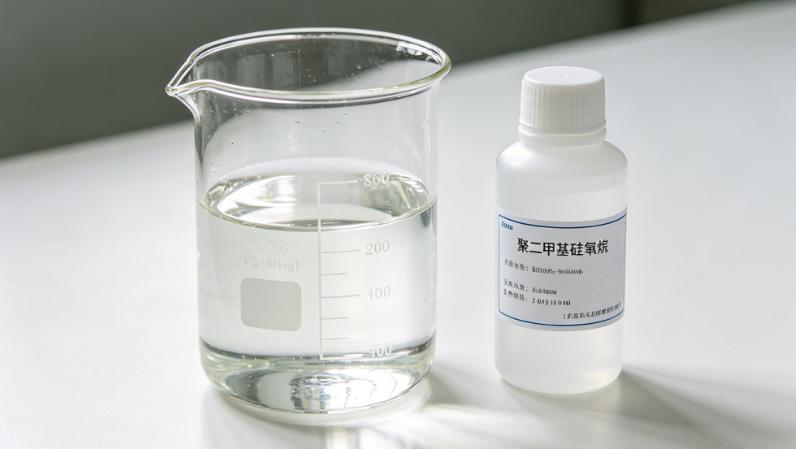
What We Analyze – Full PDMS Testing Scope
We do not simply report “silicone present”. Our platform includes gel permeation chromatography (GPC) with refractive index (RI) and multi‑angle light scattering (MALS) for absolute molecular weight (Mw, Mn) and polydispersity (PDI) of PDMS polymers, covering a range from 1,000 to >500,000 Da. For residual cyclic siloxanes (octamethylcyclotetrasiloxane D4, decamethylcyclopentasiloxane D5, etc.) and linear oligomers, we use gas chromatography‑mass spectrometry (GC‑MS) in SIM mode after solvent extraction or headspace sampling, achieving detection limits as low as 0.1 µg/g (ppm). We also perform Thermogravimetric Analysis (TGA) to measure volatile content (moisture, low MW species) and thermal decomposition temperature (Td). For structural elucidation and end‑group analysis, we use ¹H, ¹³C, and ²⁹Si nuclear magnetic resonance (NMR) spectroscopy. Fourier‑transform infrared spectroscopy (FTIR) provides rapid identification of PDMS (characteristic Si‑O‑Si and Si‑CH₃ peaks) and detection of contamination. Viscosity (kinematic or dynamic) is measured using Ubbelohde capillary viscometers or rotational rheometers over a wide temperature range. For medical device or food contact compliance, we perform extractables and leachables studies (E&L) using simulated solvents (water, ethanol, hexane, saline) with analysis by GC‑MS and LC‑MS. We also provide color, clarity, and specific gravity measurements per USP or ASTM methods.
Key parameters we routinely measure:
- Number‑average (Mn) and weight‑average (Mw) molecular weight, polydispersity (PDI) – GPC‑MALS, accuracy ±5%.
- Viscosity (cSt or mPa·s) at 25°C or 40°C – from 10 to 500,000 cSt.
- Residual cyclic siloxanes (D3, D4, D5, D6, etc.) and linear siloxanes – GC‑MS LOQ 0.1‑1 ppm.
- Volatile content (loss on drying at 150°C or 200°C) – TGA or oven method, LOQ 0.05%.
- Thermal stability (T5%, T10%, Tmax) in air or nitrogen – TGA.
- Chemical structure and end‑groups (e.g., trimethylsilyl, vinyl, hydride, hydroxyl) – FTIR and ²⁹Si NMR.
- Extractable siloxanes under simulated use conditions – by GC‑MS with qualified quantification.
- Color (APHA, Gardner) and haze – spectrophotometric.
- Refractive index (nD25) – Abbe refractometer.
- Water content (Karl Fischer) – for anhydrous PDMS grades.
How Deep We Go – Ultra‑Trace Cyclics, Crosslink Density, and Medical Device Extractables
Most routine PDMS testing labs measure only viscosity and maybe total volatiles, missing low‑level cyclic siloxanes that are regulated (e.g., D4 and D5 under EU REACH). We achieve sub‑ppm detection of D4, D5, D6 and other cyclics using optimized headspace‑GC‑MS or liquid extraction with large‑volume injection, crucial for medical device biocompatibility and environmental compliance. For crosslinked PDMS (silicone elastomers), we measure swelling ratio in toluene, crosslink density by Flory‑Rehner equation, and hardness (Shore A or OO). We also perform dynamic mechanical analysis (DMA) to determine storage modulus (E') and glass transition temperature (Tg) of cured PDMS. For extractables studies, we simulate worst‑case patient contact (e.g., 37°C for 72h in polar and non‑polar solvents) and identify leached species by GC‑MS with NIST library and LC‑QTOF, quantifying against authentic standards where available. Our ²⁹Si NMR provides detailed information on branching and end‑group distribution, essential for verifying synthesis quality.
Advanced capabilities include:
- Multi‑detector GPC (RI, MALS, viscometer) – for absolute molecular weight and Mark‑Houwink parameters.
- Thermal desorption (TD)‑GC‑MS for volatiles in solid PDMS parts – without solvent extraction.
- Rheological characterization (viscosity vs. shear rate, temperature sweep, creep recovery) – for non‑Newtonian PDMS formulations.
- Surface analysis (contact angle, XPS) for cured PDMS coatings – assess hydrophobicity and surface chemistry.
- Isothermal TGA for long‑term thermal aging studies – predict weight loss over time at service temperature.
- Quantitative ¹H NMR to determine vinyl or hydride content (mmol/g) – for addition‑cure PDMS.
- Determination of residual solvent (e.g., xylene, toluene) by GC‑HS – for solvent‑based PDMS.
We routinely achieve measurement uncertainties: Mw ±3% (GPC), viscosity ±1%, cyclics concentration ±10% at 1 ppm, extraction recovery 85‑110%. All methods follow ISO 10993‑18 (extractables), USP <87> (biological reactivity), ASTM D445 (viscosity), and EN 14786 (determination of D4/D5).
Why Choose Our PDMS Testing Services – Key Advantages
1. ISO/IEC 17025:2017 accredited methods – covering physical, chemical, and extractables testing for silicone materials.
2. Ultra‑trace detection of regulated cyclic siloxanes (D4, D5, D6) down to 0.1 ppm – essential for REACH and FDA compliance.
3. Full molecular weight profiling (GPC‑MALS) without column calibration bias – absolute values for accurate quality control.
4. Comprehensive extractables and leachables (E&L) studies for medical devices and food contact – we simulate worst‑case use and identify unknowns by GC‑MS and LC‑QTOF.
5. Structural verification by multi‑nuclear NMR (¹H, ¹³C, ²⁹Si) – confirm end‑groups, branching, and purity.
6. Fast turnaround with full data transparency – routine PDMS panel (viscosity, Mw, volatiles, D4‑D6) in 5‑7 business days; full E&L study in 10‑14 business days. You receive raw chromatograms, GPC traces, NMR spectra, and a certificate of analysis.
7. Custom method development for novel PDMS formulations (e.g., filled, emulsified, functionalized) – we develop within 2‑3 weeks.
8. Competitive pricing for complete PDMS characterization packages – bundling molecular weight, viscosity, volatiles, cyclic siloxanes, and extractables costs 30‑35% less than separate tests.
We have successfully completed over 400 PDMS testing projects for medical device manufacturers, cosmetic companies, industrial lubricant suppliers, and regulatory consultants. Our team includes PhD polymer chemists and analytical scientists specialized in silicone chemistry.
Ready to Test Your PDMS Material?
Provide your sample type (fluid, elastomer, coating, emulsion), intended application (e.g., “medical tubing”, “cosmetic base”, “antifoam additive”), and any specific regulatory requirements (e.g., “FDA food contact”, “ISO 10993”, “REACH D4/D5 limits”). We will provide a free technical consultation, a tailored test plan, and a fixed‑price quote. Whether you need a simple identity check or a full regulatory extractables study, we deliver deep, accurate, and compliance‑ready PDMS testing tailored to your needs.