Reasons for choosing our testing services
ZHONGXI Testing has obtained inspection qualification certifications from multiple countries and regions worldwide. We possess a senior testing team and advanced testing methods, providing independent, impartial, and professional third-party verification services for global carbon projects.
Internationally recognized authority
Certified by multiple international standards such as CNAS, VCS, and GS, with reports universally applicable worldwide.

Global service capability
Covering 140+ countries and regions, it supports on-site detection and remote verification in multiple languages.

Professional experimental methods
Adopt standard experimental methods to ensure accurate and reliable data.
High‑Throughput Microbial Whole‑Genome Sequencing Service – From Isolate Characterisation to Metagenomic Profiling
If you are searching for a comprehensive microbial genome sequencing test, you likely need to identify an unknown bacterial or fungal isolate, characterise antimicrobial resistance (AMR) and virulence genes, perform strain typing for outbreak surveillance, or profile an entire microbial community directly from environmental or clinical samples. Standard PCR or Sanger sequencing of single genes is insufficient for detailed genomic analysis. We provide a full‑spectrum microbial genome sequencing service – including whole‑genome sequencing (WGS) of pure cultures, amplicon sequencing (16S/ITS), and shotgun metagenomics – all powered by Illumina NextSeq and Nanopore long‑read platforms, with comprehensive bioinformatics support.
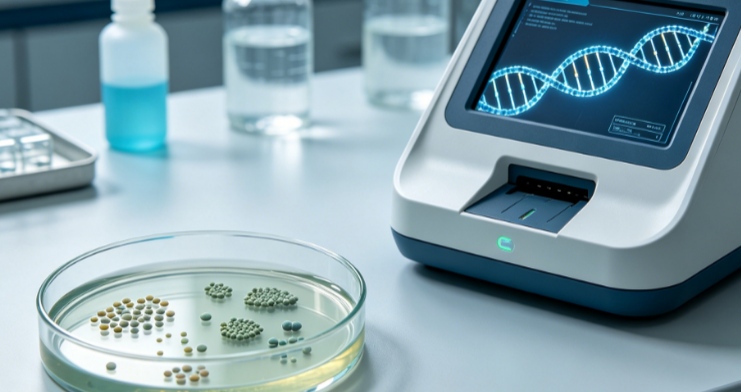
What We Sequence – Isolate Genomes, Metagenomes & Targeted Amplicons
We offer three complementary sequencing modalities tailored to your sample type and research or clinical objective. Whole‑genome sequencing (WGS) for pure microbial isolates: bacteria, yeasts, filamentous fungi, and archaea. We deliver complete or draft genomes with >100× coverage on Illumina NextSeq (2×150 bp) and optional long‑read scaffolding on Oxford Nanopore MinION (N50 >30 kb) to resolve repetitive regions and plasmids. Shotgun metagenomic sequencing for complex samples (soil, faeces, water, swabs, fermented foods) – we perform total DNA extraction, library prep (NEBNext Ultra II), and high‑throughput sequencing to profile all bacterial, fungal, viral, and archaeal taxa without culture bias, with sensitivity down to 0.01% relative abundance. Amplicon sequencing for 16S rRNA gene (V3‑V4 or full‑length), ITS (fungal) or 18S rRNA gene – ideal for taxonomically focused surveys at lower cost.
Deep Technical Capabilities – Long‑Read Hybrid Assembly & Functional Annotation
Routine short‑read sequencing leaves gaps in repetitive regions (e.g., ribosomal operons, transposons, CRISPR arrays). Our hybrid assembly pipeline combines Illumina short reads (≥100×) with Oxford Nanopore long reads (>30×) using Unicycler or Flye, producing closed circular bacterial chromosomes and complete plasmid sequences. We routinely achieve complete genomes for bacteria up to 7 Mb and plasmids up to 500 kb. Post‑assembly, we provide professional annotation using Prokka (bacteria) or Funannotate (fungi), with custom databases for resistance genes (CARD, ResFinder, MEGARes), virulence factors (VFDB, Victors), mobile genetic elements (PlasmidFinder, ISfinder), and secondary metabolite biosynthetic gene clusters (antiSMASH). For fungi, we additionally provide mating type, carbohydrate‑active enzymes (CAZymes), and mycotoxin gene cluster analysis. For metagenomes, we run Kraken2/Bracken for taxonomic profiling, MetaPhlAn4 for species‑level relative abundance, HUMAnN3 for functional pathway reconstruction, and MEGAHIT assembly to recover metagenome‑assembled genomes (MAGs) with completeness assessment (CheckM).
Strain‑Level Resolution – SNP Typing, cgMLST & Phylogenomics
Standard 16S or metagenomic binning often fails to differentiate closely related strains. For isolate WGS data, we perform high‑resolution phylogenomic analysis: core genome single nucleotide polymorphism (SNP) alignment, core genome multilocus sequence typing (cgMLST) using scheme‑specific tools (e.g., EnteroBase, BacWGSTdb), and construction of maximum‑likelihood phylogenetic trees (IQ‑TREE, RAxML‑NG) with bootstrap support. For outbreak investigations, we provide minimum spanning trees based on cgMLST allele differences. For metagenomic strain tracking, we apply StrainPhlAn4 or MIDAS to identify strain‑level variants directly from community data. We also run multi‑locus sequence typing (MLST) for over 100 bacterial species (PubMedST database) and spoligotyping for Mycobacterium tuberculosis.
Why Choose Our Microbial Genome Sequencing Service
End‑to‑end solution – from sample to annotated genome. You send us the DNA extract, culture plate, or even the raw sample (stool, soil, swab). We perform DNA extraction (optimised for Gram‑positive, fungi, environmental inhibitors), library preparation, sequencing, and full bioinformatic analysis. Platform flexibility: Illumina NextSeq 2000 (high accuracy, high throughput), Oxford Nanopore (long reads, real‑time), and PacBio (for high‑demand projects). Turnaround: amplicon sequencing 5‑7 days, isolate WGS 10‑14 days (draft) or 15‑20 days (complete hybrid assembly), metagenomic profiling 12‑18 days. Dynamic range: from single colony to samples containing 10¹ – 10¹¹ microbial cells; metagenomic detection down to 0.001% relative abundance. QC rigor: each run includes extraction blanks, library preparation controls, and PhiX spike‑in. We report sequencing metrics: raw reads, Q30 score (>85%), assembly N50, completeness (CheckM, BUSCO), and contamination estimates.
Detailed Deliverables – From Raw Reads to Interpreted Reports
Your final package includes: raw FASTQ files (compressed, ready for archival), trimmed/quality‑filtered reads, assembly files (FASTA, GFF3, GenBank format), annotation tables (XLSX): gene list, product descriptions, resistance genes with identity %, virulence factors, and plasmid replicons. For comparative analysis, we provide phylogenetic tree files (Newick format), heatmaps and bar plots of relative abundance, and a PDF final report summarising methodology, metrics, and key findings. For metagenomics, you receive taxonomic profiles (kingdom to species), functional pathway abundances (KEGG, MetaCyc), and reconstructed MAG sequences if requested. All data are delivered via secure FTP or external hard drive. Our laboratory is ISO 17025:2017 accredited for molecular biology testing and follows CLSI MM09‑A3 (whole‑genome sequencing for infectious diseases) guidelines where applicable.
Need to identify a mysterious microbial isolate, track resistance genes in an outbreak, or profile a complex microbiome without culture bias? Contact our genomics core for a free consultation. We will help you choose the right sequencing strategy (short‑read, long‑read, or hybrid) and provide a customised quotation based on your sample number and desired depth of analysis.