Reasons for choosing our testing services
ZHONGXI Testing has obtained inspection qualification certifications from multiple countries and regions worldwide. We possess a senior testing team and advanced testing methods, providing independent, impartial, and professional third-party verification services for global carbon projects.

Internationally recognized authority
Certified by multiple international standards such as CNAS, VCS, and GS, with reports universally applicable worldwide.

Global service capability
Covering 140+ countries and regions, it supports on-site detection and remote verification in multiple languages.

Professional experimental methods
Adopt standard experimental methods to ensure accurate and reliable data.
compression set Testing Services: Evaluating Elastomer & Foam Permanent Deformation Under Sustained Load
As an independent third-party testing service provider, we offer comprehensive compression set testing for elastomers, rubber, flexible foams, gaskets, seals, O‑rings, and cushioning materials. compression set is the permanent deformation remaining after a material has been compressed for a specified time at a specified temperature and then released. It measures the material‘s ability to recover its original thickness after being subjected to a compressive stress. Low compression set is critical for sealing applications (gaskets, O‑rings, weather stripping), vibration mounts, and any component that must maintain its shape and sealing force over time. Our accredited laboratory follows international standards (ASTM D395, ISO 815, ASTM D3574, ISO 1856, GB/T 7759) using precision compression jigs, ovens, and thickness gauges. This article outlines our compression set testing capabilities – including scope, key test items, and standard test methods – to help manufacturers, quality assurance teams, and material developers evaluate long‑term sealing performance and dimensional stability.
1. Our Testing Scope for compression set
We cover a broad range of materials, test configurations, and environmental conditions:
By material type: Vulcanized rubbers (natural rubber, SBR, NBR, EPDM, silicone, fluorocarbon – Viton, neoprene, polyurethane); Thermoplastic elastomers (TPE, TPU, TPV); Flexible polyurethane foams (mattress, seating, cushioning); Microcellular urethanes; Closed‑cell and open‑cell foams; Gasket materials (cork, rubber, silicone, expanded PTFE); O‑rings and seals (all standard cross‑sections); Electrical grommets and boots.
By test configuration / specimen type: Button / disc specimens (for Method B – compression set under constant deflection) – typical dimensions: diameter 29 mm, thickness 12.5 mm (ASTM D395 Method B); O‑ring specimens (full cross‑section) – tested under specified deflection (usually 25% of original cross‑section height); Foam blocks (50 mm × 50 mm × 50 mm or other sizes); Rectangular bars or strips; Plugs and molded components.
By test condition / environment: Ambient temperature (23±2°C); Elevated temperature (50°C, 70°C, 100°C, 125°C, 150°C, 200°C) – for accelerated aging and service condition simulation; Low temperature (down to -40°C) – for cold‑climate applications; Fluid immersion (oil, fuel, water, coolant) – simultaneous compression set evaluation; After heat aging (post‑cure effect).
By test method (ASTM D395): Method A (constant force) – compression under constant load; Method B (constant deflection) – compression under a fixed deflection (most common).
By compression deflection level: 25% deflection (most common for rubber); 15% deflection (for low‑stiffness materials); 50% deflection (for foams).
By industry application / standard: Automotive (engine seals, gaskets, weather stripping) – ASTM D395, ISO 815; Seals and O‑rings – SAE AS568, ISO 3601‑5; Flexible foams – ASTM D3574 (Test D – compression set), ISO 1856; General rubber – GB/T 7759 (China), DIN 53517 (Germany); Electrical enclosures – UL 50E (gasket compression set).
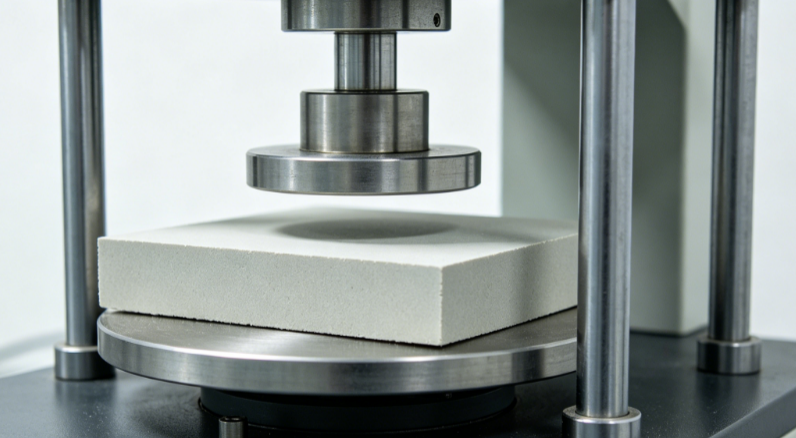
2. Key Test Items & Measurements We Perform
Our compression set testing services deliver quantitative permanent deformation data, classification of recovery performance, and acceptance criteria validation.
2.1 compression set (CS) Percentage – Primary Output
The compression set is calculated as the percentage of the original deflection that is not recovered after the release of the compressive force. Formula: CS (%) = [(t0 – ti) / (t0 – tn)] × 100, where t0 is the original specimen thickness, ti is the final thickness after recovery (typically 30 minutes at room temperature), and tn is the compressed thickness under load (e.g., for 25% deflection, tn = 0.75 × t0). A lower CS percentage indicates better elastic recovery and sealing capability. For critical sealing applications (e.g., automotive engine gaskets, fuel system seals), a CS ≤ 20% at the service temperature may be required.
2.2 Recovery Thickness (Final Thickness)
We measure the final thickness of the specimen after a specified recovery period (typically 30 minutes at 23±2°C). The recovery thickness is reported in mm. The ability to return to near‑original thickness is essential for maintaining seal compression and preventing leaks.
2.3 compression set Under Constant Force (Method A – Optional)
For materials where a constant load (rather than a fixed deflection) is more representative of the service condition, we perform Method A compression set. A fixed force (e.g., 1.8 MPa) is applied to a specimen, and the set after release is measured. This method is less common but may be required for specific applications.
2.4 Post‑Test Examination (Surface & Edge Cracking)
After the test, we visually examine the specimen for signs of cracking, tearing, or surface degradation. In some cases, compression set testing can also reveal material embrittlement, especially after elevated‑temperature exposure. Photographs of the specimen before and after testing are included in the report.
2.5 compression set vs. Temperature Profile
For materials intended for a wide temperature range, we perform compression set tests at multiple temperatures (e.g., 23°C, 70°C, 100°C, 125°C) and plot the CS% vs. temperature curve. This helps identify the maximum safe operating temperature for a seal or gasket.
2.6 compression set After Fluid Immersion
For seals in contact with oils, fuels, or coolants, we measure compression set after the specimen has been compressed while immersed in the test fluid at elevated temperature. This simulates the combined effect of thermal aging and fluid attack. The specimen is then cooled, released, and measured for thickness recovery.
3. Standard Test Methods We Apply
All tests are performed according to internationally recognised standards. Our laboratory is ISO/IEC 17025 accredited and equipped with compression jigs (spacers, plates, bolts), precision ovens (±1°C), thickness gauges (resolution 0.01 mm), and environmental chambers.
3.1 Rubber & Elastomer – ASTM D395 (Methods A & B)
ASTM D395 (Standard test methods for rubber property – compression set). – Method B (constant deflection) is the most common: specimens (discs or O‑rings) are compressed to a defined percentage (e.g., 25% of original thickness) between two plates using spacers, and clamped with bolts. The assembly is placed in an oven at the specified temperature (often 70°C, 100°C, or 125°C) for a specified time (typically 22 hours, 70 hours, or 168 hours). After removal, the specimen is allowed to cool and recover for 30 minutes, then the final thickness is measured. The compression set percentage is calculated as described. Multiple specimens (typically 3‑5) are tested per condition.
3.2 International Equivalent – ISO 815
ISO 815 (Rubber, vulcanized or thermoplastic – Determination of compression set). – Essentially equivalent to ASTM D395 Method B, with minor differences in specimen dimensions and recovery time. The standard specifies both the constant deflection method (Method B) and the constant load method (Method A). Typical test conditions: 24 hours at 70°C, 100°C, or 125°C; recovery time 30 minutes. For O‑rings, the compression is 25% of the cross‑sectional diameter. The results are expressed as compression set (Cs) in percent.
3.3 Flexible Polyurethane Foams – ASTM D3574 (Test D)
ASTM D3574 (Standard test methods for flexible cellular materials – slab, bonded, and molded urethane foams). – Test D: compression set. A foam specimen (50 mm × 50 mm × 50 mm) is compressed to 50% of its original thickness between two plates using spacers. The assembly is placed in an oven at 70°C for 22 hours. After removal and cooling, the specimen is allowed to recover for 24 hours at ambient temperature, then the thickness is measured. compression set (%) = (original thickness – final thickness) / original thickness × 100. The result is reported as percent deflection loss, e.g., “25% compression set”.
3.4 Flexible Cellular Materials – ISO 1856
ISO 1856 (Flexible cellular polymeric materials – Determination of compression set). – Similar to ASTM D3574, but with slight variations in specimen size (50 mm cube) and test conditions. It includes both room temperature and elevated temperature methods. The compression set is expressed as a percentage of the original height.
3.5 Chinese Standard – GB/T 7759
GB/T 7759 (Rubber, vulcanized – Determination of compression set under constant deflection). – Equivalent to ISO 815, widely used in China for rubber and elastomer materials.
4. Test Procedure & Specifications (Example – ASTM D395 Method B for Rubber)
Our laboratory strictly follows the procedural requirements of ASTM D395 Method B. The following step‑by‑step procedure is standardised for compression set testing of vulcanized rubbers.
Step 1: Specimen preparation – Rubber discs are molded or cut to dimensions: diameter 29 mm ± 0.5 mm, thickness 12.5 mm ± 0.5 mm. For each condition, at least 3 specimens are prepared. O‑rings are tested as whole rings; the cross‑sectional diameter is measured.
Step 2: Conditioning – Specimens are conditioned at 23±2°C, 50±5% RH for at least 24 hours. Initial thickness (t0) is measured at three points (or for O‑rings, at two perpendicular axes) and averaged.
Step 3: Assembly – The specimen is placed between two metal plates. Spacers of the required compressed thickness (tn) are placed at the corners. For 25% compression: tn = t0 × 0.75. The plates are clamped together with bolts, compressing the specimen to the spacer height. The bolts are tightened uniformly (using a torque wrench) to ensure consistent compression across all specimens.
Step 4: Aging – The assembled jig is placed in a preheated oven at the specified temperature (e.g., 70°C, 100°C, or 125°C) for the specified time (e.g., 22 h, 70 h, or 168 h). Temperature is continuously monitored.
Step 5: Removal and recovery – After the exposure period, the jig is removed from the oven and allowed to cool to room temperature (23±2°C) for 30 minutes (without unclamping). Then the bolts are loosened, and the specimen is removed. The specimen is allowed to recover on a flat surface at 23±2°C for 30 minutes (or as specified).
Step 6: Final thickness measurement – The final thickness (ti) is measured at the same points as initially. The average final thickness is calculated.
Step 7: Calculation – compression set (%) = (t0 – ti) / (t0 – tn) × 100. The mean and standard deviation of the test set are reported.
5. Advantages & Limitations of compression set Testing
Advantages: Directly measures the permanent deformation that affects seal performance, gasket reliability, and foam cushioning. Accelerated testing at elevated temperatures predicts long‑term aging behaviour (using time‑temperature superposition). The test is relatively simple, inexpensive, and highly standardized across international methods. Results are critical for material qualification, production quality control, and design of sealing systems. The test is sensitive to cross‑link density, filler content, and plasticizer loss, making it a valuable tool for compound development.
Limitations: The test is time‑consuming (typically 22‑168 hours plus conditioning and recovery). It requires multiple specimens and careful clamping to ensure uniform compression. Results can be influenced by the method of thickness measurement (e.g., micrometers vs. optical gauges). For O‑rings, the compression set value may be affected by the direction of measurement (cross‑sectional height vs. width). The test does not directly measure sealing force retention; correlation between compression set and residual sealing force may require additional testing (e.g., stress relaxation).
6. Reporting & Result Presentation
Our test reports are detailed, transparent, and compliant with ISO/IEC 17025 and the relevant standard. Each report includes:
Specimen identification – Material grade, batch number, formulation, specimen dimensions (t0), number of specimens.
Test conditions – Standard referenced, test method (B – constant deflection), compression deflection (%), test temperature, test duration, recovery time and temperature.
Individual results – For each specimen: t0 (mm), ti (mm), calculated CS (%). Mean CS%, standard deviation, and coefficient of variation.
Calibration records – Thickness gauge calibration date, oven temperature verification, torque wrench calibration.
Photographic evidence – Images of the specimen before assembly, after recovery, and any visible defects (cracks, splitting, adhesion to plates).
Compliance statement – Pass/fail determination against customer specification or material standard (e.g., “The compression set of 18% meets the requirement of ≤ 25%”).
7. Why Choose Our Third‑Party compression set Testing Services?
As an independent laboratory, we provide unbiased, accurate, and legally defensible compression set data. Our strengths include:
ISO/IEC 17025 accreditation – Our compression set testing (ASTM D395, ISO 815, ASTM D3574, ISO 1856, GB/T 7759) is CNAS/CMA accredited, with regular proficiency testing (e.g., rubber round‑robins).
Multiple test stations – We operate banks of compression jigs (up to 50 simultaneously) and ovens with precise temperature control (±1°C) across a range of temperatures (‑40°C to +300°C).
Versatile specimen capability – We test discs, O‑rings (all standard sizes), rectangular blocks, and customer‑supplied molded components. Custom fixturing available.
Fluid immersion option – We can perform compression set tests while the specimen is immersed in customer‑supplied fluids (oil, fuel, coolant, water) to simulate service conditions.
Fast turnaround – Routine 22‑hour tests at 70°C completed in 2‑3 business days (including conditioning). Longer duration tests (70 h, 168 h) scheduled accordingly.
Detailed reporting – Reports include raw data, statistical summaries, calibration records, and clear pass/fail conclusions.
Confidentiality – Full protection of your material formulations and product specifications.
Consultative support – Our elastomer specialists assist with test parameter selection (deflection, temperature, duration), interpretation of borderline results (e.g., CS% slightly above specification), and root‑cause analysis of high compression set (e.g., under‑cure, excessive plasticiser, wrong filler type).
Whether you need to qualify a new O‑ring compound for a fuel system, validate the compression set of a silicone gasket for an electrical enclosure, compare the recovery performance of different foam formulations for seating, or investigate a sealing failure in a weather strip, our compression set testing experts are ready to deliver reliable, actionable results.
Get Started with Your compression set Testing Project
Contact our team with your material type (rubber, elastomer, foam), specimen dimensions (or product description), required test method (ASTM D395, ISO 815, ASTM D3574, etc.), test conditions (temperature, duration, deflection), and any special requirements (fluid immersion, multiple temperatures). We will provide a detailed quotation, sample submission guidelines (minimum specimen quantity, conditioning instructions), and a testing schedule. Let us help you ensure that your seals, gaskets, and cushioning materials maintain their shape and performance over their service life.
This article provides an overview of our compression set testing capabilities. For specific test methods, sample quantity, and pricing, please request a tailored service proposal.