Reasons for choosing our testing services
ZHONGXI Testing has obtained inspection qualification certifications from multiple countries and regions worldwide. We possess a senior testing team and advanced testing methods, providing independent, impartial, and professional third-party verification services for global carbon projects.

Internationally recognized authority
Certified by multiple international standards such as CNAS, VCS, and GS, with reports universally applicable worldwide.

Global service capability
Covering 140+ countries and regions, it supports on-site detection and remote verification in multiple languages.

Professional experimental methods
Adopt standard experimental methods to ensure accurate and reliable data.
textile Testing Services: Comprehensive Quality Assurance for Fabrics, Garments & Home textiles
As an independent third-party testing service provider, we offer comprehensive textile testing for fabrics, garments, home textiles, technical textiles, non‑wovens, and raw materials such as fibres and yarns. textiles must meet stringent quality, safety, and performance requirements for durability, colourfastness, dimensional stability, chemical safety (e.g., restricted substances, formaldehyde, azo dyes), and specific functional properties (e.g., water resistance, breathability, antimicrobial activity). Our accredited laboratory follows international standards (ISO, ASTM, AATCC, EN, GB/T, JIS, BS) to deliver accurate, reproducible, and legally defensible test data. This article outlines our textile testing capabilities – including scope, key test items, and standard test methods – to help manufacturers, retailers, importers, and quality assurance teams verify product compliance and market access.
1. Our Testing Scope for textiles
We cover all types of textile materials and finished products:
By product type: Apparel (woven, knitted, denim, activewear, lingerie, children’s wear); Home textiles (bed linens, towels, curtains, upholstery, carpets); Technical textiles (geotextiles, medical textiles, automotive textiles, protective clothing); Non‑wovens (wipes, filters, medical masks); Yarns and fibres (cotton, wool, polyester, nylon, acrylic, blends).
By test category: Physical & mechanical properties (tensile strength, tear strength, seam strength, abrasion resistance, pilling, bursting strength); Dimensional stability (shrinkage after washing, dry cleaning, relaxation); Colourfastness (to washing, light, rubbing, perspiration, water, sea water, chlorinated water, dry cleaning); Chemical & restricted substance testing (formaldehyde, azo dyes, heavy metals, phthalates, PFAS, nickel release, pH value); Functional properties (water repellency, waterproofness, breathability, flame retardancy, antimicrobial, UV protection, antistatic, thermal resistance).
By regulatory framework: Oeko‑Tex Standard 100, REACH (SVHC, Annex XVII), CPSIA (US), GB 18401 (China general safety for textile products), GB 31701 (safety for children’s textile products), EU Regulation 1007/2011 (fibre labelling), ISO 3758 (care labelling).
2. Key Test Items & Measurements We Perform
Our textile testing services are grouped into six performance domains. Each domain includes standardised test methods accepted globally.
2.1 Physical & Mechanical Properties
tensile strength (breaking strength) – maximum force to rupture a fabric strip or grab specimen (ASTM D5034, D5035; ISO 13934‑1/-2).
Tear strength – force required to propagate a tear (tongue, trapezoid, or Elmendorf methods) – ASTM D1424, D2261; ISO 13937‑1/-2/-3.
Bursting strength (for knitted fabrics) – hydraulic or pneumatic diaphragm method (ASTM D3786, ISO 13938‑1/-2).
Seam strength / seam slippage – force to rupture a stitched seam or cause seam thread breakage (ASTM D1683, ISO 13935‑1/-2).
Seam pucker – visual evaluation of seam distortion after sewing.
Abrasion resistance (Martindale, Wyzenbeek, Taber) – cycles to failure or weight loss (ASTM D4966, D3884, D4157; ISO 12947, 12945).
Pilling resistance – random tumble, Martindale, or brush pilling (ASTM D3512, D4970; ISO 12945‑1/-2).
Stiffness / drape – cantilever or heart loop method (ASTM D1388, ISO 9073‑7).
Thickness – using a thickness gauge (ASTM D1777, ISO 5084).
Weight (mass per unit area) – g/m² or oz/yd² (ASTM D3776, ISO 3801).
Yarn count (linear density) – tex, denier, or cotton count (ASTM D1059, ISO 2060, 2062).
Fabric count (threads per inch/cm) – (ASTM D3775, ISO 7211‑2).
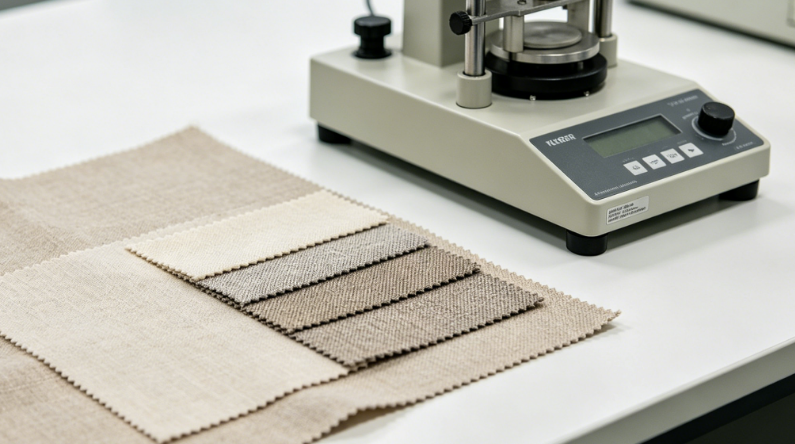
2.2 Dimensional Stability (Shrinkage)
Shrinkage after washing (domestic laundering) – fabric or garment dimensions before/after specified wash and dry cycles (ASTM D2724, AATCC 135, ISO 6330, ISO 5077).
Shrinkage after dry cleaning – (AATCC 158, ISO 3175).
Relaxation shrinkage and felting shrinkage (for wool) – (ISO 6330, AATCC 135).
Spirality / skewness (for knits) – distortion of wales/courses after washing (AATCC 179, ISO 16322).
2.3 Colourfastness
Colourfastness to washing – using launder‑Ometer with multi‑fibre adjacent fabric, graded by Grey Scale for colour change and staining (AATCC 61, ISO 105‑C06).
Colourfastness to light (xenon arc) – exposure to simulated sunlight; blue wool scale rating (AATCC 16, ISO 105‑B02).
Colourfastness to rubbing (crocking) – dry and wet crockmeter (AATCC 8, ISO 105‑X12).
Colourfastness to perspiration – acidic and alkaline solutions (AATCC 15, ISO 105‑E04).
Colourfastness to water – immersion in water (AATCC 107, ISO 105‑E01).
Colourfastness to sea water – (AATCC 106, ISO 105‑E02).
Colourfastness to chlorinated water (swimming pool) – (AATCC 162, ISO 105‑E03).
Colourfastness to dry cleaning – (AATCC 132, ISO 105‑D01).
Colourfastness to bleaching (hypochlorite) – (AATCC 188, ISO 105‑C09).
Yellowing by light or phenolic – (AATCC 124, ISO 105‑B07).
2.4 Chemical & Restricted Substance Testing
Formaldehyde content (free and released) – Japanese Law 112 (UV‑Vis), ISO 14184‑1/-2.
Azo dyes (banned aromatic amines) – GC‑MS after reductive cleavage; limit 30 mg/kg per EU Regulation 1907/2006 (REACH Annex XVII).
Heavy metals (Pb, Cd, Cr, Ni, Co, Cu, As, Hg, Sb) – ICP‑OES / ICP‑MS after acidic extraction (extractable or total).
Phthalates (DEHP, DBP, BBP, DINP, DIDP, DNOP) – GC‑MS – limit 0.1% each.
Nickel release (for metal parts) – EN 12472 + EN 1811.
PFAS (per‑ and polyfluoroalkyl substances) – LC‑MS/MS – for water/oil repellent finishes.
pH value of aqueous extract – (ISO 3071, AATCC 81). Neutral range (4.0‑7.5 for direct contact skin).
Pesticides (cotton) – GC‑MS/MS – per Oeko‑Tex list.
Chlorinated phenols (PCP, TeCP) – GC‑MS.
Organotin compounds (TBT, DBT) – GC‑MS.
Dimethyl fumarate (DMFu) – GC‑MS.
Bisphenol A (BPA) – LC‑MS/MS – for children’s textiles.
2.5 Functional & Performance Testing
Water repellency (spray test) – rating 0‑100 (AATCC 22, ISO 4920).
Water resistance (hydrostatic pressure) – (AATCC 127, ISO 811).
Air permeability – (ASTM D737, ISO 9237).
Moisture vapour transmission rate (MVTR) – (ASTM E96, ISO 15496).
Flame retardancy – vertical test (16 CFR 1610, ISO 6941), horizontal test (FAR 25.853), limited oxygen index (LOI).
Antimicrobial activity – zone of inhibition, shake flask, or absorbent method (AATCC 100, 147; ISO 20743, JIS L 1902).
UV protection factor (UPF) – (AS/NZS 4399, AATCC 183, EN 13758‑1).
Antistatic / surface resistivity – (AATCC 76, ISO 10965).
Thermal resistance (clo value) – (ASTM D1518, ISO 15831).
Fabric stiffness (handle) – Kawabata evaluation system (KES‑F) – by arrangement.
Filtration efficiency (for masks) – EN 14683, ASTM F2299, GB/T 32610.
2.6 Fibre & Yarn Identification
Fibre composition (quantitative) – manual separation or chemical dissolution (ISO 1833 series, AATCC 20A).
Qualitative identification (microscopy, burn test, solubility).
Cotton maturity and fineness – (ASTM D2480, ISO 2403).
Wool fibre diameter – projected microscope or laser scanner (ISO 137, IWTO).
Yarn twist – untwist‑retwist method (ASTM D1422, ISO 2061).
Yarn evenness – Uster tester (optional).
3. Standard Test Methods We Apply
All tests are performed according to internationally recognised standards. Our laboratory is ISO/IEC 17025 accredited and equipped with universal testing machines, crockmeters, colourfastness testers, launder‑Ometers, xenon arc weather‑ometers, abrasion/pilling testers, water repellency testers, GC‑MS, LC‑MS, ICP‑OES, pH meters, and spectrophotometers.
3.1 Physical & Mechanical Standards
ASTM D5034 (tensile – grab).
ISO 13934‑1 (tensile – strip).
ASTM D1424 (tear – Elmendorf).
ISO 13937‑1 (tear – ballistic pendulum).
ASTM D3786 (bursting – diaphragm).
ISO 13938‑1 (bursting – hydraulic).
ASTM D4966 (abrasion – Martindale).
ISO 12947‑2 (abrasion – Martindale).
ASTM D3512 (pilling – random tumble).
ISO 12945‑1 (pilling – box).
3.2 Dimensional Stability Standards
AATCC 135 (dimensional changes – automatic home laundering).
ISO 6330 (washing).
ISO 5077 (dimensional change).
ISO 16322 (spirality – knits).
3.3 Colourfastness Standards
AATCC 61 (washing – launder‑Ometer).
ISO 105‑C06 (colourfastness to domestic/industrial laundering).
AATCC 16 (light – xenon).
ISO 105‑B02 (light – xenon).
AATCC 8 (crocking).
ISO 105‑X12 (rubbing).
AATCC 15 (perspiration).
ISO 105‑E04 (perspiration).
3.4 Chemical & Restricted Substance Standards
ISO 14184‑1 (formaldehyde – free).
ISO 17234 (azo dyes – leather).
EN 14362 (azo dyes – textiles).
ISO 17072 (heavy metals – ICP).
ISO/TS 16181 (phthalates – GC‑MS).
EN 1811 (nickel release).
ISO 3071 (pH).
3.5 Functional & Performance Standards
AATCC 22 (spray test – water repellency).
ISO 4920 (spray test).
ASTM D737 (air permeability).
ISO 9237 (air permeability).
AATCC 127 (hydrostatic pressure).
ISO 811 (hydrostatic pressure).
16 CFR 1610 (flame – vertical).
ISO 6941 (flame – vertical).
AATCC 100 (antimicrobial – qualitative).
ISO 20743 (antimicrobial – quantitative).
AS/NZS 4399 (UPF).
EN 13758‑1 (UV protection).
3.6 Fibre Identification Standards
AATCC 20A (fibre composition – quantitative).
ISO 1833 (quantitative chemical analysis).
ASTM D276 (qualitative).
4. Why Choose Our Third‑Party textile Testing Services?
As an independent laboratory, we provide unbiased, accurate, and regulation‑ready data. Our advantages include:
ISO/IEC 17025 accreditation – CNAS/CMA certified, with regular proficiency testing (e.g., AATCC, ISO round robins).
Wide method portfolio – physical, colourfastness, chemical, functional – all under one roof.
Fast turnaround – typical physical and colourfastness tests in 2‑5 business days; restricted substance screens in 5‑7 business days.
Global regulatory expertise – Oeko‑Tex, REACH, CPSIA, GB 18401, Proposition 65 – we help you meet market requirements.
Detailed reporting – includes raw data, ratings (Grey Scale, Blue Wool, etc.), chromatograms (for chemicals), and clear pass/fail conclusions.
Confidentiality – full protection of your product designs, formulas, and supply chain information.
Consultative support – our textile engineers help interpret results, troubleshoot failures, and recommend material or process modifications.
Whether you need to verify fibre composition for labelling, ensure colourfastness for a new garment line, screen for restricted substances, or characterise functional properties (water repellency, UPF, antimicrobial), our textile testing experts are ready to deliver reliable, actionable data for global market access.
Get Started with Your textile Testing Project
Contact our team with your product type (fabric, garment, yarn), target market, applicable standard(s), and required test items. We will provide a detailed quotation, sample submission guidelines (including recommended sample size and conditioning requirements), and a testing schedule. Let us help you ensure that your textiles meet quality, safety, and performance expectations.
This article provides an overview of our textile testing capabilities. For specific test methods, sample quantity, and pricing, please request a tailored service proposal.