Reasons for choosing our testing services
ZHONGXI Testing has obtained inspection qualification certifications from multiple countries and regions worldwide. We possess a senior testing team and advanced testing methods, providing independent, impartial, and professional third-party verification services for global carbon projects.

Internationally recognized authority
Certified by multiple international standards such as CNAS, VCS, and GS, with reports universally applicable worldwide.

Global service capability
Covering 140+ countries and regions, it supports on-site detection and remote verification in multiple languages.

Professional experimental methods
Adopt standard experimental methods to ensure accurate and reliable data.
concrete Testing Services: Ensuring Strength, Durability & Compliance for Construction Projects
As an independent third-party testing service provider, we offer comprehensive concrete testing for ready‑mix concrete, precast concrete, cast‑in‑place structures, and concrete raw materials (cement, aggregates, admixtures). concrete is the most widely used construction material – its quality determines the safety, service life, and performance of buildings, bridges, dams, pavements, and foundations. Our accredited laboratory follows international standards (ASTM, AASHTO, EN, ISO, BS, GB/T) to deliver accurate, reproducible, and legally defensible test data for fresh concrete, hardened concrete, and constituent materials. This article outlines our concrete testing capabilities – including scope, key test items, and standard test methods – to help contractors, engineers, ready‑mix suppliers, and quality assurance teams verify concrete compliance and fitness‑for‑purpose.
1. Our Testing Scope for concrete
We cover all types of concrete and related materials:
By concrete type: Normal‑weight concrete; Lightweight concrete; High‑strength concrete; Self‑consolidating concrete (SCC); Fibre‑reinforced concrete; High‑performance concrete (HPC); Mass concrete; Roller‑compacted concrete (RCC); Precast concrete; Shotcrete; Pervious concrete.
By test category: Fresh concrete properties (slump, air content, unit weight, temperature, setting time); Hardened concrete properties (compressive strength, flexural strength, split tensile strength, modulus of elasticity); Durability tests (permeability, chloride penetration, freeze‑thaw, sulfate resistance, alkali‑silica reaction – ASR); Constituent material tests (cement, aggregates, water, admixtures); Non‑destructive testing (rebound hammer, ultrasonic pulse velocity, half‑cell potential, covermeter).
By industry standard / regulation: ASTM C31, C39, C78, C94, C143, C231, C469; AASHTO T22, T97, T152; EN 12390, ISO 1920; GB/T 50081, GB/T 50082; ACI 318 (structural design code).
2. Key Test Items & Measurements We Perform
Our concrete testing services are grouped into four domains: fresh concrete, hardened concrete, durability, and constituent materials.
2.1 Fresh concrete Properties (Workability & Consistency)
Slump test (ASTM C143, EN 12350‑2) – measures the consistency and workability of fresh concrete. A standard slump cone is filled, lifted, and the amount of subsidence measured in millimetres. Recommended slumps: for foundations, 25‑75 mm; for reinforced beams, 50‑100 mm; for columns, 75‑100 mm; for pumped concrete, 75‑150 mm.
Slump flow (for self‑consolidating concrete – SCC) – diameter of concrete after cone lift; target 550‑700 mm.
Air content (pressure method – ASTM C231, volumetric method – ASTM C173) – measures entrained air volume (percentage). Crucial for freeze‑thaw durability. Typical air content: 4‑8% for moderate exposure, 5‑8% for severe freeze‑thaw.
Unit weight (density) – mass per unit volume of fresh concrete (ASTM C138). Used for yield calculations and verification of lightweight or heavy‑weight concrete.
Temperature – measured using a thermometer (ASTM C1064). Maximum recommended pour temperature: 32°C; minimum: 5°C (unless special precautions).
Setting time (penetration resistance – ASTM C403) – initial and final setting times of concrete. Used to schedule finishing operations and formwork removal.
Vebe time (for low‑slump concrete) – measurement of workability using vibration (EN 12350‑3).
Mass per volume (yield) – calculation to verify if the delivered concrete volume matches the batch ticket.
2.2 Hardened concrete Mechanical Properties
compressive strength (ASTM C39, EN 12390‑3, BS 1881) – the most fundamental strength test. Cylinders (100×200 mm or 150×300 mm) or cubes (100 mm, 150 mm) are crushed after 7, 14, 28 days (or other specified ages). Used for acceptance of concrete mix designs and structural elements. Typical ranges: normal concrete 20‑40 MPa, high‑strength concrete 50‑100 MPa, ultra‑high performance > 120 MPa.
Flexural strength (modulus of rupture – ASTM C78, EN 12390‑5) – measured on beams (third‑point loading or centre‑point loading). Important for pavements, slabs, and bridge decks. Typical flexural strength: 3‑5 MPa for normal concrete.
Splitting tensile strength (ASTM C496, EN 12390‑6) – Brazilian test on concrete cylinder, used for indirect tensile strength. Approximately 10‑15% of compressive strength.
Static modulus of elasticity (ASTM C469, ISO 1920‑10) – measured by loading a concrete cylinder within elastic range with strain gauges or compressometer. Used for deflection calculations and structural modelling. Typical E‑modulus: 20‑40 GPa.
Poisson’s ratio – measured simultaneously with modulus, range 0.15‑0.25 for concrete.
Bond strength (pull‑out test) – between concrete and reinforcing steel (post‑installed anchors) – ASTM E488.
Core strength (drilled cores – ASTM C42) – when in‑place concrete strength is needed (e.g., suspect cylinders, old structures).
2.3 Durability & Permeability Testing
Rapid chloride permeability (RCP – ASTM C1202) – measures the charge passed through a concrete specimen in 6 hours, indicating resistance to chloride ion penetration (highway bridges, marine structures). Classification: very high (>4000 coulombs) to very low (<1000 coulombs).
Water permeability (hydrostatic pressure) – BS EN 12390‑8, DIN 1048 – measures depth of water penetration under pressure.
Surface resistivity (AASHTO TP 119) – alternative to RCP for chloride penetration assessment.
Freeze‑thaw resistance (ASTM C666) – concrete specimens subjected to repeated freezing and thawing in water. Durability factor (DF) calculated after 300 cycles. DF ≥ 80% for critical structures.
Scaling resistance (deicing salt scaling – ASTM C672) – visual rating of surface deterioration after 50 freeze‑thaw cycles with salt solution.
Sulfate resistance (ASTM C1012) – expansion of mortar bars immersed in sulfate solution over 6‑12 months. Used for concrete exposed to sulfate‑bearing soils or water.
Alkali‑silica reaction (ASR) – accelerated mortar bar test (ASTM C1260) or concrete prism test (ASTM C1293) to assess reactivity of aggregates with alkalis in cement. Expansion limits: <0.10% at 16 days for innocuous aggregates.
Carbonation depth (phenolphthalein indicator) – depth of carbonation front measured on a freshly broken concrete surface. Indicates risk of reinforcement corrosion.
Electrical half‑cell potential (ASTM C876) – measures corrosion potential of reinforcing steel in concrete; identifies active corrosion zones.
Water absorption (ASTM C1585) – initial rate of absorption (sorptivity) – indicates surface permeability and resistance to liquid ingress.
2.4 Constituent Material Testing (cement, Aggregates, Admixtures, Water)
cement tests – fineness (air permeability, ASTM C204), setting time (Vicat, ASTM C191), compressive strength of mortar cubes (ASTM C109), heat of hydration, chemical composition.
Aggregate tests – sieve analysis (gradation – ASTM C136), specific gravity & absorption (ASTM C127/C128), unit weight & voids (ASTM C29), abrasion resistance (Los Angeles – ASTM C131), soundness (ASTM C88), clay lumps and friable particles (ASTM C142).
Water quality – pH, chlorides, sulfates, total solids (ASTM C1602).
Admixture tests – air‑entraining, water‑reducing, set‑retarding, or superplasticizer – tested in concrete for compatibility (ASTM C494).
2.5 Non‑Destructive Testing (NDT) of In‑Place concrete
Rebound hammer (Schmidt hammer – ASTM C805) – measures surface hardness to estimate in‑place compressive strength. Correlation curves required.
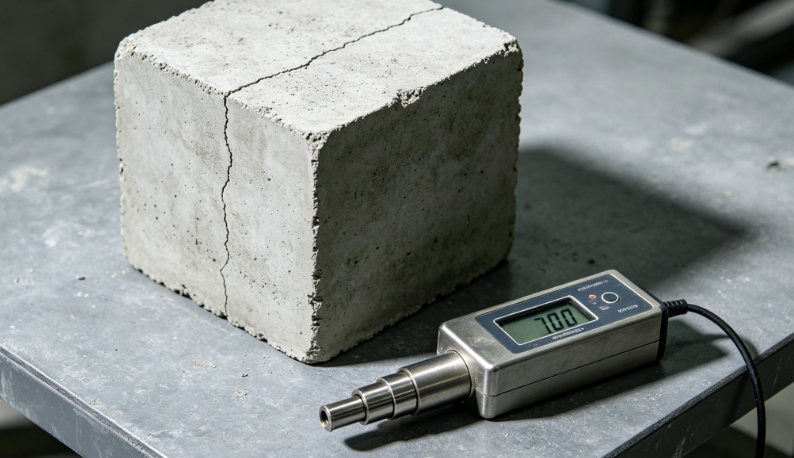
Ultrasonic pulse velocity (ASTM C597) – measures transit time of ultrasonic waves through concrete. Used to detect internal voids, cracks, and estimate elastic modulus and uniformity.
Covermeter (reinforcement cover & bar location – ASTM C1740) – locates reinforcing bars and measures concrete cover depth.
Half‑cell potential mapping (ASTM C876) – for corrosion detection of rebar.
Impact echo (ASTM C1383) – detects voids, delaminations, and thickness measurement (for plates).
3. Standard Test Methods We Apply
All tests are performed according to internationally recognised standards. Our laboratory is ISO/IEC 17025 accredited and equipped with compression machines (up to 3000 kN), flexural test frames, permeability cells, freeze‑thaw cabinets, NDT instruments, and aggregate testing equipment.
3.1 Fresh concrete Standards
ASTM C143 / C143M (slump).
ASTM C231 (air content – pressure).
ASTM C173 (air content – volumetric).
ASTM C138 (unit weight, yield).
ASTM C1064 (temperature).
ASTM C403 (setting time).
EN 12350‑2 (slump), EN 12350‑3 (Vebe), EN 12350‑4 (compacting factor).
3.2 Hardened concrete Standards
ASTM C39 (compressive strength of cylinders).
ASTM C78 (flexural strength).
ASTM C496 (splitting tensile strength).
ASTM C469 (static modulus of elasticity).
ASTM C42 (core strength).
EN 12390‑3 (compression – cubes/cylinders).
EN 12390‑5 (flexure).
EN 12390‑6 (tensile splitting).
GB/T 50081 (Chinese standard for mechanical tests).
3.3 Durability Standards
ASTM C1202 (RCP – chloride permeability).
ASTM C666 (freeze‑thaw).
ASTM C672 (scaling resistance).
ASTM C1012 (sulfate resistance).
ASTM C1260 (ASR – mortar bar).
ASTM C1293 (ASR – concrete prism).
ASTM C876 (half‑cell potential).
ASTM C1585 (sorptivity).
3.4 Aggregate & cement Standards
ASTM C136 (sieve analysis).
ASTM C127/C128 (specific gravity & absorption).
ASTM C131 (Los Angeles abrasion).
ASTM C88 (soundness).
ASTM C109 (cement mortar strength).
ASTM C191 (Vicat setting time).
ASTM C204 (fineness – air permeability).
3.5 Non‑Destructive Testing Standards
ASTM C805 (rebound hammer).
ASTM C597 (ultrasonic pulse velocity).
ASTM C1740 (covermeter).
ASTM C1383 (impact echo).
4. Why Choose Our Third‑Party concrete Testing Services?
As an independent laboratory, we provide unbiased, accurate, and legally defensible data. Our advantages include:
ISO/IEC 17025 accreditation – CNAS/CMA certified, with regular proficiency testing (e.g., ASTM C39, C78, C666).
High‑capacity testing – compression machines up to 3000 kN, accommodates large cylinders and cubes.
Field & laboratory services – we can perform field sampling (cylinder casting, slump, air content, temperature) and lab curing/testing.
Fast turnaround – compressive strength results typically 1‑2 business days after specimen age (e.g., 28‑day tests).
Detailed reporting – includes failure mode photos, stress‑strain curves (if requested), raw data, and statistical summary.
Confidentiality – full protection of your mix designs, project names, and test results.
Consultative support – our concrete technologists help interpret strength failures, troubleshoot low‑strength cylinders, and advise on mix adjustments.
Whether you need to qualify a new mix design, verify daily concrete placements, assess existing structure integrity, or investigate a concrete failure, our concrete testing experts are ready to deliver reliable, actionable data.
Get Started with Your concrete Testing Project
Contact our team with your concrete grade, project specifications, required tests (fresh, hardened, durability), and standard (ASTM, EN, GB/T). We will provide a detailed quotation, sample submission guidelines (including cylinder dimensions and curing regime), and a testing schedule. Let us help you ensure that your concrete is strong, durable, and compliant.
This article provides an overview of our concrete testing capabilities. For specific test methods, sample quantity, and pricing, please request a tailored service proposal.