Reasons for choosing our testing services
ZHONGXI Testing has obtained inspection qualification certifications from multiple countries and regions worldwide. We possess a senior testing team and advanced testing methods, providing independent, impartial, and professional third-party verification services for global carbon projects.

Internationally recognized authority
Certified by multiple international standards such as CNAS, VCS, and GS, with reports universally applicable worldwide.

Global service capability
Covering 140+ countries and regions, it supports on-site detection and remote verification in multiple languages.

Professional experimental methods
Adopt standard experimental methods to ensure accurate and reliable data.
stress relaxation Testing Services: Predicting Long‑Term Seal & Fastener Performance
As an independent third-party testing service provider, we offer comprehensive stress relaxation testing for gaskets, seals, elastomers, bolted joints, springs, and polymer components. stress relaxation is the gradual decrease in stress over time when a material is held at a constant strain (fixed deformation). Unlike creep, where strain increases under constant load, stress relaxation measures how much the initial clamping force or sealing pressure diminishes during service. This property is critical for predicting the long‑term performance of seals, gaskets, O‑rings, bolted flange joints, spring washers, electrical contacts, and plastic fasteners. Our accredited laboratory follows international standards (ASTM E328, ISO 3384, ASTM D6147, ISO 6914, GB/T 1685) using state‑of‑the‑art relaxation testers and environmental chambers. This article outlines our stress relaxation testing capabilities – including scope, key test items, and standard test methods – to help manufacturers, design engineers, and quality assurance teams evaluate material stability under sustained deformation.
1. Our Testing Scope for stress relaxation
We cover all common material classes, product forms, and environmental conditions:
By material type: Elastomers and rubber (natural rubber, nitrile, EPDM, silicone, fluorocarbon – Viton, neoprene, polyurethane, and other vulcanized rubbers); Thermoplastic elastomers (TPE, TPU, TPV); Gasket materials (compressed non‑asbestos fiber, graphite, PTFE, spiral wound gaskets, kammprofile); Polymer seals (O‑rings, lip seals, piston seals, rod seals, diaphragm seals); Metal gaskets and spring washers (Belleville disc springs, wave springs, helical springs); Bolted joint materials (steel, stainless steel, alloy steel); Adhesives and sealants (by arrangement).
By product / specimen configuration: O‑ring specimens (standard cross‑section); Flat buttons and discs (for gasket materials); Standard dumbbell or strip specimens (for elastomers); Spring washers and Belleville discs; Bolts and threaded fasteners (with calibrated strain gauges); Custom‑molded components (by arrangement).
By test parameter / measurement: Initial stress (σ₀) at defined strain; Retained stress (σₜ) after a specified time (hours or days); Percent stress relaxation (R = (σ₀ – σₜ)/σ₀ × 100%); Relaxation modulus (Er(t) = σ(t)/ε₀) – for linear viscoelastic materials; Relaxation time constant (τ) – derived from exponential decay modelling; Temperature dependence of relaxation rate (Arrhenius parameters for lifetime prediction).
By environmental condition: Ambient temperature (23°C); Elevated temperature (up to 300°C for elastomers; up to 1000°C for metal gaskets – by arrangement); Low temperature (down to -40°C); Controlled humidity (for moisture‑sensitive polymers); Immersion in fluids (oil, fuel, coolant, water – by arrangement); Corrosive environment (acid, alkali, salt spray – limited).
By industry application: Automotive (engine seals, exhaust gaskets, valve stem seals, O‑rings); Oil & gas (wellhead seals, pipeline gaskets, blowout preventer seals); Aerospace (fuel system seals, O‑rings, hydraulic seals); Industrial (bolted flange connections, heat exchanger gaskets, pressure vessel seals); Consumer products (waterproof seals, plumbing fittings, electrical connector seals).
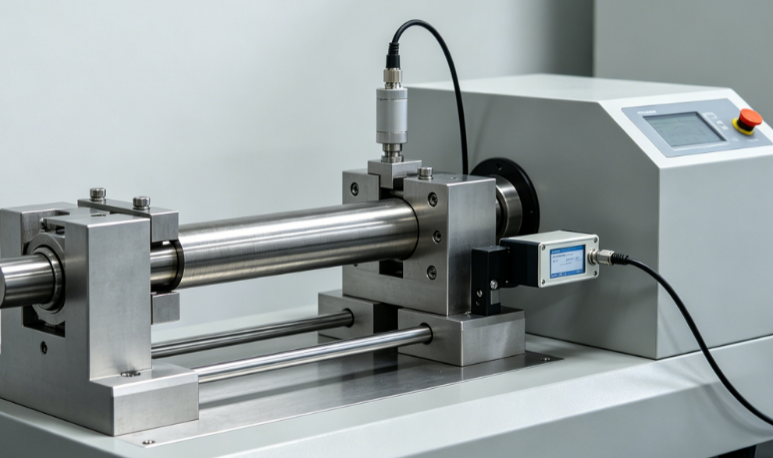
2. Key Test Items & Measurements We Perform
Our stress relaxation testing services quantify the loss of sealing force or clamping load over time, enabling prediction of service life and leakage risk.
2.1 Constant Strain Relaxation (Compression or Tension)
The specimen is compressed (or tensioned) to a defined strain (e.g., 10%, 15%, 20% of original thickness) and held at that fixed deformation. The force required to maintain that strain is continuously or periodically recorded. The decrease in force represents stress relaxation. For elastomeric gaskets and O‑rings, compression stress relaxation is the most common mode.
We report: initial load (F₀), load at time t (Fₜ), percent relaxation R(t) = (1 – Fₜ/F₀) × 100%. For multi‑specimen tests, the average and standard deviation of relaxation at each time point are calculated.
2.2 Relaxation in Bolted Joints (Screw Thread Relaxation)
For bolted joints, the bolt is tightened to a specified initial torque (or preload) and the axial force is monitored over time under constant thread displacement (or constant temperature). The loss of preload is quantified as a percent of the initial clamp force. This test is critical for ensuring that flanges remain leak‑tight over the equipment’s service life.
We report: initial clamp force (kN), residual clamp force at specified times (e.g., 24 h, 168 h, 1000 h), and percent relaxation. For high‑temperature bolting (e.g., turbine casings), we also measure the effect of thermal cycling on relaxation.
2.3 Temperature‑Accelerated Relaxation (Arrhenius Prediction)
For long‑life seals (e.g., 20‑30 years), we perform stress relaxation tests at multiple elevated temperatures (e.g., 80°C, 100°C, 120°C) for shorter durations. Using the time‑temperature superposition (TTSP) principle, we extrapolate the relaxation behaviour to the intended service temperature (e.g., 23°C or 50°C). The shift factor (aT) is calculated using the Arrhenius equation (activation energy Ea) or WLF equation. The result is a predicted retained stress after 1, 5, 10, 20, or 30 years of service.
2.4 Fluid Immersion Relaxation
For seals in contact with oils, fuels, coolants, or process fluids, we conduct relaxation tests in a controlled immersion bath. The specimen is compressed between plates with spacers and immersed in the test fluid at a specified temperature. The retained stress is measured at defined intervals. This test evaluates the combined effect of mechanical relaxation and fluid‑induced swelling or extraction.
2.5 compression set (Complementary Test)
While not directly a stress relaxation measurement, compression set (permanent deformation after unloading) is often correlated with relaxation. We offer compression set testing in parallel to provide additional insight into the material‘s recovery behaviour.
3. Standard Test Methods We Apply
All tests are performed according to internationally recognised standards. Our laboratory is ISO/IEC 17025 accredited and equipped with programmable relaxation testers (dead‑weight lever or servo‑pneumatic, 0‑10 kN force, 0‑300°C ovens), environmental chambers, and data acquisition systems.
3.1 Elastomers & Rubber Standards
ISO 3384‑1 (Rubber, vulcanized or thermoplastic – Determination of stress relaxation in compression – Part 1: Testing at constant temperature). – Specifies the method for measuring compression stress relaxation under constant strain, using a jig with a compression stop. The specimen (cylindrical disc or O‑ring) is compressed to a defined thickness and placed in an oven. At specified intervals, the test assembly is removed and the force is measured after a short recovery period. Reports relaxation as a percentage of the initial force.
ASTM D6147 (Standard test method for vulcanized rubber and thermoplastic elastomers – Determination of force decay (stress relaxation) in compression). – Similar to ISO 3384, but with specific jig geometries and procedures for O‑rings and other shapes. It includes methods for both ambient and elevated temperature testing.
DIN 53519 (Testing of rubber – Determination of stress relaxation in compression). – German standard, largely harmonized with ISO.
3.2 Gasket Materials & Sealing Standards
ASTM F36 (Standard test method for compressibility and recovery of gasket materials). – Measures short‑term relaxation after unloading, not long‑term stress relaxation. For long‑term relaxation of gaskets, we follow internal procedures based on ASTM F1574 (Standard test method for gasket stress relaxation).
PVRC (Pressure Vessel Research Council) Room Temperature Gasket Relaxation Test – A widely used protocol for evaluating gasket relaxation under sustained bolt load. We perform this test using a hydraulic universal testing machine with a constant displacement feedback loop.
3.3 Bolted Joint & Spring Washer Standards
ASTM E328 (Standard test methods for stress relaxation for materials and structures). – Covers stress relaxation testing of metals, including bolts and springs, under constant strain at ambient or elevated temperatures. Specifies the use of strain‑gauged bolts or calibrated load washers.
DIN 2093 (Belleville disc springs – Calculation and test). – Includes relaxation testing of disc springs after prolonged compression.
3.4 General Purpose & Plastics
ISO 6914 (Rubber, vulcanized – Determination of stress relaxation in tension). – For tension‑loaded elastomers.
ASTM D2991 (Standard practice for testing stress relaxation of plastics). – For polymer specimens under bending or tension (less common).
4. Test Procedure & Specifications (Example – Compression stress relaxation of Elastomers per ISO 3384)
Our laboratory strictly follows the procedural requirements of ISO 3384‑1. The following step‑by‑step procedure is standardised for elastomeric O‑rings and discs.
Step 1: Specimen preparation – O‑rings or cylindrical discs (diameter 13 mm, thickness 6.3 mm) are conditioned at 23±2°C, 50±5% RH for 24 hours. Three or more specimens are tested per condition.
Step 2: Initial thickness measurement – The thickness (h₀) of each specimen is measured at three points (for discs) or across the cross‑section (for O‑rings). The mean thickness is recorded.
Step 3: Jig assembly – The specimen is placed between two parallel metal plates with a compression stop (spacer) of defined height (hc) corresponding to the required compression strain (e.g., 15%: hc = 0.85 × h₀). The jig is tightened until the plates contact the spacer, ensuring constant strain.
Step 4: Conditioning and force measurement – The assembled jig is placed in an oven at the test temperature (e.g., 125°C) for the required duration (e.g., 22 h, 70 h, 168 h, 1000 h). At the end of each period, the jig is removed and allowed to cool to 23°C for 2‑5 minutes (or 30 minutes for some standards). The force required to maintain compression is measured by placing the assembly in a universal testing machine and compressing at a slow rate until the spacer contacts the plates again; the peak force is recorded as Fₜ. The assembly is then returned to the oven for the next interval.
Step 5: Calculation – Percent relaxation R(t) = (1 – Fₜ/F₀) × 100%, where F₀ is the initial force measured after 1‑2 hours of conditioning (or after a short relaxation period). The average relaxation and standard deviation are reported for each time point.
5. Advantages & Limitations of stress relaxation Testing
Advantages: Provides direct, time‑dependent data on sealing force decay, which is essential for predicting leak‑tightness of flanges and dynamic seals. Accelerated testing at elevated temperatures (Arrhenius extrapolation) allows prediction of decades of service life within weeks or months. The test is non‑destructive (specimens can be reused for shorter durations, though not recommended for long‑term). It directly measures the parameter of interest for bolted joints (clamp force) and gaskets (sealing stress).
Limitations: For elastomers, the test is sensitive to specimen geometry and compression stop precision; small variations in thickness can cause large differences in initial force. The measured force after removal from the oven includes a short‑term recovery component; the degree of recovery depends on the cooling rate and delay time. Standardised methods require careful calibration of the test fixture and consistent operator technique. The Arrhenius extrapolation assumes the same relaxation mechanism across the temperature range; in practice, physical changes (oxidation, cross‑link scission) may alter the mechanism at higher temperatures, leading to over‑ or under‑estimation of service life.
6. Reporting & Result Presentation
Our test reports are detailed, transparent, and compliant with ISO/IEC 17025 and relevant standards. Each report includes:
Specimen identification – Material type, compound designation, specimen geometry, dimensions, and conditioning history.
Test conditions – Standard referenced (ISO 3384, ASTM D6147, etc.), test temperature, compression strain (%), test medium (air, fluid), test duration, number of specimens.
Raw data – Initial force (F₀), force at each time interval (Fₜ), calculated percent relaxation R(t) for each specimen, mean R(t) and standard deviation.
Graphical presentation – Relaxation vs. time curve (log time scale often used). For temperature‑accelerated tests, we include an Arrhenius plot (ln relaxation rate vs. 1/T) and a predicted retained stress vs. service time plot.
Calibration records – Force transducer calibration date, temperature verification records, jig dimensions and compression spacer thickness tolerance.
Compliance statement – Pass/fail determination against customer specification or acceptance criteria (e.g., “Relaxation ≤ 20% after 1000 h at 125°C”).
7. Why Choose Our Third‑Party stress relaxation Testing Services?
As an independent laboratory, we provide unbiased, accurate, and legally defensible relaxation data. Our strengths include:
ISO/IEC 17025 accreditation – Our stress relaxation testing (ISO 3384, ASTM D6147, ASTM E328) is CNAS/CMA accredited, with regular proficiency testing (e.g., IRMRA round robins).
Multiple test stations – We operate banks of compression jigs and automated relaxation testers, capable of running up to 30 specimens simultaneously at different temperatures and time points.
Arrhenius life prediction – For long‑life seals (e.g., oil and gas, nuclear), we offer full temperature‑accelerated relaxation studies with statistical extrapolation (95% confidence bounds).
Fluid immersion capability – Our environmental chambers allow simultaneous relaxation testing in air, water, oil, fuel, and other customer‑supplied fluids.
Fast turnaround – Standard 168‑hour relaxation tests completed in 1‑2 weeks; accelerated life prediction studies in 4‑6 weeks.
Detailed reporting – Reports include raw data, relaxation curves, statistical analysis, and life prediction graphs.
Confidentiality – Full protection of your material formulation, seal design, and proprietary data.
Consultative support – Our elastomer and sealing specialists assist with test parameter selection (compression strain, temperature, duration), interpretation of relaxation profiles, and recommendations for material improvements (e.g., higher cross‑link density, better thermal stabilisation).
Whether you need to qualify a new gasket material for a high‑pressure flanged joint, predict the service life of an O‑ring in a downhole tool, compare the relaxation performance of different elastomer compounds, or verify the long‑term clamp load retention of a bolted assembly, our stress relaxation testing experts are ready to deliver reliable, actionable results.
Get Started with Your stress relaxation Testing Project
Contact our team with your material type, sealing application, service temperature, expected service life, and applicable standard (ISO 3384, ASTM D6147, ASTM E328, or customer specification). We will provide a detailed quotation, specimen submission guidelines (quantity, dimensions, conditioning), and a testing schedule. Let us help you ensure that your seals and fasteners maintain their force over decades of service.
This article provides an overview of our stress relaxation testing capabilities. For specific test methods, sample quantity, and pricing, please request a tailored service proposal.