Reasons for choosing our testing services
ZHONGXI Testing has obtained inspection qualification certifications from multiple countries and regions worldwide. We possess a senior testing team and advanced testing methods, providing independent, impartial, and professional third-party verification services for global carbon projects.

Internationally recognized authority
Certified by multiple international standards such as CNAS, VCS, and GS, with reports universally applicable worldwide.

Global service capability
Covering 140+ countries and regions, it supports on-site detection and remote verification in multiple languages.

Professional experimental methods
Adopt standard experimental methods to ensure accurate and reliable data.
Comprehensive Testing Services for Vacuum Electrode Tubes (Vacuum Feedthroughs & HV Electrode Feedthroughs)
If you are searching for vacuum electrode tube testing, you are likely manufacturing, maintaining, or qualifying critical components for high‑vacuum systems, particle accelerators, X‑ray tubes, electron microscopes, semiconductor processing equipment, or fusion research devices. These components – often called vacuum feedthrough electrodes, high‑voltage (HV) feedthroughs, or instrumentation feedthroughs – must maintain ultra‑high vacuum integrity (leak rates <10⁻¹⁰ mbar·L/s) while withstanding high voltages (kV to MV range), elevated temperatures, and corrosive environments. Even a microscopic leak or a sub‑surface dielectric defect can cause catastrophic failure, plasma arcing, or contamination of the vacuum chamber. We understand that your need for testing is driven by incoming quality control, failure analysis, qualification for extreme environments, or compliance with vacuum component standards (e.g., ISO 21358, ASTM E498). Our laboratory delivers the most advanced, multi‑parameter testing suite for vacuum electrode tubes – from ultra‑sensitive helium leak detection to high‑voltage dielectric breakdown analysis, materials characterization, and hermetic seal evaluation.
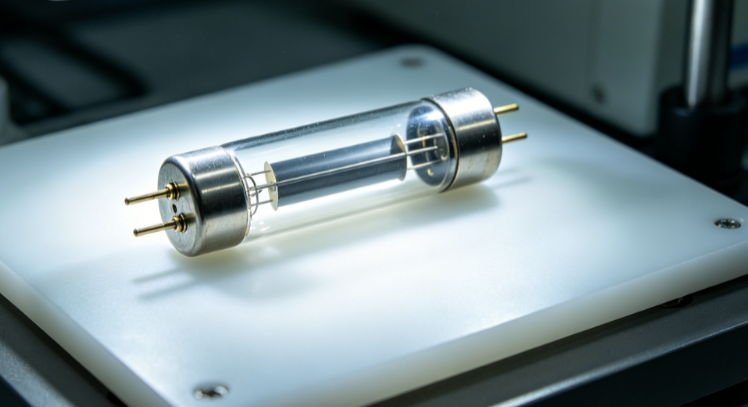
What We Can Do for Your Vacuum Electrode Tube Samples
We provide complete performance and integrity testing for all types of vacuum electrode feedthroughs: single‑pin, multi‑pin, coaxial, high‑voltage (DC/RF), thermocouple, power, and instrumentation feedthroughs. Our core capabilities include:
- Helium leak detection (mass spectrometer method) – Quantitative measurement of leak rates down to 1×10⁻¹² mbar·L/s (5×10⁻¹² atm·cc/s) using both vacuum spray and sniffing techniques. We test at room temperature, cryogenic, and elevated temperatures (up to 450 °C) to simulate real operating conditions.
- High‑voltage dielectric withstand test – AC, DC, or impulse (lightning impulse 1.2/50 µs) up to 100 kV DC and 60 kV RMS AC. Measure leakage current (pA to µA range), partial discharge inception voltage (PDIV), and corona extinction voltage per IEC 60270. We can test in vacuum (<10⁻⁶ mbar) or in pressurized SF₆ or air.
- Insulation resistance (IR) measurement from 1 MΩ to >10¹⁶ Ω using guarded megohmmeters at applied voltages up to 10 kV. Temperature range: ‑50 °C to +200 °C.
- Capacitance and dissipation factor (tan δ) measurement at frequencies from 50 Hz to 1 MHz – critical for RF feedthroughs and pulse‑power applications.
- Contact resistance (pin‑to‑pin and pin‑to‑ground) using 4‑wire Kelvin method, resolution 0.1 mΩ. Detects oxidation, loose contacts, or insufficient bonding.
- Hermetic seal integrity via helium bomb test (for smaller feedthroughs) – pre‑pressurization with helium followed by detection in vacuum chamber. Also perform gross leak detection by bubble test (fluorocarbon or silicone oil) per MIL‑STD‑883.
- Thermal cycling and thermal shock from ‑196 °C (liquid nitrogen) to +450 °C (furnace), with programmable ramps (10–30 °C/min). Combined with in‑situ leak and IR measurements.
- Mechanical integrity (tensile pull test, torque test, vibration resistance) per MIL‑STD‑202 or customer specifications. We apply pull force up to 500 N on individual pins and torque up to 5 N·m on flanges/connectors.
- Materials analysis (metal/ceramic/glass) – Identify alloy composition (e.g., Kovar, stainless steel 304/316L, Inconel) by X‑ray fluorescence (XRF) or ICP‑OES. Analyze ceramic insulator (alumina 95–99.8%, zirconia, or machinable glass‑ceramic) by XRD and SEM‑EDS. Detect impurities, porosity, or cracks.
- Surface contamination and residue analysis by Fourier‑transform infrared spectroscopy (FTIR), X‑ray photoelectron spectroscopy (XPS), or contact angle measurement – essential for identifying process contaminants (oils, flux, particles) that cause outgassing or arcing.
- Outgassing rate measurement per ASTM E595 (thermal vacuum outgassing) – determine total mass loss (TML) and collected volatile condensable materials (CVCM) in high vacuum (<10⁻⁵ Pa) at 125 °C for 24 h. Detection limit 0.01% weight loss.
How Deep Our Characterization Goes
We go far beyond basic “insulation and leak testing”. Our advanced methods are designed to detect subtle defects that standard screening misses – such as micro‑cracks in ceramic‑metal seals, partial discharge precursors, or sub‑ppm helium permeation. Examples of our technical depth:
- Temperature‑cycled helium leak detection with <10⁻¹¹ mbar·L/s sensitivity – We perform leak measurements continuously during thermal cycling (‑196 °C to +450 °C) using a custom vacuum chamber with integrated RGA (residual gas analyzer). This identifies “thermal leaks” that appear only at certain temperatures due to differential expansion.
- Partial discharge (PD) mapping with phase‑resolved pattern analysis – Our PD detector (up to 2 MHz bandwidth) locates discharge sources inside the feedthrough with ±1 mm accuracy using acoustic emission triangulation or HFCT sensors. We distinguish internal voids, surface discharge, and corona.
- High‑resolution X‑ray computed tomography (micro‑CT) at voxel sizes down to 1 µm – non‑destructive 3D inspection of internal voids, solder flow, glass‑to‑metal seal integrity, and electrode alignment without cutting the part. Detects hidden porosity, cracks, and inclusions.
- Scanning electron microscopy (SEM) with energy‑dispersive X‑ray spectroscopy (EDS) of cross‑sectioned feedthroughs (after destructive testing) – examine the ceramic‑metal brazed interface, intermetallic layers, and oxide scale. Quantify diffusion depth and elemental interdiffusion.
- High‑voltage impulse testing with waveform capture at 1 GHz sampling rate – Simulate lightning strike or switching surges up to 30 kV/µs. Capture breakdown waveform, pre‑breakdown current oscillations, and energy deposition.
- Cryogenic ‑ vacuum combined test – Evaluate feedthrough performance at liquid helium temperature (4.2 K) and ultra‑high vacuum (10⁻¹⁰ mbar) for superconducting magnet or particle accelerator feedthroughs. Measure resistance, capacitance, and leakage simultaneously.
- Gas permeation measurement using mass spectrometer in differential pressure mode – For helium, hydrogen, or nitrogen permeation through ceramic insulators or glass seals. Detection limit 1×10⁻¹⁰ mbar·L/s·cm².
- Chemical analysis of surface films by XPS depth profiling (Ar⁺ sputtering, 0.5–10 nm) – Identify oxides, chlorides, or fluorides on electrode surfaces that can enhance field emission.
Why Our Laboratory Is the Right Choice for Vacuum Electrode Tube Testing
General electronics test labs often lack the specialized high‑vacuum, high‑voltage, and cryogenic capabilities required for serious feedthrough characterization. Our advantages are built on decades of experience in vacuum component qualification for aerospace, particle physics, and semiconductor industries:
➤ Dedicated ultra‑high vacuum (UHV) test stations – We operate multiple all‑metal‑sealed vacuum chambers (base pressure <5×10⁻¹⁰ mbar) equipped with helium leak detectors, residual gas analyzers, turbo/dry pumps, and bakeout capabilities to 450 °C. All feedthroughs tested under conditions that mirror your application.
➤ ISO/IEC 17025 accredited calibration for electrical and leak measurements – Our HV testers, megohmmeters, and leak detectors are traceable to national standards. We provide detailed uncertainty budgets for every measured parameter.
➤ Custom fixturing for any feedthrough geometry – We design and manufacture adapters for CF/KF flanges, ConFlat®, ISO‑KF, custom plates, and even unflanged feedthroughs. Our engineering team can accommodate ≤ 500 kV feedthroughs with special shielding.
➤ Combined environmental‑electrical‑vacuum testing – Instead of sequential tests, we perform simultaneous thermal cycling, vibration (optional), and HV bias while continuously monitoring leakage current and helium leak rate. This reveals failure modes that sequential testing cannot trigger.
➤ Fast turnaround and forensic root‑cause analysis – Standard screening (leak, HV withstand, IR, thermal cycle) completed in 3‑5 business days. For failed units, we perform destructive cross‑sectioning, SEM/EDS, and micro‑CT to pinpoint the exact defect (e.g., void at ceramic/metal braze, micro‑crack along insulator).
➤ Comprehensive “Flight‑Ready” Certification package – For space or nuclear applications, we provide a documented test report that includes: helium leak rates before/after thermal cycling, PDIV/PDEV values, insulation resistance at temperature extremes, outgassing data (TML/CVCM), X‑ray inspection images, and micrographs of critical seals. We also supply a lifetime reliability estimate based on accelerated aging.
➤ Global logistics for high‑value components – We provide electrostatic discharge (ESD)‑safe, desiccated shipping containers with tamper‑evident seals. We can also deploy our engineers to your site for on‑site acceptance testing if required.
➤ One‑on‑one technical consultation from vacuum & HV engineers – Our team helps you interpret test anomalies (e.g., why PDIV decreased after thermal cycling), recommends design improvements, and validates repair procedures. We also assist in writing procurement specifications for new feedthroughs.
Ready to Get Your Vacuum Electrode Tube Tested?
Whether you are qualifying feedthroughs for a UHV deposition system, certifying cryogenic electrode modules for a fusion reactor, or investigating a recurring breakdown problem in pulsed power equipment, our laboratory delivers the most thorough, technically rigorous characterization of vacuum electrode tubes available. Contact our vacuum component testing team with your feedthrough specifications (voltage, current, flange type, operating temperature, desired leak rate) – we will return a custom test plan and competitive quote within 24 hours.