Reasons for choosing our testing services
ZHONGXI Testing has obtained inspection qualification certifications from multiple countries and regions worldwide. We possess a senior testing team and advanced testing methods, providing independent, impartial, and professional third-party verification services for global carbon projects.

Internationally recognized authority
Certified by multiple international standards such as CNAS, VCS, and GS, with reports universally applicable worldwide.

Global service capability
Covering 140+ countries and regions, it supports on-site detection and remote verification in multiple languages.

Professional experimental methods
Adopt standard experimental methods to ensure accurate and reliable data.
Corrosion Resistance Testing Services: Validating Material Durability in Aggressive Environments
As an independent third-party testing service provider, we offer comprehensive corrosion resistance testing for metals, alloys, coatings, fasteners, pipelines, and engineered components. Corrosion is a leading cause of material failure, safety incidents, and economic loss across industries such as automotive, aerospace, marine, oil & gas, infrastructure, and manufacturing. Our accredited laboratory simulates real‑world corrosive environments – including salt spray, cyclic humidity, chemical immersion, atmospheric exposure, and electrochemical conditions – following international standards (ASTM, ISO, NACE, SAE, GB/T). This article outlines our corrosion testing capabilities – including scope, key test items, and standard test methods – to help manufacturers, engineers, and asset owners select corrosion‑resistant materials and validate protective coatings.
1. Our Testing Scope for Corrosion Resistance
We cover a wide range of materials, corrosive environments, and test scales:
By material type: Metals (carbon steel, stainless steel, aluminium alloys, copper alloys, titanium, nickel alloys, galvanised steel); Coatings (paint, powder coating, electroplated – zinc, nickel, chrome; anodised aluminium, conversion coatings); Welded and brazed joints; Fasteners and threaded components; Pipelines and pressure vessels; Marine hardware; Automotive body panels; Aerospace components.
By corrosion type simulated: Uniform (general) corrosion; Galvanic corrosion (dissimilar metals); Pitting corrosion; Crevice corrosion; Intergranular corrosion (IGC / IGA); Stress corrosion cracking (SCC); Hydrogen induced cracking (HIC); Filiform corrosion; Erosion‑corrosion; Corrosion under insulation (CUI).
By test environment: Neutral salt spray (NSS); Acetic acid salt spray (AASS); Copper‑accelerated acetic acid salt spray (CASS); Cyclic corrosion (wet/dry/salt); Humid atmosphere (condensing humidity); SO₂ / Kesternich (industrial acid rain); Immersion in chemical solutions (acid, alkali, seawater, organic solvents); Electrochemical tests (potentiodynamic polarisation, electrochemical impedance spectroscopy – EIS); Outdoor or accelerated weathering (UV + salt spray).
2. Key Test Items We Perform
Our corrosion testing services are grouped by test type and evaluation criteria.
2.1 Salt Spray & Cyclic Corrosion Tests
Neutral salt spray (NSS) – continuous 5% NaCl fog at 35°C, pH 6.5‑7.2.
Acetic acid salt spray (AASS) – accelerated test for decorative coatings (acetic acid added, pH ~3.1‑3.3).
Copper‑accelerated acetic acid salt spray (CASS) – for copper‑nickel‑chromium or anodised aluminium (CuCl₂ added).
Cyclic corrosion test (CCT) – alternates salt spray, dry, and humid (e.g., SAE J2334, GMW14872, VCS 1027,149).
Prohesion test – cycles of dilute electrolyte (0.35% (NH₄)₂SO₄ + 0.05% NaCl) and dry‑off (ASTM G85 Annex A5).
Post‑test evaluation: Visual rating (ASTM D610 – % rust), blistering (ASTM D714), scribe creep (ASTM D1654), undercutting, coating adhesion loss.
2.2 Immersion & Chemical Resistance Tests
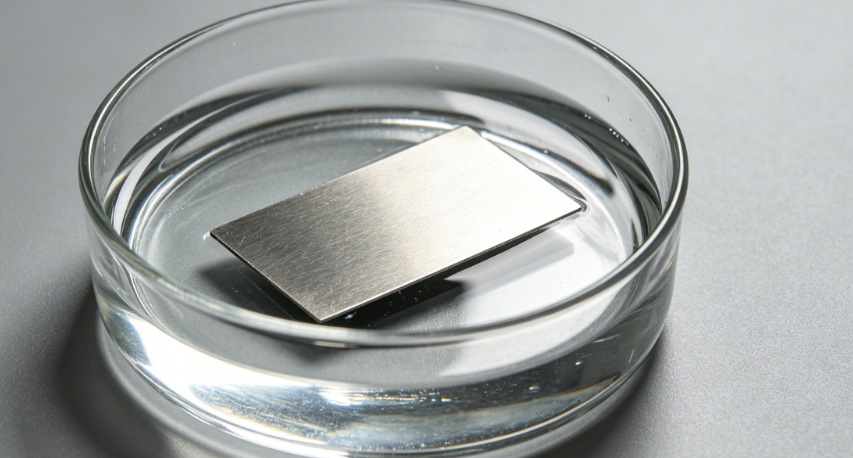
Full immersion – test coupons partially or fully immersed in aggressive liquids (acids: H₂SO₄, HCl, HNO₃; alkalis: NaOH; seawater; organic solvents; fuels; oils; brine) at controlled temperature and duration.
Alternate immersion – cyclic wetting/drying to simulate tidal or splash zones (ASTM G44).
Stress corrosion cracking (SCC) immersion – using C‑ring, U‑bend, or four‑point bent beam specimens in corrosive media (e.g., boiling MgCl₂ for stainless steels).
Intergranular corrosion (IGC) immersion – for stainless steels (Oxalic acid etch, Strauss test (copper‑copper sulfate‑16% H₂SO₄), Huey test (65% HNO₃), etc.).
Evaluation: mass loss (g/m²), corrosion rate (mm/year), pit depth (microscopy), crack detection (dye penetrant or metallography).
2.3 Electrochemical Corrosion Tests
Potentiodynamic polarisation (Tafel extrapolation) – determines corrosion potential (Ecorr), corrosion current (Icorr), and corrosion rate (mpy, mm/year).
Linear polarisation resistance (LPR) – real‑time corrosion rate monitoring.
Electrochemical impedance spectroscopy (EIS) – characterises coating barrier properties, pore resistance, and double layer capacitance.
Critical pitting temperature (CPT) and critical crevice temperature (CCT) – for stainless steels and nickel alloys.
Cyclic polarisation (hysteresis loop) – pitting susceptibility and repassivation potential.
2.4 Environmental & Atmospheric Corrosion Tests
Kesternich test (SO₂ condensation) – simulates industrial acid rain (DIN 50018, ISO 6988).
Humidity test (condensing or non‑condensing) – e.g., 95‑100% RH at 40°C for coating blister resistance (ASTM D2247).
Outdoor atmospheric exposure – marine, industrial, rural, or tropical sites (by arrangement).
Accelerated weathering + corrosion – combined UV (xenon or UV fluorescent) and salt spray (QUV + salt fog).
2.5 Specific Corrosion Mechanisms
Pitting and crevice corrosion resistance – ferric chloride immersion (ASTM G48 Method A / B) for stainless steels and nickel alloys.
Intergranular corrosion of aluminium alloys – ASTM G110 (immersion in 6% NaCl + 1% H₂O₂).
Stress corrosion cracking (SCC) – slow strain rate testing (SSRT) in corrosive environment (ASTM G129).
Hydrogen induced cracking (HIC) – for pipeline steels (NACE TM0284).
Sulfide stress cracking (SSC) – NACE TM0177 (for sour service).
Galvanic corrosion – dissimilar metal couple testing in electrolyte (ASTM G71).
Filiform corrosion – for painted or coated aluminium (ISO 4623, ASTM D2803).
2.6 Coating & Surface Treatment Evaluations
Adhesion before/after corrosion (cross‑cut, pull‑off, tape test).
Porosity of electroplated coatings – ferroxyl test or porosity (corrosion) after salt spray.
Thickness of anodised or conversion coatings – eddy current, microscopy.
Salt spray resistance of zinc flake coatings (Geomet, Dacromet) – ASTM B117 with evaluation of red rust.
Corrosion creep (undercutting) from scribe line – ASTM D1654.
3. Standard Test Methods We Apply
All tests are performed according to internationally recognised standards. Our laboratory is ISO/IEC 17025 accredited and equipped with salt spray chambers, cyclic corrosion chambers, electrochemical workstations, immersion baths, and humidity cabinets.
3.1 Salt Spray & Cyclic Corrosion Standards
Neutral salt spray (NSS): ASTM B117, ISO 9227, GB/T 10125, JIS Z 2371.
Acetic acid salt spray (AASS): ASTM G85 Annex A1, ISO 9227.
Copper‑accelerated salt spray (CASS): ASTM B368, ISO 9227.
Cyclic corrosion (automotive): SAE J2334, GMW14872, VCS 1027,149, Ford CETP 00.00‑L‑467, ISO 11997-1 (cycle A/B).
Prohesion test: ASTM G85 Annex A5.
Evaluation of rusting: ASTM D610 (percent rust), ISO 4628‑1 to ‑5.
Evaluation of blistering: ASTM D714, ISO 4628‑2.
Scribe creep: ASTM D1654, ISO 4628‑8.
3.2 Immersion & Specific Corrosion Standards
Intergranular corrosion of stainless steels (Oxalic acid etch): ASTM A262 Practice A.
Strauss test (Cu‑CuSO₄‑16% H₂SO₄): ASTM A262 Practice E, ISO 3651‑2.
Huey test (65% HNO₃): ASTM A262 Practice C, ISO 3651‑1.
Pitting/crevice corrosion (ferric chloride): ASTM G48 (Methods A & B).
Stress corrosion cracking (SCC) – boiling MgCl₂: ASTM G36.
SCC – slow strain rate test: ASTM G129, NACE TM0198.
Hydrogen induced cracking (HIC): NACE TM0284, ISO 15156.
Sulfide stress cracking (SSC): NACE TM0177, ISO 15156.
Galvanic corrosion: ASTM G71.
Filiform corrosion: ISO 4623 (painted steel), ASTM D2803 (aluminium).
3.3 Electrochemical Test Standards
Potentiodynamic polarisation (Tafel): ASTM G5 (reference), ASTM G59 (LPR), ASTM G102 (corrosion rate calculation).
Electrochemical impedance spectroscopy (EIS): ASTM G106, G3.
Critical pitting temperature: ASTM G150 (potentiostatic).
Cyclic polarisation: ASTM G61 (pitting susceptibility).
3.4 Environmental & Atmospheric Standards
Kesternich test (SO₂): DIN 50018, ISO 6988, ASTM G87.
Condensing humidity: ASTM D2247, ISO 6270-1.
Immersion corrosion of metals: ASTM G31 (laboratory immersion), G45 (alternate immersion).
Seawater immersion (natural or synthetic): ASTM D1141 (synthetic seawater).
3.5 Coating & Anodised Aluminium Standards
Salt spray for anodised aluminium: ASTM B117 (then rated per ASTM B537).
Aluminium intergranular corrosion (IGC): ASTM G110, ASTM G67 (nitric acid mass loss).
Porosity of gold/nickel coatings (electrographic): ASTM B741, B742.
4. Why Choose Our Third‑Party Corrosion Resistance Testing Services?
As an independent laboratory with extensive experience in corrosion science, we provide unbiased, accurate, and actionable data. Our strengths include:
ISO/IEC 17025 accreditation – CNAS/CMA certified, regularly participating in proficiency testing (e.g., ASTM B117 round robins).
Wide test capability – over 20 corrosion chambers (salt spray, cyclic, SO₂, humidity), electrochemical workstations, and custom immersion rigs.
Accelerated & long‑term tests – we run standard 24‑1000 hour salt spray, as well as multi‑week cyclic and long‑term immersion.
Comprehensive evaluation – we provide visual documentation (digital photos), rust/creep ratings, pit depth profiles, corrosion rate calculation (mpy, mm/year), and metallographic cross‑sections.
Fast turnaround – typical NSS (96‑500 hours) reports in 7‑10 calendar days; cyclic tests scheduled accordingly.
Confidentiality – full protection of your material composition and design.
Consultative support – our corrosion engineers help select the most relevant standard, define acceptance criteria, and interpret failure modes (pitting, crevice, SCC).
Whether you are qualifying a new coating system for automotive underbody, selecting a stainless steel grade for marine service, or evaluating pipeline resistance to sour gas, our corrosion testing experts are ready to provide the data you need to avoid premature failure and ensure long‑term durability.
Get Started with Your Corrosion Resistance Testing Project
Contact our team with your material / coating description, service environment (e.g., coastal, industrial, chemical plant, high‑humidity), and target standard or custom test duration. We will provide a detailed quotation, sample preparation guidelines, and a testing schedule. Let us help you validate corrosion resistance and extend the service life of your assets.
This article provides an overview of our corrosion resistance testing capabilities. For specific test methods, sample size, and pricing, please request a tailored service proposal.