Reasons for choosing our testing services
ZHONGXI Testing has obtained inspection qualification certifications from multiple countries and regions worldwide. We possess a senior testing team and advanced testing methods, providing independent, impartial, and professional third-party verification services for global carbon projects.

Internationally recognized authority
Certified by multiple international standards such as CNAS, VCS, and GS, with reports universally applicable worldwide.

Global service capability
Covering 140+ countries and regions, it supports on-site detection and remote verification in multiple languages.

Professional experimental methods
Adopt standard experimental methods to ensure accurate and reliable data.
high temperature Performance Testing Services: Validating Materials & Components for Thermal Extremes
As an independent third-party testing service provider, we offer comprehensive high temperature performance testing for materials, components, and assemblies used in high‑temperature environments – including aerospace, automotive exhaust, power generation, industrial furnaces, electronics, and fire protection. Elevated temperatures can degrade mechanical strength, accelerate oxidation, cause thermal deformation, induce creep, and compromise material integrity. Our accredited laboratory performs thermal ageing, thermal cycling, oxidation resistance, high‑temperature tensile/creep, and fire resistance tests according to international standards (ISO, ASTM, EN, GB/T, UL, MIL‑STD). This article outlines our high temperature testing capabilities – including scope, key test items, and standard test methods – to help manufacturers, engineers, and certification bodies ensure reliable performance under thermal stress.
1. Our Testing Scope for high temperature Performance
We cover a wide range of materials, temperature regimes, and test types:
By material type: Metals and alloys (steel, stainless steel, nickel alloys – Inconel, Hastelloy; titanium, aluminium, copper); Polymers & composites (thermoplastics, thermosets, carbon fibre composites, elastomers); Ceramics (advanced ceramics, refractory materials, ceramic matrix composites – CMC); Coatings (thermal barrier coatings – TBC, anti‑oxidation coatings); Adhesives and sealants; Building materials (concrete, fire‑resistant boards); Electronics (printed circuit boards, connectors, solder joints).
By temperature range: Moderate (up to +200°C) – typical for polymers, electronics; High (200°C – 600°C) – automotive exhaust, industrial components; Very high (600°C – 1200°C) – turbine blades, furnace parts; Extreme (>1200°C) – refractory ceramics, re‑entry materials (by arrangement).
By test type: Thermal ageing (continuous exposure); Thermal cycling (rapid temperature changes); Thermal shock (extreme gradients); Oxidation and scaling resistance; Hot corrosion; High‑temperature tensile/creep/stress rupture; Heat deflection temperature (HDT); Vicat softening temperature; Fire resistance (flame, heat flux); Thermo‑mechanical fatigue (TMF).
2. Key Test Items We Perform
Our high temperature performance testing services are grouped by test type and material category.
2.1 Thermal Ageing & Long‑Term Heat Resistance
Continuous high temperature exposure – materials aged in air or inert atmosphere at defined temperatures (e.g., 150°C, 250°C, 500°C, 1000°C) for hours to months.
Evaluation after ageing – tensile strength, elongation, hardness, mass change, colour change, surface cracking, chemical degradation (FTIR, DSC for polymers).
Arrhenius extrapolation – predicted service life at lower temperatures (for polymers, elastomers).
Standards: ASTM D3045 (plastics), ASTM D573 (rubber), ASTM D865 (rubber – hot air ageing).
2.2 Thermal Cycling & Thermal Shock Resistance
Thermal cycling (slow or medium rate) – e.g., -40°C ↔ +150°C, 10 cycles, 2‑hour dwells, 5°C/min transitions (IEC 60068‑2‑14, MIL‑STD‑883).
Thermal shock (rapid transfer between hot and cold chambers) – e.g., from +200°C to -65°C in <1 minute. For ceramics and electronic components (MIL‑STD‑202, IEC 60068‑2‑14).
Post‑cycle evaluation – visual cracks, delamination, electrical continuity, bond strength, weight change.
2.3 Oxidation & Scaling Resistance (Metals & Coatings)
Isothermal oxidation – weight gain vs. time (Thermogravimetric Analysis – TGA in air) at 600‑1200°C.
Cyclic oxidation – repeated heating (e.g., 1 hour at 1000°C) followed by forced air cooling, measuring mass change per cycle.
Evaluation – oxide scale thickness (metallography), spalling resistance, microcracks, metal loss.
Standards: ASTM G54 (simple static oxidation), ASTM G115 (cyclic oxidation).
2.4 High‑Temperature Mechanical Properties
High‑temperature tensile test – at specified temperatures (e.g., 200°C, 400°C, 800°C) with furnace and extensometer. Parameters: ultimate tensile strength, yield strength, elongation, reduction of area (ASTM E21, ISO 6892‑2).
Hot hardness – Vickers or Rockwell at elevated temperatures (ASTM E228).
Creep testing (constant load or constant stress) – strain vs. time at constant temperature (e.g., 600°C, 200 MPa) – ASTM E139, ISO 204.
Stress rupture – time‑to‑failure at constant load and temperature – ASTM E292, ISO 204.
High‑temperature fatigue (isothermal) – strain‑controlled or stress‑controlled (ASTM E606).
2.5 Heat Deflection Temperature (HDT) & Vicat Softening (Plastics)
Heat deflection temperature (HDT) – temperature at which a test bar deflects 0.25 mm or 0.34 mm under a specified load (0.45 MPa or 1.82 MPa) – ASTM D648, ISO 75.
Vicat softening temperature (VST) – temperature at which a flat needle penetrates 1 mm into specimen under defined load – ASTM D1525, ISO 306.
2.6 Fire Resistance & Flame Retardancy (high temperature Exposure)
Fire resistance of building materials – furnace test according to ASTM E119, EN 1363, ISO 834 (time‑temperature curve). Criteria: insulation (temperature rise) and integrity (flame passage).
Flame spread and smoke (ASTM E84, UL 723).
Glow wire test (IEC 60695‑2‑10) – simulates thermal stress from glowing components.
Limiting oxygen index (LOI) at elevated temperature (optional).
2.7 Thermal Conductivity & Thermal Diffusivity (high temperature)
Laser flash analysis (LFA) – measures thermal diffusivity and specific heat up to 1200°C, then calculates thermal conductivity – ASTM E1461, ISO 22007‑4.
Guarded hot plate (steady state) – for insulating materials up to 600°C – ASTM C177.
Transient plane source (Hot Disk) – up to 300°C (polymers, composites).
2.8 Thermo‑Gravimetric Analysis (TGA) & Differential Scanning Calorimetry (DSC)
TGA – measures thermal stability: decomposition onset temperature, char residue, oxidation onset (OIT) – ASTM E1131, ISO 11358.
DSC – glass transition temperature (Tg), melting point (Tm), crystallization, cure behaviour – ASTM E794, ISO 11357.
Oxidation induction time (OIT) – for polymers and lubricants – ASTM D3895.
3. Standard Test Methods We Apply
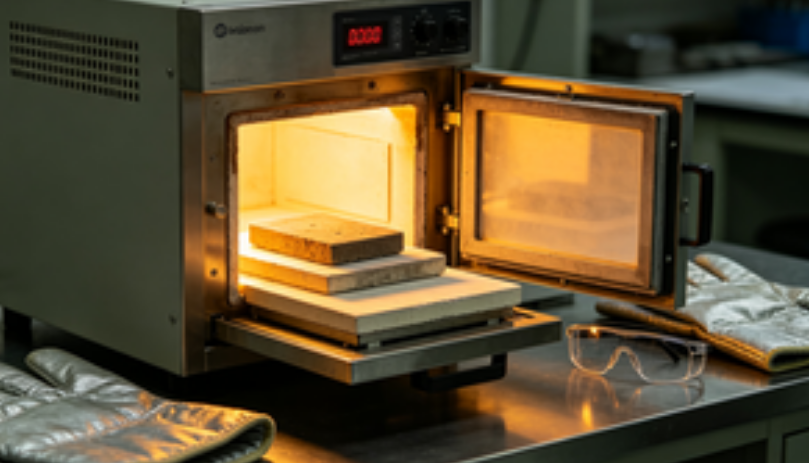
All tests are performed according to internationally recognised standards. Our laboratory is ISO/IEC 17025 accredited and equipped with multiple high‑temperature furnaces (up to 1400°C), thermal cyclers, TGA/DSC, creep frames, universal test machines with environmental chambers, and thermal conductivity analysers.
3.1 Thermal Ageing & Cycling Standards
Plastics – hot air ageing: ASTM D3045, ISO 2578.
Rubber – hot air ageing: ASTM D573, ISO 188.
Thermal cycling (general): IEC 60068‑2‑14, MIL‑STD‑810 Method 503.7.
Thermal shock (electronic components): MIL‑STD‑202 Method 107, MIL‑STD‑883 Method 1010.
3.2 Oxidation & Corrosion Standards
Static oxidation (isothermal): ASTM G54, G115 (cyclic).
high temperature corrosion (hot salt, molten salt): ASTM G111 (corrosion in high temperature environments).
Weight change measurement: ASTM D5870.
3.3 High‑Temperature Mechanical Standards
Tensile test at elevated temperature: ASTM E21 (metals), ISO 6892‑2, ASTM D638 (plastics, with thermal chamber).
Creep and stress rupture: ASTM E139 (metals), ISO 204, ASTM D2990 (plastics).
high temperature fatigue: ASTM E606 (strain‑controlled), ASTM E466 (stress‑controlled).
Hot hardness: ASTM E228 (temperature effect).
3.4 Plastics Thermal Softening Standards
HDT (heat deflection temperature): ASTM D648, ISO 75‑1/-2.
Vicat softening temperature: ASTM D1525, ISO 306.
3.5 Fire Resistance & Flame Standards
Building material fire resistance (furnace): ASTM E119, EN 1363‑1, ISO 834‑1.
Flame spread (tunnel test): ASTM E84, UL 723.
Glow wire flammability: IEC 60695‑2‑10, GB/T 5169.10.
Limiting oxygen index (LOI): ASTM D2863, ISO 4589‑2.
3.6 Thermal Analysis Standards
TGA: ASTM E1131, E2550, ISO 11358.
DSC: ASTM E794, E967, ISO 11357.
Oxidation induction time (OIT): ASTM D3895 (DSC), ASTM D6186 (PDSC).
3.7 Thermal Conductivity Standards
Laser flash (high temperature): ASTM E1461, ISO 22007‑4.
Guarded hot plate: ASTM C177, ISO 8302.
Transient plane source (Hot Disk): ISO 22007‑2.
4. Why Choose Our Third‑Party high temperature Performance Testing Services?
As an independent laboratory with extensive thermal testing expertise, we provide unbiased, accurate, and regulation‑ready data. Our advantages include:
ISO/IEC 17025 accreditation – CNAS/CMA certified, regularly participating in proficiency testing (ASTM, ILAC).
Wide temperature range – from sub‑ambient to 1400°C, with precise (±1°C) control.
Flexible sample sizes – micro‑specimens (polymer films) to large components (fire resistance panels).
Fast turnaround – typical thermal ageing (100‑500 hours) in 2‑4 weeks; HDT/Vicat in 3‑5 business days.
Comprehensive reporting – raw data curves (temperature vs. time, strain, mass change), visual documentation, and pass/fail conclusions.
Confidentiality – full protection of your material specifications and test objectives.
Consultative support – our thermal engineers help select appropriate test methods, define acceptance criteria, and interpret degradation mechanisms (oxidation, creep, thermal decomposition).
Whether you are qualifying a heat‑resistant polymer for under‑hood applications, validating a nickel alloy for turbine blades, testing fire resistance of building materials, or measuring the thermal conductivity of an insulation board, our high temperature testing experts are ready to deliver reliable data.
Get Started with Your high temperature Performance Testing Project
Contact our team with your material type, target temperature range, relevant standard (if any), and specific test items (e.g., thermal ageing, HDT, creep). We will provide a detailed quotation, sample submission guidelines, and a testing schedule. Let us help you ensure that your materials and components survive and perform reliably under extreme thermal conditions.
This article provides an overview of our high temperature performance testing capabilities. For specific test methods, sample size, and pricing, please request a tailored service proposal.