Reasons for choosing our testing services
ZHONGXI Testing has obtained inspection qualification certifications from multiple countries and regions worldwide. We possess a senior testing team and advanced testing methods, providing independent, impartial, and professional third-party verification services for global carbon projects.

Internationally recognized authority
Certified by multiple international standards such as CNAS, VCS, and GS, with reports universally applicable worldwide.

Global service capability
Covering 140+ countries and regions, it supports on-site detection and remote verification in multiple languages.

Professional experimental methods
Adopt standard experimental methods to ensure accurate and reliable data.
Impact Strength Testing Services: Measuring Material Toughness Under Sudden Loading
As an independent third-party testing service provider, we offer comprehensive impact strength testing for metals, plastics, composites, ceramics, and engineering materials. Impact strength quantifies a material’s ability to absorb energy during sudden, high‑rate loading – a critical property for components subject to shock, collision, or dynamic stress. Our accredited laboratory performs Charpy, Izod, drop weight, and instrumented impact tests according to international standards (ASTM, ISO, EN, GB/T). This article outlines our impact testing capabilities – including scope, key test items, and standard test methods – to help manufacturers, quality engineers, and R&D teams validate material toughness and fracture resistance.
1. Our Testing Scope for Impact Strength
We cover a wide range of materials, test types, and temperature conditions:
By material type: Metals (steel, aluminium, cast iron, copper alloys, titanium); Plastics (thermoplastics, thermosets, reinforced plastics, films); Composites (CFRP, GFRP, sandwich panels); Ceramics (structural ceramics, tiles); Wood and engineered wood; Adhesives and bonded joints; Finished components (gears, housings, piping).
By impact method: Charpy V‑notch (CVN) – pendulum; Charpy U‑notch; Izod impact (cantilever beam); Drop weight (falling dart, Gardner impact); Instrumented impact (force‑time, energy‑time curves); Tensile impact (tensile shock loading).
By test condition: Ambient temperature (23°C); Low temperature (down to -196°C using liquid nitrogen); high temperature (up to +300°C for polymers, +1000°C for metals – by arrangement); Sub‑size specimens (for small or precious materials).
By industry application: Construction (structural steel, pipeline steels); Automotive (bumpers, interior plastics, composite panels); Aerospace (composite skins, leading edges); Consumer goods (sports equipment, enclosures); Packaging (films, containers).
2. Key Test Items We Perform
Our impact testing services measure absorbed energy, fracture appearance, and dynamic behaviour.
2.1 Pendulum Impact Tests (Charpy & Izod)
Charpy V‑notch impact energy (KV) – energy absorbed in breaking a standard notched specimen (Joules, ft‑lbf).
Charpy U‑notch impact energy (KU).
Izod impact energy (notched or unnotched) – for plastics and metals (cantilever method).
Fracture appearance (percent shear, percent cleavage) – for metals (ASTM E23).
Lateral expansion (for metals) – deformation on the non‑notched side.
Transition temperature determination – temperature at which fracture mode changes from ductile to brittle (FATT – fracture appearance transition temperature, or energy‑based transition).
Sub‑size specimens – for thin materials or limited material availability (e.g., 2.5 mm, 5 mm thickness).
2.2 Drop Weight & Falling Dart Impact
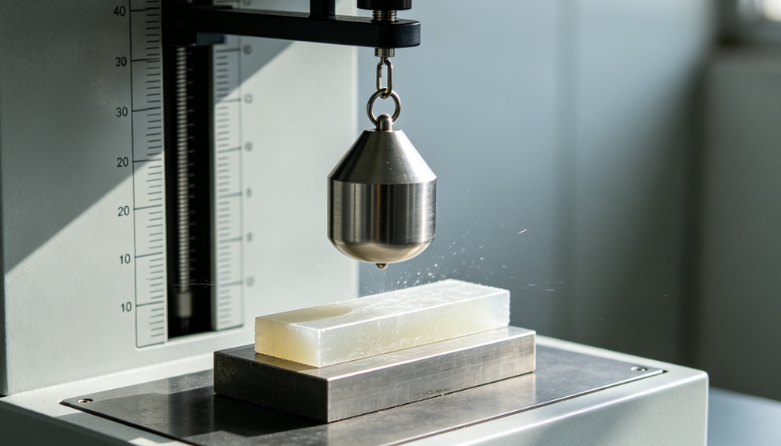
Drop weight impact (tup / dart) – energy to crack or puncture a plate or film (ASTM D7136, D3029).
Gardner impact (falling weight) – for rigid plastics and coatings (ASTM D5420, ISO 6603).
Instrumented drop weight – records force, energy, and deflection vs. time; separates initiation energy from propagation energy.
Puncture resistance of films (film impact) – ASTM D3420, ISO 7765.
Low‑velocity impact on composites – damage area, dent depth, residual strength.
2.3 Instrumented & Tensile Impact
Instrumented Charpy/Izod – provides force‑time and energy‑time curves, yield load, crack initiation energy, propagation energy, and ductile‑brittle transition analysis.
Tensile impact (tensile shock loading) – ASTM D1822, ISO 8256 – for plastics that are too flexible or thin for pendulum impact.
Multiaxial impact (falling dart with hemispherical tup) – for sheet materials (ISO 6603‑2).
2.4 Specialised Impact Tests
Charpy impact of welds (notch in weld metal, HAZ, or fusion line).
impact resistance of ceramic tiles (pendulum or falling ball).
Impact of safety glass (laminated or tempered) – steel ball drop (EN 12600, ANSI Z97.1).
Impact of pipelines (full‑scale or sub‑size) – drop weight tear test (DWTT) – ASTM E436.
High‑rate tensile impact (split Hopkinson bar) – by arrangement.
2.5 Post‑Test Evaluations
Fracture surface examination (visual, SEM) – ductile, brittle, mixed mode.
Percent shear fracture (for metals) – measured using calipers or image analysis.
Crack length measurement (for polymers).
Residual strength after impact (compression after impact – CAI) – for composites (ASTM D7137).
3. Standard Test Methods We Apply
All tests are performed according to internationally recognised standards. Our laboratory is ISO/IEC 17025 accredited and equipped with pendulum impact testers (up to 750 J), drop weight towers, instrumented impact systems, and temperature chambers (-80°C to +300°C).
3.1 Metals (Charpy & Izod)
Charpy V‑notch impact test for metallic materials: ASTM E23, ISO 148‑1, EN 10045‑1, GB/T 229.
Izod impact (metals – rarely used): ASTM E23 (optional).
Drop weight tear test (DWTT) for pipeline steels: ASTM E436, API RP 5L3.
Dynamic tear test: ASTM E604.
Evaluation of fracture appearance: ASTM E23 (section 10), ISO 148‑1 Annex.
3.2 Plastics (Charpy, Izod, Tensile Impact)
Izod impact (plastics – notched/unnotched): ASTM D256, ISO 180, GB/T 1843.
Charpy impact (plastics): ASTM D6110, ISO 179‑1/-2, GB/T 1043.
Tensile impact (plastics): ASTM D1822, ISO 8256.
Gardner impact (falling weight – rigid plastics): ASTM D5420, ISO 6603‑1.
Drop dart impact (film and sheet): ASTM D1709 (method A or B), ISO 7765‑1.
Instrumented impact (multiaxial – plastics): ISO 6603‑2 (falling dart), ASTM D3763.
3.3 Composites (Drop Weight & CAI)
Drop weight impact of composite laminates: ASTM D7136, ISO 18352.
Compression after impact (CAI): ASTM D7137, ISO 18352 (combined).
Instrumented impact of composites: ASTM D5628.
Izod/Charpy of reinforced plastics (limited): ASTM D256 (modified).
3.4 Ceramics & Glasses
impact resistance of ceramic tiles (pendulum): ISO 10545‑5, ASTM C648.
Falling ball impact (glass, glazes): ASTM C149 (glass containers), EN 12600 (glass building products).
3.5 Wood & Timber
Impact bending (toughness) of wood: ISO 3348, ASTM D143 (impact bending).
3.6 Adhesives & Bonded Joints
Impact strength of adhesive bonds (wedge impact): ISO 11343 (Charpy method).
4. Why Choose Our Third‑Party Impact Strength Testing Services?
As an independent laboratory, we provide unbiased, accurate, and legally defensible impact data. Our advantages include:
ISO/IEC 17025 accreditation – CNAS/CMA certified, with regular proficiency testing (e.g., ASTM E23, ISO 179).
Wide energy range – pendulum from 0.5 J (micro‑specimens) to 750 J (high‑strength steels).
Temperature control – liquid nitrogen cooled baths (down to -196°C) and heated chambers (up to +300°C).
Instrumented impact systems – force and energy curves for in‑depth failure analysis.
Fast turnaround – typical impact tests (5‑10 specimens) within 2‑4 business days.
Comprehensive reporting – absorbed energy values, fracture appearance (percent shear, lateral expansion), force‑time curves (instrumented), and photographs of broken specimens.
Confidentiality – full protection of your material specifications and test data.
Consultative support – our engineers help select notch type, temperature, and specimen orientation (e.g., longitudinal vs. transverse).
Whether you need to qualify a structural steel for low‑temperature service, verify plastic part toughness for automotive interiors, or assess composite impact damage tolerance, our impact testing experts are ready to deliver reliable and actionable data.
Get Started with Your Impact Strength Testing Project
Contact our team with your material type, specimen dimensions (or product description), target standard (e.g., ASTM E23, ISO 180), and required test temperature(s). We will provide a detailed quotation, specimen preparation guidelines (notching if needed), and a testing schedule. Let us help you evaluate the toughness and fracture behaviour of your materials under sudden loading.
This article provides an overview of our impact strength testing capabilities. For specific test methods, sample size, and pricing, please request a tailored service proposal.