Reasons for choosing our testing services
ZHONGXI Testing has obtained inspection qualification certifications from multiple countries and regions worldwide. We possess a senior testing team and advanced testing methods, providing independent, impartial, and professional third-party verification services for global carbon projects.
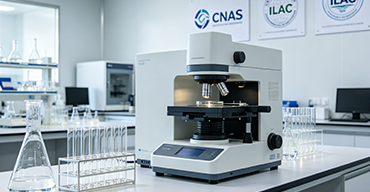
Internationally recognized authority
Certified by multiple international standards such as CNAS, VCS, and GS, with reports universally applicable worldwide.

Global service capability
Covering 140+ countries and regions, it supports on-site detection and remote verification in multiple languages.

Professional experimental methods
Adopt standard experimental methods to ensure accurate and reliable data.
yield strength Testing Services: Accurate Determination of Material Plastic Deformation Onset
As an independent third-party testing service provider, we offer comprehensive yield strength testing for metallic materials, polymers, composites, and other engineering materials. yield strength is a critical mechanical property that defines the stress at which a material transitions from elastic to plastic deformation – i.e., the point where permanent, non‑recoverable strain begins. This parameter is essential for structural design, material selection, quality control, and failure analysis across industries such as construction, automotive, aerospace, oil & gas, and manufacturing. Our accredited laboratory follows international standards (ASTM E8/E8M, ISO 6892‑1, ASTM D638, ISO 527) using precision universal testing machines (UTMs) equipped with extensometers and advanced data acquisition. This article outlines our yield strength testing capabilities – including scope, key test items, and standard test methods – to help engineers, quality assurance teams, and researchers accurately determine yield behaviour under tensile, compressive, or flexural loading.
1. Our Testing Scope for yield strength
We cover a broad range of materials, test types, and temperature conditions:
By material type: Metals (carbon steel, stainless steel, aluminium alloys, copper alloys, titanium, nickel alloys, cast iron, rebar); Polymers (thermoplastics, thermosets, reinforced plastics, films); Composites (CFRP, GFRP); Wood (parallel/perpendicular to grain); Additive manufactured parts (metals and polymers).
By loading mode: Tensile yield strength (most common); Compressive yield strength (for ductile metals and plastics); Flexural yield strength (for beams and brittle materials).
By test condition: Ambient temperature (23°C ± 2°C); Elevated temperature (up to 1200°C for metals, 250°C for polymers); Sub‑ambient / cryogenic (down to -196°C, by arrangement).
By specimen geometry: Round tensile bars; Rectangular (sheet, plate); Sub‑size specimens (limited material); Full‑section (wire, rebar, tubing).
By industry application: Structural steel (beams, columns); Automotive body panels and chassis components; Pipeline steel (yield strength for pressure rating); Aerospace alloys; Plastic injection moulded parts; Fasteners (bolts, screws).
2. Key Test Items & Measurements We Perform
Our yield strength testing services determine multiple parameters depending on material behaviour. We report both engineering stress‑strain data and calculated properties.
2.1 yield strength Determination Methods
Offset yield strength (0.2% offset) – most common method for metals and many plastics. A line parallel to the elastic modulus is drawn at 0.2% strain (ε = 0.002). The intersection with the stress‑strain curve gives the yield strength (Rp0.2).
Offset yield for plastics (0.1% or 0.5% offset) – depending on standard (e.g., ISO 527 uses 0.1% offset for certain materials).
Upper yield point (ReH) and lower yield point (ReL) – for materials with a distinct yield point phenomenon (e.g., low‑carbon steel, some polymers). Upper yield is the first stress maximum; lower yield is the subsequent plateau.
Proof strength (Rp) – for non‑linear materials without a clear yield point (e.g., cast iron, some composites).
Compressive yield strength – determined similarly from compression test stress‑strain curve (0.2% offset).
Flexural yield strength – for bending tests on beams (using outer fibre stress at yield).
2.2 Additional Measurements from the Same Test
Young’s modulus (elastic modulus) – slope of the linear elastic region.
Yield strain (%) – strain at which yield occurs (offset or upper/lower).
Yield ratio (yield strength / tensile strength) – indicator of ductility and strain hardening capacity.
Proof stress at other offsets (e.g., 0.1%, 0.5%) – on request.
Strain hardening exponent (n‑value) – from log‑log plot of true stress‑strain after yield.
2.3 Specialised yield strength Tests
High‑temperature yield strength – using furnace and elevated temperature extensometer.
Low‑temperature yield strength – with cryogenic chamber (liquid nitrogen).
Strain rate sensitivity – yield strength at different crosshead speeds (e.g., 0.00025 s⁻¹ to 0.1 s⁻¹).
Re‑test after pre‑strain (work hardening) – for forming studies.
3. Standard Test Methods We Apply
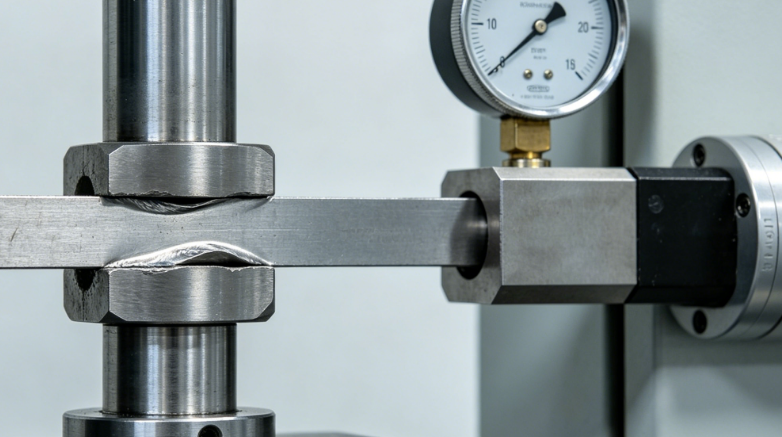
All tests are performed according to internationally recognised standards. Our laboratory is ISO/IEC 17025 accredited and equipped with universal testing machines (1 N to 600 kN), non‑contact video extensometers, and clip‑on extensometers (resolution ±0.5 μm).
3.1 Metals (Tensile Yield)
ASTM E8/E8M (Standard Test Methods for Tension Testing of Metallic Materials) – 0.2% offset yield strength, upper/lower yield point.
ISO 6892‑1 (Metallic materials – Tensile testing – Part 1: Method of test at room temperature).
GB/T 228.1 (China – Tensile testing of metallic materials).
EN 10002‑1 (historical, replaced by ISO 6892‑1).
3.2 Plastics (Tensile Yield)
ASTM D638 (Tensile properties of plastics) – yield strength (offset or maximum point depending on material).
ISO 527‑1/-2 (Plastics – Determination of tensile properties).
GB/T 1040 (Plastics – Tensile properties).
3.3 Compression Yield Standards
ASTM E9 (Compression testing of metallic materials) – 0.2% offset compressive yield strength.
ASTM D695 (Compressive properties of rigid plastics).
ISO 604 (Plastics – Determination of compressive properties).
3.4 High & Low Temperature Yield Standards
ASTM E21 (Elevated temperature tension testing of metallic materials).
ISO 6892‑2 (Metallic materials – Tensile testing – Part 2: Method of test at elevated temperature).
ASTM D638 (with thermal chamber) for plastics.
3.5 Rebar & Structural Steel Yield Standards
ASTM A615 / A706 (Standard specification for deformed steel rebar – yield strength requirement).
ISO 6935‑2 (Steel for reinforcement – Ribbed bars).
GB/T 1499.2 (China – Rebar).
4. Why Choose Our Third‑Party yield strength Testing Services?
As an independent laboratory, we provide unbiased, accurate, and legally defensible yield strength data. Our advantages include:
ISO/IEC 17025 accreditation – CNAS/CMA certified, regularly participating in proficiency testing (e.g., ASTM E8 round robins).
High‑accuracy extensometry – class 0.5 or better, essential for precise modulus and offset yield measurement.
Wide force & temperature range – 1 N to 600 kN, -196°C to +1200°C.
Multiple specimen types – round, flat, sub‑size, full‑section, and customer‑supplied.
Fast turnaround – typical yield strength tests (3‑5 specimens) within 2‑3 business days.
Detailed reporting – includes stress‑strain curves (annotated with yield point), raw data, calculated yield strength (Rp0.2, ReH, ReL), modulus, and statistical summary.
Confidentiality – full protection of your material specifications and product designs.
Consultative support – our engineers help select the appropriate offset, identify yield point behaviour, and interpret borderline cases (e.g., no clear yield).
Whether you need to qualify a new steel grade for structural use, verify plastic injection moulding material, or assess the effect of heat treatment on yield strength, our yield strength testing experts are ready to deliver precise and actionable results.
Get Started with Your yield strength Testing Project
Contact our team with your material type, specimen dimensions (or description), target standard (e.g., ASTM E8, ISO 6892‑1), and any special conditions (temperature, strain rate). We will provide a detailed quotation, specimen preparation guidelines (machining if required), and a testing schedule. Let us help you accurately determine the onset of plastic deformation for safe, reliable engineering designs.
This article provides an overview of our yield strength testing capabilities. For specific test methods, sample geometry, and pricing, please request a tailored service proposal.