Reasons for choosing our testing services
ZHONGXI Testing has obtained inspection qualification certifications from multiple countries and regions worldwide. We possess a senior testing team and advanced testing methods, providing independent, impartial, and professional third-party verification services for global carbon projects.

Internationally recognized authority
Certified by multiple international standards such as CNAS, VCS, and GS, with reports universally applicable worldwide.

Global service capability
Covering 140+ countries and regions, it supports on-site detection and remote verification in multiple languages.

Professional experimental methods
Adopt standard experimental methods to ensure accurate and reliable data.
Poisson’s Ratio Testing Services: Accurate Determination of Lateral Contraction Behaviour
As an independent third-party testing service provider, we offer comprehensive Poisson’s ratio (ν) testing for a wide range of materials – including metals, polymers, composites, ceramics, elastomers, and advanced engineering materials. Poisson’s ratio is a fundamental elastic constant that describes the ratio of lateral (transverse) strain to axial (longitudinal) strain when a material is subjected to uniaxial tensile or compressive stress. It is essential for finite element analysis (FEA), stress‑strain modelling, structural design, and material characterisation. Accurate Poisson’s ratio values improve the precision of elasticity calculations (e.g., conversion between Young’s modulus E, shear modulus G, and bulk modulus K). Our accredited laboratory follows international standards (ASTM E132, ISO 527, ASTM D638, ASTM E8, ASTM E1876) using biaxial extensometers, strain gauges, digital image correlation (DIC), and ultrasonic methods. This article outlines our Poisson’s ratio testing capabilities – including scope, key test items, and standard test methods – to help engineers, researchers, and quality professionals obtain reliable lateral contraction data.
1. Our Testing Scope for Poisson’s Ratio
We cover diverse material classes, test modes, and measurement techniques:
By material type: Metals (steel, aluminium, titanium, copper, nickel alloys, cast iron); Polymers (thermoplastics, thermosets, elastomers, rigid plastics); Composites (CFRP, GFRP – orthotropic, requires multiple orientations); Ceramics (advanced ceramics, structural ceramics); Wood (orthotropic – longitudinal, radial, tangential directions); concrete and cementitious materials; Rubber and elastomers (near 0.5 for incompressible materials); Additive manufactured parts; Thin films and coatings (by arrangement).
By loading mode / test method: Tensile Poisson’s ratio (most common – axial tension, lateral contraction); Compressive Poisson’s ratio (axial compression, lateral expansion); Flexural (indirect, limited); Dynamic / ultrasonic (non‑destructive, from wave velocities).
By measurement technique: Biaxial extensometry (contact or video); Strain gauge rosette (bonded to specimen surface); Digital image correlation (DIC) – full‑field strain mapping; Ultrasonic pulse echo (longitudinal and shear wave velocities).
By test condition: Ambient temperature (23°C); Elevated temperature (up to 300°C for polymers, 800°C for metals – special fixtures required); Sub‑ambient (down to -196°C).
By specimen geometry: Flat dog‑bone (for metals and plastics); Round tensile bar; Rectangular coupon (for DIC); Sub‑size specimens (limited material).
By industry application: Aerospace (composite layup design); Automotive (crash simulation, suspension components); Civil (concrete, rock mechanics); Medical (implant materials, orthopaedic devices).
2. Key Test Items & Measurements We Perform
Our Poisson’s ratio testing services deliver precise values of lateral contraction constant(s). For isotropic materials we report a single ν; for orthotropic materials (composites, wood) we report ν12, ν13, ν23 as required.
2.1 Static Poisson’s Ratio (Tensile Mode)
Poisson’s ratio (ν = – εlateral / εaxial) – calculated in the linear elastic region of the stress‑strain curve.
Chord Poisson’s ratio – average between two strain levels (e.g., 0.05% and 0.25%) when material response is not perfectly linear.
Secant Poisson’s ratio – at a specified axial strain (e.g., 1% or 2%).
Simultaneous Young’s modulus – automatically determined from the same test data.
Poisson’s ratio vs. strain – for non‑linear materials (e.g., polymers, elastomers).
2.2 Compressive Poisson’s Ratio
Compressive Poisson’s ratio – measured using axial compression with lateral strain monitoring (dilatometer or transverse extensometer). Important for concrete, ceramics, and rock mechanics.
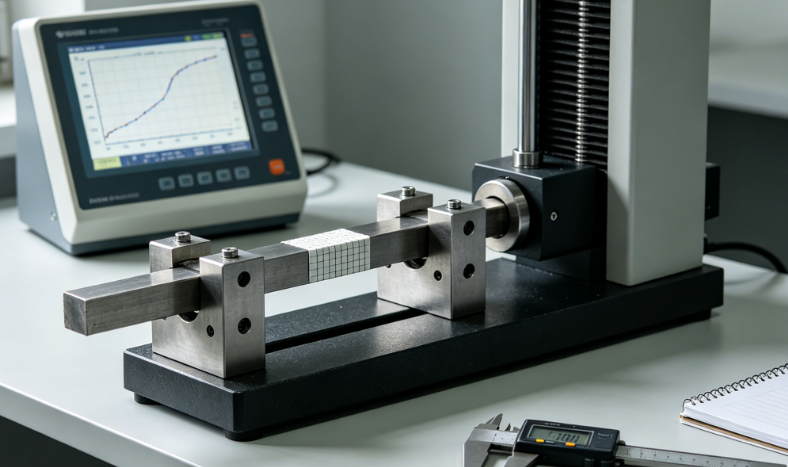
2.3 Orthotropic (Composite) Poisson’s Ratios
Major Poisson’s ratio (ν12) – from tensile test in principal material direction.
Minor Poisson’s ratio (ν21) – derived from reciprocity (ν21 = ν12 · E22 / E11) or measured directly.
Through‑thickness Poisson’s ratios – using specialised fixtures (by arrangement).
2.4 Dynamic (Ultrasonic) Poisson’s Ratio
Dynamic Poisson’s ratio – calculated from longitudinal wave velocity (VL) and shear wave velocity (VS) via ν = (VL² – 2VS²) / (2(VL² – VS²)). Non‑destructive, rapid, ideal for brittle materials (ceramics, glass, concrete).
2.5 Auxetic Materials (Negative Poisson’s Ratio)
We also characterise auxetic materials (ν < 0) – e.g., certain foams, metamaterials – using full‑field DIC to capture lateral expansion under tension.
3. Standard Test Methods We Apply
All tests are performed according to internationally recognised standards. Our laboratory is ISO/IEC 17025 accredited and equipped with biaxial extensometers, strain gauge bonding stations, DIC systems, and ultrasonic flaw detectors.
3.1 Metals & Isotropic Materials (ASTM, ISO)
ASTM E132 (Standard test method for Poisson’s ratio at room temperature).
ASTM E8/E8M (Tension testing – Poisson’s ratio measured with transverse extensometer).
ISO 6892‑1 (Metallic materials – tensile testing – optional Poisson’s ratio).
ASTM E111 (Young’s modulus, tangent modulus, chord modulus – often combined with Poisson’s ratio).
3.2 Plastics & Polymers
ASTM D638 (Tensile properties – Poisson’s ratio using transverse extensometer).
ISO 527‑1/-2 (Plastics – tensile properties – includes Poisson’s ratio option).
ASTM D882 (Thin film – biaxial strain measurement).
3.3 Composites (Orthotropic)
ASTM D3039 (Tensile properties – major Poisson’s ratio ν12).
ASTM D3518 (In‑plane shear response – complementary).
ISO 527‑4/-5 (Composites – Poisson’s ratio).
3.4 Ceramics, concrete & Brittle Materials (Dynamic Method)
ASTM E1876 (Dynamic Young’s modulus, shear modulus, and Poisson’s ratio by resonant frequency).
ASTM C1198 (Dynamic Young’s modulus – resonant beam).
ISO 12680‑1 (Refractories – dynamic modulus and Poisson’s ratio).
ASTM C215 (concrete – dynamic Poisson’s ratio).
3.5 Wood & Orthotropic Natural Materials
ASTM D143 (Clear wood – Poisson’s ratio in three directions).
ASTM D198 (Structural lumber – Poisson’s ratio).
3.6 Strain Gauge & DIC Standards
ASTM E1561 (Strain gauge selection and installation).
ASTM E2208 (Digital image correlation – guide).
4. Why Choose Our Third‑Party Poisson’s Ratio Testing Services?
As an independent laboratory, we provide unbiased, accurate, and legally defensible Poisson’s ratio data. Our advantages include:
ISO/IEC 17025 accreditation – CNAS/CMA certified, with regular proficiency testing (e.g., ASTM E132).
High‑precision transverse strain measurement – biaxial extensometers (±1 µm resolution) or bonded strain gauge rosettes (±1 µε). Digital image correlation (DIC) full‑field mapping for anisotropic or non‑uniform materials.
Multiple techniques – static (tensile/compression) and dynamic (ultrasonic, resonant) – we select the optimal method for your material.
Temperature control – environmental chambers from -196°C to +300°C (for polymers) or +800°C (metals with special extensometry).
Fast turnaround – typical Poisson’s ratio tests (3‑5 specimens) within 3‑5 business days.
Detailed reporting – includes axial vs. lateral strain curves, calculated ν in elastic region, raw data table, and statistical summary (mean, SD).
Confidentiality – full protection of your material specification and product design.
Consultative support – our engineers help select the appropriate strain measurement method, specimen geometry, and test speed to minimise bending artefacts.
Whether you need Poisson’s ratio for FEA input, material model calibration, quality control of isotropic metals, or characterisation of orthotropic composites, our Poisson’s ratio testing experts are ready to deliver precise, reliable results.
Get Started with Your Poisson’s Ratio Testing Project
Contact our team with your material type, specimen dimensions (or description), required test method (tensile, compressive, ultrasonic), temperature, and applicable standard (e.g., ASTM E132, ASTM D638). We will provide a detailed quotation, specimen preparation guidelines (including strain gauge bonding if required), and a testing schedule. Let us help you accurately determine lateral contraction behaviour for confident engineering simulations.
This article provides an overview of our Poisson’s ratio testing capabilities. For specific test methods, sample quantity, and pricing, please request a tailored service proposal.