Reasons for choosing our testing services
ZHONGXI Testing has obtained inspection qualification certifications from multiple countries and regions worldwide. We possess a senior testing team and advanced testing methods, providing independent, impartial, and professional third-party verification services for global carbon projects.

Internationally recognized authority
Certified by multiple international standards such as CNAS, VCS, and GS, with reports universally applicable worldwide.

Global service capability
Covering 140+ countries and regions, it supports on-site detection and remote verification in multiple languages.

Professional experimental methods
Adopt standard experimental methods to ensure accurate and reliable data.
shear strength Testing Services: Measuring Material Resistance to Sliding Forces
As an independent third-party testing service provider, we offer comprehensive shear strength testing for a wide range of materials – including metals, polymers, composites, adhesives, wood, and advanced structural materials. shear strength is the maximum stress a material can withstand when subjected to forces that cause one plane of the material to slide over an adjacent plane. It is a critical property for fasteners, adhesively bonded joints, composite laminates (interlaminar shear), beams, torsion shafts, and many engineering components. Our accredited laboratory follows international standards (ASTM, ISO, EN, GB/T) using universal testing machines with specialised shear fixtures, torsion testers, and punch tools. This article outlines our shear strength testing capabilities – including scope, key test items, and standard test methods – to help engineers, quality assurance teams, and researchers determine shear performance under various loading configurations.
1. Our Testing Scope for shear strength
We cover diverse material classes, shear test configurations, and environmental conditions:
By material type: Metals (steel, aluminium, copper, titanium, cast iron); Polymers (thermoplastics, thermosets, reinforced plastics); Composites (CFRP, GFRP – interlaminar, in‑plane); Adhesives & bonded joints (lap shear); Wood (parallel/perpendicular to grain); Ceramics; Fasteners (bolts, rivets, pins); Welded and brazed joints.
By shear test method: Direct shear (punch shear, double shear, single shear); Lap shear (adhesive bonds); Interlaminar shear (short beam shear – composites); Torsional shear (solid/hollow shafts); Shear of thin films and foils.
By test condition: Ambient temperature; Elevated temperature (up to 300°C for polymers, 600°C for metals); Low temperature (down to -196°C); Controlled humidity.
By specimen geometry: Round or rectangular bars; Lap shear coupons; Short beam (composites); Thin sheet strips; Custom‑machined shear test specimens.
By industry application: Aerospace (composite skin/stringer interface); Automotive (adhesive bonding, panel shear); Construction (steel connections, wood shear walls); Electronics (solder joint shear); Medical devices (implant fixation).
2. Key Test Items & Measurements We Perform
Our shear strength testing services measure the maximum shear stress a material can sustain before failure. Depending on the test method, we also report shear modulus and failure mode.
2.1 Direct shear strength (Punch / Double / Single Shear)
Ultimate shear strength (τult) – maximum shear stress calculated from failure load divided by shear area.
Punch shear strength – for sheet materials (metal, plastic, composite) using a punch and die.
Double shear (fasteners, pins, rivets) – specimen loaded across two parallel shear planes.
Single shear – specimen loaded across one shear plane (e.g., bolted joints).
Shear yield strength (offset method, for ductile materials).
2.2 Lap shear strength (Adhesive Bonds)
Single‑lap shear strength – maximum force divided by bonded area (MPa). Used for adhesives, sealants, and bonded joints.
Thick‑adherent shear (ASTM D5656) – for more accurate shear modulus and strength of adhesives.
Failure mode analysis – cohesive, adhesive, or substrate failure.
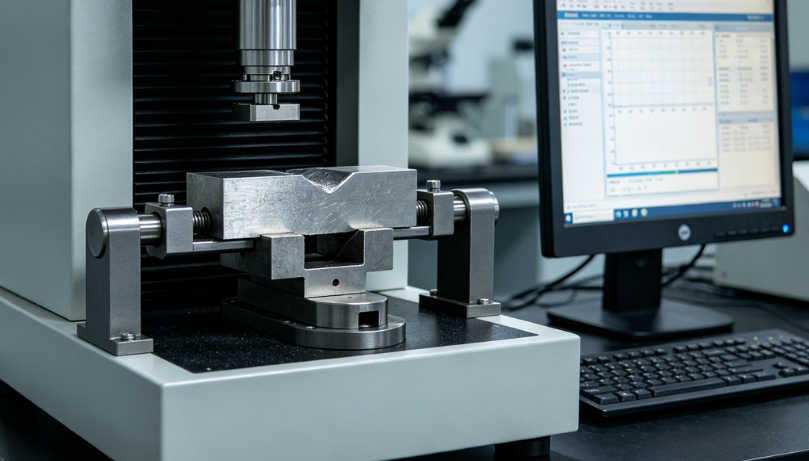
2.3 Interlaminar shear strength (Composites – Short Beam Shear)
Short beam shear (SBS) strength – for polymer matrix composites (CFRP, GFRP). Three‑point bending of a short beam with thickness‑to‑span ratio ~1:4. Maximum shear stress at neutral axis.
Interlaminar shear modulus – via ±45° tension test (ASTM D3518).
2.4 Torsional shear strength
shear strength in torsion – calculated from maximum torque and specimen geometry (solid/hollow shafts). Also yields shear modulus (G).
Angle of twist at failure.
2.5 shear strength of Wood (Parallel & Perpendicular to Grain)
Block shear (parallel to grain) – ASTM D143.
Shear perpendicular to grain (rolling shear).
We perform shear tests in environmental chambers (up to 600°C for metals, 300°C for polymers, down to -196°C).
3. Standard Test Methods We Apply
All tests are performed according to internationally recognised standards. Our laboratory is ISO/IEC 17025 accredited and equipped with universal testing machines, shear test fixtures (Iosipescu, double shear, punch tool), torsion testers, and temperature chambers.
3.1 Metals & Fasteners (Direct Shear)
ASTM B831 (Double shear testing of aluminum alloy sheet).
ASTM E290 (Bend and shear – not specifically shear strength but includes punch shear options).
ISO 8749 (Pins and wire – double shear test).
GB/T 6400 (Metals – shear test for bars and wires).
ASTM F606 (Fasteners – single and double shear).
3.2 Adhesives (Lap Shear)
ASTM D1002 (Apparent shear strength of single‑lap‑joint adhesively bonded metal specimens).
ISO 4587 (Adhesives – lap shear strength).
ASTM D5868 (Lap shear for fiber‑reinforced composites bonded with adhesive).
ASTM D5656 (Thick‑adherent lap shear).
3.3 Composites (Interlaminar & In‑Plane Shear)
ASTM D2344 (Short‑beam shear – interlaminar shear strength).
ISO 14130 (Composites – interlaminar shear strength – short beam).
ASTM D5379 (Iosipescu shear test – in‑plane shear).
ASTM D3518 (±45° tension test for in‑plane shear).
ASTM D7078 (V‑notch rail shear).
3.4 Plastics & Polymers (Shear)
ASTM D732 (shear strength of plastics by punch tool).
ISO 1922 (Rigid cellular plastics – shear strength).
3.5 Wood & Engineered Wood
ASTM D143 (Shear parallel to grain – block shear).
ASTM D2719 (shear strength of plywood in rolling shear).
3.6 Torsional Shear (Metals)
ASTM E143 (Shear modulus at room temperature).
ASTM F2232 (Torsion test for metallic materials – yield and ultimate shear strength).
4. Why Choose Our Third‑Party shear strength Testing Services?
As an independent laboratory, we provide unbiased, accurate, and regulation‑ready shear strength data. Our advantages include:
ISO/IEC 17025 accreditation – CNAS/CMA certified, with regular proficiency testing (e.g., ASTM D1002 lap shear, ASTM D2344 short beam).
Wide fixture library – Iosipescu, double shear, punch, lap shear jigs, short beam fixtures, torsion testers.
Temperature capability – from -196°C to +600°C (special furnaces).
Fast turnaround – typical shear tests (5‑10 specimens) within 3‑5 business days.
Detailed reporting – includes load‑displacement curves, calculated shear strength (MPa), failure mode description, and statistical summary.
Confidentiality – full protection of your material specifications and product designs.
Consultative support – our engineers help select the most appropriate shear test method based on material type and application (fastener, bond, composite laminate).
Whether you need to qualify an adhesive for automotive assembly, determine the interlaminar shear strength of a composite laminate, or verify the double shear strength of a fastener, our shear strength testing experts are ready to deliver precise, actionable results.
Get Started with Your shear strength Testing Project
Contact our team with your material type, specimen description, target standard (e.g., ASTM D1002, ASTM D2344), and any special conditions (temperature, environmental). We will provide a detailed quotation, specimen preparation guidelines, and a testing schedule. Let us help you accurately measure shear performance for safe and reliable designs.
This article provides an overview of our shear strength testing capabilities. For specific test methods, sample quantity, and pricing, please request a tailored service proposal.