Reasons for choosing our testing services
ZHONGXI Testing has obtained inspection qualification certifications from multiple countries and regions worldwide. We possess a senior testing team and advanced testing methods, providing independent, impartial, and professional third-party verification services for global carbon projects.

Internationally recognized authority
Certified by multiple international standards such as CNAS, VCS, and GS, with reports universally applicable worldwide.

Global service capability
Covering 140+ countries and regions, it supports on-site detection and remote verification in multiple languages.

Professional experimental methods
Adopt standard experimental methods to ensure accurate and reliable data.
izod impact toughness Testing Services: Measuring Material Resistance to Cantilever‑Beam Impact
As an independent third-party testing service provider, we offer comprehensive izod impact toughness testing for plastics, metals, composites, and other engineering materials. The Izod impact test measures the energy required to fracture a notched specimen mounted as a cantilever beam, struck by a pendulum. It is widely used for quality control, material comparison, and product development – especially for polymers and rigid plastics. Our accredited laboratory follows international standards (ASTM D256, ISO 180, ASTM E23 for metals) using precision pendulum impact testers with various pendulum capacities, temperature conditioning chambers, and automated notch cutting. This article outlines our Izod impact testing capabilities – including scope, key test items, and standard test methods – to help manufacturers, quality engineers, and researchers evaluate material toughness under high‑rate cantilever loading.
1. Our Testing Scope for izod impact toughness
We cover a wide range of materials, specimen types, and test conditions:
By material type: Plastics (thermoplastics, thermosets, reinforced plastics, rigid PVC, polycarbonate, ABS, nylon, acrylic, HDPE); Metals (steel, aluminium, copper – less common, per ASTM E23); Composites (short fibre reinforced, laminates); Wood and engineered wood; Ceramics (limited); Elastomers (not typical for Izod).
By specimen type (plastics – ASTM D256 / ISO 180): Notched Izod (most common) – specimen size typically 63.5 mm × 12.7 mm × (3‑12.7 mm) thickness with a machined V‑notch (45°, 0.25 mm root radius). Unnotched Izod; Reverse notch (for some specifications); Specimen orientation (parallel or perpendicular to flow direction for anisotropic materials).
By test parameter: Absorbed impact energy (J/m or kJ/m², or ft·lbf/in); Impact strength (energy per unit width or per unit area); Percent ductile/brittle failure; Notch sensitivity factor (ratio of notched to unnotched impact strength).
By test condition: Ambient (23°C); Low temperature (down to -40°C or lower – environmental chamber); Elevated temperature (up to +150°C for heat‑deflected specimens); Conditioned humidity (for moisture‑sensitive plastics).
By industry application: Automotive (interior trim, bumpers); Consumer electronics (housings, structural parts); Packaging (rigid containers); Medical devices (device housings); Construction (PVC pipes, profiles).
2. Key Test Items & Measurements We Perform
Our Izod impact testing services deliver quantitative toughness values and failure characterisation.
2.1 Absorbed Impact Energy (Notched Izod)
Impact energy (J) – energy absorbed to break the specimen, measured directly from pendulum drop.
Impact strength (J/m or kJ/m²) – energy normalised by specimen width (J/m) or cross‑sectional area (kJ/m²).
ft·lbf/in (US customary units) – for ASTM D256.
Reported as average of 5+ specimens (minimum 5 per ASTM).
2.2 Unnotched Izod Impact Strength
For materials that are very tough or ductile, unnotched specimens provide a measure of total fracture energy without a stress concentrator.
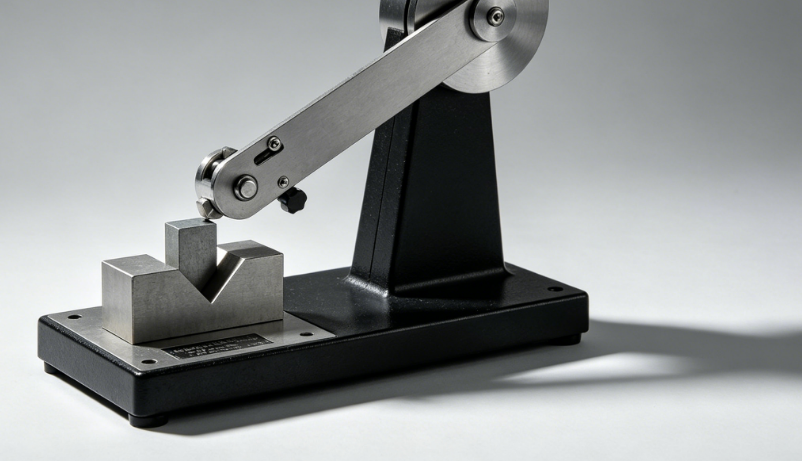
2.3 Failure Mode Classification
Complete break (C) – specimen separates into two or more pieces.
Hinge break (H) – specimen fails but remains attached by a thin hinge of material.
Partial break (P) – not complete separation; part of specimen still intact.
Non‑break (NB) – specimen did not fracture; pendulum swings through.
Percent ductile / brittle – estimation based on fracture appearance (for semi‑ductile materials).
2.4 Temperature Dependence of Izod Toughness
We perform Izod tests across a temperature range to identify ductile‑to‑brittle transition behaviour, especially for materials such as rigid PVC, polycarbonate blends, and certain composites.
2.5 Notch Sensitivity Assessment
Notch sensitivity ratio = (impact strength of notched specimen) / (impact strength of unnotched specimen). Lower ratio indicates higher notch sensitivity.
2.6 Instrumented Izod Impact (Optional)
Force‑time and energy‑time curves; crack initiation energy, crack propagation energy, and dynamic fracture characteristics (by arrangement).
3. Standard Test Methods We Apply
All tests are performed according to internationally recognised standards. Our laboratory is ISO/IEC 17025 accredited and equipped with digital Izod pendulum impact testers (0.5‑25 J capacity), automated notch cutters (to ASTM/ISO notch geometry), and temperature conditioning chambers (-70°C to +150°C).
3.1 Plastics & Polymers (Primary Standards)
ASTM D256 (Standard test methods for determining the Izod pendulum impact resistance of plastics). – Most widely used method for rigid plastics. Specifies specimen size, notch geometry, pendulum energy, and reporting (J/m).
ISO 180 (Plastics – Determination of Izod impact strength). – Specifies energy per unit area (kJ/m²), different specimen dimensions. Correlations between ASTM and ISO are not direct.
GB/T 1843 (China – Plastics – Determination of Izod impact strength). – Similar to ISO 180.
3.2 Metals (Less Common, but Offered per ASTM E23)
ASTM E23 (Standard test methods for notched bar impact testing of metallic materials). – Includes Izod option (primarily Charpy is more common, but Izod is permitted).
ISO 148‑1 (Charpy – not Izod). – For metals, Charpy is preferred; we perform Izod on metals only when customer specifies.
3.3 Composites & Other Materials
ASTM D4812 (Unnotched cantilever beam impact resistance of plastics – similar to Izod).
ISO 7765 (Plastics film – impact resistance – not Izod, but we can adapt).
3.4 Specimen Conditioning & Notching Standards
ASTM D618 (Conditioning of plastics for testing) – temperature and humidity preconditioning.
ISO 291 (Standard atmospheres for conditioning and testing).
Notch machining – per ASTM D256 (45° ± 1°, 0.25 ± 0.05 mm root radius).
4. Why Choose Our Third‑Party izod impact toughness Testing Services?
As an independent laboratory, we provide unbiased, accurate, and legally defensible Izod impact data. Our advantages include:
ISO/IEC 17025 accreditation – CNAS/CMA certified, with regular proficiency testing (e.g., ASTM D256 round robins).
High‑precision notching – automated notch cutters ensure consistent notch geometry (±0.02 mm root radius).
Wide pendulum range – 0.5 J (very brittle materials) to 25 J (tough engineering plastics).
Temperature conditioning – from -70°C to +150°C with stabilisation chambers.
Fast turnaround – typical Izod test series (5‑10 specimens) within 2‑3 business days.
Detailed reporting – includes individual impact energies, average, standard deviation, failure mode classification, notch geometry verification, and pass/fail against specification.
Confidentiality – full protection of your material formulation and product designs.
Consultative support – our engineers help select notched vs. unnotched, conditioning parameters, and specimen orientation (for anisotropic materials).
Whether you need to qualify a new plastic compound for automotive interior parts, verify batch consistency of injection‑moulded components, or compare material toughness for product redesign, our Izod impact testing experts are ready to deliver precise, actionable results.
Get Started with Your izod impact toughness Testing Project
Contact our team with your material type, available specimen dimensions (or material thickness), target standard (ASTM D256, ISO 180, etc.), and any special requirements (temperature, conditioning, notch type). We will provide a detailed quotation, specimen preparation guidelines (including notching directions), and a testing schedule. Let us help you accurately measure the impact resistance of your materials under cantilever‑beam loading.
This article provides an overview of our izod impact toughness testing capabilities. For specific test methods, sample quantity, and pricing, please request a tailored service proposal.