Reasons for choosing our testing services
ZHONGXI Testing has obtained inspection qualification certifications from multiple countries and regions worldwide. We possess a senior testing team and advanced testing methods, providing independent, impartial, and professional third-party verification services for global carbon projects.
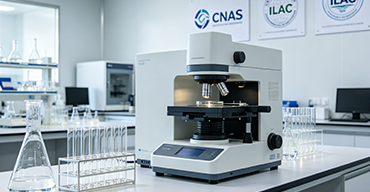
Internationally recognized authority
Certified by multiple international standards such as CNAS, VCS, and GS, with reports universally applicable worldwide.

Global service capability
Covering 140+ countries and regions, it supports on-site detection and remote verification in multiple languages.

Professional experimental methods
Adopt standard experimental methods to ensure accurate and reliable data.
leeb hardness Testing Services: Portable, Rapid & Versatile Hardness Measurement for Large Components
As an independent third-party testing service provider, we offer comprehensive leeb hardness testing for metallic materials, particularly for large, heavy, or installed components that cannot be easily transported to a laboratory. The leeb hardness test (also known as the rebound hardness test) was developed by Swiss engineer Dietmar Leeb in 1978. It measures the ratio of the rebound velocity to the impact velocity of a spring‑loaded impact body (a hardmetal tip) that strikes the test surface. The leeb hardness value (HL) is calculated as: HL = 1000 × (Vrebound / Vimpact). This dynamic test is fast, portable, and minimally invasive, making it the ideal choice for field testing of large castings, forgings, steel structures, rolls, gears, rails, pipelines, and heavy machinery. Our accredited laboratory follows international standards (ISO 16859, ASTM A956, GB/T 17394) to deliver accurate, reproducible, and legally defensible leeb hardness data, including conversion to other hardness scales (HRC, HRB, HB, HV). This article outlines our leeb hardness testing capabilities – including scope, key test items, test procedure, conversion to static scales, and standard methods – to help manufacturers, maintenance engineers, quality assurance teams, and field inspectors verify material hardness in situ.
1. What Is leeb hardness Testing?
The leeb hardness test is a dynamic rebound method. A defined impact body (tungsten carbide ball or diamond tip) is accelerated by a spring force against the test surface. The impact velocity (Vi) and the rebound velocity (Vr) are measured electronically via an inductive coil or permanent magnet. The leeb hardness (HL) is calculated as: HL = 1000 × (Vr / Vi). Softer materials absorb more energy, resulting in a lower rebound velocity and a lower HL value. Harder materials produce a higher rebound velocity and a higher HL value.
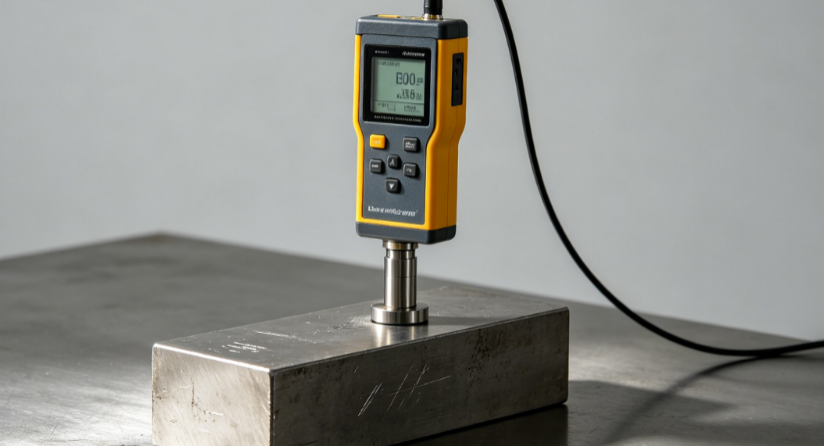
The test is typically performed using a portable device (a “leeb hardness tester” or “Equotip”), which consists of a hand‑held probe with a spring‑loaded impact body, an electronic module for measurement and calculation, and a display. Because the test is non‑destructive (leaving only a tiny impact mark, typically less than 1 mm in diameter), it is suitable for finished components and field testing. The Leeb method is well‑suited for large, heavy, or assembled parts that cannot be placed in a conventional bench hardness tester.
leeb hardness values are expressed as HL, optionally followed by the impact direction symbol (e.g., HLD for downward vertical). Typical leeb hardness values range from 200 HL for soft steel to over 900 HL for very hard steel.
2. Our Testing Scope for leeb hardness
We cover a wide range of metallic materials, component sizes, and field/laboratory conditions:
By material type: Carbon steel (low, medium, high), alloy steel, stainless steel (austenitic, martensitic), tool steel, cast steel, cast iron (gray, ductile, malleable), aluminum alloys, copper alloys, brass, bronze, titanium alloys, nickel alloys, and other engineering metals with a hardness range of 150‑900 HL (approx. 20‑68 HRC, 75‑650 HB).
By component / product form: Large castings (engine blocks, pump housings, gearbox casings); Forgings (shafts, connecting rods, turbine discs); Steel structures (bridges, pressure vessels, cranes); Heavy machinery parts (rolls, gears, bearings, dies); Rails and wheels; Pipelines and valves; Molds and dies; Weld heat‑affected zones; On‑site inspection of installed components (e.g., power plant turbines, mining equipment, offshore platforms).
By test condition / environment: Laboratory testing (controlled temperature, vibration‑free); On‑site testing (field, workshop, outdoor) – with proper surface preparation and temperature correction; Elevated or low temperature (by arrangement).
By impact device type (probe): Type D (standard – most common) – for general applications, mass 5.5 g, hardness range 200‑900 HL, suitable for most steel and cast iron parts; Type DC – for limited access (small bores, gear teeth); Type DL – for narrow slots, recesses, and curved surfaces; Type C – for thin sections, surface layers (low impact energy, low penetration depth); Type G – for heavy and coarse‑grained materials (e.g., large castings, high mass, higher impact energy); Type S – for special applications; Type E – for high‑hardness materials (diamond tip).
3. International Standards & Compliance
All leeb hardness tests are performed in strict accordance with the following international standards:
ISO 16859 (Metallic materials – leeb hardness test) – the international standard covering test method, verification, and calibration. Part 1: Test method; Part 2: Verification and calibration of testers; Part 3: Calibration of reference blocks.
ASTM A956 (Standard test method for leeb hardness testing of steel products) – the primary US standard, covering test procedure, conversion to other hardness scales, and reporting requirements for steel and other metals.
GB/T 17394 (Metallic materials – leeb hardness test) – Chinese national standard, aligned with ISO 16859.
DIN 50156 (leeb hardness testing of metallic materials) – German standard.
ISO 18265 (Metallic materials – Conversion of hardness values) – provides conversion tables from leeb hardness to static scales (HRC, HRB, HB, HV).
4. Key Test Items & Measurement Parameters
Our leeb hardness testing services are tailored to the specific requirements of on‑site or laboratory applications. Key parameters include:
leeb hardness value (HL) – The raw output from the impact device, calculated from the velocity ratio. For example, 650 HLD indicates a leeb hardness of 650 measured with a Type D probe with impact direction downward (vertical). This value is dimensionless and is used for direct comparison or conversion.
Impact direction (angle) – The hardness value is affected by gravity, which influences the rebound velocity. Most standards require reporting the impact direction (e.g., downward vertical, upward vertical, horizontal, 45° upward, 45° downward). Modern Leeb testers automatically compensate for direction using internal algorithms, but the direction should still be recorded. Typical compensation is accurate to within ±2‑3% for angles between 0° and 90°.
Conversion to static hardness scales – Because leeb hardness is a dynamic rebound method, it does not directly correspond to static indentation scales (Brinell, Rockwell, Vickers). However, established conversion curves (per ISO 18265, ASTM A956) allow reliable conversion when the material type and approximate hardness range are known. The most common conversions are: HL → HRC, HL → HB, HL → HV, HL → HRB. For example, 550 HL may correspond to approximately 50 HRC for hardened steel, or 500 HB for cast iron. We always state the conversion used and its limitations.
Surface preparation – For accurate results, the test surface must be clean, smooth, and free from scale, rust, paint, grease, or rough machining marks. A portable grinder, file, or abrasive disc is used to prepare a flat, bright area of at least 25 mm diameter. The surface roughness (Ra) should be ≤ 1.6 μm. For very rough castings, the required surface area may be larger. The specimen thickness must be sufficient to avoid structural “anvil” effects – typically at least 5‑10 mm for Type D, 3 mm for Type C, and 15 mm for Type G.
Minimum specimen mass / coupling – The test piece must be rigidly supported to prevent movement or rebound energy loss. Minimum mass requirements per ASTM A956: For Type D, at least 5 kg for an unsupported specimen; for lighter specimens, they must be rigidly coupled (e.g., clamped) to a heavy base or placed on a solid anvil. For thin or small parts, the test may be invalid if the part flexes or moves during impact.
Number of impacts (indentations) – For a single test point, a series of impacts are performed (typically 3‑5) and the average (or median) is reported. The spacing between impacts must be at least 2‑3 mm to avoid work‑hardening interference. For quality control, 5 impacts per test location are recommended.
Temperature correction – leeb hardness is slightly temperature‑sensitive. For tests performed outside the range of 10‑35°C, a correction factor may be applied if specified. We record the ambient temperature and note any deviation.
5. Test Procedure & Specifications
Our laboratory and field testing strictly follow ISO 16859 and ASTM A956. The key steps and specifications are summarised below:
Calibration verification – Before each test series, the leeb hardness tester is verified using a certified reference hardness block (calibrated according to ISO 16859‑3). At least 5 impacts are made on the block; the average HL must be within the tolerance specified (typically ±2% of the certified value). The tester’s impact direction compensation is checked. Annual calibration by an accredited laboratory is required.
Surface preparation – For field testing, we use a portable grinder or file to remove any coating, scale, or rough material, exposing a clean, flat area of at least 25‑30 mm diameter. The surface is then smoothed using fine abrasive paper (e.g., 400‑600 grit) to achieve Ra ≤ 1.6 μm. For laboratory testing, the specimen is prepared similarly. The prepared area is cleaned with a dry cloth or solvent to remove any residue.
Support and coupling – The test piece is placed on a rigid, vibration‑free support. If the specimen is light (< 5 kg for Type D), it must be clamped or placed on a heavy anvil to ensure no movement during impact. For large components (e.g., a turbine casing), no special support is needed as the mass itself is sufficient.
Impact procedure – The probe is placed perpendicular to the test surface, ensuring full contact of the support ring. The impact body is released (by pressing a trigger or sliding the release mechanism). The impact and rebound velocities are measured automatically, and the HL value is displayed. For each test location, 3‑5 impacts are performed, with the probe repositioned slightly between impacts (minimum 2‑3 mm spacing). The average or median value is recorded.
Data recording – For each test location, we record: HL value (and impact direction), number of impacts, standard deviation, converted hardness value (if requested), temperature, and any unusual observations (e.g., surface irregularities, movement of part).
6. Typical Applications & Suitable Materials
leeb hardness testing is ideally suited for the following applications where traditional bench testers cannot be used:
Large steel castings and forgings – Turbine housings, pump casings, valve bodies, large gear blanks, ship engine components, pressure vessel shells. The component is too large and heavy to transport; field testing is performed with portable Leeb testers.
Steel structures – Bridge girders, crane runways, offshore platforms, wind turbine towers, heavy machinery frames. leeb hardness testing can assess material condition in situ without cutting samples.
Railways and wheel sets – Rail hardness is critical for wear resistance; Leeb testing along the rail head and web is standard maintenance practice. Similarly, locomotive and wagon wheels are tested for hardness uniformity.
Pipelines and pressure vessels – In‑service hardness testing to detect softening due to overheating, hydrogen damage, or creep. Leeb testers can access curved surfaces and tight spaces.
Welded joints – Hardness mapping of weld metal, heat‑affected zone (HAZ), and base metal to verify welding procedures and detect embrittlement or softening.
Heavy machinery rolls and dies – Forged rolls in steel mills, large dies in forging presses – Leeb testing monitors wear and heat‑treatment integrity.
Molds and tooling – Large injection moulds, die‑cast dies, and stamping dies – on‑site hardness checks without disassembly.
Field quality control of heat‑treated components – When induction‑hardened shafts or flame‑hardened rails are installed, Leeb testing verifies that the specified hardness has been achieved.
7. Advantages & Limitations of leeb hardness Testing
Understanding the strengths and limitations is essential for appropriate use and interpretation.
Advantages: The tester is highly portable (hand‑held, battery‑operated) and can be used in any orientation (vertical, horizontal, overhead). The test is fast (seconds per impact) and requires minimal surface preparation. It is essentially non‑destructive – the impact mark is tiny (< 1 mm) and often acceptable on finished components. The method can access curved, restricted, or hard‑to‑reach surfaces using appropriate impact devices (DL, DC). The results are repeatable when proper procedures are followed. leeb hardness testers can store hundreds of readings and directly convert to HRC, HB, HV, etc. using built‑in conversion algorithms. Ideal for material sorting, incoming inspection of large parts, and condition monitoring.
Limitations: The test is sensitive to surface roughness, curvature, mass, and rigidity. Light or thin parts may give erroneously low readings (loss of energy). The conversion from Leeb (dynamic) to static hardness (Brinell, Rockwell) has an uncertainty of ±3‑5% depending on material and hardness range; it should not be used for acceptance if high precision is required. For very soft materials (< 200 HL), Leeb accuracy decreases. The test cannot be used on coatings or thin surface layers because the impact body penetrates beyond the layer. Calibration must be verified before each use using reference blocks of known hardness. The equipment is more expensive than simple durometers and requires periodic recalibration.
8. Reporting & Result Presentation
Our test reports are detailed, transparent, and compliant with ISO/IEC 17025 and ISO 16859/ASTM A956. Each report includes:
Specimen identification – Material type, component description, location, and test point identification (e.g., “Crankshaft journal #3”).
Test conditions – Standard referenced (ISO 16859, ASTM A956, GB/T 17394), impact device type (D, DC, C, G, etc.), impact direction (vertical, horizontal, etc.), number of impacts per test point, temperature, surface preparation method, any special supports.
Individual readings – For each test point: raw HL values (list of 3‑5 readings), mean HL, standard deviation, and any remarks (e.g., “first impact discarded due to surface irregularity”).
Converted hardness values – HRC, HB, HV, or HRB values as requested, with the conversion method and its estimated uncertainty noted (e.g., “Conversion per ASTM A956 – Table 4, uncertainty ±4 HRC”).
Calibration record – Leeb tester model and serial number, date of last calibration, reference block identification and certified value, verification results (mean HL vs. block).
Compliance statement – Pass/fail determination against customer specification or standard requirement (e.g., “Average hardness of 520 HL corresponds to 48‑52 HRC, which meets the requirement of 45‑50 HRC”).
Remarks – Any deviations from standard (e.g., limited space, lightweight part clamped, curved surface).
9. Why Choose Our Third‑Party leeb hardness Testing Services?
As an independent laboratory with mobile capabilities, we provide unbiased, accurate, and legally defensible field hardness data. Our strengths include:
ISO/IEC 17025 accreditation – Our leeb hardness testing (laboratory and field) is CNAS and CMA accredited, with regular proficiency testing (e.g., ASTM A956 round robins).
Comprehensive impact device set – We carry a full suite of Leeb probes (D, DC, DL, C, G) to handle virtually any geometry, from thin sheet to massive castings.
On‑site capability – Our technicians travel to your facility or job site, perform surface preparation, and deliver results on‑site. We also support testing at remote locations (e.g., offshore platforms, mines, power plants).
Fast turnaround – For routine field testing, we provide preliminary results immediately, and a certified report within 2‑3 business days.
Traceable conversion – We apply the most current conversion tables from ASTM A956 and ISO 18265, ensuring that your Leeb readings are reliably translated to HRC, HB, HV, or HRB for direct comparison to specifications.
Detailed reporting – Reports include raw data, statistical summaries, calibration records, and clear pass/fail conclusions.
Confidentiality – Full protection of your component specifications and test results.
Consultative support – Our engineers help select the correct impact device, interpret conversion uncertainties, and advise on surface preparation and support requirements.
Whether you need to verify the hardness of a large steel casting in a foundry, inspect a heat‑treated roll in a rolling mill, assess a welded joint on a pressure vessel, or perform on‑site hardness mapping of a turbine shaft, our leeb hardness testing experts are ready to deliver reliable, actionable results.
Get Started with Your leeb hardness Testing Project
Contact our team with your material type, component dimensions, estimated hardness range, required static scale conversion (HRC, HB, etc.), test location (laboratory or on‑site), and applicable standard (ISO 16859, ASTM A956, GB/T 17394). We will provide a detailed quotation, sample site requirements, and a testing schedule. Let us help you obtain accurate, portable hardness measurements for your largest and most challenging components.
This article provides an overview of our leeb hardness testing capabilities. For specific test methods, sample quantity, and pricing, please request a tailored service proposal.