Reasons for choosing our testing services
ZHONGXI Testing has obtained inspection qualification certifications from multiple countries and regions worldwide. We possess a senior testing team and advanced testing methods, providing independent, impartial, and professional third-party verification services for global carbon projects.

Internationally recognized authority
Certified by multiple international standards such as CNAS, VCS, and GS, with reports universally applicable worldwide.

Global service capability
Covering 140+ countries and regions, it supports on-site detection and remote verification in multiple languages.

Professional experimental methods
Adopt standard experimental methods to ensure accurate and reliable data.
scratch hardness Testing Services: Evaluating Material Resistance to Surface Damage
As an independent third-party testing service provider, we offer comprehensive scratch hardness testing for a wide range of materials – including paints, coatings, varnishes, plastics, glass, ceramics, metals, thin films, and decorative surfaces. scratch hardness is a measure of a material‘s ability to resist plastic deformation and fracture caused by a stylus or indenter dragged across its surface under a controlled load. Unlike indentation hardness (Brinell, Rockwell, Vickers, Knoop, etc.), which measures resistance to static indentation, scratch hardness evaluates dynamic surface damage, simulating real‑world conditions such as abrasion, handling, cleaning, and mechanical contact. This property is critical for products used in high‑traffic or visually demanding applications where surface appearance and integrity are paramount – automotive clearcoats, consumer electronics, optical lenses, floor finishes, packaging films, and anti‑scratch protective layers. Our accredited laboratory follows international standards (ASTM D7027, ISO 1518, ISO 20502, ASTM G171, ISO 4586, EN 15771, GB/T 9279, GB/T 6739) to deliver accurate, reproducible, and legally defensible scratch hardness data. This article outlines our scratch hardness testing capabilities – including scope, key test items, and standard test methods – to help manufacturers, coating suppliers, quality assurance teams, and R&D laboratories validate surface durability and product performance.
1. What Is scratch hardness Testing?
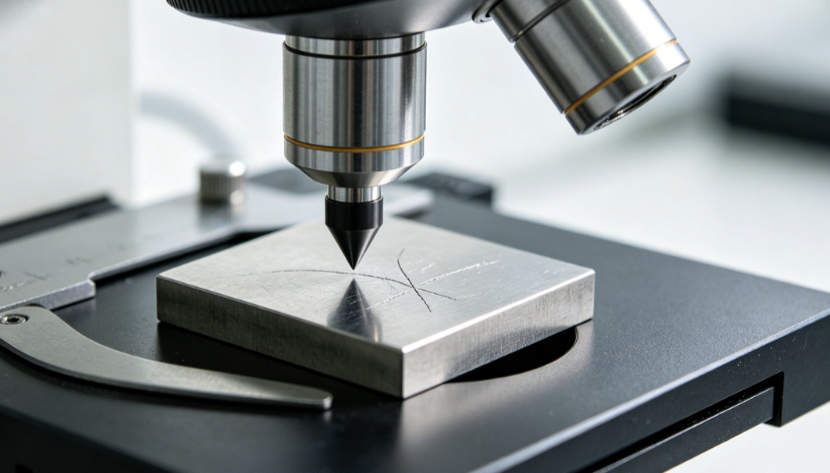
scratch hardness testing is a surface characterisation method that quantifies a material‘s resistance to scratching by a diamond, steel, or tungsten carbide tip under controlled conditions. The test can be performed in two primary modes: constant load (where a fixed force is applied and the resulting scratch width or depth is measured) and progressive load (where the load is linearly increased along the scratch path, and the critical load for coating delamination or substrate exposure is determined). The most common parameters measured include the critical load (Lc) at which a coating fails, the scratch hardness number (from the scratch width under a known load), the coefficient of friction during scratching, and the residual scratch depth (recovery after viscoelastic materials). scratch hardness is highly sensitive to surface finish, coating adhesion, material composition, hardness, modulus, and environmental conditions. The method is essential for evaluating protective coatings, anti‑scratch films, automotive clearcoats, glass, ceramics, and scratch‑resistant plastics.
2. Our Testing Scope for scratch hardness
We cover a broad range of materials, test configurations, and industrial applications:
By material / product type: Paints and coatings (automotive clearcoats, industrial coatings, powder coatings, coil coatings, varnishes, lacquers); Plastics (polycarbonate, acrylic, ABS, polypropylene, polyethylene, polyurethane, PET, polyamide); Hard coatings (PVD/CVD coatings – TiN, TiAlN, CrN, DLC, anti‑reflective coatings); Glass and ceramics (architectural glass, automotive glass, optical glass, glazed tiles, ceramic enamels); Metals (anodised aluminium, electroplated chromium, electroless nickel, polished stainless steel); Optical films (anti‑fog, anti‑glare, hardcoats on lenses, displays); Flooring and decorative surfaces (laminate flooring, wood coatings, melamine surfaces); Automotive interior/exterior trim (painted parts, chrome finishes, soft‑touch coatings); Packaging films (metallised films, barrier coatings).
By test method / configuration: Constant load scratching (fixed normal force, measurement of scratch width or depth) – for comparative ranking of scratch resistance; Progressive load scratching (linearly increasing force, determination of critical loads Lc1, Lc2, Lc3) – for coating adhesion and cohesive failure analysis; Rockwell scale (pencil hardness – ASTM D3363, ISO 15184) – using pencils of increasing hardness (9B to 9H) to determine the hardest pencil that does not permanently mark the surface; Mohs hardness (for minerals and glass) – relative scratch hardness using reference minerals; Micro‑scratch (low loads, μm‑scale scratches) – for thin coatings, thin films, and optical surfaces; Instrumented scratch testing with simultaneous measurement of acoustic emission (AE), coefficient of friction (COF), and penetration depth – for detailed failure analysis.
By indenter geometry: Diamond conical indenter (Rockwell C, 120° cone, 200 μm radius tip – standard for progressive load scratch testing); Steel ball indenter (e.g., 1 mm diameter for constant load testing); Tungsten carbide conical indenter; Pencil hardness (various hardness grades, 9B‑9H).
By environmental condition: Ambient (23 ± 2°C, 50 ± 5% RH); high temperature (up to 200°C) or low temperature (down to -40°C) – for polymers and elastomers; Wet / lubricated scratching (simulating cleaning or water exposure).
By industry standard / application: Paints & coatings – ISO 1518 (constant load), ISO 15184 (pencil hardness), ASTM D7027 (progressive load micro‑scratch), GB/T 9279 (scratch resistance of coating films), GB/T 6739 (pencil hardness of coatings); Plastics – ASTM D7027, ISO 4586‑2 (scratch resistance of high‑pressure decorative laminates), EN 15771 (scratch hardness of glass); Glass & ceramics – EN 15771, ISO 20502 (scratch testing of ceramic coatings with conical indenter).
3. Key Test Items & Measurement Parameters
Our scratch hardness testing services produce detailed quantitative and qualitative data for surface damage analysis.
3.1 Critical Load (Lc) – Progressive Load Scratch Test
Lc1 (first critical load) – the load at which the first crack or cohesive failure occurs within the coating, detected by acoustic emission, a sudden change in friction coefficient, or microscopic observation. Indicates the onset of coating damage under increasing stress.
Lc2 – the load at which significant spallation or delamination begins, often associated with adhesive failure at the coating‑substrate interface.
Lc3 – the load at which complete removal of the coating and exposure of the substrate occurs.
Relevance: Critical loads are essential for comparing coating adhesion and scratch resistance; higher Lc values indicate better performance. Results are reported as the average of at least 5 scratch tests.
3.2 Constant Load scratch hardness (Pencil / Mohs / Instrumented)
Pencil hardness – a series of pencils with increasing hardness (9B (softest) to 9H (hardest)) is drawn across the surface at a constant angle (45°) and force (7.5 N or as specified). The hardness is the hardest pencil that does not permanently mark (scratch or gouge) the surface. Example: “2H” means a 2H pencil does not damage the surface, but an H or harder pencil may. Commonly used for paints, coatings, plastics, and wood finishes (ASTM D3363, ISO 15184).
Mohs hardness – a relative scale from 1 (talc) to 10 (diamond) where each mineral can scratch those of lower number. A set of reference minerals is used to scratch the test surface; the Mohs hardness is the highest reference mineral that does not scratch the surface. Used for minerals, glasses, and ceramics.
Instrumented constant load scratch – a diamond or steel indenter of specified geometry (e.g., Rockwell C cone, spherical tip) is drawn across the surface under a fixed normal force. The residual scratch width or depth is measured optically or by profilometry. A scratch hardness number (Hs) can be calculated from the load and scratch width (e.g., Hs = 2.84 × load / (π × (scratch width)²) for certain geometries).
3.3 Scratch Morphology & Failure Mode Analysis
Optical microscopy / SEM – examination of the scratch track to identify damage mechanisms: plastic grooving (ductile ploughing), microcracking, chipping, flaking, delamination, or fracture. The failure mode determines whether the material fails cohesively (within the coating) or adhesively (at the interface).
Acoustic emission (AE) monitoring – during progressive load scratching, a sensitive microphone detects elastic waves released by cracking or delamination, pinpointing critical loads with high accuracy.
coefficient of friction (COF) – measured continuously during the scratch; a sudden change in COF often correlates with coating breakthrough or delamination.
3.4 Residual Scratch Depth & Recovery
Scratch depth (penetration depth) – measured in situ during the scratch using a depth‑sensing system, or after scratching using a surface profilometer (e.g., white‑light interferometry, stylus profilometer). For viscoelastic materials (polymers), the depth may partially recover after the indenter passes; the permanent (residual) depth is measured after a recovery period. Lower residual depth indicates better scratch resistance.
Elastic recovery (% recovery) – computed as (maximum depth – residual depth) / maximum depth × 100%. High recovery indicates a material that springs back after scratching (typical for elastomers).
3.5 Scratch Resistance Ranking & Comparative Data
For quality control and material development, we can perform scratch tests on multiple samples (different formulations, processing conditions, or suppliers) under identical conditions and provide a comparative ranking (e.g., “Sample A has a critical load Lc2 = 12 N, which is 30% higher than Sample B (9.2 N), indicating superior coating adhesion”).
4. Standard Test Methods We Apply
All tests are performed according to internationally recognised standards. Our laboratory is ISO/IEC 17025 accredited and equipped with instrumented scratch testers, pencil hardness kits, Mohs hardness kits, and profilometers.
4.1 Progressive & Constant Load Scratch Standards
ASTM D7027 (Standard test method for evaluation of scratch resistance of polymeric coatings and plastics using an instrumented scratch machine). – Uses a conical diamond indenter (Rockwell C, 200 μm tip radius) with progressive or constant load; measures critical loads, coefficient of friction, and penetration depth.
ISO 1518 (Paints and varnishes – Scratch test). – Two parts: Part 1 (constant load, spherical tip), Part 2 (variable load, conical tip).
ISO 20502 (Fine ceramics – Determination of adhesion of ceramic coatings by scratch testing). – For hard coatings (PVD, CVD, thermal spray) using a Rockwell C diamond indenter; determines critical loads Lc1, Lc2.
ASTM G171 (Standard test method for scratch hardness of materials using a diamond stylus). – For bulk materials, determines scratch hardness number from residual scratch width.
EN 15771 (Glass – scratch hardness test for glass surfaces). – Constant load method for flat glass, using a diamond indenter.
4.2 Pencil Hardness Standards
ASTM D3363 (Standard test method for film hardness by pencil test). – For paints, coatings, and plastics; uses pencils of increasing hardness (9B‑9H) to determine the hardest pencil that does not permanently mark the surface.
ISO 15184 (Paints and varnishes – Determination of film hardness by pencil test). – Equivalent to ASTM D3363.
GB/T 6739 (Determination of film hardness by pencil test). – Chinese national standard.
4.3 Mohs Hardness Standards (for minerals, glass, ceramics)
ASTM C1895 (Standard test method for determination of Mohs hardness of glass). – Uses reference mineral picks to scratch the glass surface.
ISO 22394 (Fine ceramics – Determination of scratch hardness by Mohs’ scale).
4.4 Plastics & Decorative Laminates Standards
ISO 4586‑2 (High‑pressure decorative laminates – Determination of resistance to scratch). – Constant load scratch with a hardened steel ball.
ASTM D2197 (Scratch resistance of organic coatings). – Constant load scratch with a stylus.
GB/T 9279 (Paints and varnishes – Scratch test). – Chinese standard for coating scratch resistance.
5. Why Choose Our Third‑Party scratch hardness Testing Services?
As an independent laboratory, we provide unbiased, accurate, and legally defensible scratch hardness data. Our strengths include:
ISO/IEC 17025 accreditation – Our scratch hardness testing (ASTM D7027, ISO 1518, ASTM D3363, ISO 20502) is CNAS and CMA accredited, with regular participation in proficiency testing (e.g., paint and coating scratch round robins).
Instrumented micro‑scratch tester – We operate a fully automated scratch tester (Revetest or equivalent) with load range from 0.01 N to 200 N, capable of progressive and constant load scratching; equipped with acoustic emission sensor, friction force sensor, and real‑time depth measurement (resolution 0.1 μm).
Multiple indenter geometries – Diamond conical (Rockwell C, 200 μm tip radius), steel ball (1 mm, 2 mm), tungsten carbide conical, and custom tips.
Pencil hardness testing – We use calibrated pencil sets (9B to 9H) conforming to ASTM D3363 and ISO 15184, with automated pencil holder to ensure consistent angle (45°) and force (7.5 N).
Mohs hardness testing – Reference mineral set (1‑10) for glass, ceramics, and mineral‑based materials.
Post‑scratch analysis – Optical microscopy and white‑light interferometry (profilometry) to measure residual scratch depth, width, and volume; SEM/EDS for failure mode identification.
Fast turnaround – Routine pencil hardness tests (5‑10 specimens) completed within 1‑2 business days; instrumented progressive load scratch tests (5‑10 scratches) in 3‑5 business days.
Detailed reporting – Reports include load‑displacement curves, friction coefficient graphs, critical loads (Lc1, Lc2, Lc3), optical/SEM images of scratch tracks, statistical summaries, and clear pass/fail conclusions against customer specifications.
Confidentiality – Full protection of your material formulation, coating design, and product specifications.
Consultative support – Our coating and materials engineers assist with selecting the appropriate indenter, load range, and test method; interpret failure modes (chipping, delamination, ploughing); and advise on coating or polymer modifications to improve scratch resistance.
Whether you need to qualify a new automotive clearcoat for scratch resistance, evaluate the anti‑scratch performance of a hard coating on a display cover glass, compare pencil hardness of different paint formulations, or determine the critical load of a PVD coating for tooling applications, our scratch hardness testing experts are ready to deliver reliable, actionable results.
Get Started with Your scratch hardness Testing Project
Contact our team with your material type (coating, plastic, glass, metal, ceramic), expected scratch performance, applicable standard (ASTM D7027, ISO 1518, ASTM D3363, ISO 20502, etc.), and any special requirements (temperature, humidity, multiple loads, failure mode analysis). We will provide a detailed quotation, sample submission guidelines (surface finish, minimum dimensions, substrate type), and a testing schedule. Let us help you ensure that your surfaces are durable, scratch‑resistant, and visually appealing under real‑world use.
This article provides an overview of our scratch hardness testing capabilities. For specific test methods, sample quantity, and pricing, please request a tailored service proposal.