Reasons for choosing our testing services
ZHONGXI Testing has obtained inspection qualification certifications from multiple countries and regions worldwide. We possess a senior testing team and advanced testing methods, providing independent, impartial, and professional third-party verification services for global carbon projects.

Internationally recognized authority
Certified by multiple international standards such as CNAS, VCS, and GS, with reports universally applicable worldwide.

Global service capability
Covering 140+ countries and regions, it supports on-site detection and remote verification in multiple languages.

Professional experimental methods
Adopt standard experimental methods to ensure accurate and reliable data.
akron abrasion Resistance Testing Services: Quantifying Wear Performance for Rubber & Elastomeric Materials
As an independent third-party testing service provider, we offer comprehensive akron abrasion testing for rubber materials, elastomeric compounds, tyre treads, conveyor belts, shoe soles, and industrial rubber products. Abrasion resistance is one of the most critical performance indicators for rubber materials directly exposed to sliding or rolling friction – such as tyre treads contacting road surfaces, conveyor belt covers sliding over support rollers, and shoe soles walking on pavement. Poor abrasion resistance leads to premature wear, reduced service life, increased replacement costs, and potential safety hazards (e.g., tyre blowout from worn tread). Our accredited laboratory follows international standards (GB/T 1689, ASTM D5963, ISO 4649, BS 903‑A9) to deliver accurate, reproducible, and legally defensible abrasion test data. This article outlines our akron abrasion testing capabilities – including scope, key test items, equipment specifications, test procedures, and standard methods – to help manufacturers, quality assurance teams, material developers, and regulatory bodies quantify and compare the wear resistance of rubber materials.
1. What Is akron abrasion Testing?
The akron abrasion test is a standardized laboratory method specifically designed to evaluate the abrasion resistance of vulcanized rubber and thermoplastic elastomers under rolling‑sliding friction conditions. The test derives its name from Akron, Ohio – the historic centre of the US rubber industry, where it was originally developed for tyre tread evaluation. Today, the method is widely adopted internationally as an essential quality control tool for rubber materials subjected to dynamic wear in service.
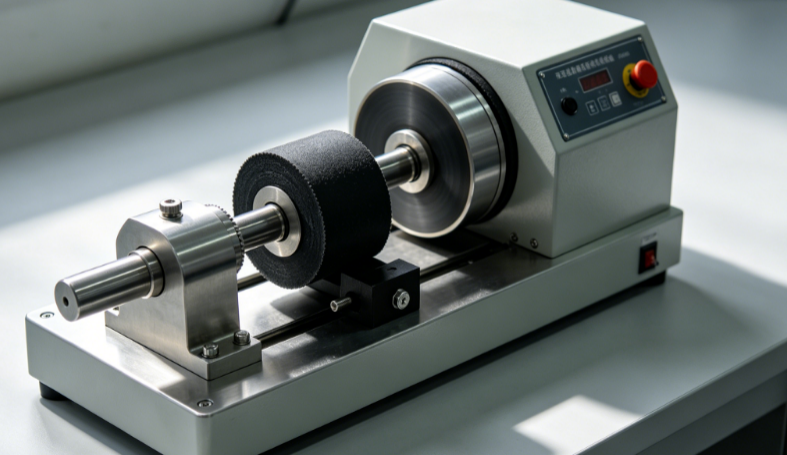
Test Principle: The akron abrasion test uses a rotating rubber specimen (mounted on a rotating wheel) pressed at a specified angle against a rotating abrasive wheel (grinding wheel). The test specimen rotates around its own axis while simultaneously rolling in contact with the abrasive wheel, simulating the combined rolling and sliding motion experienced by tyre treads on road surfaces. After a prescribed travel distance (typically 1.61 km, equivalent to 1 mile), the mass loss or volume loss is measured and converted into an abrasion resistance value. The result is expressed as volume loss (cm³) or abrasion resistance index (relative to a standard reference compound).
The key feature of the Akron method is the fixed oblique angle between the specimen and the abrasive wheel – typically 15°, which replicates the slip angle experienced by vehicle tyres during cornering and straight‑line driving. This unique configuration distinguishes akron abrasion testing from other wear tests such as DIN abrasion (ISO 4649, perpendicular contact on a rotating drum with abrasive paper) and taber abrasion (rotary platform with two abrasive wheels).[reference:0][reference:1]
2. Our Testing Scope for akron abrasion
We cover a comprehensive range of rubber and elastomeric materials, product forms, and industry applications:
By material type: Natural rubber (NR) and NR‑based compounds; Synthetic rubbers – styrene‑butadiene rubber (SBR), butadiene rubber (BR), nitrile rubber (NBR), chloroprene rubber (CR), ethylene‑propylene‑diene monomer (EPDM), isoprene rubber (IR), butyl rubber (IIR); Thermoplastic elastomers (TPE, TPU); Rubber compounds with various fillers – carbon black, silica (white carbon black), clay, calcium carbonate; Rubber blends for tyre tread, sidewall, and inner liner formulations.[reference:2]
By product / application: Tyre tread compounds (passenger car, truck, OTR, aircraft) – the primary application of akron abrasion testing; Conveyor belt cover compounds (for mining, bulk material handling, power plant coal handling); Shoe soles and footwear materials – rubber outsoles, EVA midsoles, TPU soles; Industrial rubber products – transmission belts, V‑belts, timing belts, hoses, seals, gaskets, rubber linings; Rubber sheets and floor coverings for high‑traffic areas; Rubber components for automotive applications – wiper blades, suspension bushings, engine mounts; Rubber compound R&D – for formula optimisation, filler dispersion, and wear performance screening.[reference:3]
By test condition: Standard ambient temperature (23 ± 2°C / 73.4 ± 3.6°F); Conditioned environment (50 ± 5% RH); Elevated temperature testing (by arrangement, up to 100°C); Customised abrasion profiles (for specific industry or OEM requirements).
3. Key Test Items & Measurements We Perform
Our akron abrasion testing services deliver both direct (mass loss, volume loss) and comparative (abrasion resistance index) results, providing comprehensive data for material characterisation.
3.1 Mass Loss (Direct Measurement)
Mass loss (Δm = m₁ – m₂) – the difference in specimen mass before and after abrasion, measured on an analytical balance with precision to 0.001 g. The specimen is weighed after pre‑wearing (to establish a consistent initial surface) and again after the formal abrasion run. The mass loss is directly influenced by the compound‘s crosslink density, filler type and content, and abrasion resistance. Lower mass loss indicates better wear resistance.
Equipment specifications – Electronic analytical balance with readability of 0.001 g (1 mg) and a measurement range of ≥ 200 g, calibrated and verified according to ISO 6506‑2 or equivalent.(18†L6-L7)
3.2 Volume Loss (Abrasion Loss Volume)
Volume loss (V = Δm / ρ) – calculated by dividing the mass loss by the material‘s density. Volume loss eliminates the effect of material density variations between different rubber compounds, allowing objective comparison of abrasion resistance across compounds with different specific gravities. The result is expressed in cubic centimetres (cm³). A typical formula accepted under GB/T 1689 is V = (m₁ – m₂) / ρ, where m₁ is the mass after pre‑wear (g), m₂ is the mass after formal abrasion (g), and ρ is the density of the rubber specimen (g/cm³).[reference:4]
Density determination – Density is measured in accordance with GB/T 533 (ISO 2781) using a hydrostatic balance or pycnometer method, with accuracy to ±0.001 g/cm³.(18†L20)
3.3 Abrasion Resistance Index (Comparative Method)
To normalise results across different test runs and laboratories, an abrasion resistance index is often calculated by comparing the abrasion loss of the test specimen to that of a standard reference compound: Index = (Vreference / Vtest) × 100, where Vreference is the volume loss of the standard rubber compound (tested under identical conditions) and Vtest is the volume loss of the sample. A value above 100 indicates that the test compound exhibits better abrasion resistance than the reference. The reference material is typically a specified rubber compound (e.g., the Standard Reference Rubber provided under ISO 4649) that has been calibrated for abrasion consistency. Under ASTM D5963, abrasion results are reported as an index relative to a reference compound; GB/T 1689 also describes the abrasion index calculation method.[reference:5][reference:6]
3.4 Pre‑wearing (Run‑In) Operation
Before the formal abrasion measurement, each specimen undergoes a pre‑wearing (run‑in) process: Number of pre‑wearing revolutions: 600 revolutions (equivalent to approximately 15‑20 minutes of run‑in time under standard conditions). During pre‑wearing, the abrasive wheel cuts a fresh, uniform wear surface on the rubber specimen, eliminating any surface irregularities, mould release residues, or cure skin that could affect the accuracy of the formal measurement. After pre‑wearing, the specimen is removed, brushed free of rubber debris, and weighed to determine m₁. The pre‑wearing run also conditions the abrasive wheel, ensuring consistent sharpness for the formal abrasion test.[reference:7]
3.5 Formal Abrasion Run (Standard 1.61 km)
Standard abrasion distance: 1.61 km (1 mile). The formal abrasion run is set to 1,341 revolutions of the abrasive wheel (calibrated to achieve exactly 1.61 km of sliding distance between the rubber specimen and the abrasive wheel). The distance is based on the effective perimeter of the abrasive wheel and its rotational speed ratio relative to the specimen wheel. The abrasion resistance expressed in cm³ loss per 1.61 km is the direct output of GB/T 1689. Under other standards such as ASTM D5963 or ISO 4649, different abrasion distances may apply (e.g., 40 m reference distance for the DIN method).
Calculation relationship – Under GB/T 1689, the measured mass loss after the formal run is divided by the density of the rubber compound to obtain the abrasion volume loss in cm³, which corresponds to the wear generated over 1.61 km of rubber‑to‑abrasive contact.[reference:8]
3.6 Post‑Test Examination (Optional – Characterisation of Wear Mechanisms)
For advanced material analysis or failure investigation, we offer supplementary characterisation: Wear track imaging – optical microscopy at 20× to 100× magnification to examine surface morphology, wear pattern, and failure mode (e.g., abrasive wear, fatigue wear, thermal degradation); Wear debris analysis – examination of rubber particles removed during the test to infer removal mechanisms; Surface roughness measurement (Ra, Rz) – before/after profilometry comparison to quantify wear severity; SEM/EDX – scanning electron microscopy for high‑resolution wear surface characterisation and filler distribution analysis (by arrangement).
4. Key Test Parameters & Conditions
To ensure accurate and repeatable results, all akron abrasion tests are performed under strictly controlled conditions as specified by international standards. The following table summarises the key test parameters per GB/T 1689, ASTM D5963, and ISO 4649.
Test apparatus (akron abrasion tester) – The tester consists of a rotating rubber specimen wheel and an abrasive grinding wheel mounted on separate shafts with a fixed angular relationship. The specimen wheel rotates clockwise, while the abrasive wheel rotates counter‑clockwise, providing the combined rolling‑sliding action that characterises tyre‑road contact.
Specimen rotation speed – 76 r/min ± 2 r/min (specimen wheel).
Abrasive wheel rotation speed – 34 r/min ± 1 r/min (grinding wheel).
Standard angle (specimen to abrasive) – 15° ± 0.5° (primary setting; an optional 25° angle may be used when the measured abrasion volume is < 0.1 cm³ to improve measurement resolution).
Specimen load (vertical force) – 26.7 N ± 0.2 N (2.72 kgf). Under ASTM D5963, the applied vertical load is 44.1 N (4.5 kgf) or 27.0 N (2.75 kgf) depending on the specimen holder configuration. The load is applied through a lever‑weight system and must be calibrated before each test session.
Specimen dimensions – Length = (D + 2h)π (matched to the circumference of the specimen wheel, 0 to +5 mm tolerance) × width = 12.7 mm ± 0.2 mm × thickness = 3.2 mm ± 0.2 mm. The thickness must be measured at the centreline of the cut sample.
Abrasive wheel (grinding wheel) – Diameter 150 mm ± 0.2 mm, thickness 25 mm ± 0.5 mm. Abrasive material: aluminium oxide, grain size: 36 grit (medium). Bond: vitrified (ceramic) with hardness rated as medium‑hard (Grade M).
Conditioning of rubber specimens – All specimens must be conditioned at 23 ± 2 °C and 50 ± 5 % RH for at least 24 hours before testing, in accordance with GB/T 2941 (ISO 23529). The specimen wheel assembly (with rubber bonded to the wheel) is also conditioned for a minimum of 16 hours after specimen bonding before any testing is conducted.[reference:9]
5. Test Procedure & Specifications
Our laboratory strictly follows the procedural requirements of GB/T 1689‑2014, ASTM D5963, and ISO 4649. The following step‑by‑step procedure is standardised for all akron abrasion tests.
Step 1: Specimen preparation – Rubber compound is vulcanised into sheet form. Specimens are cut using a template or die to the required dimensions: width 12.7 mm, thickness 3.2 mm, and length calculated to exactly match the circumference of the specimen wheel. The length tolerance is 0 mm to +5 mm. Both surfaces of the specimen are roughened (abraded) with sandpaper to improve adhesive bonding. The specimen is then glued onto the specimen wheel using a cyanoacrylate‑based adhesive or rubber‑to‑metal adhesive. The bonding must be free of tension, and the joint is spliced at a 45° angle for a smooth transition. The bonded specimen assembly is left to cure for at least 16 hours at ambient temperature.[reference:10]
Step 2: Density measurement – A separate section of the same rubber compound (typically a small rectangular piece) is used to measure density according to GB/T 533 (hydrostatic weighing method) or another accepted method (pycnometer for semi‑solid rubbers). The density ρ (g/cm³) is recorded with an accuracy of ±0.001 g/cm³.
Step 3: Preliminary set‑up and calibration – The abrasive wheel is inspected for wear, clogging, and condition. The angle between the specimen wheel and the abrasive wheel is adjusted to 15° ± 0.5°. The vertical load (test force) is calibrated to 26.7 N ± 0.2 N or the relevant standard requirement. The counter is set to the required number of revolutions (600 for pre‑wear, 1,341 for formal abrasion).[reference:11]
Step 4: Pre‑wear (run‑in) – The bonded specimen wheel is mounted on the tester shaft. The counter is set to 600 revolutions (approximately 15‑20 minutes). The motor is started. After the pre‑wear run, the specimen is removed, any loose rubber particles are brushed away, and the mass m₁ is weighed on the analytical balance (precision 0.001 g).[reference:12]
Step 5: Formal abrasion – The pre‑worn specimen wheel is remounted. The counter is set to 1,341 revolutions (equivalent to 1.61 km of abrasion distance). The motor is started and allowed to run until the counter stops. The specimen is removed, brushed free of debris, and weighed within one hour to determine m₂.[reference:13]
Step 6: Calculation – Mass loss Δm = m₁ – m₂ (g). Volume loss V = Δm / ρ (cm³). Abrasion resistance index = (V_reference / V_test) × 100 (if a reference compound is tested concurrently).
Reporting: The final test report includes the average volume loss of at least two valid tests (or three if specified), the standard deviation, the test conditions, and a pass/fail statement relative to the applicable specification.[reference:14]
Step 7: Quality control (QC) – To ensure long‑term data stability, a control (reference) compound is run periodically (e.g., every 10 production samples). If the reference compound‘s volume loss deviates by more than ± 10 % from its established baseline, the test equipment is re‑calibrated and the abrasive wheel is inspected or replaced. This ensures that any drift in abrasivity caused by a worn wheel or a change in standard conditions is identified and corrected before an unknown sample is tested.
6. Applicable International Standards
Our akron abrasion testing services comply with the following internationally recognised standards, covering both the Chinese market (GB/T) and international export markets (ASTM, ISO, BS).
GB/T 1689‑2014 (Primary Chinese standard) – “Rubber vulcanized – Determination of abrasion resistance (Akron machine)”. This standard specifies the test method for determining the abrasion resistance of vulcanised rubber using the akron abrasion testing machine. It defines the apparatus, specimen preparation, test procedure, calculation, and reporting requirements. GB/T 1689‑2014 supersedes the previous 1998 version. The current version adds clarifications for the test principle, improves the description of the apparatus, corrects the density unit in the calculation formula, and adds periodic wheel calibration. The standard requires a minimum of two valid tests, with a permissible deviation of ± 10 % between the highest and lowest values; otherwise, a third test is required.[reference:15][reference:16]
ASTM D5963‑22 (International export / North America) – “Standard Test Method for Rubber Property – Abrasion Resistance (Rotary Drum Abrader)”. Although ASTM D5963 specifies the DIN abrasion method (rotary drum with abrasive paper), many export contracts call for results that are equivalent or convertible to DIN abrasion. Where Akron‑specific data is required, we can adapt our equipment and procedures in accordance with relevant ASTM guidance.(7†L15-L16)[reference:17]
ISO 4649:2017 (International standard) – “Rubber, vulcanized or thermoplastic – Determination of abrasion resistance using a rotating cylindrical drum device”. This is the standard for the DIN abrasion test, not the Akron method. However, ISO 4649‑based acceptance criteria are often used in comparison with results from other abrasion methods. The abrasion wheel used in the Akron method may be substituted when a direct comparison to a reference DIN standard is required.(7†L16-L20)
BS 903‑A9 (British standard) – “Methods for testing vulcanized rubber – Part A9: Determination of abrasion resistance – Akron and Taber methods”. This British standard describes two methods for determining abrasion resistance of rubber: Method A (Akron method) and Method B (Taber method). The Akron method specified in BS 903‑A9 aligns closely with the method defined in GB/T 1689 and is used for rubber product trade between the UK and Commonwealth markets.[reference:18]
7. Sample Requirements & Conditioning
Sample quantity – Minimum 3 specimens for internal quality control; at least 5 specimens for acceptance testing; 10 specimens for material qualification or R&D (to reduce statistical uncertainty).
Sample dimensions – The specimen must be cut to width 12.7 mm ± 0.2 mm, thickness 3.2 mm ± 0.2 mm, and length as required to match the circumference of the specimen wheel (length calculated as (D + 2h)π, where D is the wheel diameter and h is the specimen thickness). The thickness of the rubber specimen must be consistent along the entire length (variation ± 0.05 mm). The density of the compound must be uniform (± 0.005 g/cm³).
Conditioning requirements – All rubber specimens must be conditioned at 23 °C ± 2 °C and relative humidity 50 % ± 5 % for a minimum of 24 hours before any test preparation begins. If the vulcanised sheet is less than 24 hours old, an additional 24‑hour stabilisation period at room temperature is required to allow full cure and relaxation.
Environmental records – The test environment is continuously monitored, and the temperature and humidity are recorded on the test data sheet. Any deviation beyond ± 2 °C or ± 5 % RH invalidates the test.
8. Advantages & Limitations of akron abrasion Testing
Understanding the strengths and limitations of the akron abrasion method ensures proper application and interpretation of results.
Advantages: The test directly simulates the rolling‑sliding contact experienced by tyre treads, making it the preferred method for tyre compound development and production quality control. The prescribed 15° contact angle replicates realistic cornering slip and frictional energy dissipation. The test is relatively fast for rubber evaluation (typically 60‑90 minutes per specimen, including pre‑wear and formal abrasion). The 1.61 km formal abrasion distance provides measurable wear for most commercial rubber compounds (volume loss typically between 0.1 and 1.5 cm³). The test can be adapted to a wide range of rubber hardness values (Shore A 40‑90) by adjusting the test load, wheel angle, or number of revolutions, while still maintaining geometric similarity of the contact conditions.[reference:19]
Limitations: The test is destructive and leaves visible wear marks on the rubber specimen; it is not applicable to finished products where only limited material is available. The rubber specimen must be vulcanised sheet rather than a product‑form sample, so the test cannot be performed directly on a tyre tread without cutting a full‑width sample. The abrasive wheel gradually becomes less aggressive over time and must be re‑conditioned (re‑sharpened) or replaced periodically. The standard 15° contact angle is optimal for tyre tread simulation but may not be representative of other applications (e.g., flat conveyer belts, shoe soles, or mechanical seals). The test measures total mass loss but does not distinguish between different wear mechanisms (e.g., abrasive vs. fatigue wear) unless supplemented by microscopy. The accuracy of the volume loss result is highly dependent on the accuracy of the density measurement (ρ). Any inaccuracy in ρ directly propagates into V = Δm/ρ.
9. Reporting & Result Presentation
Our test reports are detailed, transparent, and compliant with ISO/IEC 17025 and GB/T 1689/ASTM D5963 requirements. Each report includes:
Specimen identification – Rubber type/grade, compound batch number, recipe reference, sampling location, and specimen orientation (rolling direction vs. cut direction).
Test conditions – Standard referenced (GB/T 1689‑2014, ASTM D5963, ISO 4649, or customer specification); test equipment model and serial number; test load (N), angle (degrees), abrasive wheel type and condition, date of last wheel calibration; temperature and humidity during testing.
Raw data – Mass before pre‑wear (g), mass after pre‑wear m₁ (g), mass after formal abrasion m₂ (g), density ρ (g/cm³), calculated volume loss V (cm³). For each specimen, the individual values are recorded. For multiple specimens, the average volume loss, standard deviation, and coefficient of variation (%) are reported.
Statistical analysis – Mean volume loss (cm³), standard deviation, and range (min, max). The allowable deviation between tests is typically ± 10 % (per GB/T 1689). If the deviation exceeds this limit, a third or fifth test is performed and all results are reported, noting that the repeatability requirement was not met.
Calibration records – Details of the most recent equipment calibration (load cell, angle adjustment, wheel condition). A copy of the daily reference compound verification results (difference from baseline, pass/fail).
Compliance statement – Pass/fail determination against customer specification, purchase order, or material standard (e.g., “The volume loss of 0.65 cm³ meets the customer requirement of ≤ 0.80 cm³ per 1.61 km”).
Microscopic images (if requested) – Optical microscope photographs of the worn rubber surface at 20× to 100× magnification, annotated to highlight wear features such as abrasion patterns, tearing, or localised debris accumulation.
10. Why Choose Our Third‑Party akron abrasion Testing Services?
As an independent laboratory, we provide unbiased, accurate, and legally defensible abrasion data. Our strengths include:
ISO/IEC 17025 accreditation – Our akron abrasion testing (GB/T 1689‑2014, ASTM D5963, ISO 4649, BS 903‑A9) is CNAS and CMA accredited. We participate regularly in proficiency testing programmes (e.g., rubber abrasion round robins).
Full‑specification Akron testers – We operate dedicated akron abrasion testers (GT‑7012‑A, Amade‑Tech, Yasuda Seiki No.152) that meet GB/T 1689, ASTM D5963, and ISO 4649 specifications. Our equipment is equipped with precision load cells (±0.2 N accuracy), angle adjustment to ±0.1°, and electronic counters for accurate revolution control.
Comprehensive supplementary characterisation – We offer density determination, wear surface microscopy (optical and SEM), and chemical analysis (FTIR, filler dispersion) to understand the root cause of abrasion failure.
Fast turnaround – Routine akron abrasion tests (3‑5 specimens) typically completed within 2‑3 business days. Full qualification series (10 specimens) in 5‑7 business days. Long‑term wear monitoring programmes available by arrangement.
Detailed reporting – Reports include raw data, statistical summaries, calibration records, and clear pass/fail conclusions.
Confidentiality – Full protection of your material formulation, compound recipe, and test results.
Consultative support – Our rubber technologists assist with specimen preparation, parameter selection (angle, load, cycle count), interpretation of abnormal wear patterns (uneven wear, chunking, rolling), and root‑cause investigation of wear‑related field failures.
Whether you need to qualify a new tyre tread compound for high‑mileage applications, optimise a shoe sole formulation for abrasion resistance, validate a conveyor belt cover material against an OEM specification, or investigate the cause of premature wear in a rubber component, our akron abrasion testing experts are ready to deliver reliable, actionable results.
Get Started with Your akron abrasion Testing Project
Contact our team with your rubber type, compound hardness, target application (tyre, shoe sole, belt, industrial), applicable standard (GB/T 1689, ASTM D5963, ISO 4649, BS 903‑A9, or customer spec), and any special requirements (elevated temperature, surface analysis, reference compound testing). We will provide a detailed quotation, sample submission guidelines (specimen dimensions, minimum quantity, conditioning instructions), and a testing schedule. Let us help you quantify and improve the wear resistance of your rubber materials for longer service life and safer operation.
This article provides an overview of our akron abrasion testing capabilities. For specific test methods, sample quantity, and pricing, please request a tailored service proposal.