Reasons for choosing our testing services
ZHONGXI Testing has obtained inspection qualification certifications from multiple countries and regions worldwide. We possess a senior testing team and advanced testing methods, providing independent, impartial, and professional third-party verification services for global carbon projects.
Internationally recognized authority
Certified by multiple international standards such as CNAS, VCS, and GS, with reports universally applicable worldwide.

Global service capability
Covering 140+ countries and regions, it supports on-site detection and remote verification in multiple languages.

Professional experimental methods
Adopt standard experimental methods to ensure accurate and reliable data.
DIN Abrasion Testing Services: Precision Wear Resistance Evaluation for Rubber & Elastomer Materials
As an independent third-party testing service provider, we offer comprehensive DIN abrasion testing for rubber materials, elastomers, thermoplastic elastomers (TPE), rubber compounds, conveyor belts, shoe soles, tyres, seals, gaskets, industrial hoses, and flooring materials. DIN abrasion testing – also known as the rotating cylindrical drum abrasion method – is one of the most widely accepted and standardized methods for evaluating the wear resistance of vulcanized rubber and elastomeric materials. The test simulates the mechanical wear experienced by rubber components in service by pressing a cylindrical test specimen against a rotating drum covered with standardized abrasive paper, measuring the resulting material volume loss[reference:0]. Abrasion resistance is a critical performance indicator for rubber products that are subject to friction, sliding contact, scraping, or repeated mechanical stress in everyday use – such as tyre treads contacting road surfaces, conveyor belt covers sliding over support rollers, shoe soles walking on pavement, and industrial seals operating in abrasive environments. Poor abrasion resistance leads to premature wear, reduced service life, increased replacement costs, and potential safety hazards[reference:1]. Our accredited laboratory follows international standards (ISO 4649, DIN 53516, ASTM D5963, GB/T 9867) to deliver accurate, reproducible, and legally defensible abrasion test data. This article outlines our DIN abrasion testing capabilities – including scope, key test items, equipment specifications, test procedures, and standard methods – to help manufacturers, quality assurance teams, material developers, and regulatory bodies quantify and compare the wear resistance of rubber materials.[reference:2]
1. What Is DIN Abrasion Testing?
DIN abrasion testing (also referred to as the rotating cylindrical drum abrasion method) is a standardized laboratory test that measures the resistance of rubber and elastomeric materials to abrasion wear. The test was originally developed under the German industrial standard DIN 53516 and is now harmonized with the international standard ISO 4649, which supersedes DIN 53516. The method is used to evaluate the abrasion loss of a material when subjected to friction against a standardized abrasive surface[reference:3].
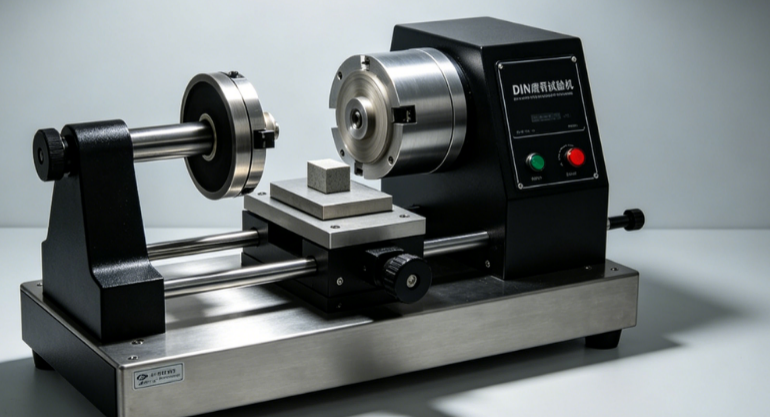
Test Principle: The DIN abrasion test uses a rotating cylindrical drum covered with a standardized sheet of abrasive paper (typically 60‑grit aluminium oxide). A cylindrical test specimen is pressed against the abrasive drum under a specified vertical force (usually 10 N). The drum rotates at a constant speed (40 r/min), and the specimen holder moves transversely across the drum surface to ensure even abrasion across the entire face of the specimen[reference:4]. After the specimen has traversed a defined sliding distance (typically 40 m), the mass loss is measured and converted into volume loss using the material‘s density. Results can be reported as relative volume loss (mm³) or as an abrasion resistance index (%) relative to a standard reference rubber compound.[reference:5][reference:6]
The DIN abrasion test is suitable for comparative testing, quality control, specification compliance, referee purposes, and research and development work. It is important to note, however, that no direct correlation between the results of this laboratory abrasion test and actual service performance can be inferred, as wear behaviour in real applications depends on many additional factors such as temperature, surface roughness, lubricants, and contact geometry.[reference:7]
2. Our Testing Scope for DIN Abrasion
We cover a comprehensive range of rubber and elastomeric materials, product forms, and industry applications:
By material type: Natural rubber (NR) and NR‑based compounds; Synthetic rubbers – styrene‑butadiene rubber (SBR), butadiene rubber (BR), nitrile rubber (NBR), chloroprene rubber (CR), ethylene‑propylene‑diene monomer (EPDM), isoprene rubber (IR), butyl rubber (IIR); Thermoplastic elastomers (TPE, TPV, TPU); Rubber compounds with various fillers – carbon black, silica (white carbon black), clay, calcium carbonate.[reference:8]
By product / application: Tyre tread compounds (passenger car, truck, off‑the‑road, motorcycle) – the primary application of DIN abrasion testing; Conveyor belt cover compounds for mining, bulk material handling, and power plants; Shoe soles and footwear materials – rubber outsoles, TPU soles, and EVA midsoles; Industrial rubber products – transmission belts, V‑belts, timing belts, hoses, seals, gaskets, rubber linings; Rubber sheets and floor coverings for high‑traffic areas; Rubber components for automotive applications – wiper blades, suspension bushings, engine mounts; Rubber compound R&D – for formula optimization, filler dispersion, and wear performance screening.[reference:9]
By test condition: Standard ambient temperature (23 ± 5 °C); Extended travel distance (84 revolutions = 40 m); Reduced travel distance (20 m or 10 m for high‑wear materials). When the sample mass loss exceeds approximately 600 mg after 40 m of travel, the test may be performed over a shorter distance (20 m or 10 m), and the result is then multiplied by an appropriate factor (2× for 20 m, 4× for 10 m) to express the loss for the standard 40 m distance.[reference:10]
3. Key Test Parameters & Equipment Specifications
To ensure accurate and repeatable results, all DIN abrasion tests are performed under strictly controlled conditions as specified by ISO 4649 and DIN 53516. Key test parameters are summarized below:
Test apparatus (rotating cylindrical drum abrasion tester) – The tester consists of a rotating drum (stainless steel or other specified material) covered with a standardized abrasive paper, a horizontally movable specimen holder, a loading arm to apply vertical force, and a revolution counter.[reference:11]
Drum diameter – 150 mm ± 0.2 mm.[reference:12]
Drum rotational speed – 40 r/min ± 1 r/min.[reference:13]
Abrasive paper – Aluminium oxide with a grain size of 60 (medium grit). For a standard test run of 40 m, the abrasive paper shall be conditioned such that a reference rubber compound exhibits a mass loss of 180 mg to 220 mg. This ensures consistent abrasiveness between different batches of abrasive paper and across different testing laboratories.[reference:14][reference:15]
Specimen shape – Cylindrical (drilled using a circular cutter).[reference:16]
Specimen diameter – 16.0 mm ± 0.2 mm.[reference:17][reference:18]
Specimen thickness – Minimum 6 mm (6 mm to 10 mm). If the specimen height is less than 6 mm, it can be adhered to a base piece (base rubber hardness not less than 80 Shore A) provided the rubber specimen height is at least 2 mm.[reference:19][reference:20]
Applied vertical load – 10.0 N ± 0.2 N (approximately 1 kgf). Some testers may be calibrated to apply loads of 2.5 N, 5.0 N, 7.5 N, 10.0 N, 12.5 N, 15.0 N, 17.5 N, or 20.0 N, depending on specimen properties and application.[reference:21][reference:22]
Standard abrasion distance – 40.0 m ± 0.2 m (equivalent to 84 revolutions of the drum). For materials exhibiting very high wear, the test may be performed over a reduced distance of 20.0 m ± 0.1 m (or 10 m for extremely high‑wear materials) and the result is scaled accordingly.[reference:23][reference:24]
Number of test specimens – Minimum of 3 specimens per rubber compound for routine quality control. For referee (arbitration) purposes, 10 specimens are required.[reference:25]
Conditioning requirements – Rubber specimens must be conditioned according to GB/T 2941 (ISO 23529) before testing: temperature 23 ± 2 °C, relative humidity 50 ± 5 %, for a minimum of 16 hours.[reference:26]
4. Key Test Items & Measurements We Perform
Our DIN abrasion testing services deliver both direct (mass loss, volume loss) and comparative (abrasion resistance index) results, providing comprehensive data for material characterisation and quality control.
4.1 Mass Loss (Direct Measurement)
Mass loss (Δm = m₁ – m₂) – the difference in specimen mass before and after abrasion, measured on a precision analytical balance. The specimen is weighed before the test (after pre‑conditioning) and again after the abrasion run has been completed. The mass loss is directly influenced by the compound‘s crosslink density, filler type and content, and abrasion resistance. Lower mass loss indicates better wear resistance.[reference:27]
Equipment specifications – Electronic analytical balance with readability of 1 mg (0.001 g) or higher precision as specified, calibrated and verified according to standard procedures.[reference:28][reference:29]
4.2 Volume Loss (Abrasion Loss Volume)
Volume loss (V) – calculated by dividing the mass loss by the material‘s density (ΔV = Δm / ρ). Volume loss eliminates the effect of material density variations between different rubber compounds, allowing objective comparison of abrasion resistance across compounds with different specific gravities. The result is expressed in cubic millimetres (mm³). A typical formula accepted under DIN 53516 and ISO 4649 is: ΔV = Δm × 200 / (ρ × S), where S is the abrasion loss of the reference compound (mg) used to correct for variations in abrasive paper sharpness.[reference:30][reference:31]
4.3 Abrasion Resistance Index (Comparative Method – ISO 4649)
To normalise results across different test runs, different batches of abrasive paper, and different laboratories, an abrasion resistance index is often calculated by comparing the abrasion loss of the test specimen to that of a standard reference compound: Index = (Vreference / Vtest) × 100, where Vreference is the volume loss of the standard reference rubber compound (tested under identical conditions) and Vtest is the volume loss of the sample. A value above 100 indicates that the test compound exhibits better abrasion resistance than the reference. The reference material is typically a specified rubber compound (e.g., the Standard Reference Rubber provided under ISO 4649) that has been calibrated for abrasion consistency. A smaller number denotes poorer abrasion resistance, and a smaller volume loss indicates better abrasion resistance.[reference:32][reference:33]
4.4 Standard Abrasion Run – 40 m Travel Distance
The standard abrasion run is set to 40 m of sliding distance, which corresponds to 84 revolutions of the abrasive drum. The volume loss measured under this condition is reported as the DIN abrasion loss (mm³) for the material. The value is reported with the test conditions to ensure comparability. Most rubber compounds for tyre treads, conveyor belts, and shoe soles are tested at this standard distance.[reference:34][reference:35]
4.5 Reduced Travel Distance – 20 m or 10 m
For rubber compounds with very high wear (e.g., soft rubber or low‑density compounds), the mass loss after 40 m may be too high for accurate weighing (> 600 mg). In such cases, the test is performed over a reduced distance of 20 m ± 0.1 m (or 10 m). After measurement, the mass loss is multiplied by the appropriate factor (2× for 20 m, 4× for 10 m) to express the result as the equivalent 40 m loss. The report clearly notes when a reduced test distance has been used.[reference:36][reference:37]
4.6 Abrasive Sheet Verification (Reference Rubber Test)
Before testing production samples, a standard reference rubber block is tested (typically three times) to verify the sharpness (abrasiveness) of the abrasive paper. The mean mass loss of the reference (S) should be within the range of 180 mg to 220 mg after the 40 m abrasion run. If the abrasion loss deviates beyond this range, the abrasive paper is replaced with a fresh sheet, and the reference test is repeated.[reference:38][reference:39]
4.7 Post‑Test Examination (Optional – Wear Mechanism Analysis)
For advanced material analysis or failure investigation, we offer supplementary characterisation: Wear track imaging – optical microscopy at 20× to 100× magnification to examine surface morphology, wear pattern, and failure mode (e.g., abrasive wear, fatigue wear, thermal degradation); Mass loss vs. travel distance profiling – for research purposes; Surface roughness measurement (Ra, Rz) – before/after profilometry comparison to quantify wear severity; SEM/EDX – scanning electron microscopy for high‑resolution wear surface characterisation and filler distribution analysis (by arrangement).
5. Test Procedure & Specifications
Our laboratory strictly follows the procedural requirements of ISO 4649, DIN 53516, ASTM D5963, and GB/T 9867. The following step‑by‑step procedure is standardised for all DIN abrasion tests.
Step 1: Specimen preparation – Rubber compound is vulcanised into sheet form. Specimens are cut using a cylindrical rotary cutter (circular cutting knife) to the required dimensions: diameter 16.0 mm ± 0.2 mm, thickness between 6 mm and 10 mm. The cut surfaces are inspected for defects, air bubbles, or foreign inclusions. For thin rubber sheets (thickness less than 6 mm), multiple layers are stacked or the specimen is bonded to a rigid base rubber of known hardness (≥ 80 Shore A), provided the rubber specimen height is at least 2 mm.[reference:40][reference:41]
Step 2: Density measurement – A separate section of the same rubber compound (typically a small rectangular or irregular piece) is used to measure density according to GB/T 533 (ISO 2781). The method may be hydrostatic weighing (Archimedes) using a precision balance and a water bath, or a pycnometer method for very small samples. The density ρ (g/cm³ or mg/mm³) is recorded with an accuracy of ± 0.001 g/cm³.[reference:42]
Step 3: Reference rubber (standardization) – Before testing production samples, a standard reference rubber block (supplied and certified by an accredited body) is tested to verify the abrasiveness of the abrasive paper. Three reference tests are performed, and the mean mass loss S is calculated. If S falls outside the range of 180 mg to 220 mg, the abrasive paper is replaced with a fresh sheet, and the reference test is repeated until an acceptable S value is obtained. The measured S value is recorded and used in the abrasion loss calculation for production samples.[reference:43][reference:44]
Step 4: Pre‑test weighing – Each specimen is cleaned with a soft brush to remove any loose debris, conditioned at 23 ± 2 °C / 50 ± 5 % RH for a minimum of 16 hours, and then weighed on a precision analytical balance (resolution 1 mg or better) to record the initial mass m₁ (mg).[reference:45][reference:46]
Step 5: Mounting and setup – The abrasive drum is fitted with a fresh sheet of 60‑grit aluminium oxide abrasive paper, wrapped tightly and secured. The specimen is inserted into the specimen holder (clamp) with the test face exposed. The vertical load is applied (10.0 N ± 0.2 N). The counter is set to the required number of revolutions (84 revolutions for 40 m, 42 revolutions for 20 m, or 21 revolutions for 10 m). The transverse movement mechanism is checked to ensure the specimen moves smoothly across the full width of the abrasive drum.[reference:47][reference:48]
Step 6: Abrasion run – The test is started. The drum rotates at 40 r/min, and the specimen holder moves horizontally across the drum. The specimen is in constant contact with the abrasive paper under the applied load. The machine runs until the pre‑set number of revolutions is reached. The rotating specimen ensures that the entire face of the cylindrical test piece is uniformly abraded. The instrument stops automatically, and the specimen is removed from the holder.[reference:49]
Step 7: Post‑test weighing – After the abrasion run, the specimen is brushed free of rubber debris and re‑weighed on the same analytical balance to record the final mass m₂ (mg). The mass loss Δm = m₁ – m₂ (mg) is calculated.[reference:50]
Step 8: Calculation – Mass loss Δm (mg) is recorded. Volume loss V (mm³) is calculated as V = Δm / ρ (mg/mm³). Optionally, the abrasion loss is corrected for the reference rubber abrasiveness using the formula: ΔVcorrected = Δm × 200 / (ρ × S), where S is the measured mass loss of the reference compound (mg). The abrasion resistance index is calculated as Index = (Vreference / Vtest) × 100 if required.[reference:51][reference:52]
Step 9: Statistical reporting – For each test condition, a minimum of three specimens are tested, and the mean volume loss (mm³) is calculated along with the standard deviation (SD) and coefficient of variation (CV). The mean volume loss is reported as the DIN abrasion loss for the compound. The report notes any deviations from the standard test distance (e.g., testing at 20 m rather than 40 m), with the appropriate scaling factor applied.[reference:53]
6. Applicable International Standards
Our DIN abrasion testing services comply with the following internationally recognised standards, covering both the European market (DIN, ISO) and international export markets (ASTM, GB/T).
ISO 4649:2024 (International standard) – “Rubber, vulcanized or thermoplastic – Determination of abrasion resistance using a rotating cylindrical drum device”. This is the most current international standard, superseding older versions of DIN 53516. It specifies two methods: Method A (non‑rotating test piece) and Method B (rotating test piece). For each method, the result can be reported as a relative volume loss (mm³) or an abrasion resistance index (%). These test methods are suitable for comparative testing, quality control, specification compliance testing, referee purposes, and research and development work. The standard also specifies two standard reference elastomers. No close relation between the results of this abrasion test and service performance can be inferred. The abrasion loss is often more uniform using the rotating test piece because the whole surface of the test piece is in contact with the abrasive sheet over the duration of the test. However, there is considerable experience using the non‑rotating test piece.[reference:54]
DIN 53516 (German standard, partially superseded) – “Elastomere oder thermoplastische Elastomere – Bestimmung des Abriebwiderstandes mit einem Gerät mit rotierender Zylindertrommel”. This German industrial standard was the original DIN abrasion method. It has been superseded by DIN ISO 4649:2021 (and its subsequent versions). However, many historical specifications and customer references still mention DIN 53516. Our laboratory continues to support tests in accordance with DIN 53516 when explicitly requested, but the modern ISO 4649 method is preferred for new qualification programmes.[reference:55][reference:56]
ASTM D5963‑22 (North American / international) – “Standard Test Method for Rubber Property – Abrasion Resistance (Rotary Drum Abrader)”. This ASTM standard covers the measurement of abrasion resistance of vulcanised thermoset rubbers and thermoplastic elastomers. The abrasion resistance is measured by moving a test piece across the surface of an abrasive sheet mounted to a revolving drum and is expressed as volume loss in cubic millimetres or abrasion resistance index in percent. For volume loss, a smaller number indicates better abrasion resistance, while for the abrasion resistance index, a smaller number denotes poorer abrasion resistance. Test results obtained by this test method shall not be assumed to represent the wear behaviour of rubber products experienced in actual service.[reference:57]
GB/T 9867‑2008 (Chinese national standard) – “硫化橡胶或热塑性橡胶耐磨性能的测定(旋转辊筒式磨耗机法)”. This standard is identical to ISO 4649:2010 (the 2010 version) and specifies the rotating cylindrical drum abrasion method. It includes Method A (non‑rotating test piece) and Method B (rotating test piece). Test results can be expressed as relative volume loss (mm³) or abrasion resistance index (%). The standard is applicable to comparative testing, quality control, specification compliance, referee purposes, and R&D. The standard also specifies that the abrasive paper must be such that a standard reference rubber compound exhibits a mass loss of 180‑220 mg after the 40 m abrasion run.[reference:58][reference:59]
DIN ISO 4649:2021‑06 (German adoption) – “Elastomere oder thermoplastische Elastomere – Bestimmung des Abriebwiderstandes mit einem Gerät mit rotierender Zylindertrommel (ISO 4649:2017)”. This is the German adoption of the international standard, fully aligned with ISO 4649. It supersedes DIN 53516 for new qualifications. The DIN adoption is used for CE marking and European market acceptance.[reference:60][reference:61]
7. Sample Requirements & Conditioning
Sample quantity – Minimum 3 specimens for internal quality control; at least 5 specimens for acceptance testing; 10 specimens for referee (arbitration) purposes or material qualification (to reduce statistical uncertainty).[reference:62]
Sample dimensions – Specimen must be cylindrical: diameter 16.0 mm ± 0.2 mm, thickness (height) between 6 mm and 10 mm. For very thin rubber sheets (less than 6 mm thick), multiple layers may be stacked, or the specimen may be adhered to a base piece (base rubber hardness ≥ 80 Shore A) as long as the rubber specimen itself has a height of at least 2 mm.[reference:63]
Density measurement – A separate piece of the same rubber compound is required for density determination. The mass of the density specimen should be at least 1 g for reliable measurement. Density is measured according to GB/T 533 (hydrostatic weighing method) or an equivalent method, with accuracy ± 0.001 g/cm³.[reference:64]
Conditioning requirements – All rubber specimens must be conditioned before any test preparation begins. Temperature: 23 ± 2 °C, relative humidity: 50 ± 5 %, for a minimum of 16 hours. The laboratory environment is continuously monitored, and temperature and humidity are recorded on the test data sheet. Any deviation beyond ± 2 °C or ± 5 % RH invalidates the test.[reference:65]
8. Advantages & Limitations of DIN Abrasion Testing
Understanding the strengths and limitations of the DIN abrasion method ensures proper application and interpretation of results.
Advantages: The test is highly standardised across international standards (ISO 4649, DIN 53516, ASTM D5963, GB/T 9867), enabling direct comparison of results between different laboratories and suppliers. The rotating specimen (Method B) ensures that the entire face of the cylindrical test piece is uniformly abraded, providing good repeatability and reducing variability caused by anisotropic material properties.[reference:66] The test uses a relatively simple, robust apparatus that is widely available and can be operated by trained technicians with moderate experience. The test is moderately fast – a full set of 3‑5 specimens can be completed in 2‑3 hours, including preparation, weighing, and calculation. The volume loss result is expressed in mm³, which is directly comparable across different rubber compounds, eliminating the influence of density variations. The test includes a reference rubber standardisation step, which normalises results across different batches of abrasive paper, ensuring long‑term consistency of test data. The method is suitable for a wide range of rubber hardness (Shore A 40‑95) and filler types. The test is well‑accepted in the automotive, tyre, conveyor belt, and footwear industries, and results are routinely used for supplier qualification, production quality control, and material development.
Limitations: The test is destructive and leaves a visible wear scar on the rubber specimen; it is not applicable to finished products where only limited material is available. The rubber specimen must be cut from a vulcanised sheet rather than directly from a finished product, so the test cannot be performed on a tyre tread without cutting a full‑width sample – however, this is acceptable for quality control of rubber compounds. The abrasive paper gradually becomes less aggressive (blunter) with use and must be replaced frequently. The reference standardisation step (reference rubber test) is required before every test session to verify the sharpness of the abrasive paper. If the reference rubber loss deviates outside the 180‑220 mg range, the paper must be replaced. The test measures total mass loss but does not distinguish between different wear mechanisms (e.g., abrasive, fatigue, thermal) unless supplemented by microscopy or surface analysis. The accuracy of the volume loss result is highly dependent on the accuracy of the density measurement (ρ). Any inaccuracy in ρ directly propagates into V = Δm / ρ. For very soft rubber compounds (≤ 40 Shore A), the specimen may deform excessively under the 10 N load, leading to inaccurate results. Lower test forces (e.g., 5 N) may be used for such materials, but the result must be reported with the adjusted test conditions.
9. Reporting & Result Presentation
Our test reports are detailed, transparent, and compliant with ISO/IEC 17025 and ISO 4649/DIN 53516 requirements. Each report includes:
Specimen identification – Rubber type/grade, compound batch number, recipe reference, sampling location, and specimen preparation details (e.g., cut from moulded sheet).
Test conditions – Standard referenced (ISO 4649:2024, DIN 53516, ASTM D5963, GB/T 9867, or customer specification). Equipment model and serial number; applied load (N); test distance (40 m, 20 m, or 10 m); drum speed (40 r/min); abrasive paper grade (60‑grit aluminium oxide); temperature and humidity during testing; specimen rotation (Method B, rotating, is standard).
Reference rubber verification data – Mass loss of the standard reference compound (S, mg). Verification that S falls within the required range (180‑220 mg) or notation that the abrasive paper was replaced and re‑tested.
Individual test data – For each specimen: initial mass m₁ (mg), final mass m₂ (mg), mass loss Δm (mg), density ρ (g/cm³), calculated volume loss V (mm³). For reduced‑distance tests, the scaling factor applied (e.g., 2× for 20 m, 4× for 10 m) and the equivalent 40 m volume loss are reported.
Statistical summary – Mean volume loss (mm³), standard deviation (SD), coefficient of variation (CV), range (min to max), number of valid specimens. The abrasion resistance index (ARI) relative to the standard reference compound is included if requested, calculated as Index = (Vreference / Vtest) × 100.
Calibration records – Details of the most recent equipment calibration (load cell, drum speed, revolution counter). Copy of the reference rubber test and abrasive paper verification.
Compliance statement – Pass/fail determination against customer specification, purchase order, or material standard (e.g., “The measured DIN abrasion of 125 mm³ meets the customer requirement of ≤ 150 mm³”).
Microscopic images (if requested) – Optical microscope photographs of the worn rubber surface at 20× to 100× magnification, annotated to highlight wear features.
10. Why Choose Our Third‑Party DIN Abrasion Testing Services?
As an independent laboratory, we provide unbiased, accurate, and legally defensible abrasion data. Our strengths include:
ISO/IEC 17025 accreditation – Our DIN abrasion testing (ISO 4649, DIN 53516, ASTM D5963, GB/T 9867) is CNAS and CMA accredited. We participate regularly in proficiency testing programmes (e.g., ISO 4649 round robins).
Full‑specification DIN abrasion testers – We operate dedicated DIN abrasion testers (MonTech ABR 3000 or equivalent) that meet ISO 4649, DIN 53516, and ASTM D5963 specifications. Our testers are equipped with precision load cells (± 0.2 N accuracy), electronic counters, and safety interlocks. Both Method A (non‑rotating specimen) and Method B (rotating specimen) are available.
Complete test suite – We provide specimen preparation (cylindrical cutting), density measurement, reference rubber standardisation, precision weighing, and full statistical reporting. Optional wear surface characterisation (optical microscopy, SEM, profilometry) is also available.
Fast turnaround – Routine DIN abrasion tests (3‑5 specimens) typically completed within 2‑3 business days. Full qualification series (10 specimens) in 5‑7 business days. Long‑term wear monitoring programmes available by arrangement.
Detailed reporting – Reports include raw data, statistical summaries, calibration records, and clear pass/fail conclusions.
Confidentiality – Full protection of your material formulation, compound recipe, and test results.
Consultative support – Our rubber technologists assist with specimen preparation, test distance selection, interpretation of volume loss results, diagnosis of inconsistent abrasion patterns, and root‑cause investigation of wear‑related field failures.
Whether you need to qualify a new tyre tread compound for an OEM application, optimise a conveyor belt cover formulation for extended service life, validate a shoe sole material against a customer specification, or investigate the cause of premature wear in a rubber component, our DIN abrasion testing experts are ready to deliver reliable, actionable results.
Get Started with Your DIN Abrasion Testing Project
Contact our team with your rubber type, compound hardness, target application (tyre, conveyor belt, shoe sole, industrial), applicable standard (ISO 4649, DIN 53516, ASTM D5963, GB/T 9867, or customer spec), and any special requirements (reduced test distance, wear surface analysis, reference rubber testing). We will provide a detailed quotation, sample submission guidelines (specimen dimensions, minimum quantity, conditioning instructions), and a testing schedule. Let us help you quantify and improve the wear resistance of your rubber materials for longer service life and safer operation.
This article provides an overview of our DIN abrasion testing capabilities. For specific test methods, sample quantity, and pricing, please request a tailored service proposal.