Reasons for choosing our testing services
ZHONGXI Testing has obtained inspection qualification certifications from multiple countries and regions worldwide. We possess a senior testing team and advanced testing methods, providing independent, impartial, and professional third-party verification services for global carbon projects.

Internationally recognized authority
Certified by multiple international standards such as CNAS, VCS, and GS, with reports universally applicable worldwide.

Global service capability
Covering 140+ countries and regions, it supports on-site detection and remote verification in multiple languages.

Professional experimental methods
Adopt standard experimental methods to ensure accurate and reliable data.
taber abrasion Testing Services: Evaluating Wear Resistance of Coatings, Plastics & Flooring
As an independent third-party testing service provider, we offer comprehensive taber abrasion testing for a wide range of materials – including paints, coatings, plastics, laminates, flooring, textiles, leather, wood, ceramics, and metal finishes. The taber abrasion test is a widely accepted method for measuring the wear resistance of surfaces under controlled rotary abrasive action. It simulates long‑term mechanical wear from foot traffic, cleaning, sliding contact, and surface handling. Our accredited laboratory follows international standards (ASTM D4060, ASTM D3884, ISO 9352, ISO 5470, GB/T 17657, DIN 53109) to deliver accurate, reproducible, and legally defensible abrasion data. This article outlines our taber abrasion testing capabilities – including scope, key test items, equipment specifications, test procedures, and standard methods – to help manufacturers, quality assurance teams, and material developers quantify surface durability.
1. What Is taber abrasion Testing?
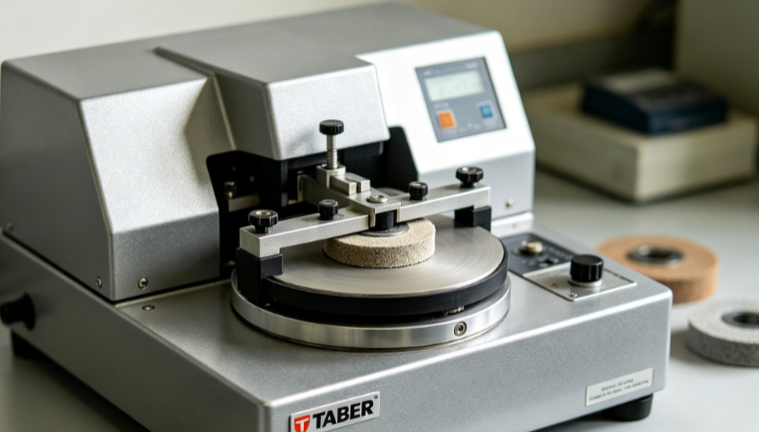
The taber abrasion test uses a rotary platform abraser (Taber abraser) in which a flat test specimen is mounted on a rotating turntable. Two abrasive wheels (e.g., CS‑10, CS‑17, H‑18, Calibrade) are lowered onto the specimen surface under a specified load (typically 250 g, 500 g, or 1000 g per wheel). The turntable rotates, causing the wheels to abrade the specimen along a circular path. After a defined number of cycles, the mass loss or volume loss is measured, or the remaining coating thickness or visual appearance is evaluated.
taber abrasion is particularly suited for evaluating the wear resistance of surface coatings (paint, varnish, powder coating), plastics (polycarbonate, acrylic, ABS), decorative laminates, flooring (vinyl, wood, carpet), leather, and textiles. The method is highly flexible – abrasive wheels, loads, and cycle counts can be selected to match the intended service environment of the end product.
2. Our Testing Scope for taber abrasion
We cover a wide range of material types, product forms, and industry applications:
By material type: Paints and coatings (automotive clearcoats, industrial paints, powder coatings, varnishes, lacquers); Plastics and polymers (polycarbonate, PMMA, ABS, polypropylene, polyethylene, PVC, polyamide, polyurethane); Laminates (decorative high‑pressure laminates – HPL, continuous pressure laminates – CPL, phenolic sheets); Flooring materials (vinyl composition tile – VCT, luxury vinyl tile – LVT, solid wood, engineered wood, laminate flooring, carpet, linoleum); textiles (upholstery fabrics, coated fabrics, synthetic leather); Leather (automotive leather, footwear leather, upholstery leather); Wood and wood coatings; Ceramic tiles and glazes; Metal finishes (anodised aluminium, electroplated chromium, painted metal).
By product / application: Interior and exterior coatings; Automotive interior trim and exterior paint; Consumer electronics housings (laptop, phone back covers); Furniture surfaces (tables, countertops, desktops); Flooring and wall coverings; Conveyor belts; Protective films and anti‑scratch layers.
By test parameter: Abrasive wheel type (CS‑10, CS‑10F, CS‑17, H‑18, H‑22, Calibrade, rubber wheels); Load per wheel (250 g, 500 g, 1000 g, or custom); Number of cycles (typically 100 to 10,000 cycles); Specimen rotation speed (60 rpm or 72 rpm standard); Abrasion measurement – mass loss (mg), thickness loss (μm), volume loss (mm³), wear cycle to failure, or visual rating.
3. Key Test Items & Measurements We Perform
Our taber abrasion testing services deliver quantitative and qualitative data for material characterisation and product qualification.
3.1 Mass Loss (Gravimetric Method – ASTM D4060)
For homogeneous materials such as plastics, solid laminates, and thick coatings, the specimen is weighed before and after abrasion on a precision analytical balance (0.1 mg resolution). The mass loss (mg) is reported after a specified number of cycles. Results can be expressed as average mass loss per 1,000 cycles. Lower mass loss indicates better abrasion resistance.
Test procedure: Specimens are conditioned (23±2°C, 50±5% RH) and weighed. They are mounted on the turntable, abraded for the required number of cycles (e.g., 1,000 cycles), then cleaned and reweighed. At least three specimens are tested per material.
3.2 Thickness Loss (for Coatings – Coating Removal)
For thin coatings on a substrate (e.g., paint on metal, varnish on wood), the number of cycles required to wear through the coating to the substrate is recorded. Alternatively, the coating thickness loss per number of cycles is measured using a magnetic or eddy current thickness gauge.
Typical reporting: “Coating failed (substrate exposed) after 350 cycles using CS‑10 wheels / 500 g load.”
3.3 Volume Loss (for Plastics & Laminates – ISO 9352)
Volume loss (mm³) is calculated by dividing the mass loss by the material density. This normalises results across materials with different densities, allowing objective comparison.
3.4 Visual Evaluation (Scratch & Wear Appearance)
After a defined number of cycles, the abraded track is visually rated for surface damage: hazing, scuffing, cracking, delamination, or gloss change. Photographs of the test area are included in the report. This is particularly important for decorative finishes (automotive trim, furniture, flooring).
3.5 Abrasion Cycles to Endpoint (Wear‑Through)
The number of cycles required to reach a specific endpoint – e.g., removal of coating, exposure of substrate, or wear depth of 0.1 mm – is determined. This is a common acceptance criterion for protective coatings.
3.6 Gloss Retention After Abrasion
For glossy surfaces, gloss measurements (20°, 60°, 85°) are taken before and after abrasion. The percentage of gloss retained indicates the degree of surface marring.
3.7 Haze Measurement (for Transparent Plastics)
For clear plastics (polycarbonate, acrylic), haze is measured before and after abrasion per ASTM D1003. Increased haze indicates surface degradation.
4. taber abrasion Parameters & Selection Guide
Choosing the correct abrasive wheel, load, and cycle count is critical to obtaining meaningful results. The table below summarises common configurations for different material categories.
Abrasive wheel types (most common):
CS‑10 (Calibrase) – Medium‑duty abrasive wheel (resilient rubber with mild abrasive). Suitable for soft plastics, coatings, laminates, and wood. Produces mild, progressive wear. Commonly used with 250 g or 500 g load.
CS‑10F – Same as CS‑10 but with a finer abrasive. Used for very soft coatings and plastics where CS‑10 would remove material too aggressively.
CS‑17 – Coarser abrasive wheel (rubber with coarse grit). Used for harder coatings, rigid plastics, and metal finishes. Load: 500 g or 1000 g.
H‑18 (Hard wheel) – High‑density abrasive wheel with very aggressive cut. Used for hard plastics (phenolic, epoxy), floor wear layers, and heavy‑duty coatings. Load: 1000 g.
H‑22 (Hard wheel) – Very coarse abrasive for extremely hard materials such as ceramic glazes and metal coatings.
Calibrade wheels (rubber without abrasive) – Used in conjunction with abrasive particles (slurry) for wet abrasion testing or for softer rubber evaluation (not common).
Load selection: 250 g – for soft coatings, decorative surfaces, and low‑wear materials. 500 g – standard for most plastics, paints, and laminates. 1000 g – for heavy‑duty flooring, industrial coatings, and ceramic tiles.
Cycle count: 100 cycles (screening); 500 cycles (light wear); 1,000 cycles (standard for many material specifications); 2,000‑10,000 cycles (long‑term wear simulation for flooring).
5. Standard Test Methods We Apply
All tests are performed according to internationally recognised standards. Our laboratory is ISO/IEC 17025 accredited and equipped with calibrated Taber Abrasers (Model 5135, 5155, or equivalent).
5.1 Coatings & Paints
ASTM D4060 (Standard test method for abrasion resistance of organic coatings by the Taber abraser) – Specifies procedure for determining mass loss or thickness loss of paint, varnish, lacquer, and powder coatings. Uses CS‑10 or CS‑17 wheels; results in mg loss per 1,000 cycles.
ISO 7784‑2 (Paints and varnishes – determination of resistance to abrasion – Part 2: rotating abrasive rubber wheel method) – Equivalent to ASTM D4060.
5.2 Plastics & Laminates
ASTM D4060 (also applies to rigid plastics).
ISO 9352 (Plastics – determination of resistance to wear by abrasive wheels) – uses Taber abraser with specified wheels and loads; reports volume loss in mm³.
GB/T 17657 (Test methods of wood‑based panels and decorative surface bonded paper) – Clause 6.6 (abrasion resistance) for HPL and laminates; uses CS‑0, CS‑10, or CS‑17 wheels, 500 g load, 100 cycles; reports mass loss (mg/100 cycles).
5.3 Flooring & textiles
ASTM D3884 (Standard test method for abrasion resistance of textile fabrics – Taber method) – used for upholstery, carpets, and coated fabrics. Results can be cycles to failure, mass loss, or visual rating.
ISO 5470‑1 (Rubber‑ or plastics‑coated fabrics – determination of abrasion resistance – Part 1: Taber abraser) – uses H‑18, CS‑10, or CS‑17 wheels.
ASTM F510 (Resistance of floor surfaces to abrasion – Taber method) – for resilient flooring (vinyl, linoleum, rubber). Uses CS‑10 wheels / 1000 g load / 1,000 cycles; reports mass loss.
5.4 Leather & Wood
ASTM D7255 (Standard test method for abrasion resistance of leather – Taber method).
DIN 53109 (Abrasion test for wood and wood coatings – Taber method).
6. Test Procedure & Specifications
Our laboratory strictly adheres to the procedural requirements of the applicable standards. The following step‑by‑step procedure is standardised for ASTM D4060.
Step 1: Specimen preparation – Specimens are cut to the required size (typically 100 mm × 100 mm or 100 mm diameter). For coatings, the coating is applied to a rigid flat substrate (metal, glass, or rigid plastic) of sufficient thickness to prevent flexing. Specimens are conditioned at 23±2°C, 50±5% RH for a minimum of 24 hours.
Step 2: Calibration of abrasive wheels – New abrasive wheels are resurfaced (refaced) by running them against a special refacing stone (S‑11) for 25 cycles to remove mould release and establish uniform roughness.
Step 3: Pre‑test weighing – Each specimen is weighed on an analytical balance (precision 0.1 mg). For coating thickness measurement, the initial thickness is recorded.
Step 4: Mounting – The specimen is centred on the turntable and clamped securely. The abrasive wheels are lowered onto the specimen with the specified load.
Step 5: Abrasion run – The turntable is rotated at 60 rpm (or 72 rpm) for the specified number of cycles. The vacuum system (if used) is adjusted to remove abraded debris from the surface.
Step 6: Post‑test weighing – The specimen is removed, cleaned with a soft brush or compressed air, and reweighed. For coating thickness, the thickness is measured again at multiple points along the wear track.
Step 7: Calculation – Mass loss = (initial mass – final mass) (mg). For volume loss: volume loss = mass loss / density (mm³). For wear‑through test: the number of cycles at which the coating is penetrated is recorded.
Step 8: Reporting – Average mass loss (or volume loss) from at least 3 specimens is reported, along with standard deviation. For visual evaluation, photographs are included.
7. Advantages & Limitations of taber abrasion Testing
Advantages: Highly versatile – applicable to a wide range of materials (coatings, plastics, textiles, leather, wood, metals). Flexible test parameters allow simulation of different wear scenarios (light to heavy abrasion). Results are reproducible and can be directly compared across different laboratories when parameters are standardised. The test can be accelerated (up to 10,000 cycles) to simulate years of wear in hours. Both gravimetric and visual metrics provide comprehensive insight into wear performance. The Taber abraser is a standard piece of equipment in most quality control and R&D laboratories, making results widely accepted.
Limitations: The test is destructive and leaves a visible circular wear track – not suitable for finished products unless dedicated test panels are used. The abrasive wheels must be refaced regularly, and the wheel condition affects results. Wheel wear and loading must be carefully controlled. The test does not perfectly simulate all real‑world wear mechanisms (e.g., sliding abrasion, impact abrasion, environmental factors). For very soft materials (elastomers, foam), the Taber method may produce tearing or smearing rather than clean abrasion; alternative methods (e.g., DIN abrasion) may be more appropriate. The test is not suitable for materials with very high wear resistance (e.g., ceramic tile) unless using H‑22 wheels and high loads; even then, mass loss may be below detection.
8. Reporting & Result Presentation
Our test reports are detailed, transparent, and compliant with ISO/IEC 17025 and the relevant standards. Each report includes:
Specimen identification – Material name, coating system, substrate, thickness, colour, surface finish, and batch/lot number.
Test conditions – Standard referenced (ASTM D4060, ISO 9352, etc.), Taber abraser model, abrasive wheel type (e.g., CS‑10, CS‑17, H‑18), load per wheel (g or N), number of cycles, rotation speed, temperature and humidity.
Individual test data – For each specimen: initial mass (g), final mass (g), mass loss (mg), or initial thickness (μm), final thickness (μm), thickness loss (μm), or cycles to coating breakthrough. For volume loss: density (g/cm³) and calculated volume loss (mm³).
Statistical summary – Mean mass loss (mg) or mean cycles to failure, standard deviation, range, number of specimens. Photographs of the wear track (before/after) are included.
Calibration records – Equipment model and serial number, date of last calibration, abrasive wheel refacing history, and verification with a reference standard (if applicable).
Compliance statement – Pass/fail determination against customer specification, purchase order, or material standard (e.g., “The average mass loss of 45 mg/1000 cycles meets the requirement of ≤ 60 mg/1000 cycles”).
9. Why Choose Our Third‑Party taber abrasion Testing Services?
As an independent laboratory, we provide unbiased, accurate, and legally defensible abrasion data. Our strengths include:
ISO/IEC 17025 accreditation – Our taber abrasion testing (ASTM D4060, ISO 9352, ISO 7784‑2, GB/T 17657, etc.) is CNAS and CMA accredited, with regular participation in proficiency testing.
Calibrated Taber Abrasers – We operate dual‑wheel Taber Abrasers (Model 5135 and 5155) with digital cycle counters, vacuum systems, and interchangeable wheels covering all common types (CS‑10, CS‑10F, CS‑17, H‑18, H‑22, Calibrade). Our instruments are calibrated annually by an accredited metrology laboratory.
Comprehensive wheel inventory – We stock all common abrasive wheels, and we reface them to the required specification before each test series, ensuring consistent abrasiveness.
Wide material coverage – From soft automotive coatings to hard floor laminates and ceramic glazes, we can tailor the test parameters to your material.
Fast turnaround – Routine taber abrasion tests (1,000 cycles, 3 specimens) typically completed within 3‑5 business days; longer cycle tests (5,000‑10,000 cycles) in 5‑10 business days.
Detailed reporting – Reports include raw data, statistical summaries, calibration records, and high‑resolution photographs of the wear tracks.
Confidentiality – Full protection of your material formulations, coating system details, and product designs.
Consultative support – Our surface science engineers assist with parameter selection (wheel type, load, cycle count), interpretation of failure modes (coating delamination vs. abrasive wear), and correlation of laboratory results to field performance.
Whether you need to qualify a new automotive clearcoat for scratch resistance, certify a laminate floor for commercial use, evaluate the durability of a protective coating on a mobile phone case, or compare the wear performance of different vinyl flooring formulations, our taber abrasion testing experts are ready to deliver reliable, actionable results.
Get Started with Your taber abrasion Testing Project
Contact our team with your material type (coating, plastic, laminate, flooring, leather, textile), expected end‑use environment, applicable standard (ASTM D4060, ISO 9352, GB/T 17657, or custom), and any special requirements (abrasive wheel type, load, cycle count). We will provide a detailed quotation, sample preparation guidelines (minimum size, substrate requirements for coatings), and a testing schedule. Let us help you quantify and improve the wear resistance of your surfaces for longer product life and customer satisfaction.
This article provides an overview of our taber abrasion testing capabilities. For specific test methods, sample quantity, and pricing, please request a tailored service proposal.