Reasons for choosing our testing services
ZHONGXI Testing has obtained inspection qualification certifications from multiple countries and regions worldwide. We possess a senior testing team and advanced testing methods, providing independent, impartial, and professional third-party verification services for global carbon projects.

Internationally recognized authority
Certified by multiple international standards such as CNAS, VCS, and GS, with reports universally applicable worldwide.

Global service capability
Covering 140+ countries and regions, it supports on-site detection and remote verification in multiple languages.

Professional experimental methods
Adopt standard experimental methods to ensure accurate and reliable data.
coefficient of friction (COF) Testing Services: Quantifying Slip & Slide Resistance for Materials & Surfaces
As an independent third-party testing service provider, we offer comprehensive coefficient of friction (COF) testing for a wide range of materials – including plastic films, sheets, laminates, paper, cardboard, rubber, metals, coatings, flooring, footwear, and medical devices. Friction is the resistance encountered when one surface slides over another. The coefficient of friction (µ) is a dimensionless scalar that quantifies the ratio of the frictional force to the normal force. COF is critical for determining slip safety (flooring, footwear, bathtubs), packaging machinability (film feeding, bag opening), material handling (conveyor belts, chutes), automotive brake and clutch performance, and medical device insertion forces (catheters, guidewires). Our accredited laboratory follows international standards (ASTM D1894, ISO 8295, ASTM D4918, DIN 51131, GB/T 10006) to deliver accurate, reproducible, and legally defensible friction data. This article outlines our COF testing capabilities – including scope, key test items, measurement methods, and standard procedures – to help manufacturers, quality assurance teams, and safety regulators evaluate slip resistance and surface performance.
1. What Is coefficient of friction (COF) Testing?
coefficient of friction testing quantifies the frictional behavior between two surfaces in contact. Two primary values are measured:
Static COF (µs) – the ratio of the force required to initiate sliding between two surfaces to the normal force pressing them together. This represents the “stiction” or breakaway friction.
Kinetic (dynamic) COF (µk) – the ratio of the force required to maintain constant sliding motion between two surfaces. This represents the sustained sliding resistance.
The test involves moving one surface relative to another under a specified normal load, while measuring the tangential frictional force. COF values typically range from 0.05 (very slippery, like PTFE on ice) to 1.5 (very high friction, like rubber on concrete). For pedestrian safety applications (flooring, footwear), COF values above 0.4 are generally considered slip‑resistant; values below 0.2 are considered slippery.
2. Our Testing Scope for coefficient of friction
We cover a broad range of materials, product forms, and industry applications:
By material type: Plastic films and sheets (PE, PP, PET, PVC, PTFE, polycarbonate, acrylic); Paper and paperboard (corrugated, coated, uncoated); Rubber and elastomers (natural rubber, SBR, EPDM, silicone, TPU); Metals (steel, aluminum, stainless steel, copper, brass, nickel, chrome plating); Coatings (paint, varnish, powder coating, anodised layers, anti‑slip coatings); Flooring materials (vinyl, linoleum, wood, laminate, ceramic tile, carpet); Footwear materials (leather, synthetic leather, rubber outsoles, EVA midsoles); Medical devices (catheters, guidewires, syringes, surgical instruments); Packaging films (shrink wrap, stretch film, blister packs, pouches).
By test configuration / interface: Film‑on‑film (same material); Film‑on‑metal (e.g., plastic on steel); Film‑on‑rubber; Rubber‑on‑flooring (walkway safety); Shoe‑sole‑on‑flooring (slip resistance); Coating‑on‑coating; Material‑on‑itself (self‑mating).
By test condition: Ambient temperature (23±2°C); Elevated temperature (up to 150°C for heat‑seal films); Low temperature (down to -20°C for cold‑slip performance); Conditioned humidity (50±5% RH standard; optionally wet/dry for flooring tests); Lubricated (water, oil, or other fluids).
By industry application: Packaging – film slip for automated packaging lines; Consumer goods – lid opening force, bottle cap friction; Flooring safety – pedestrian slip resistance (wet/dry); Automotive – seat belt webbing, dashboard materials, brake pads; Medical – catheter insertion force, syringe plunger friction; Sports equipment – hockey sticks, ski bases, climbing holds.
3. Key Test Items & Measurements We Perform
Our COF testing services deliver both static and kinetic friction data, along with supplementary analysis for advanced applications.
3.1 Static coefficient of friction (µs)
The static COF is measured as the peak frictional force just before the onset of sliding. It is calculated as µs = Fs,max / N, where Fs,max is the maximum frictional force recorded during the initial movement, and N is the normal load (e.g., 200 g, 500 g, or as specified). High static COF means the surfaces require more force to start moving; low static COF means they slide easily from rest. For packaging films, a µs of 0.2‑0.4 is typical for good machinability.
3.2 Kinetic (Dynamic) coefficient of friction (µk)
The kinetic COF is measured as the average frictional force during steady‑state sliding over a defined distance (e.g., 50 mm, 150 mm). It is calculated as µk = Fk,average / N. Kinetic COF is typically lower than static COF for most material pairs. For flooring safety, wet kinetic COF ≥ 0.4 is considered slip‑resistant per many building codes (e.g., ADA, OSHA). For conveyor belts, µk determines required drive power and product stability.
3.3 coefficient of friction Profile (Force vs. Time / Distance)
We record the entire friction curve over the test duration, capturing any stick‑slip behavior, surface irregularities, or frictional variations. This is especially important for evaluating lubricant effectiveness, surface texture effects, and coating uniformity.
3.4 Wet / Dry Slip Resistance (Flooring & Footwear)
For pedestrian safety, we test flooring materials with standard reference footwear soles (leather, rubber, Neolite) under dry, wet (water), or oily conditions. The test is conducted on a horizontal pull‑slip meter or a ramp‑type tribometer (e.g., James Machine, English XL, Tortus). Results are reported as static COF (µs) or as slip resistance rating (e.g., Pendulum Test Value – PTV).
3.5 Friction at Elevated Temperatures (Heat‑Seal Films)
For packaging films that are processed on high‑speed form‑fill‑seal (FFS) machines, friction properties at elevated temperatures (e.g., 40‑80°C) are critical. We use heated platens to control the specimen temperature while performing the COF measurement.
3.6 coefficient of friction for Medical Devices
For catheters, guidewires, and surgical instruments, we measure the frictional force against a wet or dry tissue simulant (e.g., polyurethane membrane) to assess insertion and withdrawal forces. Typical values range from 0.1 to 0.5 for lubricious coatings.
4. Standard Test Methods We Apply
All tests are performed according to internationally recognised standards. Our laboratory is ISO/IEC 17025 accredited and equipped with universal friction testers (e.g., Instron, Mecmesin, TMI, Chatillon) with interchangeable sleds and surfaces.
4.1 Films & Plastics (Packaging / Thin Materials)
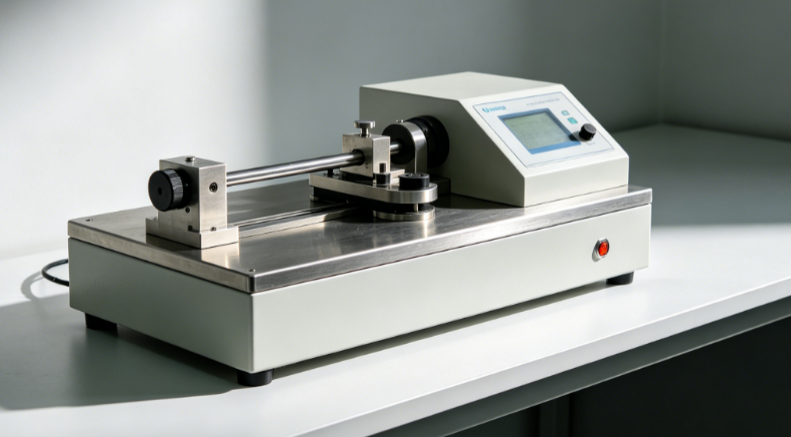
ASTM D1894 (Standard test method for static and kinetic coefficients of friction of plastic film and sheeting). – The most widely used standard for plastic films. Specifies a 200 g sled (63.5 mm × 63.5 mm), wrapped with the test material, pulled over a flat steel plane (or other specified surface) at 150 mm/min. Reports static and kinetic COF.
ISO 8295 (Plastics – Film and sheeting – Determination of the coefficients of friction). – Equivalent to ASTM D1894.
GB/T 10006 (Plastics – Determination of coefficient of friction for film and sheeting). – Chinese national standard.
4.2 Flooring & Walkway Safety
ASTM D4918 (Standard test method for coefficient of friction of resilient flooring materials). – Uses a horizontal pull‑slip meter with standard leather shoe sole.
ASTM D2047 (Standard test method for static coefficient of friction of polish‑coated flooring surfaces). – For waxed or polished floors.
DIN 51131 (Testing of floor coverings – Determination of sliding friction coefficient). – Uses a measurement device with a fixed sliding shoe under defined load.
EN 13893 (Resilient, laminate and textile floor coverings – Determination of dynamic coefficient of friction).
ASTM F1677 (Standard test method for static coefficient of friction of floor surfaces using a portable pull‑slip meter).
4.3 Rubber & Tire Friction
ASTM D1894 (modified for rubber on steel).
ISO 15113 (Rubber – Determination of frictional properties).
4.4 Medical Devices
ASTM D3354 (Standard test method for blocking load of plastic film – relates to friction).
ASTM D1894 (adapted for medical device coatings).
ISO 15325 (Ophthalmic optics – Spectacle frames – Determination of friction of joints).
Custom protocols for catheter insertion testing per FDA guidance.
5. Test Procedure & Specifications (ASTM D1894 / ISO 8295 Example)
Our laboratory follows the standard procedure for plastic film and sheeting as described below. Equivalent procedures are applied for other materials with modifications to load, speed, and surface interface.
Specimen preparation – Test specimens are conditioned at 23±2°C, 50±5% RH for a minimum of 40 hours (or per material specification). The film is cut to a size slightly larger than the sled base (typically 120 mm × 120 mm). The sled base is wrapped with the test film, ensuring a smooth, wrinkle‑free surface. The stationary plane (usually stainless steel or glass) is cleaned with a solvent (e.g., isopropanol) and dried. If testing film‑on‑film, another sheet of film is attached to the plane with double‑sided tape.
Test parameters – Standard sled weight: 200 g ± 5 g (providing a normal force of 1.96 N). Sled size: 63.5 mm × 63.5 mm (ASTM D1894). Test speed: 150 mm/min. Travel distance: at least 130 mm (to obtain a stable sliding region after initial 50‑80 mm). Temperature: 23±2°C.
Test procedure – The sled is placed on the plane surface and attached to the load cell via a non‑stretch string. The crosshead is started at 150 mm/min, and the force is recorded over the entire travel. The peak force (at initiation of sliding) is used to calculate static COF. The average force over the steady‑state sliding region (e.g., from 50 mm to 120 mm) is used to calculate kinetic COF.
Calculation – µs = Fmax / (sled mass × g). µk = Faverage / (sled mass × g). The coefficient of friction is reported as a dimensionless number.
Number of tests – For each material pair, five replicates (or more as specified) are performed, and the mean and standard deviation are reported.
6. Advantages & Limitations of COF Testing
Advantages: Provides objective, quantitative data for material specification, quality control, and safety assessment. Standardised methods (ASTM, ISO) allow direct comparison across suppliers and laboratories. Both static and kinetic COF can be measured in a single test, giving insight into start‑up and running friction. The test is relatively fast (2‑5 minutes per specimen) and requires minimal sample preparation. Multiple surface combinations can be tested (film‑on‑metal, rubber‑on‑flooring, etc.) by changing the stationary plane. The test can be performed at elevated or reduced temperatures, with wet or lubricated conditions, to simulate real‑world environments.
Limitations: Results are highly dependent on surface cleanliness, roughness, and conditioning. Slight contaminants (oil, dust) can dramatically change COF values. The test is a laboratory simulation and may not fully replicate field conditions (e.g., flooring COF on a dry, clean laboratory surface may differ from actual worn, dusty, or wet floor in use). The standard 200 g sled may not represent actual contact pressure for all applications (e.g., heavy‑duty floor traffic). For very soft or tacky materials (some elastomers, adhesives), the sled may deform or cause cohesive tearing, leading to invalid results.
7. Reporting & Result Presentation
Our test reports are detailed, transparent, and compliant with ISO/IEC 17025 and the relevant standard. Each report includes:
Specimen identification – Material name, grade, thickness, surface orientation (film side, machine direction), batch/lot number, and any surface treatment (corona, release coating).
Test conditions – Standard referenced (ASTM D1894, ISO 8295, ASTM D4918, etc.), test temperature and humidity, normal load (g or N), test speed (mm/min), travel distance (mm), sled dimensions, plane material (e.g., stainless steel, glass, rubber), and whether the test was dry, wet, or lubricated.
Individual test data – For each replicate: static COF (µs), kinetic COF (µk), and a force‑distance graph (showing peak and steady‑state region).
Statistical summary – Mean µs, standard deviation; mean µk, standard deviation; coefficient of variation; number of replicates. A statement of whether the results meet specified acceptance criteria.
Calibration records – Force transducer calibration date, load cell accuracy, speed verification.
Compliance statement – Pass/fail determination against customer specification, purchase order, or safety guideline (e.g., “The average wet COF of 0.52 meets the ADA slip resistance requirement of ≥ 0.42”).
Remarks – Any deviations from standard (e.g., increased sled mass, non‑standard plane material, testing with lubricant).
8. Why Choose Our Third‑Party COF Testing Services?
As an independent laboratory, we provide unbiased, accurate, and legally defensible friction data. Our strengths include:
ISO/IEC 17025 accreditation – Our COF testing (ASTM D1894, ISO 8295, ASTM D4918, etc.) is CNAS and CMA accredited, with regular participation in proficiency testing.
Multiple test platforms – We operate universal friction testers with interchangeable plane surfaces (steel, glass, rubber, plastic, flooring materials), temperature‑controlled platens (up to 200°C), and environmental chambers (‑20°C to +100°C) for humidity‑controlled tests.
Wide material coverage – From ultra‑low friction PTFE films (µ ≈ 0.05) to high‑grip rubber flooring (µ > 1.0), we can measure across the full range.
Wet / dry testing – Our custom water, oil, and detergent dispensing systems enable realistic simulation of wet or contaminated surfaces (e.g., spill‑resistant flooring, wet catheters).
Fast turnaround – Routine COF testing (5 specimens, 1 condition) typically completed within 2‑3 business days; multi‑condition studies within 5‑7 business days.
Detailed reporting – Reports include force‑distance curves, statistical summaries, and clear pass/fail conclusions.
Confidentiality – Full protection of your material formulations, product designs, and proprietary surface treatments.
Consultative support – Our tribology engineers assist with parameter selection (sled weight, speed, plane material), interpretation of stick‑slip behavior, and correlation of COF results to end‑use performance (packaging line speed, pedestrian slip risk, medical insertion force).
Whether you need to qualify a new packaging film for high‑speed form‑fill‑seal machinery, certify a floor covering for wet‑area safety, optimize a catheter coating for lubricity, or investigate a consumer complaint about a slippery tablet surface, our coefficient of friction testing experts are ready to deliver reliable, actionable results.
Get Started with Your COF Testing Project
Contact our team with your material type (film, sheet, coating, rubber, flooring, medical device), interface pair (e.g., film‑on‑metal, rubber‑on‑vinyl), required standard (ASTM D1894, ISO 8295, ASTM D4918, custom), and any special conditions (temperature, humidity, lubricant). We will provide a detailed quotation, sample submission guidelines (minimum sample size, conditioning requirements), and a testing schedule. Let us help you quantify the frictional behavior of your surfaces for improved performance, safety, and quality.
This article provides an overview of our coefficient of friction testing capabilities. For specific test methods, sample quantity, and pricing, please request a tailored service proposal.