Reasons for choosing our testing services
ZHONGXI Testing has obtained inspection qualification certifications from multiple countries and regions worldwide. We possess a senior testing team and advanced testing methods, providing independent, impartial, and professional third-party verification services for global carbon projects.

Internationally recognized authority
Certified by multiple international standards such as CNAS, VCS, and GS, with reports universally applicable worldwide.

Global service capability
Covering 140+ countries and regions, it supports on-site detection and remote verification in multiple languages.

Professional experimental methods
Adopt standard experimental methods to ensure accurate and reliable data.
Advanced Performance and Stability Testing of Solid Amine-Based Gas Adsorption Materials: A Comprehensive Analytical Service
Solid amine adsorbents – including amine-functionalized mesoporous silicas (e.g., SBA-15, MCM-41), amine-grafted metal–organic frameworks (MOFs), amine-impregnated polymers, and polyamine-based hybrid composites – have emerged as leading candidates for post-combustion CO₂ capture, direct air capture (DAC), and the removal of acidic gases (H₂S, SO₂, NO₂) from industrial gas streams. Their high selectivity, reversible uptake, and tunable regeneration make them highly attractive. However, the practical performance of these materials is governed by a delicate balance of amine loading, accessible active site density, pore architecture, diffusion kinetics, and long-term stability against oxidative degradation, urea formation, and moisture competition. Reliable, multi-parameter characterization is therefore essential for material development, scale-up, quality control, and field deployment. Our ISO/IEC 17025-accredited laboratory offers a specialized, mechanistic-driven testing service for solid amine adsorbents, providing insights that transcend conventional CO₂ capacity measurements and deliver a complete picture of adsorptive performance, regenerability, and chemical durability under realistic process conditions.
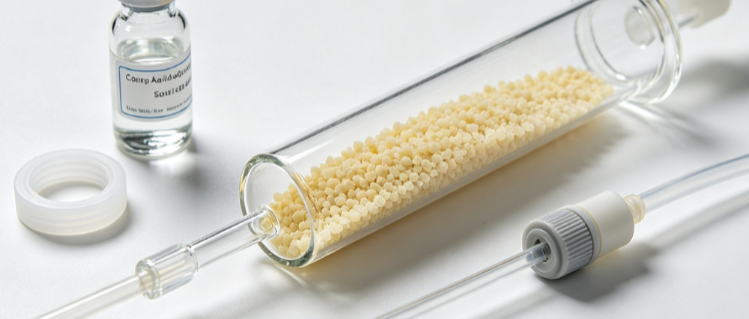
Why In-Depth Solid Amine Adsorbent Testing Is Critical for Carbon Capture and Gas Purification
Clients seeking our testing services typically aim to: (i) quantify the CO₂ working capacity under simulated flue gas or ambient air conditions, (ii) determine the optimal temperature and pressure swing regeneration regimes, (iii) assess the impact of moisture, oxygen, and trace impurities (SO₂, NOₓ) on long-term stability, (iv) diagnose performance loss in aged or field-exposed samples, (v) compare the efficiency of different amine types (primary, secondary, tertiary, or polyethylenimine) and loading methods, or (vi) generate defensible data for process design and techno-economic analysis. Standard gravimetric or volumetric screening is insufficient because solid amine adsorption involves coupled chemisorption (carbamate formation) and physisorption, with mass transfer limitations and heat effects that strongly influence breakthrough behavior. Our integrated platform combines high-pressure Thermogravimetric Analysis (HP-TGA), fixed-bed breakthrough testing, advanced spectroscopic speciation, and accelerated aging studies to deliver a holistic performance and stability profile – enabling clients to confidently select and optimize their adsorbent for specific gas matrices and operating windows.
Our Comprehensive Analytical Suite for Solid Amine Adsorbents
1. Chemical Composition and Amine Loading Quantification
We begin with a precise determination of amine content and distribution. Elemental analysis (CHN/O) provides total nitrogen mass fraction, from which theoretical amine loading (mmol NH₂/g) is calculated. For impregnated amines, we distinguish free vs. grafted species using Thermogravimetric Analysis (TGA) coupled with FTIR of evolved gases – amine decomposition occurs in distinct temperature ranges, enabling quantification with ±0.05 mmol/g precision. Solid-state ¹³C and ²⁹Si MAS NMR (for silica-based supports) identifies the bonding state (mono-, di-, or tri-dentate grafting) and the presence of residual silanol groups. We also perform Boehm-type titration adapted for amine basicity, and colorimetric assays (e.g., ninhydrin method) to measure primary amine content specifically, providing a complete speciation of active sites.
2. Textural Properties and Pore Accessibility
Amine functionalization often reduces porosity and alters pore connectivity. We measure N₂ physisorption at 77 K over the full relative pressure range (10⁻⁶–0.995) to determine BET surface area, total pore volume, and pore size distribution via NLDFT models, with a repeatability of ±1.5% for surface area. For mesoporous supports, we perform small-angle X-ray scattering (SAXS) to confirm periodic ordering and to detect pore blockages. Additionally, we use positron annihilation lifetime spectroscopy (PALS) to probe sub-nanometer free-volume elements that influence gas diffusion – a critical parameter often overlooked but essential for kinetic modeling. Our combined textural analysis ensures that we characterize not just the total porosity but the accessible pore network relevant for gas transport.
3. CO₂ Adsorption Isotherms and Working Capacity
We conduct static volumetric and gravimetric adsorption measurements using a fully automated multi-chamber instrument (0–50 bar, −10 to 150 °C). CO₂ purity is 99.999% and is supplemented with binary or ternary gas mixtures (CO₂/N₂, CO₂/H₂O, CO₂/O₂) via mass flow controllers. We measure pure-component isotherms at multiple temperatures (25, 40, 60, 80 °C) and fit them to Langmuir, Sips, dual-site Langmuir, and Tóth models, with AICc-based model selection. For DAC applications, we perform measurements at very low CO₂ pressures (0.1–10 mbar) using a high-vacuum setup, achieving detection limits of <0.01 mmol/g. The working capacity is determined by simulating temperature-swing (TSA) or pressure-swing (PSA) cycles, and we report the cyclic stability over 100+ consecutive adsorption-desorption cycles – a key metric for practical viability.
4. Dynamic Breakthrough Kinetics and Mass Transfer Analysis
We operate a bench-scale fixed-bed breakthrough apparatus (1–5 cm ID columns, up to 50 cm bed height) under controlled temperature (0–150 °C) and pressure (1–30 bar). The feed gas (CO₂/N₂ or CO₂/air) is humidified (0–80% RH) and optionally spiked with SO₂, NOₓ, or O₂ to mimic real flue gas or ambient conditions. Effluent CO₂ is monitored by online NDIR analyzer and mass spectrometry at 1 Hz frequency, generating high-resolution breakthrough curves. We apply axial dispersion and linear driving force (LDF) models to extract effective diffusivities, mass transfer coefficients, and the length of unused bed (LUB). This dynamic data is essential for scale-up and process design, and we provide dimensionless breakthrough correlations that predict performance under different flow rates and inlet concentrations.
5. Stability and Degradation Studies: Oxidation, Urea Formation, and Moisture Effects
Solid amines are susceptible to oxidative degradation (especially in the presence of O₂ at elevated temperatures) and urea formation via reaction with CO₂ and moisture. We conduct accelerated aging tests in a custom-built environmental chamber that exposes samples to simulated flue gas (CO₂/O₂/N₂/H₂O) at 60–120 °C for up to 30 days. At regular intervals, we extract aliquots and analyze them by FTIR (to detect carbonyl, amide, and urea bands), XPS (for C 1s, N 1s, and O 1s chemical shifts), and TGA-MS (to track changes in decomposition profiles). We also perform solid-state ¹⁵N NMR to distinguish carbamate vs. urea nitrogen environments. Our protocols follow accelerated aging standards (ASTM D5510) and yield deactivation rate constants and lifetime predictions under defined conditions, empowering clients to design appropriate regeneration strategies or protective coatings.
6. Regeneration Efficiency and Energy Requirement
We evaluate multiple regeneration modes: temperature swing (TSA) at 80–150 °C under inert gas or vacuum, pressure swing (PSA), and steam-assisted regeneration. We measure the residual CO₂ loading after each regeneration step and the total energy consumption (sensible heat + desorption heat) using differential scanning calorimetry (DSC) coupled with our gravimetric system. The heat of adsorption is determined directly from DSC or indirectly via Clausius–Clapeyron fitting, with a typical accuracy of ±2 kJ/mol. We then calculate the specific energy penalty (kJ/mol CO₂) and compare it against benchmark materials, providing a clear cost-performance metric for process engineers.
7. Environmental and Safety Compliance Testing
For industrial applications, we assess the potential release of amine vapors (volatile organic amines) and degradation by-products (e.g., nitrosamines, amides) into the gas stream. We perform off-gas analysis using GC–MS with thermal desorption and ion mobility spectrometry (IMS) to detect trace amine emissions down to ppb levels. We also conduct leaching tests for any water-soluble species (in case of water wash) and evaluate the flammability and dust explosion risks according to relevant standards. This safety suite ensures that your material meets occupational exposure limits and environmental release guidelines, a crucial aspect often overlooked in routine testing.
Our Unrivaled Advantages in Solid Amine Adsorbent Testing
1. Fully Integrated Mechanistic Platform: We seamlessly combine thermogravimetric, volumetric, breakthrough, and spectroscopic (NMR, XPS, FTIR) methods with accelerated aging and modeling in a single coordinated workflow. This enables us to correlate, for example, the loss of amine sites (from CHN) with the appearance of degradation products (FTIR, NMR) and the decline in working capacity (breakthrough), providing a cause-and-effect narrative rather than a disconnected set of numbers. Such integrated data are invaluable for root-cause analysis and material redesign.
2. Expertise in Challenging Amine-Based Materials: Solid amines are often hygroscopic, oxygen-sensitive, and prone to structural rearrangement during sample handling. We operate inert-atmosphere gloveboxes for sample preparation and transfer, and we use cryo-grinding to ensure representative sub-sampling without thermal degradation. Our protocols preserve the native state of the adsorbent, as validated by post-handling FTIR and XRD, achieving repeatability better than 2% RSD for capacity measurements across different batches.
3. Advanced Data Analytics and Predictive Modeling: Beyond experimental reporting, we employ transient kinetic modeling using our proprietary software (based on 1D heterogeneous reactor model) to extract intrinsic kinetic constants and activation energies. We also develop artificial neural network (ANN) models trained on our extensive database (over 150 amine sorbents) to predict the optimal amine loading and pore architecture for a given application – saving clients months of trial-and-error synthesis. Our modeling outputs have been validated against pilot-scale data with mean absolute errors < 5%.
4. Regulatory-Ready Quality and Full Traceability: Our facility is accredited under ISO/IEC 17025:2017 for key parameters (CO₂ capacity by gravimetry, elemental analysis, BET, and TGA). All reference gases are certified, and mass flow controllers are calibrated against NIST-traceable standards. We provide full uncertainty budgets (expanded uncertainty, k=2) typically <3% for working capacities, making our data defensible in patent filings, technology demonstrator reports, and regulatory submissions.
5. Collaborative and Transparent Partnership: Each project is managed by a senior adsorption scientist with extensive experience in amine-based materials. We provide interim progress reports and a final comprehensive report that includes graphical summaries, statistical analyses, degradation pathway diagrams, and actionable recommendations for process optimization (e.g., regeneration temperature, moisture pre-treatment). We also offer co-authorship support and draft experimental sections for academic publications (e.g., Chemical Engineering Journal, Industrial & Engineering Chemistry Research), accelerating your dissemination and recognition.
Deliverables That Empower Process Development and Quality Assurance
Our final comprehensive report includes: (a) full chemical composition and amine speciation; (b) N₂ physisorption isotherms and pore size distribution curves; (c) pure and mixed-gas adsorption isotherms with model parameters and confidence intervals; (d) breakthrough curves and derived mass transfer coefficients; (e) cyclic working capacity and long-term stability profiles; (f) degradation product identification and quantified rates; (g) regeneration energy requirements and cost indices; (h) off-gas emissions and safety assessment; (i) a comparative benchmark against reference materials from our database (including commercially available amines like PEI-MCM-41, and benchmark sorbents from literature); and (j) a process design summary with recommended operating windows and performance forecasts. All raw data (isotherm files, breakthrough logs, spectral data) are provided in open formats (CIF, JCAMP-DX, .csv, .msw) for independent analysis.
For clients with continuous R&D pipelines, we offer subscription-based testing packages that include periodic re-characterization of new batches, accelerated aging check-ups, and 24/7 remote data access through our secure client portal. We also provide expert consultation for interpreting results in the context of your specific gas source, capture process, and economic constraints.
Conclusion: Precision Characterization for Next-Generation Solid Amine Sorbents
Solid amine adsorbents hold immense promise for efficient and selective gas capture, but their successful deployment depends on a thorough understanding of their chemical, textural, kinetic, and stability attributes under conditions that mirror real-world operation. Our testing service is designed to furnish precisely this depth – integrating high-precision measurements, advanced spectroscopy, realistic dynamic testing, and predictive modeling to deliver a complete performance and durability blueprint. By choosing our laboratory, you gain access to a platform where scientific rigor meets engineering relevance, ensuring that your solid amine material is not only high-performing but also reliable, safe, and economically viable. Engage with our technical team today to craft a customized testing plan – we are committed to accelerating your carbon capture and gas purification innovations with data you can trust.