Reasons for choosing our testing services
ZHONGXI Testing has obtained inspection qualification certifications from multiple countries and regions worldwide. We possess a senior testing team and advanced testing methods, providing independent, impartial, and professional third-party verification services for global carbon projects.

Internationally recognized authority
Certified by multiple international standards such as CNAS, VCS, and GS, with reports universally applicable worldwide.

Global service capability
Covering 140+ countries and regions, it supports on-site detection and remote verification in multiple languages.

Professional experimental methods
Adopt standard experimental methods to ensure accurate and reliable data.
Comprehensive Structural and Chemical Characterization of High-Silica Mordenite: Advanced Analytical Services for Zeolite Quality and Catalytic Performance
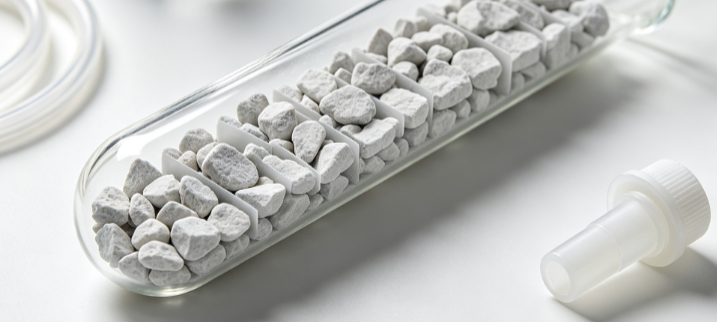
High-silica mordenite (HS-MOR) is a large-pore zeolite with a one-dimensional channel system and a high Si/Al ratio (typically >15), making it a valuable catalyst for isomerization, alkylation, and reforming reactions, as well as for gas separation and adsorption processes. Its performance in these applications is critically dependent on the framework Si/Al ratio, the distribution of aluminium in framework positions, the concentration and strength of Brønsted acid sites, the crystallinity and phase purity, and the textural properties (microporosity and mesoporosity). In addition, the presence of extra-framework species (e.g., aluminium or amorphous silica) can significantly affect activity and stability. Therefore, a rigorous, multi-technique analytical approach is indispensable for material qualification, process optimization, and troubleshooting of deactivation phenomena. Our ISO/IEC 17025-accredited laboratory offers a dedicated, high-level testing service specifically tailored for high-silica mordenite, integrating advanced spectroscopic, diffraction, and thermal methods to deliver a complete structural and chemical fingerprint – far beyond routine Si/Al determination by EDX or simple XRD verification.
Why In-Depth Characterization of High-Silica Mordenite Is Critical for Industrial Applications and Catalyst Development
Clients seeking our testing services typically aim to: (i) accurately determine the framework Si/Al ratio and quantify the amount of extra-framework aluminium, which directly influences acidity and stability, (ii) evaluate the acid site density and the strength distribution (weak vs. strong Brønsted sites), as well as the Brønsted-to-Lewis acid ratio, (iii) confirm the zeolite topology and detect any crystalline impurities (e.g., quartz, amorphous silica, or competing zeolite phases), (iv) measure the crystallite size and the degree of structural order, which affect diffusion and catalyst lifetime, (v) assess the microporous surface area, micropore volume, and the presence of secondary mesoporosity, (vi) evaluate the hydrothermal stability under realistic steaming conditions, and (vii) generate robust data for quality assurance, product certification, and regulatory compliance. Standard single-parameter tests such as total Si/Al by ICP provide only the bulk composition, but the framework Si/Al and the acid site distribution are the true determinants of catalytic behaviour. Our integrated platform combines solid-state ²⁹Si and ²⁷Al MAS NMR for framework composition and coordination analysis, high-resolution X-ray diffraction (HR-XRD) with Rietveld refinement, X-ray fluorescence (XRF) and inductively coupled plasma optical emission spectrometry (ICP-OES) for elemental analysis, X-ray photoelectron spectroscopy (XPS) for surface composition, temperature-programmed desorption of ammonia (NH₃-TPD) and pyridine-adsorbed Fourier-transform infrared spectroscopy (FTIR) for acidity characterisation, N₂ and Ar physisorption for textural analysis, scanning electron microscopy (SEM) with energy-dispersive X-ray spectroscopy (EDS) for morphology and elemental mapping, and Thermogravimetric Analysis (TGA) for thermal stability and template removal efficiency – providing a comprehensive and correlative quality assessment.
Our Comprehensive Analytical Framework for High-Silica Mordenite
1. Framework Composition and Aluminium Speciation
We determine the bulk Si/Al ratio by ICP-OES after microwave-assisted acid digestion, with a precision of ±1% and a detection limit of 0.1 mg/kg. However, to distinguish framework aluminium (Al in tetrahedral coordination) from extra-framework aluminium (octahedral or polymeric Al species), we perform solid-state ²⁹Si MAS NMR with spectral deconvolution to quantify the relative amounts of Q⁴(nAl) species, where n = 0–4, providing a direct measure of the framework Si/Al ratio. Simultaneously, ²⁷Al MAS NMR at high magnetic field (≥600 MHz) is used to quantify tetrahedral framework Al (δ ~55 ppm) and octahedral extra-framework Al (δ ~0 ppm). The percentage of framework aluminium is reported with an uncertainty of ±2%. We also use XPS to assess the surface Si/Al ratio, which often differs from the bulk due to dealumination or surface enrichment, and we correlate these results with the NH₃-TPD data to understand the acid site distribution.
2. Crystal Structure, Phase Purity, and Lattice Parameters
We perform high-resolution powder X-ray diffraction (HR-XRD) with Cu Kα radiation and a step size of 0.005° 2θ over the 5°–60° range, and, for refined structure analysis, we use synchrotron radiation to detect minor impurities (<0.5 wt%). Rietveld refinement is carried out using TOPAS or GSAS to determine the precise lattice parameters (a, b, c, and β), the fractional atomic coordinates, and the site occupancies, especially for the extra-framework cations (Na⁺, H⁺) if present. The crystallite size is estimated from the Scherrer equation and from Williamson–Hall analysis to account for microstrain. We also compute the relative crystallinity by comparing the integrated intensity of the main peaks (e.g., (200), (020), (150)) against a well-defined reference standard. This phase analysis is essential to confirm the absence of amorphous silica or other zeolite topologies that may compromise catalytic selectivity.
3. Acidity Characterisation: Site Density, Strength, and Type
We quantify the total acid site density using NH₃-TPD with online mass spectrometry, from 100 °C to 800 °C, resolving weak (desorption <300 °C), medium (300–500 °C), and strong (>500 °C) acid sites. To differentiate between Brønsted and Lewis acidity, we employ pyridine-adsorbed FTIR with in situ evacuation at 150 °C, 250 °C, and 350 °C; the characteristic bands at 1545 cm⁻¹ (Brønsted) and 1450 cm⁻¹ (Lewis) are quantified using integrated molar extinction coefficients, yielding the B/L ratio and the absolute concentrations of each site type (μmol/g). For a detailed acid-strength distribution, we additionally use ³¹P MAS NMR with trimethylphosphine oxide (TMPO) as a probe, which provides chemical shifts directly correlated with the acid strength (e.g., 60 ppm for weak, 86 ppm for superstrong sites). The acidity data are then correlated with the framework Al content and the dealumination history to derive a structure–activity relationship for specific catalytic reactions (e.g., hydroisomerisation).
4. Textural Properties: Microporosity, Mesoporosity, and Surface Area
We perform N₂ physisorption at 77 K over a wide relative pressure range (10⁻⁶–0.995) to obtain the BET-specific surface area (reproducibility ±1.5%), the micropore volume (via t-plot and NLDFT), and the external surface area. For microporous zeolites, we also measure Ar physisorption at 87 K to achieve a more accurate micropore size distribution, especially in the sub-nanometre range. The pore size distribution is derived using NLDFT and QSDFT models. The mesopore volume is determined from the Barrett–Joyner–Halenda (BJH) method applied to the desorption branch. We also perform mercury intrusion porosimetry to evaluate the macroporosity and interparticle voids, which affect mass transfer in pelletised catalysts. These data are critical for predicting diffusion limitations and for designing hierarchical structures.
5. Hydrothermal and Thermal Stability
We subject the mordenite samples to hydrothermal aging in a custom-built stainless-steel reactor with 100% steam at 150–600 °C for up to 7 days, followed by re-characterisation using XRD, BET, and ²⁷Al NMR to quantify the loss of crystallinity, surface area, and framework Al. From these data, we derive the hydrothermal stability index (percentage of retained properties) and the temperature at which significant dealumination or structure collapse occurs. We also perform Thermogravimetric Analysis (TGA) coupled with differential scanning calorimetry (DSC) and evolved gas mass spectrometry (MS) from 30 °C to 900 °C under air and nitrogen, monitoring the desorption of water, the decomposition of organic templates (if any), and the dehydroxylation of the zeolite. The thermal behaviour is correlated with the acidity and the structural integrity to provide a comprehensive stability assessment.
6. Morphology, Particle Size, and Elemental Distribution
We use field-emission scanning electron microscopy (FE-SEM) at low accelerating voltage to image the crystal shape (needle-like or prismatic), the crystal size distribution, and any surface defects. The particle size distribution is measured by laser diffraction (wet dispersion) from 0.1 to 3500 µm, reporting D10, D50, D90, and the span. For sub-micrometre crystals, we use transmission electron microscopy (TEM) with selected-area electron diffraction (SAED) to confirm the mordenite structure and to detect amorphous coatings or occluded phases. Elemental mapping by STEM-EDS at the nanoscale reveals the spatial distribution of Si, Al, and any impurities (e.g., Fe, Na), providing insight into compositional zoning or local dealumination.
7. Trace Impurity and Cation Analysis
We screen for trace metallic impurities (e.g., Fe, Ti, Cr, Ni, Cu, Na, K, Ca, Mg) by inductively coupled plasma mass spectrometry (ICP-MS) after acid digestion, with detection limits in the sub-ppb range. The cation exchange capacity (CEC) and the nature of extra-framework cations (Na⁺, H⁺) are determined by atomic absorption spectroscopy (AAS) after ion-exchange with ammonium acetate. This information is essential for evaluating the purity and for adjusting the ion-exchange procedures to achieve the desired H-form or metal-exchanged form.
8. Catalytic Performance Screening (Optional)
For clients requiring direct validation of the material, we offer catalytic test reactions such as the isomerisation of n-butane, the cracking of cumene, or the methanol-to-hydrocarbon (MTH) reaction, using a fixed-bed microreactor with on-line GC analysis. The conversion, selectivity, and deactivation rate are measured and correlated with the acidity and textural data, providing a complete feedback loop for material optimization.
Our Distinctive Advantages in High-Silica Mordenite Testing
1. Unrivalled Framework Speciation and Acidity Profiling: We uniquely combine multinuclear solid-state NMR (²⁹Si, ²⁷Al, ¹H, ³¹P), XPS, NH₃-TPD, and pyridine-FTIR to provide a comprehensive picture of aluminium distribution, acid site type, and strength. This integrated approach allows us to accurately quantify the true framework Si/Al ratio, distinguish extra-framework aluminium, and map the acid site heterogeneity – information that is critical for predicting catalytic selectivity and stability, and which is unavailable from conventional bulk analysis.
2. Advanced Crystallographic and Microstructural Analysis: Our access to synchrotron radiation for HR-XRD and total scattering enables us to resolve subtle structural changes, such as disorder, stacking faults, or the presence of trace impurities, at a level of precision that is rarely attainable in routine laboratory XRD. Combined with Rietveld refinement and pair distribution function (PDF) analysis, we can detect structural features that influence diffusion and reactivity, providing a truly detailed structural fingerprint.
3. Expertise in Handling Dealuminated and Acidic Zeolites: High-silica mordenite is often dealuminated and may contain sensitive surface species. We perform all sample preparation and handling under controlled inert or dry conditions, using glovebox and vacuum transfer techniques to preserve the native state of the zeolite. Our methods have been validated on numerous industrial MOR samples, achieving inter-laboratory reproducibility within 2% RSD for framework Si/Al and acidity measurements.
4. Regulatory-Grade Quality and Full Traceability: Our laboratory is accredited under ISO/IEC 17025:2017 for XRD, NMR (solid-state), ICP-OES, NH₃-TPD, and physisorption. We use NIST-traceable reference materials and certified zeolite standards (e.g., NIST SRM 8850, ZSM-5 reference). All uncertainties are reported with expanded uncertainties (k=2) typically <2% for Si/Al ratios and <3% for acid site densities, ensuring the data are defensible in technical data sheets, patent submissions, and regulatory approvals.
5. Consultative Scientific Partnership and Application Support: Each project is led by a senior zeolite chemist with extensive industrial experience. We provide interpretative reports that not only list the data but also correlate the acidity with the catalytic performance, the hydrothermal stability with the dealumination process, and the textural properties with the diffusion efficiency. We offer actionable recommendations for synthesis optimisation (e.g., adjustment of Si/Al ratio, steaming conditions, or cation exchange) and for quality control. We also provide co-authorship support for research publications and assist in drafting methods sections for high-impact journals.
Report Deliverables and Client Empowerment
Our final comprehensive report includes: (a) framework Si/Al ratio from ²⁹Si NMR and bulk Si/Al from ICP; (b) quantification of framework and extra-framework Al from ²⁷Al NMR; (c) XRD diffractogram with Rietveld refinement – lattice parameters, phase purity, crystallite size, and relative crystallinity; (d) acidity data – total acid density, B/L ratio, and acid strength distribution from NH₃-TPD, pyridine-FTIR, and TMPO-NMR; (e) textural properties – BET surface area, micropore volume, mesopore volume, and pore size distribution; (f) thermal and hydrothermal stability indices from TGA-DSC-MS and post-steaming characterisation; (g) SEM and TEM images with EDS/STEM-EDS elemental maps; (h) particle size distribution and trace impurity profile (ICP-MS); (i) optional catalytic test results; (j) a benchmarking summary comparing your material with reference MOR samples and competitor products; and (k) a process optimisation roadmap with specific recommendations. All raw data (NMR spectra, diffractograms, isotherms, thermograms, images) are supplied in open, machine-readable formats (CIF, JCAMP-DX, .csv, .tiff, .mzML) for independent verification and long-term data archiving.
We also offer subscription-based quality surveillance programs for regular batch testing, with trend analysis and statistical quality control (SQC) charts. Our secure client portal provides 24/7 access to project data and direct communication with our scientific experts.
Conclusion: Precision Characterization for High-Performance High-Silica Mordenite
High-silica mordenite is a versatile material whose performance in industrial catalysis and separation relies on a precise understanding of its framework composition, acid site architecture, pore structure, and stability. Our testing service delivers that understanding – integrating advanced solid-state NMR, high-resolution diffraction, detailed acidity measurements, textural analysis, and stability assessments with expert interpretation. By choosing our laboratory, you gain a trusted partner that ensures your mordenite consistently meets the most demanding specifications, accelerates your catalyst development, and enhances your process efficiency. Partner with our team today to design a customized testing protocol – we are committed to advancing your innovation with unparalleled analytical depth and scientific rigour.