Reasons for choosing our testing services
ZHONGXI Testing has obtained inspection qualification certifications from multiple countries and regions worldwide. We possess a senior testing team and advanced testing methods, providing independent, impartial, and professional third-party verification services for global carbon projects.

Internationally recognized authority
Certified by multiple international standards such as CNAS, VCS, and GS, with reports universally applicable worldwide.

Global service capability
Covering 140+ countries and regions, it supports on-site detection and remote verification in multiple languages.

Professional experimental methods
Adopt standard experimental methods to ensure accurate and reliable data.
Comprehensive Performance and Quality Assessment of Photocatalytic Honeycomb Activated Carbon for Formaldehyde Degradation: Advanced Analytical Services for Indoor Air Purification Materials
Honeycomb activated carbon (HAC) loaded with photocatalytic semiconductors (e.g., TiO₂, ZnO, or doped/mixed oxides) represents a class of high-efficiency composite materials for the removal of gaseous formaldehyde (HCHO) through combined physical adsorption and photocatalytic oxidation (PCO). The honeycomb structure offers a low pressure drop, high geometric surface area, and excellent mass transfer characteristics, while the photocatalyst enables the destruction of adsorbed formaldehyde into CO₂ and H₂O under UV or visible light, thereby extending the service life beyond simple adsorption. However, the actual performance of this composite is governed by a complex interplay of carbon pore architecture, photocatalytic dispersion and crystallinity, interfacial charge transfer, light penetration depth, humidity effects, and reaction kinetics, all of which must be thoroughly characterized to validate product claims, optimize manufacturing, and ensure reliable indoor air quality outcomes. Our ISO/IEC 17025-accredited laboratory offers a dedicated, multi-technique testing service for photocatalytic honeycomb activated carbon, integrating advanced material characterization, dynamic flow-through photo-reaction testing, and mechanistic studies to deliver a complete performance and durability profile – far beyond simple static batch tests.
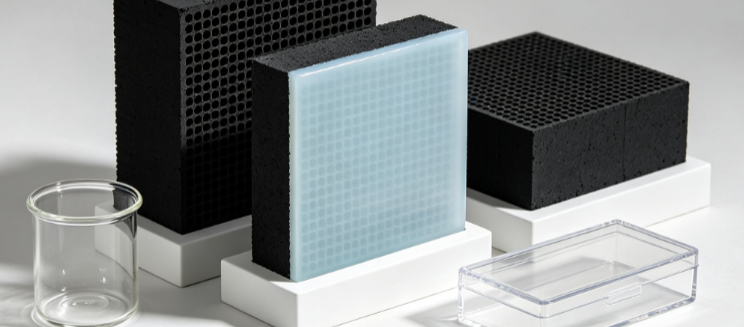
Why Comprehensive Testing of Photocatalytic Honeycomb Carbon Is Critical for Product Validation and Market Differentiation
Clients seeking our testing services typically aim to: (i) quantify the formaldehyde single-pass removal efficiency and the clean air delivery rate (CADR) under realistic airflow, humidity, and light conditions, (ii) determine the dynamic adsorption capacity and the photocatalytic regeneration efficiency, (iii) evaluate the distribution and adherence of the photocatalyst on the carbon surface and within the honeycomb channels, (iv) assess the potential for by-product formation (e.g., formic acid, CO, or volatile organic intermediates), (v) measure the long-term stability and the effect of deactivation by dust or moisture, (vi) compare different material formulations (carbon type, catalyst loading, binder) to optimize cost-performance, and (vii) generate robust data for product certifications (e.g., GB/T 18801, JIS Z 2801, or CARB compliance). Conventional static desiccator tests are insufficient because real air purifiers operate under continuous flow, and the synergy between adsorption and photocatalysis is strongly dependent on residence time, light distribution, and mass transfer. Our integrated platform combines dynamic photoreactor breakthrough testing, real-time gas monitoring, advanced surface spectroscopy, and post-mortem analysis to provide a holistic understanding of the material's performance and failure modes.
Our Advanced Analytical Framework for Photocatalytic Honeycomb Activated Carbon
1. Physical and Structural Characterization of the Honeycomb Substrate
We begin with a complete assessment of the bare and coated honeycomb structure. X-ray computed tomography (XCT) provides a 3D reconstruction of the channel geometry, wall thickness, open frontal area, and uniformity of the photocatalyst coating, with a spatial resolution of 1 µm. Mercury intrusion porosimetry and N₂ physisorption (BET, micropore volume, pore size distribution) characterize the carbon's micro- and mesoporosity, while helium pycnometry determines the skeletal density. The coating thickness and morphology are evaluated by scanning electron microscopy (SEM) with EDS elemental mapping, and by optical profilometry for surface roughness. We also perform compressive strength tests to ensure mechanical integrity under flow conditions. These data provide a baseline for correlating structural features with adsorption and photocatalytic performance.
2. Photocatalyst Phase, Crystallinity, and Loading Quantification
The photocatalytic component (typically TiO₂, but also ZnO, WO₃, or doped variants) is characterized by powder X-ray diffraction (XRD) after gently separating the coating from the carbon, or by grazing-incidence XRD directly on the honeycomb surface to identify the crystalline phase (anatase, rutile, brookite) and the crystallite size (via Scherrer equation) with a precision of ±0.2 nm. The loading of the photocatalyst (wt%) is determined by Thermogravimetric Analysis (TGA) in air, from 30 °C to 800 °C, monitoring the weight loss due to carbon burn-off and the residual oxide mass. For elemental composition, we use inductively coupled plasma optical emission spectrometry (ICP-OES) after acid digestion to quantify Ti, Zn, W, etc., and X-ray photoelectron spectroscopy (XPS) to assess the surface chemical states (e.g., Ti⁴⁺/Ti³⁺ ratio, oxygen vacancies) and the presence of dopants or surface modifiers.
3. Optical Properties and Light Absorption Efficiency
We measure the UV-Vis diffuse reflectance spectroscopy (DRS) of the coating (separated or on a flat surrogate substrate) to determine the bandgap energy via the Tauc plot, and to assess the light absorption edge and any red-shift due to doping. To evaluate the light penetration through the honeycomb channels, we perform in situ optical transmission measurements at multiple wavelengths using a fiber-optic probe, quantifying the attenuation of irradiance along the channel length – critical for predicting the volumetric photocatalytic efficiency. We also measure the photoluminescence (PL) spectrum and the time-resolved PL (TRPL) to assess the charge carrier recombination rate, which directly correlates with the quantum yield of the photocatalyst.
4. Dynamic Flow-Through Photocatalytic Performance Testing
We operate a custom-designed single-pass and recirculation photoreactor that accommodates honeycomb monoliths of various sizes (diameter up to 150 mm, length up to 300 mm). The system precisely controls the airflow (0.5–10 m³/h), temperature (15–40 °C), relative humidity (10–90% RH), and formaldehyde inlet concentration (0.1–5 ppm), using a certified permeation tube or gas cylinder. The light source (UV-A, UV-C, or visible LED arrays) is positioned to simulate the actual illumination geometry, and the irradiance (mW/cm²) is measured by a calibrated radiometer. Downstream formaldehyde is monitored continuously by a high-sensitivity FTIR spectrometer (LOD: 5 ppb) and a DNPH-HPLC system for cross-validation. We derive the single-pass removal efficiency, the CADR, the breakthrough curve (in the dark adsorption phase), and the steady-state conversion under illumination. For recirculation tests, we determine the decay constant of formaldehyde concentration over time, simulating real room conditions. We also perform multiple flow velocity tests to extract the mass transfer coefficient and the intrinsic reaction rate constant using a validated 1D reactor model.
5. By-Product Identification and Off-Gassing Analysis
A critical safety aspect is the potential formation of secondary pollutants such as formic acid, methanol, CO, or ozone. We use a proton-transfer-reaction mass spectrometer (PTR-MS) for real-time monitoring of volatile organic compounds (VOCs) and a GC-MS with thermal desorption for comprehensive speciation. Carbonyl compounds are collected on DNPH cartridges and analyzed by HPLC-UV. We also measure carbon monoxide (CO) using a non-dispersive infrared (NDIR) analyzer with a LOD of 0.1 ppm. If any by-products are detected at concentrations above the established safety limits (e.g., EPA or WHO guidelines), we report them quantitatively and recommend operational adjustments to minimize their generation.
6. Humidity Effects and Long-Term Stability
Water vapor can competitively adsorb on active sites and affect the photocatalytic oxidation pathway. We evaluate the performance across a humidity gradient (10–90% RH) and construct a humidity response surface to identify the optimal range for maximum formaldehyde removal. We also conduct accelerated aging tests under continuous UV irradiation and humidified air for up to 500 hours, periodically measuring the formaldehyde conversion, the photocatalyst structural integrity (XRD, XPS), and the carbon pore characteristics (BET). We report the deactivation rate and the half-life of the photocatalytic activity, enabling clients to predict the service life and to plan for maintenance or replacement.
7. Dust Loading and Regeneration Assessment
In real environments, dust accumulation can block the honeycomb channels and reduce the effective irradiation. We simulate dust loading by introducing standard test dust (ISO 12103-1) into the airflow, and we measure the pressure drop increase and the performance decay. We then evaluate the regeneration efficiency by rinsing with water or low-pressure air, and we re-measure the formaldehyde conversion to assess the recoverability. These data are essential for product specifications and for guiding end-user cleaning procedures.
8. Comparative Benchmarking and Statistical Analysis
We maintain a proprietary database of photocatalytic honeycomb materials (including commercial references and literature benchmarks). For each client, we perform a side-by-side comparison under identical test conditions, reporting the performance percentiles and ranking. We also apply multivariate statistical analysis (PCA, PLS) to correlate the measured material properties (crystallite size, bandgap, specific surface area, catalyst loading) with the photocatalytic performance metrics, providing a descriptor-based optimization that guides formulation improvements. This predictive capability accelerates R&D and reduces the need for extensive trial-and-error experiments.
Our Distinctive Advantages in Photocatalytic Honeycomb Carbon Testing
1. Fully Integrated Dynamic and Molecular-Level Platform: We uniquely combine real-time flow photoreactor testing, PTR-MS by-product screening, advanced spectroscopy (XRD, XPS, DRS, PL), and post-reaction characterization (SEM, BET, TGA) in a single coordinated workflow. This allows us to correlate the macroscopic removal efficiency (from breakthrough curves) with the microscopic photocatalyst properties (crystallinity, defect density, bandgap) and the reaction intermediates (from PTR-MS), providing a complete mechanism–performance linkage that is indispensable for diagnosing underperformance and for engineering improved materials.
2. Handling of Large-Format and Heterogeneous Monoliths: Honeycomb samples can be large and have anisotropic properties. We have developed sub-sampling strategies that preserve the representative structure, including core-drilling from different positions and flow-direction segments. Our custom photoreactor accommodates full-sized monoliths up to 150 mm diameter and 300 mm length, and we provide spatial performance mapping by dividing the monolith into sections for separate analysis. Our protocols have been validated on over 80 different honeycomb formulations with inter-laboratory reproducibility within 3% RSD for CADR and breakthrough capacity.
3. Advanced Data Modeling and Predictive Tools: We employ computational fluid dynamics (CFD) coupled with surface reaction kinetics to simulate the performance in user-specified operating conditions, and we validate these models with our experimental data. We also use machine learning (gradient boosting, random forest) to predict the long-term performance based on accelerated aging data, providing a lifetime prediction model that is calibrated against real-time aging experiments. These predictive tools are offered as part of our consulting service, enabling clients to confidently design their products for specific market requirements.
4. Regulatory-Ready Quality and Full Traceability: Our facility is accredited under ISO/IEC 17025:2017 for key test methods (formaldehyde concentration by FTIR and DNPH, airflow measurement, UV irradiance calibration, and photocatalytic testing per ISO 22197-1). We use NIST-traceable standards for formaldehyde, flow, and light intensity. All uncertainties are reported with expanded uncertainties (k=2) typically <4% for removal efficiency and <5% for capacity, making our data defensible in product claims, regulatory submissions, and patent applications.
5. Expert Scientific Consultation and Actionable Reporting: Each project is led by a senior chemical engineer with deep expertise in adsorption and photocatalysis. We provide comprehensive interpretative reports that include detailed performance curves, by-product risk assessments, mechanistic diagrams, and explicit recommendations for material optimization (e.g., adjusting the catalyst loading, improving the binder formulation, or modifying the calcination temperature). We also offer co-authorship support for academic publications and draft the methods sections in compliance with journals like Building and Environment and Chemical Engineering Journal, accelerating your innovation cycle.
Report Deliverables That Empower Product Development and Quality Assurance
Our final comprehensive report includes: (a) full structural characterization – honeycomb geometry, pore structure, photocatalyst loading, crystallite size, phase composition, and bandgap; (b) dynamic breakthrough curves with derived single-pass efficiency, CADR, mass transfer coefficient, and intrinsic kinetic constants; (c) humidity and flow rate response surfaces; (d) by-product speciation and quantified emission rates; (e) accelerated aging and deactivation profiles with lifetime predictions; (f) dust loading and regeneration efficiency data; (g) a benchmarking section comparing your material against reference samples from our database; (h) a process optimization summary with recommended synthesis and operating parameters; and (i) a risk assessment for formaldehyde breakthrough and secondary pollutant formation. All raw data (concentration logs, chromatograms, spectra, images, etc.) are supplied in open, machine-readable formats (CDF, JCAMP-DX, .csv, .tiff) for independent verification.
For clients with ongoing production, we offer subscription-based quality surveillance programs that include periodic batch testing, rapid troubleshooting of field returns, and on-site training for your QA/QC team. Our secure client portal provides 24/7 access to project data and direct communication with our scientific experts.
Conclusion: Precision Testing for Reliable and High-Performing Photocatalytic Air Purification Solutions
Photocatalytic honeycomb activated carbon is a sophisticated composite material that offers a compelling solution for indoor formaldehyde removal, but its successful market deployment requires rigorous, multi-dimensional characterization that goes beyond simple adsorption capacity. Our testing service delivers exactly that – integrating dynamic flow performance, detailed physicochemical analysis, by-product safety screening, and predictive modeling to provide a complete performance and durability assessment. By choosing our laboratory, you gain access to a platform where scientific excellence meets industrial practicality, ensuring that your honeycomb material achieves the highest efficiency, safety, and longevity for your target applications. Engage with our expert team today to design a customized testing protocol – we are committed to helping you deliver trustworthy and effective air purification products that meet the highest standards of indoor environmental quality.