Reasons for choosing our testing services
ZHONGXI Testing has obtained inspection qualification certifications from multiple countries and regions worldwide. We possess a senior testing team and advanced testing methods, providing independent, impartial, and professional third-party verification services for global carbon projects.

Internationally recognized authority
Certified by multiple international standards such as CNAS, VCS, and GS, with reports universally applicable worldwide.

Global service capability
Covering 140+ countries and regions, it supports on-site detection and remote verification in multiple languages.

Professional experimental methods
Adopt standard experimental methods to ensure accurate and reliable data.
Comprehensive Characterization and Performance Testing of Silica-Based Granular Adsorbents: Advanced Analytical Services for Industrial Gas and Liquid Purification
Silica-based granular adsorbents – including silica gel, mesoporous silicas (e.g., SBA-15, MCM-41), functionalized silicas (e.g., amino-, mercapto-, or phenyl-modified), and composite silica materials – are widely employed in gas drying, volatile organic compound (VOC) removal, CO₂ capture, heavy metal ion adsorption, and chromatographic separations. Their performance hinges on a delicate interplay of specific surface area, pore architecture, particle size distribution, mechanical strength, surface chemistry (silanol density and functional group loading), and dynamic adsorption capacity under realistic flow and temperature conditions. A rigorous, multi-dimensional analytical evaluation is therefore indispensable for material selection, quality assurance, process scale-up, and troubleshooting of field failures. Our ISO/IEC 17025-accredited laboratory offers a dedicated, mechanistic-driven testing service specifically tailored for silica-based granular adsorbents, integrating advanced physicochemical, textural, thermal, and dynamic breakthrough methods to deliver a complete performance and durability profile – beyond simple BET surface area or static batch isotherms.
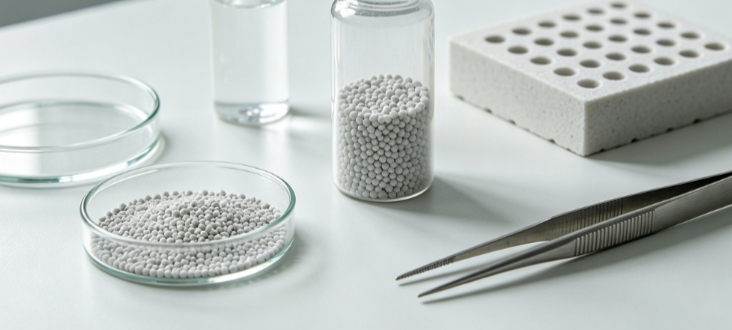
Why In-Depth Characterization of Silica Granular Adsorbents Is Critical for Industrial Applications
Clients seeking our testing services typically aim to: (i) determine the specific surface area, pore volume, and pore size distribution to confirm the material's textural quality, (ii) measure the particle size distribution and mechanical attrition resistance to ensure suitability for packed-bed or fluidized-bed operations, (iii) quantify the density and concentration of surface functional groups (e.g., silanols, organic grafts) that govern selectivity and capacity, (iv) evaluate the static and dynamic adsorption capacities for target adsorbates (water, VOCs, CO₂, metal ions) under controlled temperature, humidity, and gas composition, (v) assess the regeneration efficiency and long-term cyclic stability, (vi) diagnose deactivation due to fouling, hydrolysis, or thermal degradation, and (vii) generate robust data for product certification, patent filings, and process design. Routine single-parameter tests (e.g., single-point BET or loss-on-ignition) are insufficient because the real-world performance depends on the coupled effects of pore diffusion, surface reaction kinetics, and hydrodynamic flow distribution. Our integrated platform combines N₂/Ar physisorption, mercury porosimetry, laser diffraction, dynamic breakthrough testing, Thermogravimetric Analysis, FTIR, XPS, solid-state NMR, and standardized adsorption isotherm measurements to provide a holistic, mechanism-informed evaluation that directly correlates material properties with practical separation efficiency.
Our Comprehensive Analytical Framework for Silica-Based Granular Adsorbents
1. Physical and Textural Characterization: We measure the specific surface area (BET) and total pore volume by N₂ physisorption at 77 K (or Ar at 87 K for micropore analysis) over a wide relative pressure range (10⁻⁶–0.995). Pore size distributions are obtained via NLDFT, BJH, and QSDFT models, with a reproducibility of ±1.5% for surface area and ±2% for pore volume. For macroporosity and interparticle voids, we use mercury intrusion porosimetry up to 600 MPa, providing pore throat distributions and bulk density. The particle size distribution (0.1–3000 µm) is determined by laser diffraction with dry and wet dispersion, and we report the D10, D50, D90, and span. Helium pycnometry yields the skeletal density, and envelope density is measured by mercury displacement. Mechanical integrity is assessed by side-crushing strength for individual particles and attrition resistance according to ASTM D5757, generating a mechanical durability index that predicts particle breakage during handling and operation.
2. Chemical Composition and Surface Chemistry: The bulk elemental composition (Si, O, and any heteroatoms or dopants) is quantified by X-ray fluorescence (XRF) and inductively coupled plasma optical emission spectrometry (ICP-OES) after fusion or microwave digestion, with detection limits in the ppm range. The surface functional groups – silanol (Si–OH), organic grafts (amine, thiol, phenyl), and adsorbed water – are characterized by diffuse reflectance infrared Fourier transform spectroscopy (DRIFTS) with in situ heating and evacuation, and by solid-state ²⁹Si and ¹³C CP/MAS NMR to distinguish Q², Q³, Q⁴ silicon environments and to quantify the degree of condensation and functionalization. The surface acidity is probed by temperature-programmed desorption (TPD) of ammonia and by pyridine-adsorbed FTIR to differentiate Brønsted and Lewis acid sites. For functionalized silicas, we perform elemental analysis (CHN/O) to determine the loading of organic groups (mmol/g), and titration methods (e.g., acid–base or complexometric) to confirm accessible surface site density.
3. Static Adsorption Isotherms and Selectivity: We measure gravimetric and volumetric adsorption isotherms for target adsorbates – including water vapor, nitrogen, CO₂, CH₄, H₂S, VOCs (toluene, acetone, hexane), and metal ions (e.g., Pb²⁺, Cd²⁺) in aqueous solution. For gases, we use a fully automated multi-chamber instrument (0–50 bar, −10 to 150 °C), with ultra-high-purity adsorbates and mass flow controllers for mixed gases. For liquids, we perform batch equilibration with controlled pH, ionic strength, and temperature, followed by analysis using UV-Vis spectrophotometry, HPLC, or ICP-MS. We fit the isotherm data to Langmuir, Freundlich, Sips, and Tóth models with AICc-based selection, and we report the monolayer capacity (Qm), affinity constant (K), and the selectivity coefficient for binary or multicomponent mixtures. Our isotherm measurements achieve an R² > 0.995 for most systems, and we provide full confidence intervals for all fitted parameters.
4. Dynamic Breakthrough and Column Performance: We operate a custom-built fixed-bed breakthrough system (1–5 cm ID columns, up to 1 m bed height) with precise control of gas/liquid flow rate (0.1–100 mL/min), temperature (5–80 °C), and inlet concentration. Effluent concentrations are monitored online by FTIR, GC-FID, or ICP-MS with a time resolution of 1 second. We generate breakthrough curves and derive the dynamic adsorption capacity (at 5% and 10% breakthrough), the length of mass transfer zone (MTZ), and the utilization efficiency of the bed. Using mathematical models (Thomas, Yoon–Nelson, and the linear driving force model), we extract mass transfer coefficients and effective pore diffusion coefficients, which are essential for scale-up and for predicting performance under varying operating conditions. We also evaluate the effect of competing species (e.g., water vapor in gas streams, or co-ions in liquid) and report the dynamic selectivity factor.
5. Regeneration and Cyclic Stability: We conduct thermal swing (TSA) regeneration (heating in inert or reactive gas up to 350 °C), pressure swing (PSA), or solvent washing protocols. For each cycle, we measure the residual adsorbate loading and the recovery of capacity. We perform up to 100 cycles and characterize the adsorbent after every 10 cycles by BET, FTIR, and XRD to track any structural or chemical changes – such as siloxane formation, sintering, or loss of functional groups. We report the deactivation rate constant and the cumulative capacity loss, and we provide a recommended regeneration protocol that balances energy consumption and lifetime extension.
6. Thermal and Hydrothermal Stability: Using Thermogravimetric Analysis (TGA) coupled with differential scanning calorimetry (DSC) and mass spectrometry (MS), we monitor the mass loss and heat flow from 30 °C to 1000 °C under air, N₂, and steam-containing atmospheres. We identify the desorption of physically adsorbed water, the dehydroxylation of silanols, and the decomposition of organic grafts. For hydrothermal stability, we expose the adsorbent to 100% steam at 150–300 °C for up to 7 days and then re-characterize the textural and chemical properties. The thermal stability index (temperature at which 5% weight loss occurs) and the hydrothermal degradation factor (percentage of surface area retained) are reported, providing critical data for applications in high-temperature or high-humidity environments.
7. Chemical Resistance and Leaching Assessment: We test the adsorbent’s resistance to acids, bases, and organic solvents by soaking in representative solutions (e.g., 1 M HCl, 1 M NaOH, toluene, ethanol) for 24–72 hours, followed by measurements of mass loss, surface area, and functional group integrity (FTIR, XPS). We also analyze the leachate for silicon and any heavy metals by ICP-MS, ensuring that the material does not release harmful species under operational or accidental conditions. These data are essential for environmental compliance and for qualifying the adsorbent for food-contact or pharmaceutical applications.
Our Distinctive Advantages in Silica-Based Adsorbent Testing
1. Fully Integrated Physicochemical and Performance Platform: We uniquely combine textural analysis (BET, porosimetry, laser diffraction), chemical speciation (FTIR, NMR, XPS, TGA-MS), static and dynamic adsorption measurements, and cyclic regeneration studies in a single coordinated workflow. This enables us to correlate the pore structure and surface chemistry with the breakthrough behavior and deactivation kinetics, producing a complete performance–structure–durability relationship that is invaluable for material development and process optimization. Such integrated insights are rarely offered by conventional contract laboratories.
2. Expertise in Challenging Granular Materials: Silica particles can be friable, hygroscopic, and electrically insulating, which complicates handling and analysis. We have developed gentle sample preparation protocols – including cryogenic grinding, non-destructive degassing, and electrostatic-free dispersion – to ensure that the measured properties truly represent the as-received material. Our procedures are validated on over 200 different granular silicas (including pure, doped, and functionalized types) with inter-laboratory reproducibility within 2% RSD for key metrics such as surface area, pore volume, and dynamic capacity.
3. Advanced Modeling and Predictive Analytics: We employ computational fluid dynamics (CFD)-based reactor simulations and machine learning (random forest, gradient boosting) to predict column breakthrough and cyclic performance based on the measured material descriptors. We provide a predictive scale-up report that translates laboratory breakthrough data into full-scale column design recommendations – including bed diameter, height, flow rate, and regeneration interval – with validated error margins of <5%. This service significantly reduces the need for costly pilot-plant trials.
4. Regulatory-Ready Quality and Full Traceability: Our facility is accredited under ISO/IEC 17025:2017 for key test methods including BET surface area, mercury porosimetry, TGA, and adsorption isotherm measurements. We use NIST-traceable reference materials (e.g., standard silica, certified gases, and calibration standards). All uncertainties are reported with expanded uncertainties (k=2) typically <3% for surface area and <4% for dynamic capacities, making our data defensible in technical data sheets, regulatory submissions, and patent applications.
5. Consultative Scientific Partnership: Each project is overseen by a senior adsorption scientist with extensive industrial experience. We provide comprehensive interpretative reports that include graphical summaries, comparative benchmarking against reference adsorbents (e.g., commercial silica gels, molecular sieves, and activated carbons), and actionable recommendations for material selection, pre-treatment, or process adjustment. We also offer co-authorship support for academic publications and draft the experimental methods in compliance with journals like Adsorption, Chemical Engineering Journal, and Industrial & Engineering Chemistry Research, accelerating your research dissemination and technology transfer.
Report Deliverables and Client Empowerment
Our final comprehensive report includes: (a) detailed textural properties – BET surface area, Langmuir surface area, total pore volume, micropore volume, pore size distribution (NLDFT/BJH), and particle size distribution; (b) bulk and surface chemical composition – elemental analysis, silanol density, functional group loading, and surface acidity; (c) static adsorption isotherms for target adsorbates with model parameters and confidence intervals; (d) dynamic breakthrough curves with derived capacity, MTZ length, and mass transfer coefficients; (e) cyclic regeneration performance with deactivation rates and recommended protocols; (f) thermal and hydrothermal stability profiles; (g) chemical resistance and leaching test results; (h) a benchmarking section comparing your adsorbent against reference materials from our extensive database; and (i) a process design summary with scale-up guidelines and performance forecasts. All raw data (physisorption isotherms, breakthrough logs, thermograms, spectra, etc.) are provided in open, machine-readable formats (CIF, JCAMP-DX, .csv, .mzML) for independent verification.
For clients with continuous quality control needs, we offer subscription-based monitoring programs that include periodic batch testing, rapid failure analysis, and on-site training for your QA team. Our secure client portal provides 24/7 access to project data and direct communication with our technical experts.
Conclusion: Precision Characterization for High-Performance Silica Adsorbents
Silica-based granular adsorbents are versatile workhorses in countless separation and purification processes, but their success depends on a profound understanding of their textural, chemical, and dynamic properties. Our testing service delivers that understanding – integrating advanced physicochemical analysis, dynamic breakthrough testing, stability assessments, and predictive modeling to provide a complete performance and durability profile. By choosing our laboratory, you gain access to a platform where scientific rigor meets industrial practicality, ensuring that your silica adsorbent achieves the highest efficiency, reliability, and cost-effectiveness for your specific application. Engage with our expert team today to design a customized testing protocol – we are committed to transforming your material innovation into a validated, market-ready solution with uncompromised quality and insight.