Reasons for choosing our testing services
ZHONGXI Testing has obtained inspection qualification certifications from multiple countries and regions worldwide. We possess a senior testing team and advanced testing methods, providing independent, impartial, and professional third-party verification services for global carbon projects.

Internationally recognized authority
Certified by multiple international standards such as CNAS, VCS, and GS, with reports universally applicable worldwide.

Global service capability
Covering 140+ countries and regions, it supports on-site detection and remote verification in multiple languages.

Professional experimental methods
Adopt standard experimental methods to ensure accurate and reliable data.
Comprehensive Analytical Characterization of Basic Aluminum Chlorosulfate: Advanced Testing Services for Quality Control and Application Optimization
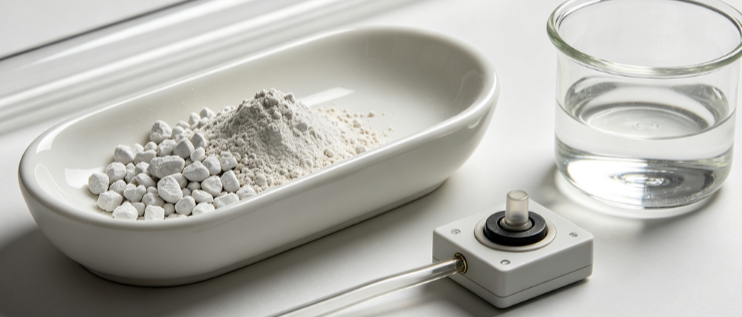
Basic aluminum chlorosulfate – a complex inorganic polymer with the general formula Al(OH)xCly(SO4)z·nH₂O – is widely utilized in water treatment, papermaking, and as a catalyst or coagulant due to its high charge density and bridging capability. The performance of this material is intrinsically linked to its basicity (OH/Al molar ratio), chloride-to-sulfate ratio, degree of polymerization, crystal or amorphous structure, and the presence of impurity phases. Reliable and in-depth characterization is therefore essential for production optimization, batch-to-batch consistency, regulatory compliance, and troubleshooting of application failures. Our ISO/IEC 17025-accredited laboratory offers a dedicated, multi-technique testing service specifically tailored for basic aluminum chlorosulfate, integrating advanced chemical, thermal, structural, and morphological analyses to deliver a complete product fingerprint – far beyond simple pH or density measurements.
Why Rigorous Testing of Basic Aluminum Chlorosulfate Is Critical for Industry and Regulatory Compliance
Clients seeking our testing services typically aim to: (i) precisely determine the basicity (OH/Al ratio) and the molar concentrations of chloride and sulfate, which govern the coagulating activity and hydrolysis behavior, (ii) identify the crystalline phases (e.g., AlCl₃·6H₂O, Al₂(SO₄)₃·xH₂O, or basic chloride/sulfate salts) and quantify any amorphous fraction, (iii) evaluate the thermal stability and decomposition pathways, including loss of water, dehydroxylation, and evolution of HCl or SO₂/SO₃, (iv) assess the purity and detect trace contaminants (heavy metals, organic residues, or unreacted raw materials), (v) determine the particle size distribution, specific surface area, and morphology that influence dissolution kinetics and flocculation efficiency, (vi) measure the long-term storage stability and the effects of humidity and temperature on chemical composition, and (vii) generate robust data for product certifications, patent filings, and environmental safety assessments. Standard single-parameter titrations or simple elemental analyses are insufficient because the performance of basic aluminum chlorosulfate is determined by the synergistic balance of hydroxyl, chloride, and sulfate ligands, as well as the degree of oligomerization, which requires a combination of wet chemistry, spectroscopic, and thermal techniques. Our integrated platform combines potentiometric titration, ion chromatography (IC), Thermogravimetric Analysis (TGA) coupled with evolved gas analysis (EGA), Fourier-transform infrared spectroscopy (FTIR), X-ray diffraction (XRD), scanning electron microscopy (SEM) with energy-dispersive X-ray spectroscopy (EDS), and particle size analysis to provide a holistic understanding of the material's composition, structure, stability, and functional performance.
Our Comprehensive Analytical Framework for Basic Aluminum Chlorosulfate
1. Determination of Basicity, Chloride, and Sulfate Content
We perform potentiometric acid-base titration to measure the total alkalinity and to calculate the basicity (OH/Al molar ratio) with a precision of ±0.02. The chloride content is determined by potentiometric argentometric titration (AgNO₃) or by ion chromatography (IC) after dissolution, achieving a detection limit of 0.01% w/w and a reproducibility of ±0.5% relative. Sulfate is quantified by gravimetric precipitation as BaSO₄ or by IC with conductivity detection, with similar sensitivity. Aluminum is determined by complexometric back-titration with EDTA or by inductively coupled plasma optical emission spectrometry (ICP-OES), providing the total Al content. From these data, we report the empirical formula (e.g., Al(OH)aClb(SO4)c·nH₂O) and the basicity index, along with the charge balance to verify the stoichiometric consistency. We also perform free acid titration to distinguish between hydrolyzed and unhydrolyzed species, which is critical for predicting the coagulation behavior in water treatment.
2. Structural and Crystalline Phase Analysis
We use powder X-ray diffraction (XRD) with a high-resolution diffractometer (Cu Kα radiation) over the 2θ range of 5°–80° to identify any crystalline phases. For samples that are predominantly amorphous or poorly crystalline, we employ synchrotron-based total scattering and pair distribution function (PDF) analysis to extract local structural information, including Al–O and Al–Cl/S bond distances and coordination numbers. The XRD patterns are processed with Rietveld refinement (when crystalline) to quantify phase fractions (e.g., AlCl₃·6H₂O, Al₂(SO₄)₃·18H₂O, or basic chloride hydrates) and to determine the crystallite size. Fourier-transform infrared spectroscopy (FTIR) in the mid-IR range (400–4000 cm⁻¹) is used to identify the characteristic vibrational bands of hydroxyl (νOH, δOH), sulfate (ν₃, ν₄), and Al–O/Al–Cl bonds. The relative intensities of these bands are correlated with the degree of polymerization and the local coordination environment of aluminum.
3. Thermal Stability and Decomposition Behavior
We perform Thermogravimetric Analysis (TGA) and differential scanning calorimetry (DSC) simultaneously, from 30 °C to 800 °C under inert (N₂) and oxidizing (air) atmospheres at controlled heating rates (2–20 °C/min). The TGA curve reveals successive mass losses: dehydration (removal of adsorbed and crystalline water), dehydroxylation (loss of structural OH groups as H₂O), and decomposition of chloride (evolution of HCl) or sulfate (evolution of SO₂/SO₃). The evolved gases are continuously monitored by an online mass spectrometer (MS) or a FTIR gas cell, enabling the identification of specific decomposition events. We calculate the water content, OH content, and the onset temperatures for each degradation step, and we determine the activation energy of the main decomposition processes using the Kissinger and Ozawa methods. This data is essential for assessing the thermal stability during drying, calcination, or application at elevated temperatures.
4. Purity and Trace Impurity Profiling
We screen for trace metal impurities (e.g., Fe, Cu, Mn, Zn, Pb, Cd, Cr) by ICP-MS after acid digestion, with detection limits in the low ppb range. For non-metallic impurities, we perform combustion analysis for total carbon (organic residues) and ion chromatography for nitrate, phosphate, and other anions. We also evaluate the insoluble residue (e.g., silica, alumina, or organic polymers) by gravimetric determination after dissolution and filtration. The results are compared against relevant specifications (e.g., AWWA, NSF, or industrial standards) to confirm the material's suitability for drinking water treatment or other sensitive applications. Our full traceability and accreditation ensure that the impurity data are defensible in regulatory audits.
5. Morphology, Particle Size, and Specific Surface Area
We characterize the physical form using laser diffraction particle size analysis (wet or dry dispersion) to obtain the volume-weighted size distribution (D10, D50, D90) and the span, with a measurement range of 0.01–3500 µm. The specific surface area is determined by the BET method from N₂ physisorption at 77 K, and the pore volume and average pore diameter are derived from the BJH or NLDFT models. For morphological features, we use scanning electron microscopy (SEM) with an energy-dispersive X-ray spectrometer (EDS) to image the crystal habit, particle shape, and surface texture, and to obtain semi-quantitative elemental maps of Al, Cl, S, and O. These physical properties directly influence the dissolution rate, settling behavior, and flocculation performance in aqueous systems.
6. Evaluation of Coagulation and Performance-Related Properties
To directly link the chemical composition to practical efficacy, we perform jar testing using standard synthetic water or real water samples (upon client request) to measure the optimal dosage, turbidity removal, and residual aluminum. We also measure the zeta potential of the coagulant solutions as a function of pH, which provides insight into the charge neutralization capacity. For catalytic or polymer-grade applications, we may conduct viscosity measurements of the solution and solubility tests in various solvents. These performance-oriented tests provide a direct validation of the material's fitness for its intended use, complementing the physicochemical data.
7. Long-Term Storage Stability and Aging Studies
We simulate real-world storage conditions by exposing samples to controlled environments (e.g., 25 °C/60% RH, 40 °C/75% RH) for defined periods (up to 12 months) and periodically re-characterizing the key parameters (basicity, chloride, sulfate, pH, and thermal behavior). We also evaluate the effect of freeze-thaw cycles and the impact of packaging materials. The storage stability index – the percentage change in the basicity or active content over time – is reported, along with a recommendation for shelf-life and storage conditions. This is invaluable for quality assurance and for providing end-users with reliable product life data.
Our Distinctive Advantages in Basic Aluminum Chlorosulfate Testing
1. Comprehensive Multi-Method Platform: We uniquely combine titrimetric, chromatographic, thermal, diffractometric, spectroscopic, and performance-based testing in a single coordinated workflow. This enables us to cross-validate the chemical composition (titration, IC, ICP) with the structural integrity (XRD, FTIR, TGA) and the functional activity (jar testing), providing a complete quality assurance loop that is essential for both R&D and production control. Such integration is rarely offered by conventional contract laboratories.
2. Expertise in Complex Inorganic Polymers: Basic aluminum chlorosulfate is chemically intricate, with varying degrees of hydrolysis and oligomerization. We have developed proprietary sample preparation protocols (including low-temperature drying and inert-atmosphere handling) to preserve the native chemical state during analysis. Our methods are validated on hundreds of production batches, achieving inter-laboratory reproducibility within 2% RSD for all major parameters, even for samples with high chloride or sulfate content.
3. Advanced Data Interpretation and Correlation: Our team of inorganic chemists and process engineers provides interpretative reports that go beyond data tables. We correlate the basicity with the coagulation efficiency, the impurity levels with the potential toxicity, and the thermal stability with the drying and handling requirements. We offer actionable recommendations for adjusting synthesis conditions (e.g., temperature, aging time, or reactant ratio) to achieve target properties, such as higher basicity or lower water content.
4. Regulatory-Grade Quality and Full Traceability: Our facility is accredited under ISO/IEC 17025:2017 for all relevant test methods (titration, IC, TGA, XRD, BET, and particle size). We use NIST-traceable standards and certified reference materials. All uncertainties are reported with expanded uncertainties (k=2) typically <3% for composition values and <5% for thermal and physical parameters, making our data defensible in product data sheets, regulatory submissions, and patent filings.
5. Consultative Partnership and Rapid Turnaround: Each project is managed by a senior analytical chemist with specific expertise in aluminum-based coagulants. We provide interim updates and a final comprehensive report that includes graphical summaries, comparative benchmarking against standard grades (e.g., commercial PAC or aluminum chlorohydrate), and a clear summary of compliance or non-compliance with your specified requirements. We also offer emergency testing for production troubleshooting, with results delivered in as little as 48 hours. Our secure client portal facilitates real-time data access and direct communication with our experts.
Deliverables That Empower Quality Control and Process Improvement
Our final comprehensive report includes: (a) full chemical composition – Al, OH, Cl, SO₄, and basicity (OH/Al ratio), with calculated empirical formula; (b) XRD diffractogram with phase identification and crystallite size (if applicable); (c) FTIR spectrum with band assignment and qualitative structural comparison; (d) TGA/DSC-MS curves with mass loss percentages and decomposition temperatures; (e) trace impurity concentrations (metals and anions) with specification compliance; (f) particle size distribution, BET surface area, and SEM images with EDS maps; (g) coagulation performance data (turbidity removal, optimal dosage) and zeta potential results; (h) storage stability assessment with aging profiles; (i) a benchmarking summary comparing your material against reference standards and typical commercial products; and (j) a quality improvement roadmap with specific recommendations for synthesis optimization, purification, or handling. All raw data (titration curves, chromatograms, diffractograms, thermograms, spectra, and images) are supplied in open, machine-readable formats (CIF, JCAMP-DX, .csv, .tiff, .mzML) for independent verification and integration into your own quality management system.
For continuous quality surveillance, we offer subscription-based testing programs that include periodic batch characterization, rapid failure analysis, and on-site training for your laboratory personnel. Our dedicated support team ensures that your material consistently meets the highest standards of purity, performance, and safety.
Conclusion: Precision Characterization for Reliable Basic Aluminum Chlorosulfate Products
Basic aluminum chlorosulfate is a versatile and widely used chemical, but its effectiveness and safety depend on a precise understanding of its composition, structure, and stability. Our testing service delivers that understanding – integrating state-of-the-art wet chemical, instrumental, and performance-based analyses with expert interpretation and practical recommendations. By choosing our laboratory, you gain access to a platform where scientific rigor meets industrial practicality, ensuring that your product achieves the desired performance, complies with regulations, and maintains consistent quality. Engage with our technical team today to design a customized testing protocol – we are committed to helping you optimize your production and deliver a superior product to your customers.