Reasons for choosing our testing services
ZHONGXI Testing has obtained inspection qualification certifications from multiple countries and regions worldwide. We possess a senior testing team and advanced testing methods, providing independent, impartial, and professional third-party verification services for global carbon projects.

Internationally recognized authority
Certified by multiple international standards such as CNAS, VCS, and GS, with reports universally applicable worldwide.

Global service capability
Covering 140+ countries and regions, it supports on-site detection and remote verification in multiple languages.

Professional experimental methods
Adopt standard experimental methods to ensure accurate and reliable data.
Comprehensive Analytical Characterization of Fluorescence-Grade Europium Oxide: Advanced Testing Services for High-Purity Phosphor and Scintillator Materials
Fluorescence-grade europium oxide (Eu₂O₃) is a critical raw material for red phosphors in lighting, displays (LEDs and plasma panels), and scintillation detectors, where its luminescent properties are directly governed by the purity, crystalline perfection, surface chemistry, and particle morphology. Even trace impurities (particularly other rare earths such as Gd, Tb, Dy, or non-rare-earth metals like Fe, Cu, and Cr) or structural defects can severely quench the emission intensity and alter the decay kinetics. Therefore, a rigorous, multi-parameter analytical regime is indispensable for quality control, process optimization, regulatory compliance, and failure investigation. Our ISO/IEC 17025-accredited laboratory offers a dedicated, high-end testing service tailored specifically for fluorescence-grade Eu₂O₃, integrating ultra-trace elemental analysis, high-resolution structural diffraction, advanced surface spectroscopy, and particle characterization – all performed under controlled environments to preserve sample integrity. Our approach delivers a complete purity-to-performance profile, far surpassing routine single-technique inspections.
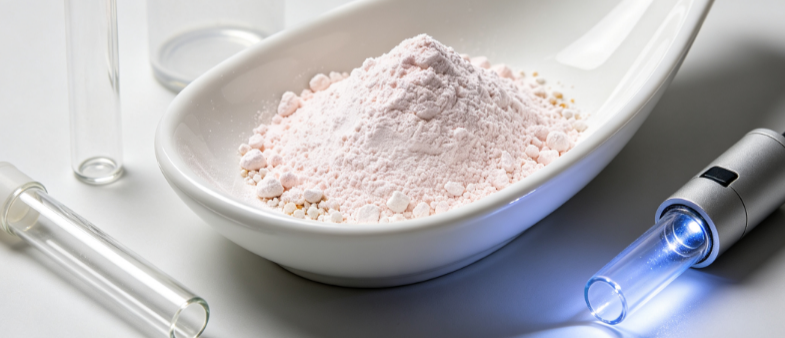
Why Comprehensive Europium Oxide Testing Is Critical for High-End Phosphor Applications
Clients seeking our testing services typically aim to: (i) quantify the purity of Eu₂O₃ and precisely identify all trace impurities, including individual rare-earth elements at sub-ppm levels, (ii) determine the crystalline phase purity, lattice parameters, and the degree of crystallinity – which affect the excitation and emission spectra, (iii) measure the particle size distribution, specific surface area, and morphology that influence slurry dispersion and coating uniformity, (iv) evaluate the surface chemical state, including carbon contamination and hydroxyl content that can introduce non-radiative recombination centers, (v) assess the thermal stability and phase transitions upon heating, (vi) directly characterize the photoluminescence (PL) and cathodoluminescence efficiency under relevant excitation wavelengths, and (vii) generate robust certification data for customer specifications, regulatory submissions, and patent protection. Standard purity certificates by ICP-MS alone are insufficient because fluorescence performance is sensitive to the combined effects of trace metallic impurities, oxygen stoichiometry, surface hydroxylation, and crystallite size, all of which require a suite of complementary techniques. Our integrated platform combines high-resolution inductively coupled plasma mass spectrometry (HR-ICP-MS) for all 14 rare-earths, glow discharge mass spectrometry (GD-MS) for metallic impurities, combustion analysis for carbon and oxygen stoichiometry, high-resolution X-ray diffraction (HR-XRD) with Rietveld refinement, Raman micro-spectroscopy, X-ray photoelectron spectroscopy (XPS) for surface analysis, scanning electron microscopy (SEM) with energy-dispersive X-ray spectroscopy (EDS), laser diffraction particle sizing, nitrogen physisorption (BET), Thermogravimetric Analysis (TGA) coupled with evolved gas mass spectrometry (EGA-MS), and photoluminescence spectroscopy (steady-state and time-resolved) – providing a complete structural–chemical–functional fingerprint.
Our Advanced Analytical Framework for Fluorescence-Grade Europium Oxide
1. Ultra-Trace Purity Analysis and Rare-Earth Profile
We employ high-resolution inductively coupled plasma mass spectrometry (HR-ICP-MS) with magnetic sector analysis to quantify all 14 other rare-earth elements (La, Ce, Pr, Nd, Sm, Gd, Tb, Dy, Ho, Er, Tm, Yb, Lu, and Y) at detection limits below 0.01 ppm, with a precision of ±2% relative. For non-rare-earth metals (Fe, Cr, Cu, Ni, Zn, Pb, etc.), we use glow discharge mass spectrometry (GD-MS) for direct solid-state analysis, avoiding acid digestion contamination and achieving sub-0.1 ppm detection for most elements. For carbon and sulfur – which can form luminescence-quenching complexes – we perform combustion analysis (LECO) with an IR detector, reaching a detection limit of 2 ppm. The total purity is reported as the sum of Eu₂O₃ and the individual impurity concentrations, and we provide a rare-earth distribution pattern that is compared against industry specifications (e.g., 99.99% or 99.999% grades). We also offer semiquantitative GD-MS survey scans to detect unexpected impurities for troubleshooting new synthesis routes.
2. Structural Phase Analysis and Crystallinity
We perform high-resolution X-ray diffraction (HR-XRD) with Cu Kα radiation over a wide 2θ range (10°–110°) to identify the cubic (C-type) structure of Eu₂O₃ and to detect any additional phases (e.g., monoclinic or hexagonal polymorphs, or secondary europium oxycarbonate). Rietveld refinement is conducted using TOPAS software to determine the precise lattice parameter (a) with an accuracy of ±0.0005 Å, the atomic positions, and the thermal displacement factors. We also quantify the crystallite size and microstrain via the Williamson–Hall plot. For samples with amorphous surface layers or very small crystallites, we use synchrotron-based total scattering and pair distribution function (PDF) analysis to obtain local structure information. Raman spectroscopy (with 325 and 532 nm excitation) provides a complementary fingerprint of the phonon modes, with shifts indicating any non-stoichiometry or oxygen vacancies.
3. Surface Chemistry, Carbon Contamination, and Stoichiometry
The surface of Eu₂O₃ readily adsorbs water and CO₂, forming hydroxyl and carbonate species that can act as quenching centers. We use X-ray photoelectron spectroscopy (XPS) with monochromatic Al Kα radiation to analyze the Eu 3d, O 1s, and C 1s core levels. The Eu 3d spectrum is deconvoluted to differentiate Eu³⁺ from any Eu²⁺ species (the latter is undesirable for most phosphor applications). The O 1s peak is fitted to lattice oxygen (at ~529 eV), hydroxyl groups (~531 eV), and carbonate species (~532.5 eV). We also quantify the surface carbon content (adventitious + carbonate). For bulk oxygen stoichiometry, we use inert gas fusion analysis (LECO) to determine the oxygen content directly, and we calculate the O/Eu ratio to detect any deviation from the ideal 1.5. Additionally, we perform Thermogravimetric Analysis (TGA) up to 1000 °C in air and in inert atmosphere, identifying weight losses due to adsorbed water (100–200 °C), decomposition of carbonates (400–600 °C), and any phase change. The evolved gases are monitored by an online mass spectrometer to confirm the nature of each weight loss.
4. Particle Morphology, Size Distribution, and Specific Surface Area
We measure the particle size distribution by laser diffraction (wet dispersion) from 0.01 to 3500 µm, reporting D10, D50, D90, and the span. For sub-micron particles, we use dynamic light scattering (DLS) or nanoparticle tracking analysis (NTA). The morphology and primary crystallite shape are examined by field-emission scanning electron microscopy (FE-SEM) with high-resolution imaging, and by transmission electron microscopy (TEM) when needed for nanoparticle characterization. The specific surface area is determined by the BET method from N₂ physisorption at 77 K, and the pore volume is derived from the BJH model (if pores are present). We correlate the surface area with the particle size to estimate the degree of agglomeration, which is critical for downstream slurry preparation.
5. Photoluminescence (PL) Performance Assessment
We directly evaluate the luminescent properties using a state-of-the-art PL spectrofluorometer equipped with a Xe lamp, monochromators, and a photomultiplier detector. We measure the excitation spectra (monitoring the 612 nm emission of Eu³⁺) and the emission spectra (under excitation at 393 nm or 465 nm), with a spectral resolution of 0.5 nm. The ratio of the emission intensity at 612 nm (electric dipole transition ⁵D₀→⁷F₂) to that at 592 nm (magnetic dipole ⁵D₀→⁷F₁) is calculated as the asymmetry ratio, which is sensitive to the local symmetry and site distortion – a critical quality indicator. We also measure the luminescence decay time at the 612 nm peak using a pulsed Xe flash lamp (or a laser) to derive the excited-state lifetime (τ), with a precision of ±0.01 ms. For cathode-ray excitation (CRT or field emission), we perform cathodoluminescence (CL) measurement under variable accelerating voltages. We compare the PL intensity and lifetime against a reference standard of certified high-purity Eu₂O₃ to report a relative luminescence efficiency, providing direct evidence of the material's quality for phosphor applications.
6. Thermal Stability and Phase Transition Monitoring
We conduct in situ high-temperature XRD (up to 1200 °C) to monitor any phase transformation (e.g., from cubic to monoclinic) and to determine the expansion coefficients. Differential thermal analysis (DTA) and TGA are performed simultaneously to identify endo- or exothermic events associated with dehydration, decarbonation, or structural changes. The thermal stability data are essential for validating the material's suitability for high-temperature processing (e.g., calcination, sintering) and for ensuring consistent phosphor performance after heat treatment.
7. Leaching and Chemical Stability Testing
For applications in water-based slurries or harsh chemical environments, we perform leaching tests in acidic (pH 2) and alkaline (pH 10) media, monitoring the release of Eu and trace impurities by ICP-MS. We also evaluate the moisture absorption by exposing the sample to 80% RH at 40 °C and measuring the weight gain over time. These data are critical for predicting the storage stability and the handling behavior of the powder.
Our Distinctive Advantages in Fluorescence-Grade Europium Oxide Testing
1. Unmatched Purity Analysis Depth: We are among the few labs that combine HR-ICP-MS (for solution-based rare-earth analysis) with GD-MS (for direct solid metallic impurity profiling) and combustion analysis (for C, S), providing a comprehensive purity assessment down to sub-ppm levels. Our GD-MS library covers all elements from Li to U, enabling the detection of unexpected contaminants that might not be targeted by routine ICP protocols. The combination of these techniques ensures that the total purity is not overestimated and that the actual impurity fingerprint is accurately captured.
2. Integrated Structural and Functional Correlation: Our platform integrates HR-XRD with Rietveld refinement, Raman spectroscopy, XPS, and PL/CL measurements into a single coordinated workflow. This allows us to cross-validate the crystallinity (XRD) with the local symmetry (Raman, PL asymmetry ratio) and the surface chemistry (XPS) to directly link the structural integrity with the luminescence efficiency – providing a complete quality map that is essential for diagnosing performance issues. Such integration is rarely offered in standard commercial testing.
3. Expertise in Air-Sensitive and Hydroscopic Materials: Europium oxide is hygroscopic and can carbonate upon exposure to atmospheric CO₂. We perform all sample handling (for XPS, TGA, and PL) under a dry argon atmosphere or with controlled humidity, and we use air-tight transfer vessels for vacuum instruments. Our protocols have been validated on hundreds of rare-earth oxide samples, achieving inter-laboratory reproducibility within 2% RSD for purity and lattice parameters.
4. Advanced Data Interpretation and Customer-Specific Reporting: Our team of rare-earth specialists provides interpretative reports that go beyond data tables. We compare your material's impurity profile and PL performance against established commercial grades (e.g., 5N, 5.5N) and provide a quality grade recommendation based on the application (LED phosphor, scintillator, or optical glass). We also offer correlation analysis between specific impurities and quenching effects, helping you identify the most critical contaminants to target in purification. We provide co-authorship support for academic publications and draft methods sections in compliance with journals such as Journal of Luminescence and Optical Materials.
5. Regulatory-Grade Quality and Full Traceability: Our facility is accredited under ISO/IEC 17025:2017 for ICP-MS, XPS, XRD, TGA, and PL measurements. We use NIST-traceable standards for rare-earth elements and certified reference materials (e.g., NIST SRM 3115a for Eu). All uncertainties are reported with expanded uncertainties (k=2) typically <3% for impurity concentrations and <2% for lattice parameters, making our data defensible in customer specification agreements, regulatory submissions, and patent filings.
Report Deliverables and Client Empowerment
Our final comprehensive report includes: (a) quantitative purity table with full rare-earth profile and non-rare-earth impurities (from GD-MS and combustion); (b) XRD pattern with Rietveld refinement – lattice parameter, crystallite size, phase purity; (c) Raman spectrum with peak assignments; (d) XPS spectra – Eu 3d, O 1s, C 1s with deconvolution and surface composition; (e) particle size distribution, BET surface area, and SEM images; (f) PL excitation and emission spectra, asymmetry ratio, decay lifetime, and relative efficiency; (g) TGA-DSC-MS curves with thermal events and stoichiometry data; (h) leaching and moisture absorption results; (i) a quality summary comparing your sample with commercial standards and literature benchmarks; and (j) a process recommendation for purification or synthesis adjustments. All raw data (spectra, diffractograms, thermograms, images) are supplied in open, machine-readable formats (CIF, JCAMP-DX, .csv, .tiff) for independent verification and for integration into your own quality management system.
We also offer subscription-based quality surveillance programs for regular incoming inspection, including rapid turnaround (3–5 business days) for routine batches. Our secure client portal provides 24/7 access to data and direct communication with our scientists.
Conclusion: Precision Characterization for High-Performance Europium Oxide Phosphors
Fluorescence-grade europium oxide is a premium material whose performance in advanced lighting and detection systems depends on a delicate balance of purity, structural order, surface chemistry, and particle characteristics. Our testing service delivers that insight – integrating ultra-trace elemental analysis, advanced structural diagnostics, surface science, and photoluminescence characterization into a unified, expert-interpreted package. By choosing our laboratory, you gain a partner that ensures your material meets the most stringent specifications, enabling you to consistently produce high-brightness, long-life phosphors. Engage with our technical team today to design a customized testing protocol – we are committed to supporting your quality excellence with unparalleled analytical depth and scientific rigor.