Reasons for choosing our testing services
ZHONGXI Testing has obtained inspection qualification certifications from multiple countries and regions worldwide. We possess a senior testing team and advanced testing methods, providing independent, impartial, and professional third-party verification services for global carbon projects.

Internationally recognized authority
Certified by multiple international standards such as CNAS, VCS, and GS, with reports universally applicable worldwide.

Global service capability
Covering 140+ countries and regions, it supports on-site detection and remote verification in multiple languages.

Professional experimental methods
Adopt standard experimental methods to ensure accurate and reliable data.
Comprehensive Physicochemical and Performance Characterization of Activated Calcium Carbonate: Advanced Analytical Services for Quality Assurance and Application Optimization
Activated calcium carbonate – typically surface-modified with stearic acid, titanate, aluminate, or other coupling agents – is a functional filler widely used in plastics, rubber, coatings, sealants, and adhesives to enhance mechanical properties, dispersion, and processing flowability. The activation process significantly alters the surface chemistry, particle morphology, agglomeration behavior, and hydrophobic/hydrophilic balance, all of which directly influence the filler’s performance in composite matrices. Consequently, a rigorous, multi-parametric analytical regime is essential for evaluating activation efficiency, ensuring batch-to-batch consistency, optimizing formulation, and troubleshooting field performance issues. Our ISO/IEC 17025-accredited laboratory offers a dedicated, in-depth testing service tailored specifically for activated calcium carbonate, integrating advanced chemical, physical, thermal, and morphological methods to deliver a complete material profile – far beyond routine whiteness or particle size measurements.
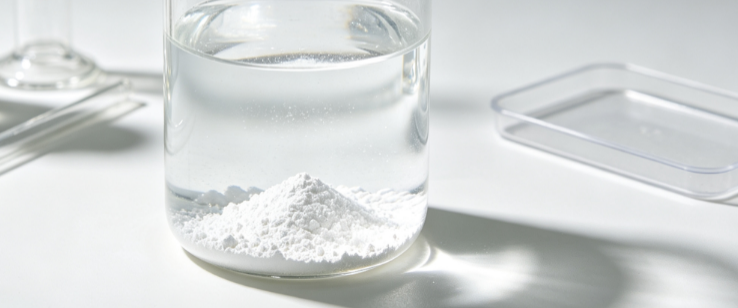
Why Comprehensive Characterization of Activated Calcium Carbonate Is Critical for Industrial Quality Control and Formulation Success
Clients seeking our testing services typically aim to: (i) verify the degree of surface modification and quantify the active agent loading (e.g., stearic acid content), (ii) determine the particle size distribution, specific surface area, and morphology – which affect dispersion and rheology, (iii) measure the moisture content, volatile matter, and thermal stability to predict processing behavior, (iv) evaluate the oil absorption (DBP or linseed oil) and bulk density, which are key for compounding and extrusion, (v) assess the whiteness, brightness, and yellow index for optical quality in finished products, (vi) detect trace impurities (e.g., heavy metals, silicates, or other minerals) that may affect end-use performance or regulatory compliance, and (vii) generate robust data for material certifications, supplier qualification, and patent applications. Standard tests such as simple titration or sieve analysis are insufficient because the activation efficiency is governed by the surface coverage, the grafting density, and the uniformity of the organic coating, which require a combination of thermogravimetric, spectroscopic, and wettability techniques. Our integrated platform combines Thermogravimetric Analysis (TGA) coupled with Fourier-transform infrared spectroscopy (FTIR) for evolved gas, X-ray photoelectron spectroscopy (XPS) for surface elemental composition, scanning electron microscopy (SEM) with energy-dispersive X-ray spectroscopy (EDS), laser diffraction particle sizing, BET specific surface area, stearic acid content determination (by solvent extraction and titration), oil absorption (DBP) measurement, whiteness/colorimetry, and moisture/volatile analysis – providing a complete functional fingerprint.
Our Comprehensive Analytical Framework for Activated Calcium Carbonate
1. Quantification of Surface Modification and Organic Coating
We determine the amount and nature of the organic surface treatment using Thermogravimetric Analysis (TGA) coupled with a mass spectrometer (MS) or FTIR for evolved gas analysis. The weight loss in the temperature range typical of the organic agent (e.g., 200–400 °C for stearate) is quantified, and the evolved species are identified to confirm the coating chemistry. To distinguish between chemically grafted and physically adsorbed species, we perform solvent extraction (e.g., with toluene or acetone) followed by re-weighing and TGA on the residue, providing the grafting efficiency. For a direct surface analysis, we use XPS to measure the surface atomic ratios (e.g., C/O, Ca/C) and to detect the presence of specific elements (e.g., Si from silane coupling agents). The contact angle measurement (sessile drop) on compressed pellets gives the hydrophobicity/hydrophilicity index, which is correlated with the dispersion quality in non-polar matrices. We report the total organic content, grafted percentage, and surface coverage with a precision of ±0.2%.
2. Particle Size, Shape, and Specific Surface Area
We measure the particle size distribution by laser diffraction (both dry and wet methods) from 0.01 to 3500 µm, reporting D10, D50, D90, and the distribution width (span). For sub-micron activated carbonates, we use dynamic light scattering (DLS) or centrifugal sedimentation (X-ray disk centrifuge) to resolve primary particle sizes. Morphology and agglomeration are examined by field-emission scanning electron microscopy (FE-SEM) at multiple magnifications, with image analysis to quantify aspect ratio and shape factors. The specific surface area (BET) is determined from N₂ physisorption at 77 K, with a reproducibility of ±2%. These data directly affect the oil absorption and the rheological properties of filled compounds.
3. Oil Absorption, Bulk Density, and Flowability
We measure oil absorption (DBP absorption value) according to ASTM D2414 or similar standards, using a torque-controlled absorptometer to determine the end point. This parameter is crucial for estimating the filler’s structural porosity and its effect on plasticizer demand. The apparent density (bulk density), tapped density, and Hausner ratio are measured to evaluate the packing behavior and flowability, which are critical for pneumatic conveying and hopper discharge. We also perform angle of repose measurements for powder flow characterization.
4. Moisture, Volatile Content, and Thermal Stability
We determine moisture content by the Karl Fischer titration method or by loss on drying at 105 °C (with desiccator cooling) to an accuracy of ±0.02%. The volatile organic content (other than water) is evaluated by TGA from ambient to 600 °C under nitrogen. The decomposition temperature of the organic coating is reported, and the residue at 800 °C (mainly CaO) is used to calculate the CaCO₃ purity. These data are essential for predicting the processing window during extrusion or injection molding, as premature degradation can cause off-gassing or surface defects.
5. Whiteness, Color, and Brightness
We measure the whiteness index (Hunter, CIE, or ISO brightness) using a spectrophotometer with an integrating sphere, following standards such as TAPPI T525 or ISO 2470. We report L*, a*, b* values, whiteness (W), and yellowness (YI). These optical properties are critical for applications in white masterbatches and high-quality coatings. We also perform UV-Vis reflectance spectroscopy to detect any discoloration due to iron or other chromatic impurities.
6. Purity and Trace Impurity Profiling
We analyze the inorganic purity by acid digestion followed by ICP-MS (or ICP-OES) to quantify trace elements, including heavy metals (Pb, Cd, As, Hg), Fe, Mn, Cu, and others, with detection limits in the sub-ppm range. X-ray diffraction (XRD) is performed to identify any crystalline phases other than calcite (e.g., quartz, dolomite, or aragonite) and to estimate the crystallinity. The insoluble acid residue (e.g., silica or silicate) is determined gravimetrically after dissolution in dilute HCl. These purity parameters ensure compliance with food-contact, toy, or pharmaceutical regulations.
7. Surface Energy and Wettability Assessment
To evaluate the effectiveness of surface activation, we perform inverse gas chromatography (IGC) at infinite dilution to determine the dispersive surface energy (γsᵈ) and the acid–base character. We also measure dynamic contact angle on compressed powder pellets using a variety of test liquids (water, diiodomethane, ethylene glycol) to calculate the surface energy components according to the Owens–Wendt or van Oss–Chaudhury–Good approaches. These data directly correlate with the ease of dispersion and the adhesion to polymer matrices.
8. Rheological and Dispersion Performance in Polymer Composites
For application-oriented testing, we offer rheological measurements on filled polymer melts (capillary rheometer or rotational rheometer) to assess the viscosity, shear thinning, and activation energy. We also prepare masterbatch test specimens and evaluate the impact strength, tensile modulus, and elongation to quantify the reinforcing effect of the activated filler. These performance tests, though optional, provide direct validation of the filler's effectiveness in the final product.
Our Distinctive Advantages in Activated Calcium Carbonate Testing
1. Comprehensive Surface and Interface Characterization: We uniquely combine TGA-MS, XPS, IGC, and contact angle measurements to provide a complete picture of the organic coating – from bulk loading to surface coverage and interaction energetics. This allows us to distinguish between effective chemical grafting and simple physical wetting, which is critical for evaluating the activation process quality. Such integrated data are rarely available from standard filler testing services.
2. Expertise in Handling Fine Powders and Hygroscopic Materials: Activated calcium carbonate is often fine, hygroscopic, and may contain residual moisture or solvent. We employ controlled-environment sample preparation (dry nitrogen glovebox) and utilize specialized powder handling tools for precise and representative sampling. Our procedures ensure that agglomeration is minimized during analysis, and our results reflect the true material properties. Inter-laboratory reproducibility for key parameters (e.g., oil absorption, BET, and particle size D50) is within 2–3% RSD.
3. Advanced Data Correlation and Application Guidance: Our team of polymer and filler experts provides interpretative reports that not only list the measured values but also correlate them with expected performance in specific applications (e.g., PVC, polypropylene, or paints). We offer comparative benchmarking against industry-standard grades (e.g., Omya, Huber) and provide recommendations for adjusting the surface treatment to achieve target properties, such as higher flowability or improved impact resistance. We also provide support for co-authorship in research publications and for drafting technical data sheets.
4. Regulatory-Grade Quality and Full Traceability: Our facility is accredited under ISO/IEC 17025:2017 for all relevant methods (particle size by laser diffraction, BET, oil absorption, whiteness, and elemental analysis). We use NIST-traceable reference materials and participate in proficiency testing programs. All uncertainties are reported with expanded uncertainties (k=2) typically <3% for composition and <5% for physical parameters, ensuring the data are acceptable for regulatory submissions and customer quality agreements.
Report Deliverables and Client Empowerment
Our final comprehensive report includes: (a) quantitative organic coating content and grafting efficiency (TGA, extraction); (b) surface composition (XPS) and hydrophobicity (contact angle); (c) particle size distribution (D10, D50, D90) with SEM images; (d) BET surface area and porosity; (e) oil absorption, bulk/tapped densities, and flowability indices; (f) moisture, volatile matter, and decomposition temperatures (TGA); (g) whiteness and colorimetric values; (h) purity profile including trace elements and acid-insoluble residue; (i) surface energy components (IGC or contact angle); (j) optional rheological and mechanical performance data; (k) a benchmarking summary against reference standards; and (l) a process optimization roadmap suggesting adjustments to activation parameters. All raw data (thermograms, diffractograms, spectra, images, etc.) are provided in open, machine-readable formats (CIF, JCAMP-DX, .csv, .tiff) for independent verification.
We also offer subscription-based quality surveillance programs for routine incoming material inspection, with rapid turnaround (2–3 business days) for standard suites. Our secure client portal enables real-time project tracking and direct communication with our scientific staff.
Conclusion: Precision Characterization for High-Performance Activated Calcium Carbonate
Activated calcium carbonate is a sophisticated filler whose performance relies on a precise balance of surface chemistry, particle morphology, and physical properties. Our testing service provides that insight – integrating advanced surface analysis, thermal characterization, physical testing, and impurity profiling into a unified, expert-interpreted package. By choosing our laboratory, you gain a partner that ensures your material consistently meets the demands of your compounding process and final application. Engage with our technical team today to design a customized testing protocol – we are committed to supporting your quality and innovation with unmatched analytical depth and scientific rigor.