Reasons for choosing our testing services
ZHONGXI Testing has obtained inspection qualification certifications from multiple countries and regions worldwide. We possess a senior testing team and advanced testing methods, providing independent, impartial, and professional third-party verification services for global carbon projects.

Internationally recognized authority
Certified by multiple international standards such as CNAS, VCS, and GS, with reports universally applicable worldwide.

Global service capability
Covering 140+ countries and regions, it supports on-site detection and remote verification in multiple languages.

Professional experimental methods
Adopt standard experimental methods to ensure accurate and reliable data.
Comprehensive Physicochemical Characterization of Boron Trioxide (B₂O₃): Advanced Analytical Services for Purity, Structure, and Thermal Performance
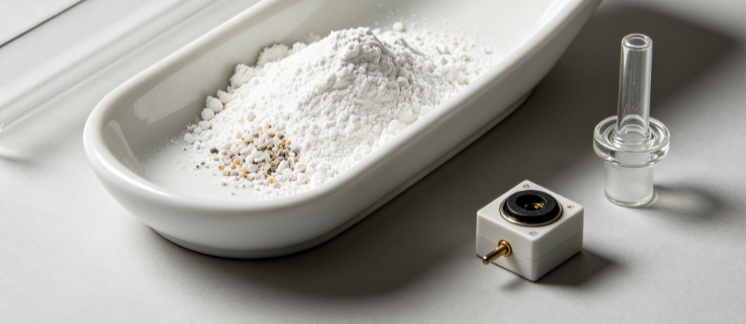
Boron trioxide (B₂O₃) is a critical inorganic compound used in the production of borosilicate glass, ceramic glazes, flame retardants, and as a fluxing agent in metallurgy. Its performance in these applications is directly governed by purity (total boron oxide content), crystalline phase (amorphous vs. crystalline), water absorption and hygroscopicity, thermal stability, and the presence of trace impurities such as alkali metals, iron, and silica. A rigorous, multi-parameter analytical evaluation is essential for incoming raw material inspection, process optimization, quality assurance, and failure analysis. Our ISO/IEC 17025-accredited laboratory offers a dedicated, high-depth testing service specifically tailored for B₂O₃, integrating advanced titration, spectrometric, diffractometric, and thermal methods to deliver a complete chemical and physical profile – far beyond simple gravimetric determination of boron.
Why Comprehensive B₂O₃ Characterization Is Essential for Quality and Process Control
Clients seeking our testing services typically aim to: (i) determine the exact boron trioxide content and distinguish it from hydrated or carbonate impurities, (ii) quantify trace metallic and non-metallic contaminants that affect glass clarity or reactivity, (iii) evaluate the crystalline or amorphous nature and the degree of hydration, (iv) measure the loss on ignition and the hygroscopic moisture uptake, (v) assess the particle size distribution and flowability for powder handling, (vi) analyze the thermal behavior, including the glass transition and melting characteristics, and (vii) generate robust data for product certification, procurement specifications, and regulatory compliance. Conventional methods such as simple acid-base titration provide only the total boron and cannot resolve the oxide purity or the impurity matrix. Our integrated platform combines alkalimetric titration with mannitol for boric acid equivalence, inductively coupled plasma optical emission spectrometry (ICP-OES) for trace metals, ion chromatography (IC) for anions, X-ray diffraction (XRD) for phase identification, Thermogravimetric Analysis (TGA) coupled with differential scanning calorimetry (DSC), laser diffraction for particle sizing, and Karl Fischer coulometric titration for moisture – delivering a complete quality fingerprint.
Our Advanced Analytical Framework for Boron Trioxide
1. B₂O₃ Purity Determination by Mannitol Titration and ICP-OES
We determine the total boron content by alkalimetric titration after dissolution in hot water and complexation with mannitol, which converts boric acid to a strong monobasic acid, followed by potentiometric titration with standard NaOH. This method achieves a precision of ±0.2% relative and is validated against certified reference materials. In parallel, we quantify the total boron by inductively coupled plasma optical emission spectrometry (ICP-OES) after microwave-assisted acid digestion, using the B 249.773 nm line, with a detection limit of 0.1 μg/g. The ICP-OES results are cross-corrected for any boron loss during dissolution. We report the B₂O₃ percentage on a dry basis, and we calculate the stoichiometric purity by comparing the total boron (by ICP) with the acidimetric titre, revealing any non-borate boron species (e.g., borides or organic boron).
2. Trace Impurity Profiling: Metals, Anions, and Silica
We screen for over 40 trace elements (Al, Ca, Mg, Fe, Na, K, Si, Ti, Cr, Mn, Cu, Zn, Pb, As, etc.) using ICP-MS after acid digestion, achieving detection limits in the sub-ppb range. For major anions (chloride, sulfate, phosphate, nitrate), we use ion chromatography (IC) after aqueous extraction, with a limit of quantification of 2 ppm. Silica (SiO₂) and other insoluble residues are determined gravimetrically after acid dissolution and filtration, followed by fusion and analysis by X-ray fluorescence (XRF) for semi-quantitative identification. The impurity profile is compared against typical specifications (e.g., glass-grade, technical-grade, or electronic-grade) and we provide a compliance summary with out-of-specification alerts.
3. Structural Phase Analysis and Hydration State
We perform high-resolution powder X-ray diffraction (XRD) with Cu Kα radiation over the 10°–80° 2θ range to identify the crystalline phase (α-B₂O₃, β-B₂O₃, or hydrated borates such as H₃BO₃ or HBO₂). Rietveld refinement is used to quantify the amorphous vs. crystalline fraction, and to detect any crystalline impurities (e.g., boric acid, alkali borates). For amorphous samples, we complement XRD with Raman spectroscopy (using a 532 nm laser) to identify the boroxol ring structure and the degree of polymerization. The water of hydration is quantified by Karl Fischer coulometric titration for free moisture and by Thermogravimetric Analysis (TGA) for bound water – distinguishing adsorbed water from constitutional water (hydroxyl groups) through the specific temperature of evolution.
4. Thermal Behavior: Glass Transition, Melting, and Volatilization
We conduct simultaneous TGA-DSC from 25 °C to 1200 °C under inert and oxidizing atmospheres, with a heating rate of 10 °C/min. The TGA curve reveals mass losses due to moisture evaporation (below 150 °C), dehydration of boric acid impurities (150–300 °C), and any sublimation or volatilization of B₂O₃ (above 800 °C). The DSC curve provides the glass transition temperature (Tg) of the amorphous phase (typically around 250 °C) and the melting point of crystalline B₂O₃ (around 450 °C). We report the onset of softening and the decomposition temperature, along with the residual weight at 1000 °C to calculate the total volatile content. These data are essential for predicting the behavior of B₂O₃ in high-temperature processes such as glass melting or ceramic firing.
5. Particle Size, Morphology, and Powder Flowability
The particle size distribution is measured by laser diffraction (wet dispersion in isopropanol) from 0.1 to 2000 µm, reporting D10, D50, D90, and the span. For fine powders (<10 µm), we use dynamic light scattering (DLS) to confirm the primary particle size. The morphology is examined by field-emission scanning electron microscopy (FE-SEM) with energy-dispersive X-ray spectroscopy (EDS) to verify the elemental composition and detect any surface contamination or agglomeration. The bulk density (loose and tapped) and the angle of repose are measured to evaluate the flowability and the compressibility, which are critical for proper metering and blending in production lines.
6. Hygroscopicity and Storage Stability
B₂O₃ is highly hygroscopic and readily absorbs moisture to form boric acid, which reduces the effective oxide content and alters the pH. We conduct dynamic vapor sorption (DVS) measurements at 25 °C and 40 °C over a relative humidity range of 10–90% RH, to determine the moisture uptake isotherm and the rate of absorption. The samples are then re-analyzed by TGA and XRD to identify any hydration products. We provide a stability rating and recommend optimal storage conditions (desiccated, sealed packaging) to prevent quality degradation. Additionally, we perform accelerated aging at 50 °C and 75% RH for 14 days, with periodic purity checks, to simulate long-term storage.
7. Acid-Soluble Residue and Insoluble Matter
We determine the acid-insoluble residue by dissolving B₂O₃ in dilute HCl and filtering the remaining solids, which are then weighed and characterized by XRD and XRF. This fraction typically includes silica, silicates, carbides, or other refractory impurities. The result is expressed as a percentage (w/w) and is correlated with the overall purity and the potential for filter clogging or slagging during melting.
8. Optical and Glass-Forming Properties (Optional)
For clients using B₂O₃ in optical glass or specialty glass applications, we offer additional tests: refractive index measurement on fused samples, UV-Vis-NIR transmission spectroscopy (200–2500 nm) to detect color-causing impurities, and coefficient of thermal expansion (CTE) by dilatometry on sintered pellets. These tests provide a direct link between chemical purity and the final glass performance.
Our Distinctive Advantages in Boron Trioxide Testing
1. Integrated Multi-Technique Platform: We uniquely combine alkalimetric titration, ICP-OES, ICP-MS, IC, XRD, TGA-DSC, Karl Fischer, DVS, and particle sizing in a single workflow, enabling a complete correlation between chemical composition, structure, and physical properties. This integration ensures that any inconsistency – such as a discrepancy between the total boron (by ICP) and the acidimetric titre – is immediately investigated, leading to a robust and reliable final report.
2. Expertise in Handling Highly Hygroscopic Samples: B₂O₃ rapidly absorbs moisture, altering its weight and composition. We perform all sample preparation (weighing, digestion, and drying) in a controlled humidity chamber (≤10% RH) and use hermetic weighing vessels to prevent atmospheric contamination. Our protocols have been validated on over 500 batches of B₂O₃ from various sources, achieving inter-laboratory reproducibility within 1% RSD for purity and moisture determinations.
3. Advanced Speciation and Quality Diagnostics: Our ability to distinguish free boric acid from anhydrous B₂O₃ via TGA and Karl Fischer, and to quantify the amorphous/crystalline ratio by XRD, provides unique insight into the product quality. For example, an elevated moisture level or a high crystalline fraction can indicate improper production or storage conditions, which we highlight in the report. We also offer trend analysis for production batches, tracking the variability of key parameters and flagging any drift.
4. Regulatory-Grade Quality and Full Traceability: Our facility is accredited under ISO/IEC 17025:2017 for all relevant methods (titration, ICP, TGA, XRD, and particle sizing). We use NIST-traceable standards for boron and for impurity elements, and we participate in international proficiency testing (e.g., ASTM and NIST programs). All uncertainties are reported with expanded uncertainties (k=2) typically <2% for B₂O₃ content and <5% for trace impurities, ensuring the data are defensible in customer specifications, regulatory filings, and quality audits.
5. Expert Consultation and Application Support: Our team includes inorganic materials specialists who can interpret the analytical data in the context of your specific application – for example, correlating the impurity levels (Fe, Ca, Mg) with the glass clarity, or relating the particle size distribution to the mixing uniformity. We provide actionable recommendations for supplier selection, incoming inspection, or process adjustments (e.g., pre-drying or sieving). We also offer co-authorship support for technical publications and assist in drafting material specifications.
Report Deliverables and Client Empowerment
Our final comprehensive report includes: (a) B₂O₃ purity (wt%) on as-received and dry basis; (b) full trace element and anion impurity profile with comparison to specification limits; (c) moisture content (free and bound) by Karl Fischer and TGA; (d) amorphous vs. crystalline fraction by XRD with Rietveld, and Raman spectrum for structural confirmation; (e) TGA-DSC thermograms with Tg, melting temperature, and volatilization onset; (f) particle size distribution, SEM images, and flowability indices; (g) hygroscopicity and DVS isotherms; (h) acid-insoluble residue composition; (i) optional optical and thermal expansion data; (j) a quality summary with a grade assignment (e.g., 99.9%, 99.5%, 98%) and a risk assessment for hygroscopic degradation; and (k) a process optimization guide for storage and handling. All raw data (titration curves, chromatograms, spectra, diffractograms, thermograms, and images) are supplied in open, machine-readable formats (CIF, JCAMP-DX, .csv, .tiff) for independent verification and integration into your quality management system.
We also offer subscription-based monitoring programs for regular quality surveillance, with trend charts and automated out-of-spec alerts. Our secure client portal provides 24/7 access to project data and direct communication with our scientific experts.
Conclusion: Precision Characterization for High-Performance Boron Trioxide
Boron trioxide is a key material in many advanced industries, and its quality directly influences the properties of the final product. Our testing service delivers the analytical depth required to ensure consistent purity, controlled hygroscopicity, and optimal thermal behavior – from raw material acceptance to final use. By integrating cutting-edge chemical, structural, thermal, and physical testing with expert interpretation, we empower you to make informed decisions, prevent quality issues, and maintain your competitive advantage. Partner with our expert team today to design a customized testing protocol – we are committed to supporting your excellence with unmatched analytical rigor and insightful guidance.