Reasons for choosing our testing services
ZHONGXI Testing has obtained inspection qualification certifications from multiple countries and regions worldwide. We possess a senior testing team and advanced testing methods, providing independent, impartial, and professional third-party verification services for global carbon projects.

Internationally recognized authority
Certified by multiple international standards such as CNAS, VCS, and GS, with reports universally applicable worldwide.

Global service capability
Covering 140+ countries and regions, it supports on-site detection and remote verification in multiple languages.

Professional experimental methods
Adopt standard experimental methods to ensure accurate and reliable data.
Advanced AU Formaldehyde Scavenger Testing Services: Comprehensive Characterization for Indoor Air Quality, textile, and Material Applications
Formaldehyde (HCHO) remains one of the most pervasive and consequential indoor air pollutants, classified as a Group 1 human carcinogen by the International Agency for Research on Cancer (IARC). Its emission from engineered wood products, adhesives, resins, textiles, coatings, and insulation materials poses persistent health risks, including nasopharyngeal cancer, leukemia, respiratory irritation, and sensitization. Formaldehyde scavengers — also termed formaldehyde capture agents, absorbers, or neutralizing agents — constitute a class of chemical formulations designed to react with, adsorb, or catalytically decompose free formaldehyde, thereby reducing emission from finished products and indoor environments. Among these, AU-type formaldehyde scavengers typically designate amino-urea or urea-based capture systems, whose active nucleophilic amine and amide functionalities react with carbonyl groups to form stable Mannich-type or methylol adducts. Because scavenger performance is governed by active ingredient content, reaction kinetics, pH, residual free formaldehyde, and byproduct formation, comprehensive analytical characterization is indispensable for quality control, efficacy substantiation, regulatory compliance, and product development.
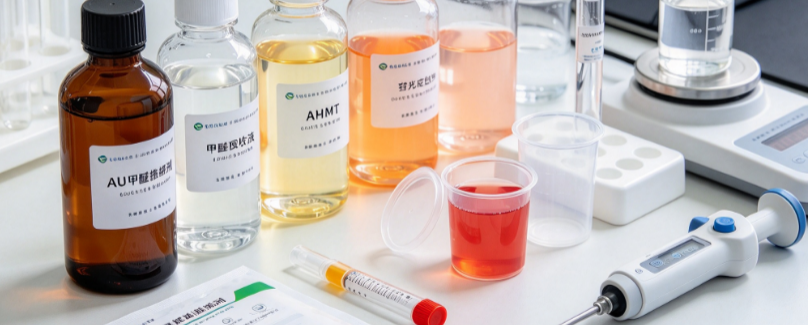
Why Clients Commission AU Formaldehyde Scavenger Testing
Clients seek AU formaldehyde scavenger testing for several distinct yet interconnected purposes. Efficacy substantiation and performance verification require quantitative evidence that the scavenger reduces free formaldehyde to target levels, whether in engineered wood panels, adhesives, coatings, textiles, or indoor air, supporting marketing claims and technical data sheets. Regulatory compliance and product certification demand demonstration that treated materials meet E1, E0, CARB Phase 2, EPA TSCA Title VI, EN 717-1, and GB 18580 emission standards, as well as OEKO-TEX and GB 18401 textile requirements. Active ingredient quantification and batch consistency monitoring ensure that scavenger formulations contain the declared content of urea, amino compounds, or other active moieties, guarding against adulteration or manufacturing variability. Formulation development and optimization relies on characterization of reaction kinetics, pH-dependent performance, and byproduct formation to guide product improvement. Residual formaldehyde and byproduct assessment verifies that scavenger treatment does not introduce new hazards, such as unreacted amine volatiles, formaldehyde-amine condensates, or nitrosamine precursors. Material compatibility evaluation assesses whether scavengers alter the physical, mechanical, or aesthetic properties of treated substrates. Finally, failure investigation and root cause analysis in cases of emission non-compliance or product rejection relies on detailed characterization of both the scavenger and the treated material.
Our AU Formaldehyde Scavenger Testing Capabilities: From Active Content to Emission Performance
We provide comprehensive testing services for AU formaldehyde scavengers and treated materials, spanning active ingredient quantification, physicochemical characterization, efficacy evaluation, emission testing, and byproduct profiling. Our analytical portfolio includes, but is not limited to:
Active ingredient content determination — including urea and substituted urea quantification by HPLC or ion chromatography, amino compound content by titration (Kjeldahl nitrogen, formol titration), primary and secondary amine content by NMR or colorimetric assays, and total nitrogen determination by Dumas or Kjeldahl methods.
Free formaldehyde quantification in scavenger formulations — including acetylacetone spectrophotometric method (Hantzsch reaction), 2,4-dinitrophenylhydrazine (DNPH) derivatization followed by HPLC-UV or LC-MS/MS, chromotropic acid method, and 3-methyl-2-benzothiazolinone hydrazone (MBTH) assay, with detection limits extending to parts-per-billion (ppb) levels.
Formaldehyde emission testing from treated materials — including chamber testing per EN 717-1, ASTM D6007, and ISO 16000-9, desiccator method per JIS A 1460 and GB/T 18259, perforator method per EN 120, gas analysis method per EN 717-2, and large chamber testing per ASTM E1333, enabling classification of products against E1, E0, CARB Phase 2, and EPA TSCA Title VI thresholds.
Indoor air formaldehyde monitoring — including active sampling with DNPH-coated cartridges followed by HPLC-UV or LC-MS/MS, passive diffusive sampling with 2,4-DNPH or 2-benzylaminoethanol, real-time monitoring by electrochemical sensors or proton-transfer-reaction mass spectrometry (PTR-MS), and on-site detection by portable spectrophotometric or electrochemical devices.
Reaction kinetics and mechanism characterization — including time-resolved formaldehyde depletion monitoring by HPLC or spectrophotometry, reaction rate constant determination, pH-dependent performance profiling, temperature-dependent kinetics, and adduct identification by LC-MS/MS and NMR.
Byproduct and residual volatile profiling — including volatile organic compound (VOC) emission testing by GC-MS per ISO 16000-6 and ASTM D5116, amine volatile quantification, formaldehyde-amine condensate identification, nitrosamine precursor screening, and residual solvent profiling by headspace GC-MS.
Physicochemical property characterization — including pH determination, viscosity and rheological profiling, density and specific gravity, solid content, particle size analysis for dispersed systems, and stability testing under accelerated conditions.
Material compatibility and performance assessment — including mechanical property evaluation of treated panels (internal bond strength, modulus of rupture, modulus of elasticity), dimensional stability testing, adhesive bond strength assessment, surface appearance evaluation, and coating adhesion testing.
Elemental and heavy metal analysis — including ICP-MS determination of lead, cadmium, chromium, mercury, and arsenic per EN 71-3, CPSIA, and RoHS requirements, supporting consumer safety compliance.
Our laboratories employ HPLC/UHPLC systems with UV/DAD and fluorescence detection, LC-MS/MS and HRAM-MS platforms, GC-MS and headspace GC-MS, ICP-MS and ICP-OES, NMR spectrometers, spectrophotometers, emission test chambers (small, desiccator, and large-scale), PTR-MS and electrochemical real-time monitors, and mechanical testing equipment. These platforms enable free formaldehyde quantification at ppb levels, active ingredient determination with precision below 1% RSD, and correlation of scavenger chemistry with emission performance.
Methodological Depth and Analytical Rigor
Our testing protocols are anchored in ISO/IEC 17025-accredited quality management systems and align with EN 717, ASTM D6007, ISO 16000, JIS A 1460, GB 18580, CARB Phase 2, and EPA TSCA Title VI requirements. We perform rigorous method validation evaluating specificity, linearity, accuracy, precision, range, detection limit, quantitation limit, and robustness for each analytical procedure.
Our formaldehyde quantification workflows utilize certified reference standards and include blank and spiked recovery controls in every run. For DNPH derivatization, we employ certified DNPH cartridges and validate derivatization efficiency and stability. For chamber emission testing, we monitor temperature, relative humidity, air exchange rate, and loading ratio to ensure compliance with reference standards, and we verify chamber background formaldehyde before each test. For active ingredient determination, we employ orthogonal methods (titration, HPLC, NMR) to confirm content and exclude adulteration. For reaction kinetics, we utilize time-resolved sampling with validated quenching to capture true reaction rates.
For research and formulation development applications, we offer custom method development, reaction monitoring by LC-MS, byproduct isolation and identification, structure-activity relationship (SAR) investigations, forced degradation and stability studies, and correlation of scavenger chemistry with emission performance. Our mass spectrometry-based approaches enable adduct identification, byproduct characterization, and degradation pathway elucidation.
Our Competitive Advantages in AU Formaldehyde Scavenger Testing
1. End-to-End Testing Capability: From active ingredient content in the raw scavenger formulation to formaldehyde emission from finished products and indoor air monitoring, we provide a complete analytical chain from a single laboratory partner.
2. Regulatory-Compliant Emission Testing: Our chamber, desiccator, perforator, and gas analysis methods align with EN 717, ASTM D6007, ISO 16000, JIS A 1460, CARB Phase 2, and EPA TSCA Title VI, enabling direct classification of products against global emission standards.
3. Ultra-Sensitive Formaldehyde Quantification: Our DNPH-LC-MS/MS and acetylacetone methods achieve detection limits at ppb levels, enabling quantification of residual formaldehyde even in well-treated materials and low-emission environments.
4. Reaction Kinetics and Mechanism Elucidation: Beyond static efficacy testing, we characterize reaction rate constants, pH-dependent performance, and adduct structures, enabling mechanistic understanding of scavenger chemistry and rational formulation optimization.
5. Byproduct and VOC Profiling: We identify and quantify residual amines, formaldehyde-amine condensates, nitrosamine precursors, and VOC emissions, ensuring that scavenger treatment does not introduce new hazards — a critical differentiator for regulatory acceptance and consumer safety.
6. Material Compatibility Assessment: We evaluate the impact of scavenger treatment on mechanical properties, dimensional stability, adhesive bond strength, and surface appearance, ensuring that formaldehyde reduction does not compromise product quality.
7. Complex Matrix Expertise: We have validated methods for challenging matrices including engineered wood panels, adhesives, resins, coatings, textiles, leather, paper, and indoor air samples, where conventional approaches frequently fail due to matrix interference or low analyte levels.
8. Expert Interpretive Support: Our team includes analytical chemists, polymer scientists, and indoor air quality specialists who provide not only analytical data but also contextual interpretation, regulatory guidance, and formulation optimization support.
9. Rapid Turnaround and Scalability: Standard turnaround is 5–10 business days for routine characterization and 10–15 business days for comprehensive emission and byproduct packages, with expedited options available. Automated platforms ensure consistent high-volume capacity without compromising analytical quality.
10. Custom Research and Method Development: For clients with novel scavenger chemistries, specialized substrates, or unique research objectives, we offer bespoke method development, validation, and technology transfer services, including reaction monitoring, byproduct isolation, and SAR investigations.
Applications Across Building Materials, textiles, and Consumer Products
Our AU formaldehyde scavenger testing services support a diverse range of clients, including engineered wood and panel manufacturers, adhesive and resin producers, formaldehyde scavenger formulators, textile and leather processors, coating and paint manufacturers, indoor air quality consultancies, consumer product brands, academic investigators, and regulatory agencies. Whether for active ingredient qualification, efficacy substantiation, emission certification, byproduct profiling, material compatibility assessment, or formulation development support, we deliver data that is analytically rigorous, regulatory-compliant, and directly actionable for quality assurance, product certification, and market access.
Conclusion
AU formaldehyde scavengers play a critical role in reducing formaldehyde emission from building materials, textiles, and consumer products, thereby protecting indoor air quality and public health. Their performance depends not only on active ingredient content but on reaction kinetics, pH conditions, byproduct formation, and compatibility with the treated substrate. Reliable characterization depends on analytical sensitivity, orthogonal methodology, and regulatory-aligned emission testing. With our end-to-end testing capability, ultra-sensitive formaldehyde quantification, reaction mechanism elucidation, and deep materials chemistry domain knowledge, we empower clients to substantiate efficacy claims, achieve regulatory compliance, optimize formulations, and troubleshoot performance issues with confidence. For AU formaldehyde scavenger testing that meets the highest standards of precision and regulatory acceptance, our laboratory is your trusted partner.