Reasons for choosing our testing services
ZHONGXI Testing has obtained inspection qualification certifications from multiple countries and regions worldwide. We possess a senior testing team and advanced testing methods, providing independent, impartial, and professional third-party verification services for global carbon projects.

Internationally recognized authority
Certified by multiple international standards such as CNAS, VCS, and GS, with reports universally applicable worldwide.

Global service capability
Covering 140+ countries and regions, it supports on-site detection and remote verification in multiple languages.

Professional experimental methods
Adopt standard experimental methods to ensure accurate and reliable data.
Advanced Hindered Aliphatic Vinyl Monomer Testing Services: Comprehensive Characterization for Polymer, Coating, Adhesive, and Specialty Material Applications
Hindered aliphatic vinyl monomers are polymerizable compounds in which the vinyl double bond is sterically shielded by bulky aliphatic substituents. Representative examples include vinyl esters of branched aliphatic carboxylic acids such as vinyl pivalate, vinyl neodecanoate, and vinyl versatate; branched alkyl (meth)acrylates such as tert-butyl acrylate and tert-butyl methacrylate; and sterically hindered vinyl ethers. These monomers are widely used in low-VOC coatings, weather-resistant resins, pressure-sensitive adhesives, inks, rheology modifiers, personal care polymers, and specialty biomedical materials. Their performance is governed by chemical purity, branched isomer distribution, residual monomer content, inhibitor concentration, and trace impurities, all of which influence polymerization kinetics, molecular weight development, film formation, adhesion, and regulatory compliance. Reliable analytical characterization is therefore essential for raw material qualification, process control, product development, and safety assessment.
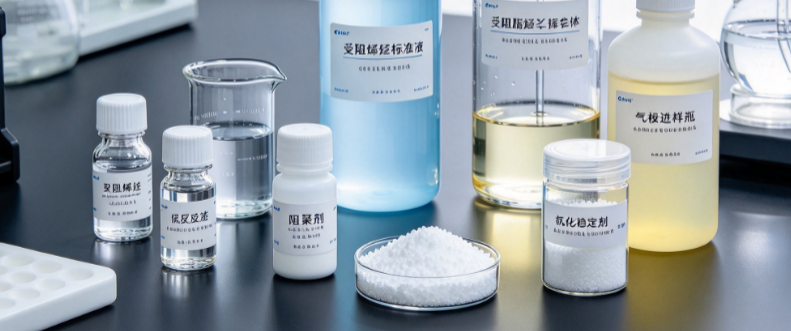
Why Clients Commission Hindered Aliphatic Vinyl Monomer Testing
Clients seek testing of hindered aliphatic vinyl monomers for several distinct yet interconnected purposes. Raw material identification and purity assessment verify that incoming monomers meet declared specifications and are free from adulteration, cross-contamination, or degradation. Residual monomer quantification supports regulatory compliance, workplace safety, and product safety, particularly for monomers classified as irritants, sensitizers, or hazardous air pollutants. Branched isomer distribution analysis is critical because positional and branching isomers can exhibit different reactivity ratios, glass transition temperatures, and weathering performance, even when bulk purity appears acceptable. Inhibitor and stabilizer quantification ensures that polymerization inhibitors such as MEHQ, hydroquinone, BHT, phenothiazine, or TEMPO derivatives are present at effective concentrations to prevent premature polymerization during storage and transport. Polymerization process optimization requires kinetic and impurity data to control conversion, molecular weight, and copolymer composition. Regulatory submission support demands methodologically defensible data for REACH, TSCA, FDA, ICH Q3C, ICH Q3D, EU 10/2011, and ISO 10993 programs. Failure investigation in cases of gelation, poor cure, discoloration, adhesive failure, or batch rejection relies on detailed impurity and structural profiling. Finally, research and development utilizes monomer characterization to correlate molecular structure with polymer properties and to guide the design of next-generation specialty monomers.
Our Hindered Aliphatic Vinyl Monomer Testing Capabilities: From Trace Impurity Profiling to Polymerization Behavior Assessment
We provide comprehensive testing services for hindered aliphatic vinyl monomers and their polymeric derivatives. Our analytical portfolio includes, but is not limited to:
Identity confirmation and structural elucidation using nuclear magnetic resonance (NMR) spectroscopy, including 1H, 13C, COSY, HSQC, and HMBC experiments; Fourier-transform infrared (FT-IR) spectroscopy; Raman spectroscopy; high-resolution accurate mass spectrometry (HRAM-MS); and tandem mass spectrometry (MS/MS) for molecular formula confirmation and fragmentation mapping.
Purity and impurity profiling by gas chromatography with flame ionization detection (GC-FID), gas chromatography-mass spectrometry (GC-MS), comprehensive two-dimensional gas chromatography (GCxGC-MS), liquid chromatography-tandem mass spectrometry (LC-MS/MS), and supercritical fluid chromatography (SFC). We quantify residual monomers, dimeric and oligomeric species, oxidation products, aldehydes, acids, and process-related impurities at parts-per-million (ppm) to parts-per-billion (ppb) levels.
Residual monomer quantification using headspace gas chromatography-mass spectrometry (HS-GC-MS), solid-phase microextraction (SPME) coupled with GC-MS, purge-and-trap GC-MS, and LC-MS/MS with stable isotope-labeled internal standards. Detection limits extend to ppb levels for many analytes, supporting occupational exposure assessment and product safety compliance.
Branched and positional isomer resolution using optimized GC column selectivity, GCxGC-MS, SFC, ion mobility spectrometry (IMS), and NMR-based structural assignment. We distinguish among branched isomers, positional isomers, and cis/trans configurations that may co-elute under conventional chromatographic conditions.
Inhibitor and stabilizer quantification including MEHQ, hydroquinone, BHT, phenothiazine, TEMPO derivatives, and proprietary stabilizer systems by LC-MS/MS, GC-MS, HPLC-UV/DAD, and electrochemical detection. We determine both free inhibitor content and inhibitor efficiency under accelerated storage conditions.
Physicochemical property determination including moisture content by Karl Fischer titration, acid value, peroxide value, color by APHA/Pt-Co or Gardner scale, density and specific gravity, refractive index, viscosity and rheological profiling, and boiling point and distillation range.
Polymerization behavior and cure kinetics assessment using differential scanning calorimetry (DSC), rheometry, real-time FT-IR, photo-DSC, and GC monitoring of monomer conversion. We characterize induction time, gel time, exotherm profile, conversion rate, and activation energy.
Molecular weight and molecular weight distribution of polymeric derivatives using high-performance size-exclusion chromatography coupled with multi-angle light scattering (HPSEC-MALS), gel permeation chromatography (GPC), and asymmetric flow field-flow fractionation (AF4) for absolute molecular weight determination and polydispersity index calculation.
Thermal and mechanical characterization including glass transition temperature (Tg) by DSC, thermal stability by Thermogravimetric Analysis (TGA), dynamic mechanical analysis (DMA), and tensile, adhesion, and film property testing.
Elemental and residual solvent analysis using ICP-MS for elemental impurities per ICH Q3D, headspace GC-MS for residual solvents per ICH Q3C, and ion chromatography for anionic impurities.
Workplace air and environmental monitoring using thermal desorption GC-MS, active sorbent tube sampling, passive diffusive sampling, and real-time photoionization detection (PID) for occupational exposure assessment against OSHA, NIOSH, and ACGIH limits.
Methodological Depth and Analytical Rigor
Our testing protocols are anchored in ISO/IEC 17025-accredited quality management systems and align with ICH Q6A, ICH Q3C, ICH Q3D, ASTM, ISO, REACH, TSCA, and FDA requirements where applicable. We perform rigorous method validation evaluating specificity, linearity, accuracy, precision, range, detection limit, quantitation limit, robustness, and stability for each analytical procedure.
Our trace analysis workflows utilize certified reference standards, stable isotope-labeled internal standards, and matrix-matched calibration to achieve accurate quantification in complex matrices. For reactive monomers prone to spontaneous polymerization, we employ low-temperature sample handling, inhibitor-preserved collection, and rapid analytical turnaround to prevent artifact formation. For headspace analysis, we optimize equilibration temperature and time to maximize sensitivity while minimizing thermal degradation. For NMR analysis, we use quantitative 1H NMR with internal standards for purity determination and 2D correlation spectroscopy for complete structural assignment. For isomer resolution, we develop orthogonal chromatographic methods and confirm assignments by NMR and HRAM-MS. For polymerization kinetics, we combine DSC, rheology, and real-time spectroscopic monitoring to capture complementary kinetic information.
For research and product development applications, we offer custom method development, reaction monitoring, impurity isolation and identification, forced degradation and stability studies, structure-property relationship investigations, and correlation of monomer composition with polymer performance.
Our Competitive Advantages in Hindered Aliphatic Vinyl Monomer Testing
1. Multi-Platform Analytical Strategy: By integrating GC-MS, GCxGC-MS, LC-MS/MS, SFC, NMR, FT-IR, and HRAM-MS, we deliver orthogonal confirmation that eliminates platform-specific false positives and negatives.
2. Branched and Positional Isomer Resolution: We resolve isomer distributions that directly affect reactivity, Tg, weathering, and adhesion, providing data that conventional purity assays often miss.
3. Ultra-Trace Residual Monomer Quantification: Our HS-GC-MS and LC-MS/MS platforms achieve detection limits at ppb levels, supporting the most stringent safety and regulatory requirements.
4. Inhibitor and Stabilizer Profiling: We quantify both free inhibitor content and inhibitor efficiency, helping clients prevent premature polymerization during storage and transport.
5. Polymerization Kinetics and Cure Behavior: Our DSC, rheology, and real-time FT-IR platforms characterize induction time, gel time, exotherm, and conversion, enabling direct correlation with processability.
6. Complex Matrix Expertise: We have validated methods for challenging matrices including crude monomers, stabilized formulations, adhesives, coatings, polymer emulsions, medical device extracts, and workplace air.
7. Regulatory and Safety Support: We provide data packages aligned with REACH, TSCA, FDA, ICH Q3C, ICH Q3D, EU 10/2011, and ISO 10993 requirements, including method validation summaries and toxicological risk assessment support.
8. Expert Interpretive Support: Our team includes polymer chemists, analytical chemists, and regulatory specialists who provide contextual interpretation, structure-property insights, and guidance on formulation and process optimization.
9. Rapid Turnaround and Scalability: Standard turnaround is 5 to 10 business days for routine characterization and 10 to 15 business days for comprehensive structural, kinetic, and impurity packages, with expedited options available.
10. Custom Research and Method Development: For clients with novel monomers, specialized applications, or unique research objectives, we offer bespoke method development, validation, and technology transfer services.
Applications Across Polymer, Coating, Adhesive, and Specialty Material Settings
Our hindered aliphatic vinyl monomer testing services support a diverse range of clients, including polymer and resin manufacturers, coating and paint producers, adhesive and sealant companies, ink and graphic arts formulators, personal care ingredient suppliers, medical device developers, contract research organizations, academic investigators, and regulatory agencies. Whether for raw material qualification, residual monomer compliance, isomer distribution analysis, inhibitor monitoring, polymerization kinetics assessment, failure investigation, or regulatory submission support, we deliver data that is analytically rigorous, structurally contextualized, and directly actionable for product development and quality assurance.
Conclusion
Hindered aliphatic vinyl monomers are essential building blocks for high-performance polymers, coatings, adhesives, and specialty materials. Their reactivity, storage stability, and final polymer properties depend on purity, isomer distribution, residual monomer content, and inhibitor concentration. Reliable characterization requires orthogonal analytical platforms, trace-level sensitivity, and structure-property correlation. With our comprehensive GC-MS, GCxGC-MS, LC-MS/MS, NMR, and polymerization kinetics capabilities, and deep polymer chemistry domain knowledge, we empower clients to ensure batch consistency, achieve regulatory compliance, optimize formulations, and troubleshoot performance issues with confidence. For hindered aliphatic vinyl monomer testing that meets the highest standards of precision and regulatory acceptance, our laboratory is your trusted partner.