Reasons for choosing our testing services
ZHONGXI Testing has obtained inspection qualification certifications from multiple countries and regions worldwide. We possess a senior testing team and advanced testing methods, providing independent, impartial, and professional third-party verification services for global carbon projects.

Internationally recognized authority
Certified by multiple international standards such as CNAS, VCS, and GS, with reports universally applicable worldwide.

Global service capability
Covering 140+ countries and regions, it supports on-site detection and remote verification in multiple languages.

Professional experimental methods
Adopt standard experimental methods to ensure accurate and reliable data.
Advanced Dextran Sulfate Compound Testing Services: Comprehensive Characterization for Pharmaceutical, Biomedical, and Research Applications
Dextran sulfate compounds constitute a family of semisynthetic sulfated polysaccharides derived from dextran, a glucose polymer produced by Leuconostoc mesenteroides and related bacterial strains. Sulfation is typically achieved through reaction with chlorosulfonic acid, sulfur trioxide-pyridine complex, or sulfuric acid in appropriate solvent systems, introducing sulfate ester groups at hydroxyl positions along the glucose backbone. The resulting products — ranging from low-molecular-weight dextran sulfate sodium (DSS) used as a colitis-inducing agent in preclinical models to high-molecular-weight dextran sulfate sodium salt employed as an antiviral and anticoagulant agent — exhibit profoundly different biological and physicochemical properties depending on degree of sulfation (DS), molecular weight distribution, sulfation pattern, counterion composition, and residual impurity profile. Dextran sulfate is widely utilized as an antiviral agent against enveloped viruses, a heparin analogue with anticoagulant activity, a drug delivery excipient, a tissue engineering scaffold component, and a standard reagent for inducing experimental colitis. Because biological activity, safety, and experimental reproducibility are exquisitely sensitive to structural parameters, comprehensive analytical characterization is indispensable for quality control, regulatory compliance, structure-activity relationship (SAR) investigation, and product development.
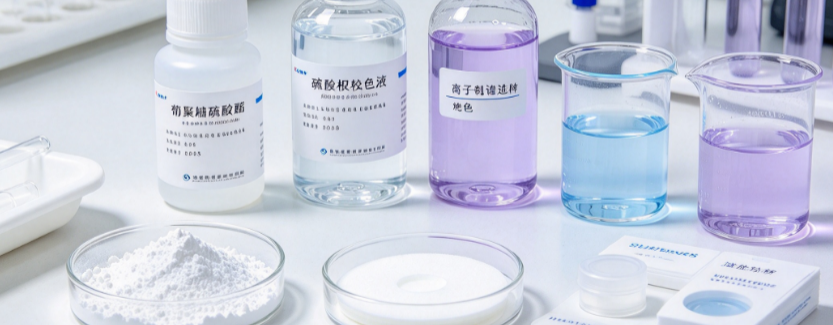
Why Clients Commission Dextran Sulfate Compound Testing
Clients seek dextran sulfate compound testing for several distinct yet interconnected purposes. Pharmaceutical and antiviral drug development requires structural confirmation, degree of sulfation determination, molecular weight characterization, and impurity profiling to support Investigational New Drug (IND) and Clinical Trial Application (CTA) filings. Anticoagulant potency assessment demands measurement of activated partial thromboplastin time (aPTT), anti-factor Xa, and anti-factor IIa activities, which are directly governed by sulfation degree and chain length. Preclinical colitis model standardization requires verification of DSS molecular weight, sulfation degree, and lot-to-lot consistency, since these parameters critically influence colitis severity, onset, and reproducibility in animal studies. Batch-to-batch consistency and raw material qualification require monitoring of DS, molecular weight distribution, and residual reagents, as small variations can disproportionately affect biological potency and toxicity. Structure-activity relationship (SAR) research investigates how molecular weight, sulfation degree, and substitution position influence antiviral, anticoagulant, and immunomodulatory activities, guiding rational design of optimized derivatives. Generic drug development and biosimilar comparison requires detailed comparison of critical quality attributes between test and reference products. Safety assessment necessitates quantification of residual sulfating reagents, process-related impurities, and elemental contaminants that may contribute to toxicity. Finally, failure investigation and root cause analysis in cases of batch rejection, variable experimental outcomes, or potency variability relies on detailed structural and impurity characterization.
Our Dextran Sulfate Compound Testing Capabilities: From Sulfation Degree to Molecular Weight Distribution
We provide comprehensive testing services for dextran sulfate compounds and related sulfated polysaccharide derivatives, spanning identity confirmation, structural characterization, purity assessment, molecular weight determination, and functional property evaluation. Our analytical portfolio includes, but is not limited to:
Degree of sulfation and sulfate content determination — including elemental sulfur analysis by combustion ion chromatography (CIC) or inductively coupled plasma optical emission spectrometry (ICP-OES), conductimetric titration, turbidimetric barium chloride assay, Fourier-transform infrared (FT-IR) spectroscopy with sulfate band integration, and quantitative ¹³C NMR. We determine total sulfate content, degree of sulfation (DS, defined as sulfate groups per glucose unit), and sulfation distribution across hydroxyl positions.
Positional sulfation pattern analysis — including methylation analysis followed by gas chromatography-mass spectrometry (GC-MS) for linkage and substitution position determination, 2D NMR (COSY, HSQC, HMBC, TOCSY) for complete structural assignment, ¹H-¹³C heteronuclear correlation for sulfation site mapping, and enzymatic depolymerization coupled with LC-MS/MS for oligosaccharide sequencing.
Molecular weight and molecular weight distribution — including high-performance size-exclusion chromatography coupled with multi-angle light scattering (HPSEC-MALS) for absolute molecular weight determination (Mw, Mn, Mz, and polydispersity index), asymmetric flow field-flow fractionation (AF4) for high-molecular-weight and aggregated species characterization, agarose gel electrophoresis for molecular weight profiling, viscometry-based molecular weight estimation, and MALDI-TOF MS for oligosaccharide profiling.
Chromatographic purity and impurity profiling — including high-performance liquid chromatography (HPLC) with UV/DAD or refractive index detection, high-performance anion-exchange chromatography with pulsed amperometric detection (HPAEC-PAD) for monosaccharide composition and contaminant profiling, LC-MS/MS for residual reagent and byproduct identification, and capillary electrophoresis (CE) for charge-based separation of sulfated species.
Monosaccharide composition analysis — including acid hydrolysis followed by HPAEC-PAD or GC-MS, trifluoroacetic acid (TFA) or methanolic HCl hydrolysis optimization, and quantification of glucose, fructose, and other neutral sugars as well as determination of residual unsulfated dextran content.
Backbone and linkage characterization — including methylation analysis with GC-MS, periodate oxidation and Smith degradation, NMR-based linkage determination, and enzymatic fingerprinting with dextranase to determine the proportion of α-(1→6), α-(1→3), and α-(1→4) linkages.
Counterion and salt form determination — including sodium, potassium, and other counterion quantification by ICP-OES or ion chromatography, determination of free sulfate versus bound sulfate, and verification of declared salt form.
Residual reagent and process impurity profiling — including residual sulfating reagents (chlorosulfonic acid, sulfur trioxide-pyridine complex, sulfuric acid) by ion chromatography or LC-MS/MS, residual solvents by headspace GC-MS, residual pyridine, dimethylformamide, and other reaction solvents, heavy metals by ICP-MS per ICH Q3D, protein and nucleic acid contaminants, and microbiological quality assessment.
Physicochemical property determination — including degree of polymerization, viscosity and rheological profiling, solubility profiling, charge density and zeta potential determination, particle size and morphology characterization, melting point and differential scanning calorimetry (DSC), and Thermogravimetric Analysis (TGA).
Functional bioactivity assessment — including antiviral activity assays (plaque reduction, viral entry inhibition, syncytium formation inhibition) against HSV, HIV, HPV, and SARS-CoV-2, anticoagulant activity (aPTT, PT, TT, anti-factor Xa, anti-factor IIa), complement activation assays (CH50, alternative pathway), growth factor binding assays (FGF, VEGF, TGF-beta), and cytokine induction assays.
Colitis model characterization — including verification of DSS molecular weight and sulfation degree against reference specifications, lot-to-lot consistency assessment, determination of optimal DSS concentration for colitis induction, and correlation of DSS structural attributes with colitis severity in preclinical models.
Our laboratories employ NMR spectrometers (400–800 MHz), HPSEC-MALS and AF4 systems, HPAEC-PAD, GC-MS and LC-MS/MS platforms, FT-IR and Raman spectrometers, ICP-MS and ICP-OES, ion chromatography, capillary electrophoresis, rheometers and zeta potential analyzers, and cell culture and virology platforms for bioactivity assessment. These platforms enable degree of sulfation determination with precision below 2% relative standard deviation, molecular weight determination with accuracy within 5% of true value, substitution position mapping at the glucose unit level, and correlation of structural attributes with biological potency.
Methodological Depth and Analytical Rigor
Our testing protocols are anchored in ISO/IEC 17025-accredited quality management systems and align with ICH Q6A, ICH Q3C, ICH Q3D, and pharmacopeial general chapters where applicable, including USP dextran sulfate sodium monographs and European Pharmacopoeia polysaccharide monographs. We perform rigorous method validation evaluating specificity, linearity, accuracy, precision, range, detection limit, quantitation limit, and robustness for each analytical procedure.
Our sulfate quantification workflows utilize certified reference standards (e.g., dextran sulfate sodium reference standards, heparin sodium) and include blank and spiked recovery controls in every run. For degree of sulfation determination, we employ orthogonal methods (elemental sulfur, conductimetric titration, FT-IR, NMR) to confirm content and exclude matrix interference. For NMR analysis, we employ quantitative ¹³C NMR with internal standards for sulfation degree determination and 2D correlation spectroscopy for complete structural assignment. For methylation analysis, we follow established protocols with GC-MS confirmation and validate methylation completeness. For molecular weight determination, we calibrate with narrow-dispersity dextran or pullulan standards and validate with MALS absolute molecular weight determination. For bioactivity assessment, we include positive and negative controls in every run and express results as relative potency against reference standards where available.
For research and drug development applications, we offer custom method development, depolymerization and oligosaccharide sequencing, impurity isolation and identification, structure-activity relationship (SAR) investigations, forced degradation and stability studies, and correlation of molecular attributes with antiviral and anticoagulant potency. Our mass spectrometry-based approaches enable sulfation pattern mapping, byproduct characterization, and metabolite identification following biological exposure.
Our Competitive Advantages in Dextran Sulfate Compound Testing
1. Comprehensive Sulfation Characterization: We determine total sulfate content, degree of sulfation, and positional substitution pattern in a single analytical workflow, enabling differentiation of materials with identical sulfate content but different biological activity — a critical differentiator for SAR and biosimilarity assessment.
2. Positional Substitution Mapping: Beyond bulk sulfate content, we provide methylation analysis and 2D NMR-based determination of sulfation site (C-2, C-3, or C-4 of glucose), enabling differentiation of regioisomeric derivatives with distinct biological activities.
3. Absolute Molecular Weight Determination: Our HPSEC-MALS and AF4 platforms provide absolute molecular weight and molecular weight distribution without reliance on column calibration, delivering accuracy that relative methods cannot achieve.
4. DSS Colitis Model Standardization: We provide lot-to-lot consistency assessment of DSS molecular weight and sulfation degree, enabling reproducible colitis induction in preclinical studies — a critical differentiator for research reproducibility.
5. Integrated Structural and Bioactivity Correlation: We combine detailed structural analysis with functional bioactivity testing, including antiviral and anticoagulant assays, enabling direct correlation of molecular attributes with biological potency.
6. Antiviral and Anticoagulant Bioassay Expertise: Our virology and hematology platforms enable plaque reduction, viral entry inhibition, aPTT, anti-factor Xa, and complement activation assays, supporting mechanistic and potency assessment.
7. Residual Reagent and Impurity Profiling: Our ion chromatography, LC-MS/MS, and ICP-MS platforms identify and quantify residual sulfating reagents, reaction solvents, and elemental impurities at ppm to ppb levels, supporting biocompatibility and regulatory submissions.
8. Counterion and Salt Form Verification: We determine sodium, potassium, and other counterion content and verify declared salt form, supporting pharmacopeial compliance and product consistency.
9. Expert Interpretive Support: Our team includes carbohydrate chemists, virologists, hematologists, and pharmaceutical scientists who provide not only analytical data but also contextual interpretation, SAR insights, and guidance on regulatory submissions and product development.
10. Rapid Turnaround and Scalability: Standard turnaround is 5–10 business days for routine characterization and 10–15 business days for comprehensive structural and bioactivity packages, with expedited options available. Automated platforms ensure consistent high-volume capacity without compromising analytical quality.
11. Custom Research and Method Development: For clients with novel derivatives, specialized applications, or unique research objectives, we offer bespoke method development, validation, and technology transfer services, including depolymerization and sequencing, impurity isolation, and SAR investigations.
Applications Across Pharmaceutical, Biomedical, and Research Settings
Our dextran sulfate compound testing services support a diverse range of clients, including pharmaceutical and biotechnology companies, antiviral and anticoagulant drug developers, excipient suppliers, contract manufacturing organizations, preclinical research laboratories, colitis model research groups, biomedical device developers, academic investigators, and regulatory agencies. Whether for structural confirmation, degree of sulfation determination, molecular weight characterization, impurity profiling, bioactivity assessment, colitis model standardization, biosimilarity evaluation, or process development support, we deliver data that is analytically rigorous, structurally contextualized, and directly actionable for quality assurance, regulatory submissions, and product development.
Conclusion
Dextran sulfate compounds represent a structurally sophisticated class of sulfated polysaccharides whose antiviral, anticoagulant, and immunomodulatory activities are exquisitely sensitive to sulfate content, substitution position, molecular weight, and residual impurities. Their utility as pharmaceutical agents, drug delivery excipients, and preclinical colitis-inducing reagents depends on rigorous characterization and lot-to-lot consistency. Reliable characterization depends not only on analytical sensitivity but also on orthogonal methodology, positional substitution mapping, and structure-activity correlation. With our comprehensive NMR, mass spectrometry, molecular weight, and bioactivity platforms, and deep carbohydrate and sulfation chemistry domain knowledge, we empower clients to ensure batch consistency, substantiate regulatory submissions, optimize derivatives, and troubleshoot experimental variability with confidence. For dextran sulfate compound testing that meets the highest standards of precision and regulatory acceptance, our laboratory is your trusted partner.