Reasons for choosing our testing services
ZHONGXI Testing has obtained inspection qualification certifications from multiple countries and regions worldwide. We possess a senior testing team and advanced testing methods, providing independent, impartial, and professional third-party verification services for global carbon projects.

Internationally recognized authority
Certified by multiple international standards such as CNAS, VCS, and GS, with reports universally applicable worldwide.

Global service capability
Covering 140+ countries and regions, it supports on-site detection and remote verification in multiple languages.

Professional experimental methods
Adopt standard experimental methods to ensure accurate and reliable data.
Amino Triazine Resin Testing Services for Cure State, Network Architecture, and Thermal-Mechanical Performance Qualification
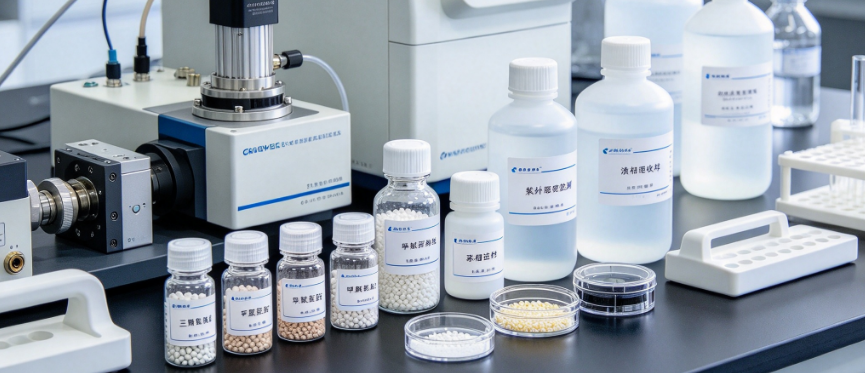
Customers requesting amino triazine resin testing are typically not seeking a generic material certificate. They need to resolve specific engineering questions: whether a resin batch has reached the intended degree of cure, whether the crosslinked network will deliver the required glass transition temperature and modulus, whether residual reactivity will cause formaldehyde emission during service, and whether a field failure originates from resin chemistry, processing, or interfacial incompatibility. Our service is structured around these decision points. We provide multi-technique characterization of amino triazine resins—including melamine-formaldehyde, benzoguanamine, and aminotriazine novolak systems—so that customers can qualify materials, diagnose process deviations, and establish defensible specifications[reference:0].
Why Amino Triazine Resin Testing Is Requested
Amino triazine resins derive their performance from the triazine ring, a thermally stable heterocycle that contributes flame resistance, hardness, and network rigidity[reference:1]. However, the same chemistry introduces sensitivity to cure schedule, moisture, and thermal history. Under-cure leaves unreacted methylol or amine groups that can participate in post-processing reactions, release formaldehyde, or depress Tg. Over-cure or excessive thermal exposure can degrade the aminotriazine–methylene linkages, particularly in aminotriazine novolak systems, generating free aminotriazine species and altering the network[reference:2]. Our testing programs are designed to quantify where a material sits within this processing window, rather than merely reporting a single pass or fail value. Typical customer objectives include incoming batch qualification, cure schedule optimization, supplier comparison, failure analysis, and emission compliance.
Cure State Determination by Spectroscopic and Thermal Methods
Degree of cure in amino triazine systems is best approached through complementary techniques rather than a single measurement. We employ Fourier transform infrared spectroscopy to track the consumption of reactive groups and the emergence of triazine-associated vibrational features. In cyanate ester–triazine systems, for example, the triazine ring formation at approximately 1380 cm⁻¹ can be ratioed against a decreasing cyanate ester peak to calculate conversion[reference:3]. For melamine-based resins, the development of triazine ring bands during cure provides a direct spectroscopic handle on network formation[reference:4]. We perform quantitative FTIR analysis using internal reference bands and Beer–Lambert treatment, supported by differential scanning calorimetry to measure residual exothermic heat and to model cure kinetics under isothermal and dynamic conditions[reference:5][reference:6]. Where residual reactivity is low or overlapped by moisture effects, modulated DSC and temperature-modulated methods are used to separate glass transition from enthalpic relaxation.
Network Architecture: Crosslink Density, Tg, and Molecular Weight Distribution
Amino triazine resin performance cannot be reduced to degree of cure alone. Two resins at nominally identical conversion can differ in crosslink density, branching, and low-molecular-weight fraction, producing different mechanical and thermal behavior. We determine crosslink density from dynamic mechanical analysis using the rubbery plateau storage modulus, and we report Tg from both the tan δ maximum and the onset of the storage modulus drop[reference:7]. Our DMA capabilities resolve sub-ambient through high-temperature transitions and allow comparison of crosslink density across resin formulations, cure schedules, and aging states. For oligomeric and prepolymer characterization, gel permeation chromatography provides number-average and weight-average molecular weights and dispersity, enabling customers to distinguish batch-to-batch variation in resin synthesis from cure-related differences[reference:8]. Solid-state and solution NMR are applied where structural confirmation of triazine environments or N-substitution is required.
Thermal Stability and Decomposition Behavior
Thermogravimetric Analysis is used to establish thermal stability limits, decomposition onset, and char yield under nitrogen and air atmospheres. The triazine ring contributes to char formation, and comparative TGA of melamine-containing versus urea-based amino resins shows improved thermal stability and higher residual char attributable to the melamine component[reference:10]. We couple TGA with evolved gas analysis by FTIR or mass spectrometry to identify decomposition products and to differentiate pathways such as deamination, methylene bridge scission, and triazine ring degradation[reference:11]. For aminotriazine novolak hardeners, we assess structural stability across the recommended curing range and flag thermal exposure conditions that risk generating free aminotriazine compounds[reference:12].
Formaldehyde Emission and Residual Volatile Assessment
Formaldehyde evolved during cure is a characteristic side reaction of melamine-formaldehyde crosslinking and a critical quality and compliance parameter. We measure cure formaldehyde using controlled laboratory evolution followed by DNPH derivatization and HPLC/UV analysis, with a working range spanning approximately 500 to 22,000 μg formaldehyde per gram of dry coating under specified flow conditions[reference:13]. We distinguish cure formaldehyde generated during crosslinking from free formaldehyde present as a residual raw-material impurity[reference:14], and we support method development for customer-specific bake profiles and coating weights. Results are reported on both wet-weight and dry-weight bases to align with coating specification practices.
Mechanical and Interfacial Performance
For coatings, laminates, and composite applications, amino triazine resin testing must extend beyond bulk network properties to interfacial behavior. We evaluate adhesion, surface energy, and failure locus through contact angle analysis, cross-cut or pull-off adhesion testing, and fractographic examination. Scanning electron microscopy with energy-dispersive X-ray spectroscopy is used to identify phase separation, filler dispersion, and contamination at failure surfaces. We correlate bulk crosslink density and Tg with observed mechanical performance, allowing customers to determine whether an adhesion or embrittlement issue is resin-intrinsic or substrate-driven. Where hydrolytic or thermal aging is relevant, we combine gravimetric analysis, FTIR, and DMA to track property retention.
Failure Analysis and Root-Cause Investigation
When an amino triazine resin system fails in service or during qualification, the analytical question shifts from specification testing to mechanism identification. We integrate FTIR, DSC, TGA, DMA, GPC, and microscopy into a single failure-analysis workflow. We differentiate among incomplete cure, thermal degradation, moisture-induced hydrolysis, incompatible resin blending, and contamination by cross-referencing spectroscopic, thermal, and morphological evidence. This approach is particularly valuable for diagnosing formaldehyde emission excursions, delamination in coated substrates, and batch-to-batch performance shifts that cannot be explained by certificate-of-analysis data alone.
Standards Alignment and Data Reporting
Our testing protocols reference recognized standards where applicable, including ASTM methods for formaldehyde evolution from melamine-formaldehyde coatings, nonvolatile content of amino adhesives, and dynamic mechanical Tg determination[reference:15][reference:16]. We report measurement uncertainty, calibration traceability, and method-specific detection limits so that results can be used for supplier qualification and regulatory documentation. Where no standard method exists for a customer-specific resin or cure condition, we develop and validate an application-relevant protocol and document the basis for the reported values.
Our Advantages in Amino Triazine Resin Testing
The central advantage of our service is method integration. Amino triazine resin behavior is governed by coupled chemical, thermal, and mechanical phenomena, and a single technique rarely provides a defensible root cause. We combine vibrational spectroscopy, calorimetry, thermogravimetry, dynamic mechanical analysis, chromatography, and microscopy within one coordinated characterization plan, allowing cross-validation of cure state, network architecture, and degradation mechanism. Our team supports custom method development for non-standard resin systems, confidential sample handling, and scalable programs ranging from single-batch troubleshooting to multi-lot supplier qualification. We do not merely report that a resin is “under-cured” or “thermally degraded”; we quantify the extent, map the property consequences, and identify the processing or compositional variable most likely responsible.
Applications and Industries We Support
Our amino triazine resin testing services support coatings for metal and plastic substrates, copper-clad laminates, molding compounds, adhesives, composite binders, flame-retardant systems, and paper treatment. We serve resin manufacturers, formulators, coating applicators, laminate fabricators, and research groups working with aminotriazine novolak hardeners, benzoguanamine resins, and melamine-based crosslinkers. Whether the requirement is incoming quality control, cure schedule validation, emission compliance, or failure investigation, we provide the analytical depth needed to make technically defensible material and process decisions.
Request Amino Triazine Resin Testing
To begin, customers can provide resin type, cure schedule, substrate or formulation context, observed performance issue, and any existing specification limits. Based on these inputs, we design a targeted characterization plan that balances spectroscopic cure analysis, thermal and mechanical property measurement, emission testing, and failure analysis as required. We can build a customized amino triazine resin testing program aligned with production timelines and qualification requirements. Contact us to discuss sample submission, method selection, reporting format, and turnaround expectations.