Reasons for choosing our testing services
ZHONGXI Testing has obtained inspection qualification certifications from multiple countries and regions worldwide. We possess a senior testing team and advanced testing methods, providing independent, impartial, and professional third-party verification services for global carbon projects.

Internationally recognized authority
Certified by multiple international standards such as CNAS, VCS, and GS, with reports universally applicable worldwide.

Global service capability
Covering 140+ countries and regions, it supports on-site detection and remote verification in multiple languages.

Professional experimental methods
Adopt standard experimental methods to ensure accurate and reliable data.
Amine-Alkyl Ferrocene Derivative Testing Services for Structural Confirmation, Purity, Electrochemical Activity, and Thermal Stability Qualification
Customers searching for amine-alkyl ferrocene derivative testing are usually confronting a specific technical decision rather than requesting a routine certificate of analysis. They need to confirm that a synthesized batch carries the intended amine-alkyl substituent and not a mixture of homologues or unsubstituted ferrocene; to quantify the amine content that governs reactivity as a curing agent, ligand, or burn-rate catalyst; to verify electrochemical reversibility where the ferrocene/ferrocenium couple is the functional mechanism; or to establish that the derivative will survive the thermal and oxidative environment of its intended application. Our service is organized around these decision points. We provide multi-technique characterization of amine-alkyl ferrocene derivatives and related metallocene compounds so that customers can qualify batches, validate synthetic routes, and establish defensible specifications.
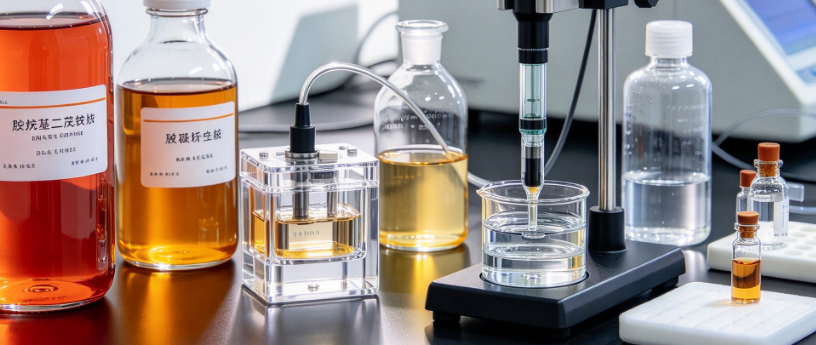
Why Amine-Alkyl Ferrocene Derivative Testing Is Requested
Amine-alkyl ferrocene derivatives occupy a distinctive position in materials chemistry because they combine three functional elements in a single molecule: the redox-active ferrocene core, the amine group, and the flexible alkyl tether between them. This combination is exploited in solid rocket propellant burn-rate catalysts, epoxy curing agents, electrochemical mediators, redox-active surfactants, asymmetric catalysis ligands, and biologically active compounds. Each application is sensitive to different aspects of the molecule, and a defect in any one element can cause failure. Our testing programs quantify the structural, chemical, electrochemical, and thermal properties that determine whether a derivative is fit for its intended function, rather than reporting isolated values. Typical customer objectives include synthesis validation, batch qualification, impurity profiling, electrochemical performance verification, thermal stability assessment, and failure investigation.
Derivative Types and Structural Families We Characterize
We characterize a broad range of amine-alkyl ferrocene derivatives, including aminoethyl ferrocene, aminopropyl ferrocene, dimethylaminomethyl ferrocene, diethylaminoethyl ferrocene, ferrocenylalkylamines, quaternized ferrocenyl ammonium salts, and ferrocene derivatives bearing secondary or tertiary amine functionality on variable-length alkyl chains. We support both mono-substituted and disubstituted ferrocene systems, including 1,1′-disubstituted and heteroannularly substituted derivatives, as well as mixtures containing unreacted ferrocene, higher homologues, and quaternary ammonium by-products. Programs can be designed for R&D samples, pilot lots, and multi-batch supplier qualification, and we accommodate air- and moisture-sensitive samples with appropriate handling procedures.
Structural Confirmation and Isomer Discrimination
Confirming the structure of an amine-alkyl ferrocene derivative requires more than a single spectroscopic technique, because the ferrocene core, the alkyl tether, and the amine group each produce overlapping signatures. We employ proton and carbon-13 nuclear magnetic resonance spectroscopy to confirm substitution patterns, alkyl chain length, and amine alkylation state. Our NMR capabilities include 57Fe NMR and two-dimensional correlation experiments where cyclopentadienyl ring substitution must be resolved, including discrimination between 1,2- and 1,1′-substitution and detection of heteroannular versus homoannular products. Fourier transform infrared spectroscopy confirms the presence of amine N–H and C–N modes and the characteristic ferrocene ring vibrations. High-resolution mass spectrometry, including electrospray ionization and atmospheric pressure chemical ionization, establishes molecular formula and detects homologous or dimeric impurities. Where crystallinity permits, single-crystal X-ray diffraction provides unambiguous confirmation of molecular geometry and ring substitution.
Purity, Impurity Profiling, and Residual Ferrocene Determination
Synthetic routes to amine-alkyl ferrocenes frequently generate unreacted ferrocene, mono- and disubstituted by-products, quaternary ammonium species, and residual alkylating agents. We quantify these impurities using high-performance liquid chromatography with ultraviolet and mass spectrometric detection, gas chromatography for volatile impurities, and thin-layer chromatography for rapid profiling. We report residual unsubstituted ferrocene at trace levels, since even small fractions can alter electrochemical response, catalytic behavior, and thermal decomposition pathways. Ion chromatography quantifies counterions in quaternary ammonium derivatives, and elemental analysis provides independent confirmation of empirical formula. For each impurity identified, we report both identity and quantity, allowing customers to determine whether a batch deviation originates from incomplete substitution, over-alkylation, or feedstock quality.
Amine Content, Basicity, and Functional Group Quantification
The amine group is the reactive handle of the molecule, and its content and basicity determine performance in curing, catalysis, and acid–base applications. We determine total amine content by non-aqueous titration and by spectroscopic methods, and we distinguish primary, secondary, and tertiary amine fractions using salicylaldehyde or ninhydrin derivatization followed by spectrophotometric or chromatographic analysis. We measure amine equivalent weight and base dissociation behavior across the relevant pH range, allowing customers to calculate stoichiometric ratios for epoxy curing or acid neutralization. For quaternized derivatives, we determine quaternary ammonium content by titration and ion-pair chromatography. Where the amine is sterically hindered or electronically coupled to the ferrocene core, we assess reactivity through kinetic measurements rather than relying on nominal content alone.
Electrochemical Characterization and Redox Behavior
The ferrocene/ferrocenium couple is the functional heart of these derivatives, and its behavior depends on substituent electronic effects, steric environment, and solution conditions. We perform cyclic voltammetry, differential pulse voltammetry, and square-wave voltammetry to determine half-wave potential, peak separation, peak current ratio, and diffusion coefficient. Our electrochemical capabilities resolve substituent-induced potential shifts, detect irreversible or quasi-reversible behavior caused by amine–ferrocenium interactions, and quantify the fraction of electrochemically active ferrocene in a sample. We evaluate redox behavior across solvents and supporting electrolytes, since the amine group can participate in proton-coupled electron transfer and can coordinate the oxidized ferrocenium center. For applications in mediated electrochemistry or redox flow systems, we measure charge–discharge cycling stability and quantify decomposition or adsorption losses over extended cycling.
Thermal Stability, Decomposition, and Volatility Assessment
Amine-alkyl ferrocene derivatives used as burn-rate catalysts, curing agents, or high-temperature additives must survive thermal processing and service environments. We use Thermogravimetric Analysis to determine decomposition onset, weight-loss stages, and residual mass under nitrogen, air, and oxidizing atmospheres. We couple TGA with evolved gas analysis by FTIR or mass spectrometry to identify decomposition products and to distinguish amine loss, alkyl chain scission, and ferrocene ring degradation. Differential scanning calorimetry characterizes melting behavior, polymorphic transitions, and exothermic decomposition events. For propellant and energetic applications, we evaluate compatibility with oxidizers and binder systems through thermal aging and differential scanning calorimetry screening. Volatility and sublimation tendency are assessed for low-molecular-weight derivatives where migration during storage is a concern.
Compatibility, Migration, and Matrix Interaction Testing
In formulated systems, an amine-alkyl ferrocene derivative must remain compatible with its matrix and must not migrate, bloom, or react prematurely. We evaluate compatibility with epoxy resins, polyurethane binders, nitrate ester plasticizers, and composite propellant ingredients through accelerated aging, viscosity monitoring, and thermal analysis. We quantify migration and blooming tendency using contact-angle analysis, surface spectroscopy, and extraction studies, and we assess whether the amine group participates in unintended side reactions with the matrix. For propellant applications, we evaluate burn-rate catalytic activity and its stability over storage, distinguishing chemical degradation of the catalyst from physical redistribution within the formulation. These data allow customers to determine whether a compatibility problem originates from the derivative itself, from residual impurities, or from the matrix formulation.
Failure Analysis and Root-Cause Investigation
When an amine-alkyl ferrocene derivative fails qualification or field performance, the analytical question shifts from specification testing to mechanism identification. We integrate NMR, FTIR, mass spectrometry, chromatography, cyclic voltammetry, TGA, DSC, and microscopy into a single failure-analysis workflow. We differentiate among incomplete substitution, over-alkylation, oxidation of the ferrocene core, amine degradation, residual catalyst contamination, and matrix incompatibility by cross-referencing structural, electrochemical, and thermal evidence. This approach is particularly valuable for diagnosing loss of catalytic activity, electrochemical irreversibility, thermal instability, and batch-to-batch performance shifts that cannot be explained by supplier certificate data alone.
Standards Alignment and Data Reporting
Our testing protocols reference recognized standards where applicable, including methods for amine value determination, electrochemical measurement, thermal analysis, and elemental impurity limits. We report measurement uncertainty, calibration traceability, and method-specific detection limits so that results can support supplier qualification, synthesis documentation, and regulatory submissions. Where no standard method exists for a specific derivative or application matrix, we develop and validate an application-relevant protocol and document the basis for the reported values, including the rationale for the separation, detection, and electrochemical strategy used.
Our Advantages in Amine-Alkyl Ferrocene Derivative Testing
The central advantage of our service is the integration of structural, chemical, electrochemical, and thermal characterization within one coordinated workflow. Amine-alkyl ferrocene derivative performance is governed by coupled substituent effects, redox chemistry, acid–base behavior, and thermal stability, and no single technique provides a defensible characterization. We combine NMR, FTIR, high-resolution mass spectrometry, HPLC, GC, ion chromatography, non-aqueous titration, cyclic voltammetry, TGA with evolved gas analysis, DSC, and X-ray diffraction, allowing cross-validation of structure, purity, electrochemical activity, and thermal behavior. Our team supports custom method development for non-standard derivatives and air-sensitive samples, confidential sample handling, and scalable programs ranging from single-batch troubleshooting to multi-lot supplier qualification. We do not merely report that a derivative is “impure” or “electrochemically irreversible”; we identify the impurity, quantify the electroactive fraction, map thermal degradation pathways, and determine the synthetic or formulation variable most likely responsible.
Applications and Industries We Support
Our amine-alkyl ferrocene derivative testing services support solid rocket propellants and energetic materials, epoxy curing and polymer modification, electrochemical mediators and redox flow systems, asymmetric catalysis, redox-active surfactants, chemical sensors, biomedical research, and specialty metallocene chemistry. We serve synthesis laboratories, propellant and energetic material manufacturers, specialty chemical producers, catalyst developers, and research institutions. Whether the requirement is synthesis validation, batch qualification, electrochemical performance verification, thermal stability assessment, or failure investigation, we provide the analytical depth needed to make technically defensible material and process decisions.
Request Amine-Alkyl Ferrocene Derivative Testing
To begin, customers can provide derivative name or structure, synthetic route, physical form, intended application, suspected impurity or performance issue, and any existing specification limits. Based on these inputs, we design a targeted characterization plan that balances structural confirmation, purity and impurity profiling, amine content determination, electrochemical characterization, and thermal stability assessment as required. We can build a customized amine-alkyl ferrocene derivative testing program aligned with development timelines and qualification requirements. Contact us to discuss sample submission, handling requirements, method selection, reporting format, and turnaround expectations.