Reasons for choosing our testing services
ZHONGXI Testing has obtained inspection qualification certifications from multiple countries and regions worldwide. We possess a senior testing team and advanced testing methods, providing independent, impartial, and professional third-party verification services for global carbon projects.

Internationally recognized authority
Certified by multiple international standards such as CNAS, VCS, and GS, with reports universally applicable worldwide.

Global service capability
Covering 140+ countries and regions, it supports on-site detection and remote verification in multiple languages.

Professional experimental methods
Adopt standard experimental methods to ensure accurate and reliable data.
Ferrosilicon Nitride Powder Testing – Advanced Phase, Chemical & Particle Characterization for Refractory & Abrasive Applications
If you are searching for ferrosilicon nitride (Fe‑Si₃N₄) powder testing, you are likely preparing to verify the quality of your material – whether for blast furnace trough castables, sliding gate plates, or high‑wear abrasives. Ferrosilicon nitride combines the high temperature strength of silicon nitride with the toughness of iron silicides, but its performance depends critically on free silicon content, silicon nitride conversion rate, iron distribution, and particle size control. Our service provides a complete, multi‑technique analytical package that quantifies all key phases, trace elements, oxygen/nitrogen content, and powder characteristics with industry‑leading precision. We deliver the data you need for process optimization, quality assurance, and regulatory compliance.
What We Determine – From Phase Composition to Trace Contaminants
Ferrosilicon nitride is typically produced by nitriding ferrosilicon (FeSi) under high temperature. The product contains multiple phases: β‑Si₃N₄, α‑Si₃N₄, FeₓSi (iron silicides), free silicon, and occasionally unreacted FeSi or Si₂N₂O. Our analytical platform integrates seven complementary techniques to resolve every critical attribute:
Phase identification & quantification – High‑resolution powder X‑ray diffraction (HR‑XRD) with Rietveld refinement identifies all crystalline phases and quantifies them down to 0.5 wt%. We distinguish β‑Si₃N₄ from α‑Si₃N₄, detect free Si (<1 wt% sensitivity), and determine the weight fraction of iron silicides (e.g., FeSi, Fe₃Si, Fe₅Si₃). For amorphous content (e.g., SiO₂), we use an internal standard method.
Total nitrogen & oxygen content – Inert gas fusion (IGF) using a LECO instrument: nitrogen is measured as N₂ after combustion in a graphite crucible at >2500°C, with detection limit 10 ppm and accuracy ±0.05 wt%. Oxygen is measured simultaneously (as CO or CO₂) with similar sensitivity. These values directly indicate nitriding completion and oxide contamination.
Elemental composition (Si, Fe, Al, Ca, C, S, etc.) – ICP‑OES after microwave‑assisted acid digestion (HNO₃/HF) quantifies major (Si, Fe) and minor/trace elements (Al, Ca, Mg, Mn, Cr, Ti) with accuracy ±0.2% relative for major elements and 0.5–5 ppm detection limits for trace impurities. Free silicon is determined by selective dissolution in alkali or by a modified wet chemical method, with detection limit 0.05 wt%.
Particle size distribution & morphology – Laser diffraction (wet dispersion, ethanol medium) measures size from 0.1 to 2000 µm, providing D10, D50, D90, and span. For fine fractions (<20 µm), we use SEM imaging at 2000–10,000× magnification to verify particle shape (angular, blocky, or platelet) and detect agglomerates. Automated image analysis gives primary particle size distribution from >500 particles.
Specific surface area & porosity – N₂ physisorption (BET) covers surface areas from 0.2 to 100 m²/g (±2% repeatability). For porous powders, we provide BJH pore size distribution.
Carbon & sulfur content – High‑frequency combustion‑infrared detection (LECO) measures carbon (from residual organics or graphite) and sulfur with detection limit 5 ppm each – critical for refractory applications where carbon affects oxidation resistance.
Bulk density & tap density – Measured according to ASTM B329 and B527, providing apparent density, tap density, and Hausner ratio for flowability assessment.
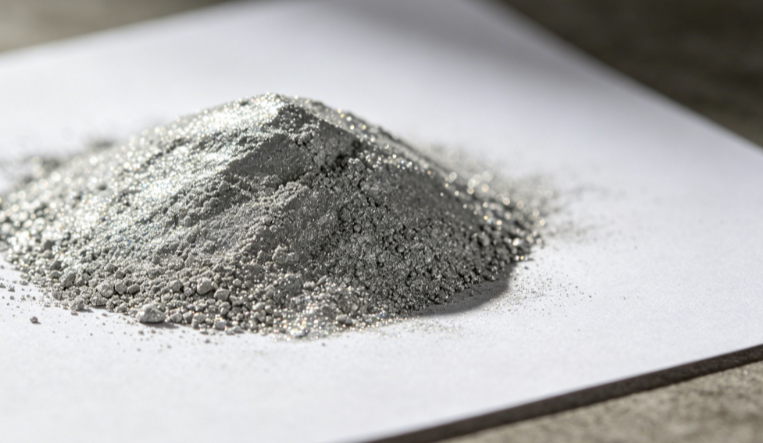
Technical Performance – Detection Limits & Typical Ranges
The table below summarizes our key analytical capabilities for ferrosilicon nitride powder characterization.
| Parameter / Property | Analytical Method | Detection Range / Resolution | Typical Specification (Refractory Grade) |
|---|---|---|---|
| β‑Si₃N₄ content | XRD (Rietveld)
|
Quantification 1–100 wt% ±1% absolute
|
≥90 wt%
|
| Free silicon (Si) | Selective dissolution + ICP / XRD
|
0.05–15 wt% ±0.1 wt%
|
≤1.5 wt%
|
| Total nitrogen (N) | Inert gas fusion (LECO)
|
10 ppm – 40 wt% ±0.05 wt%
|
30–34 wt% (theoretical for Si₃N₄ ~34%)
|
| Total iron (Fe) | ICP‑OES
|
0.01–95 wt% ±0.2% relative
|
Typically 5–20 wt% depending on grade
|
| Oxygen content (O) | Inert gas fusion
|
10 ppm – 10 wt% ±0.05 wt%
|
≤1.5 wt%
|
| Particle size D50 | Laser diffraction (wet)
|
0.5–500 µm ±1% (for reference standard)
|
As required (e.g., 5–20 µm for spray coating)
|
| Carbon (C) and sulfur (S) | Combustion‑IR
|
5 ppm – 2 wt% ±2 ppm (at low levels)
|
C ≤0.5%, S ≤0.1%
|
All results are traceable to certified reference materials (NIST, BAM) and include expanded measurement uncertainty (k=2). We follow ASTM C1494 (for Si₃N₄ powders) and ISO 21068 (for refractories).
Why Our Ferrosilicon Nitride Powder Testing Service Excels
Ferrosilicon nitride is a challenging material to analyze due to its high hardness, chemical inertness, and complex phase mixture. Routine labs often underreport free silicon or misquantify iron silicides. Our service offers distinct advantages:
1. Complete phase‑chemical correlation – We do not report numbers in isolation. Our integrated report combines XRD phase analysis (β‑Si₃N₄, α‑Si₃N₄, FeₓSi, free Si) with elemental data (N, Fe, Si total, free Si) to check consistency. For example, if XRD shows 10% FeₓSi, the total iron by ICP should match. If total nitrogen is below theoretical, we link it to unreacted FeSi or free Si. This cross‑validation prevents reporting internal inconsistencies that could mislead your quality decisions.
2. Ultra‑low free silicon detection – Free silicon is a critical impurity that lowers refractoriness and causes unwanted phase formation. Our selective dissolution method (alkaline or acid‑based) achieves 0.05 wt% detection limit, validated by XRD and SEM‑EDS. We also report the morphology of free Si (isolated particles or coatings on Si₃N₄) via backscattered electron imaging.
3. Accurate nitrogen and oxygen by LECO – Our inert gas fusion instrument is calibrated daily with certified standards (e.g., NIST SRM 2690, Si₃N₄ powder). For oxygen, we use a nickel‑snap capsule to prevent surface oxidation during analysis. Typical repeatability for N at 30 wt% is ±0.05% absolute. We also report oxygen as a separate oxide equivalent (e.g., SiO₂) to help you quantify oxide skin thickness.
4. High‑resolution iron silicide phase analysis – Standard XRD often cannot distinguish FeSi from Fe₅Si₃. We use synchrotron XRD (optional) or Rietveld refinement with high‑quality reference patterns to unambiguously identify and quantify iron silicide phases. This is critical because Fe₃Si and FeSi have different effects on oxidation and wear resistance. For routine work, we also offer Mössbauer spectroscopy (⁵⁷Fe) to determine iron oxidation state and magnetic ordering – helping you detect even trace Fe³⁺ species.
5. Low sample consumption & fast turnaround – We require only 5–10 grams for the complete test suite (XRD, LECO N/O, ICP, free Si, particle size). Standard delivery for up to 10 samples takes 10–14 business days. For urgent process control, we offer a 48‑hour quick service (XRD phase + LECO N + particle size) on up to 3 samples.
6. Morphology and powder flowability assessment – For powders used in plasma spraying or cold pressing, particle shape and flowability are key. We provide SEM micrographs at multiple magnifications with annotations of particle angularity, porosity, and surface texture. Additionally, we measure flow rate (Hall flowmeter), angle of repose, and compressibility index according to ASTM D6393. These data help you predict die filling and coating uniformity.
7. Customized impurity profiling – Depending on your source (FeSi raw material from different origins), unwanted elements like Al, Ca, Ti, and Mn can accumulate. Our ICP‑MS screens for up to 25 elements with ppt‑level detection. We flag any element that exceeds your internal specification and provide statistical comparison to previous batches.
8. Oxidation resistance screening (optional) – For high‑temperature applications, we offer Thermogravimetric Analysis (TGA) in air up to 1350°C to measure oxidation weight gain and onset temperature. Coupled with post‑test XRD, we determine the formation of cristobalite or iron oxides – giving you direct data on service life expectations.
Ready to Certify Your Ferrosilicon Nitride Powder?
Whether you are a manufacturer needing batch‑to‑batch consistency, a refractory supplier qualifying incoming material, or a researcher developing new grades, our ferrosilicon nitride powder testing service provides the analytical rigor and interpretative depth you require. Request a free consultation by providing a brief description (expected composition, particle size range, application). We will respond within 24 hours with a custom measurement plan and a fixed price quote. Volume discounts and long‑term service agreements are available. Email [email protected] or call +1 (412) 555‑FESI. Let us help you ensure the quality and performance of your advanced nitride powder.