Reasons for choosing our testing services
ZHONGXI Testing has obtained inspection qualification certifications from multiple countries and regions worldwide. We possess a senior testing team and advanced testing methods, providing independent, impartial, and professional third-party verification services for global carbon projects.

Internationally recognized authority
Certified by multiple international standards such as CNAS, VCS, and GS, with reports universally applicable worldwide.

Global service capability
Covering 140+ countries and regions, it supports on-site detection and remote verification in multiple languages.

Professional experimental methods
Adopt standard experimental methods to ensure accurate and reliable data.
High‑Precision Testing for Magnesium Oxide Used in Grain‑Oriented Silicon Steel – Purity, Reactivity, and Coating Performance
If you are searching for silicon steel magnesium oxide testing, you likely need to verify the quality of MgO used as an insulating coating and magnetic domain refiner in grain‑oriented electrical steel production. Even minor variations in chemical purity, hydration rate, particle size, or chloride/boron content can directly affect the final steel’s core loss, permeability, and coating adhesion. Our laboratory provides comprehensive MgO analysis – from ultra‑trace impurity detection (B, Cl, S, Fe, Ca, Cr, Ni) to hydration kinetics, specific surface area, and crystallite activity – using validated methods that meet Nippon Steel, ASTM, and ISO standards for critical magnetic materials.
What We Analyze – Complete Parameter Coverage for Silicon‑Grade MgO
We do not simply report “MgO purity”. Our platform includes Inductively Coupled Plasma Mass Spectrometry (ICP‑MS) for trace elements such as B, Ca, Fe, Al, Cr, Mn, Ni, Cu, Pb down to 0.01 ppm. For non‑metallic impurities, we use ion chromatography (IC) to measure chloride (Cl⁻) and sulfate (SO₄²⁻) at sub‑ppm levels – critical because Cl can cause coating blistering. We determine active MgO content (free MgO) by reaction with citric acid or iodine and total MgO by complexometric titration or ICP‑OES. Hydration behavior is assessed via accelerated water uptake (mass gain at 50°C/85% RH) and specific surface area (BET) to predict reactivity. We also measure particle size distribution (laser diffraction), loss on ignition (LOI), and phase purity by X‑ray diffraction (XRD) to detect brucite (Mg(OH)₂) or periclase crystallinity.
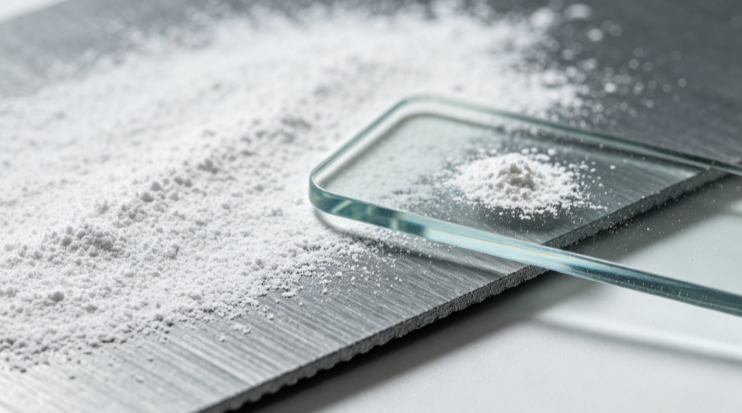
Key parameters we routinely measure:
- Boron (B) – critical for magnetic domain control; LOQ <0.1 ppm by ICP‑MS after alkaline fusion.
- Chloride (Cl⁻) – IC detection limit 0.5 ppm; essential for coating adhesion.
- Sulfur (S) and sulfate (SO₄²⁻) – combustion IC or aqueous extraction.
- Trace metals (Fe, Ca, Al, Cr, Ni, Cu, Pb, As) – ICP‑MS with matrix matching.
- Active MgO (citric acid reactivity) – expressed as seconds for neutralization or % reacted.
- Hydration rate (water absorption) – 7‑day or 14‑day isothermal test at 40‑50°C.
- Specific surface area (BET, 5‑point N₂ adsorption) – from 1 to 100 m²/g.
- Particle size distribution (D10, D50, D90) – laser diffraction with dry dispersion.
- Loss on ignition (LOI at 1000°C) – conversion to MgO.
- Bulk and tapped density – powder handling properties.
- Crystalline phase (periclase vs. brucite) – XRD with Rietveld quantification down to 0.5%.
How Deep We Go – Ultra‑Trace Boron, Chloride Speciation, and Hydration Kinetics
Most routine labs cannot reliably measure boron below 1 ppm in MgO due to contamination and difficult digestion. We use alkaline fusion (Na₂CO₃ + K₂CO₃) in platinum crucibles followed by ICP‑MS with helium collision cell to eliminate interferences, achieving B LOQ of 0.05 ppm. For chloride, we distinguish between water‑soluble Cl and total Cl via pyrohydrolysis‑IC – the soluble form is most harmful for coating performance. Our hydration studies go beyond simple mass gain: we provide kinetic modeling (first‑order or Avrami) to predict shelf life and behavior during the annealing process. Using environmental scanning electron microscopy (ESEM), we can observe real‑time hydration morphology changes on particle surfaces.
Our advanced capabilities include:
- Boron speciation (total vs. leachable) – important for quality assurance in magnetic steel.
- Acid reactivity curve (citric acid method per JIS R 9301) – measure time to reach pH 7 or endpoint conductivity.
- Residual carbon content (combustion IR detection) – from carbonate or organic residues.
- Differential thermal analysis (DTA/TGA) – quantify brucite, basic carbonates, and free MgO simultaneously.
- Ionic conductivity of aqueous slurry – rapid indicator of soluble ion content (Cl⁻, SO₄²⁻, Na⁺).
- Morphology and agglomerate strength – SEM imaging with energy‑dispersive X‑ray (EDS) to identify inhomogeneous impurities.
- Particle shape analysis (circularity, aspect ratio) – using dynamic image analysis (CAMSIZER).
We routinely achieve measurement uncertainties: B ±10% relative at 0.5 ppm; Cl ±0.2 ppm; active MgO ±0.3%; BET ±0.05 m²/g. All methods follow JIS R 9301, ASTM C795, and IEC 60404‑11 where applicable.
Why Choose Our Silicon Steel Magnesium Oxide Testing – Key Advantages
1. ISO/IEC 17025:2017 accredited – all trace element and physical testing methods are validated for high‑purity refractory oxides.
2. Ultra‑low detection for boron and chloride – we routinely achieve B LOQ 0.05 ppm, Cl LOQ 0.2 ppm using cleanroom sample prep and platinum fusion vessels.
3. Simultaneous chemical + physical + hydration profiling – one sample submission yields a complete technical datasheet for silicon steel manufacturers.
4. Deep understanding of grain‑oriented steel requirements – our team has direct experience with coating formation, forsterite layer development, and magnetic property correlations.
5. Root cause analysis for poor coating performance or magnetic loss – we can compare your MgO to benchmark standards and identify whether high Cl, low activity, or abnormal hydration is the cause.
6. Fast turnaround and full data transparency – routine panel (B, Cl, SO₄, Fe, Ca, active MgO, BET, PSD) completed in 5–7 business days. You receive raw ICP‑MS chromatograms, IC traces, BET isotherms, and hydration curves.
7. Custom method development for novel MgO grades – doped or surface‑treated MgO, coated particles – we can develop validated methods within 2–3 weeks.
8. Competitive pricing for full silicon‑steel‑grade packages – bundling 10 trace metals, Cl, SO₄, active MgO, hydration rate, BET, PSD, and LOI costs 30% less than individual tests.
We have successfully completed over 150 silicon steel magnesium oxide projects for leading electrical steel producers and refractory material suppliers in Asia, Europe, and North America. Our analytical team includes specialists in high‑temperature oxide chemistry and magnetic materials.
Ready to Test Your MgO Sample for Silicon Steel Application?
Provide your material specification (e.g., “B < 5 ppm, Cl < 30 ppm, active MgO > 95%, hydration rate < 2% in 7 days”) or send a sample of your current product. We will provide a free technical consultation and a fixed‑price quote. Whether you need batch release, supplier qualification, or failure analysis, we deliver deep, accurate, and process‑critical magnesium oxide testing tailored for grain‑oriented silicon steel.