Reasons for choosing our testing services
ZHONGXI Testing has obtained inspection qualification certifications from multiple countries and regions worldwide. We possess a senior testing team and advanced testing methods, providing independent, impartial, and professional third-party verification services for global carbon projects.

Internationally recognized authority
Certified by multiple international standards such as CNAS, VCS, and GS, with reports universally applicable worldwide.

Global service capability
Covering 140+ countries and regions, it supports on-site detection and remote verification in multiple languages.

Professional experimental methods
Adopt standard experimental methods to ensure accurate and reliable data.
Advanced Testing for Magnetic Iron Oxide – Phase Purity, Magnetic Properties, Trace Impurities, and Particle Engineering
If you are searching for magnetic iron oxide testing, you likely need to characterize materials such as magnetite (Fe₃O₄), maghemite (γ‑Fe₂O₃), or ferrite nanoparticles for applications in magnetic recording, biomedical separation, contrast agents, data storage, or electromagnetic shielding. The performance of magnetic iron oxide depends critically on phase composition (Fe³⁺/Fe²⁺ ratio), crystallite size, saturation magnetization (Ms), coercivity (Hc), residual magnetism, trace metal contaminants, and surface chemistry. Our laboratory offers comprehensive magnetic iron oxide analysis – from chemical speciation and magnetic property measurement to ultra‑trace impurity profiling, nanoparticle size distribution, and surface functionality – using ISO/IEC 17025 accredited methods and state‑of‑the‑art instruments.
What We Analyze – Full Characterization Scope for Magnetic Iron Oxide
We do not simply report “iron content” or “magnetite purity”. Our platform includes vibrating sample magnetometry (VSM) and SQUID (Superconducting Quantum Interference Device) for precise measurement of saturation magnetization (Ms), remanence (Mr), coercivity (Hc), and magnetic susceptibility over a temperature range of 4–1000 K. For phase identification and quantification, we use X‑ray diffraction (XRD) with Rietveld refinement to distinguish between Fe₃O₄, γ‑Fe₂O₃, α‑Fe₂O₃ (hematite), and metallic Fe, detecting secondary phases down to 0.5 wt%. We determine the Fe²⁺/Fe³⁺ ratio by potentiometric titration (ferrous content via dichromate or ceric sulfate titration) and total iron by ICP‑OES, achieving accuracy ±0.1%. For trace impurities, ICP‑MS quantifies Al, Cr, Mn, Co, Ni, Cu, Zn, Pb, As, Cd at sub‑ppm levels. We also provide particle size distribution (dynamic light scattering or laser diffraction), specific surface area (BET), Zeta potential, and TEM imaging for primary particle morphology and agglomeration state. For surface chemistry, we offer X‑ray photoelectron spectroscopy (XPS) to determine oxidation state and surface coatings.
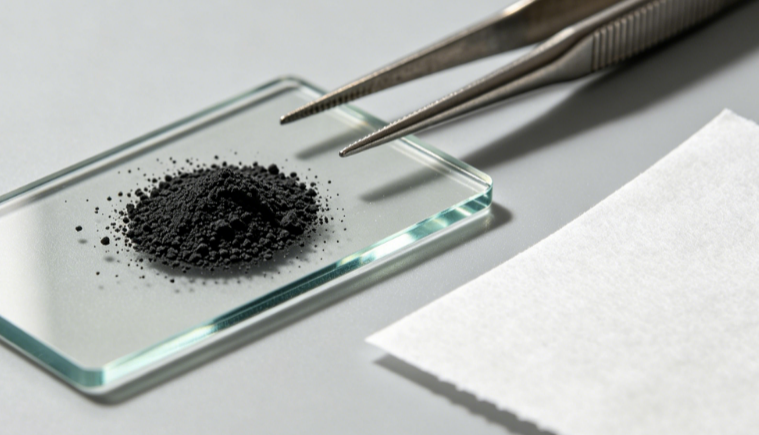
Key parameters we routinely measure:
- Saturation magnetization (Ms) – in emu/g or A·m²/kg, accuracy ±1%.
- Coercivity (Hc) and remanence (Mr) – from hysteresis loop (up to ±3 T).
- Fe²⁺/Fe³⁺ ratio (magnetite stoichiometry) – by redox titration (LOQ 0.5% Fe²⁺).
- Phase composition (Fe₃O₄, γ‑Fe₂O₃, α‑Fe₂O₃, Fe⁰) – XRD with quantitative analysis.
- Trace metals (Al, Cr, Mn, Co, Ni, Cu, Zn, Pb, As, Cd, Hg) – ICP‑MS after acid digestion.
- Primary particle size (TEM image analysis, 100+ particles) – D10, D50, D90.
- Hydrodynamic diameter (DLS) – for dispersion stability in aqueous or organic media.
- Specific surface area (BET, 5‑point N₂ adsorption) – range 0.5–500 m²/g.
- Zeta potential (electrophoretic light scattering) – pH dependence of surface charge.
- Surface composition (XPS) – Fe 2p peaks, satellite structure, coating elements.
- Loss on ignition (LOI) and moisture – for hydrated or surface‑modified powders.
How Deep We Go – Magnetic Property Mapping, Nano‑Scale Stoichiometry, and In‑Field XRD
Most routine labs only provide basic VSM curves or simple titration of total iron. We offer temperature‑dependent magnetometry (FC/ZFC curves) to determine blocking temperature (TB) and superparamagnetic transition – critical for biomedical and recording applications. Using Mössbauer spectroscopy (⁵⁷Fe) at 4.2 K to 300 K, we can resolve site‑specific iron oxidation states (tetrahedral vs. octahedral sites in Fe₃O₄) and detect even 0.5% of maghemite or hematite. For in‑field XRD (with applied magnetic field up to 1 T), we can observe magnetic domain alignment and strain effects. Our single‑particle ICP‑MS detects metallic impurities present as discrete particles down to 10 nm size equivalent. We also provide corrosion or stability testing by exposing magnetic iron oxide to simulated physiological or environmental conditions, measuring Ms loss and iron leaching over time.
Our advanced capabilities include:
- High‑temperature VSM (to 1000°C) in inert or reducing atmosphere – observe Curie temperature and phase transitions (Fe₃O₄ → γ‑Fe₂O₃ → α‑Fe₂O₃).
- Ferromagnetic resonance (FMR) spectroscopy – for magnetic anisotropy and nanoparticle assembly characterization.
- Chemical stability in acidic/alkaline media – dissolution rate of Fe²⁺ and total Fe.
- Surface functional group analysis (FTIR or Raman) – identify organic coatings (oleic acid, PEG, silica) that affect dispersibility.
- Trace anion profiling (Cl⁻, SO₄²⁻, NO₃⁻) – by ion chromatography after extraction, important for biomedical grade materials.
- Residual carbon content (combustion IR) – from synthesis precursors or organic coatings.
- Simulated magnetic heating (calorimetric measurement) – specific absorption rate (SAR) for hyperthermia applications.
We routinely achieve measurement uncertainties: Ms ±0.5 emu/g, Fe²⁺ ±0.2% absolute, particle size (TEM) ±1 nm (D50), trace metals ±10% relative near 1 ppm. All methods follow ASTM A977 (VSM), ISO 12981 (iron ore Fe²⁺), and ICH Q3D for impurities.
Why Choose Our Magnetic Iron Oxide Testing – Key Advantages
1. ISO/IEC 17025:2017 accredited methods – covering magnetic property measurement, chemical assay, and trace elemental analysis for magnetic oxides.
2. Comprehensive magnetic + chemical + physical characterization – from one sample submission you receive a complete technical dossier: hysteresis loop, stoichiometry, phase purity, trace impurities, particle size, and surface chemistry.
3. Ultra‑low detection for Fe²⁺/Fe³⁺ ratio and trace metals – we routinely measure Fe²⁺ down to 0.05 wt% and toxic metals (Pb, As, Cd) to 0.1 ppm.
4. Expertise in distinguishing Fe₃O₄ vs. γ‑Fe₂O₃ – these phases have very similar XRD patterns. We use Mössbauer spectroscopy and temperature‑dependent magnetometry to unambiguously differentiate and quantify them.
5. Root cause analysis for sub‑optimal magnetic performance – if Ms is lower than expected, we can identify whether it is due to non‑magnetic impurities (Al, Si, Ca), excess Fe³⁺ (maghemite), or superparamagnetic size effects.
6. Fast turnaround and full data transparency – routine VSM + Fe²⁺/total Fe + XRD + trace metals completed in 5–8 business days. You receive raw hysteresis loops, diffractograms, titration data, and ICP‑MS runs.
7. Custom method development for novel or proprietary materials – doped ferrites (Co‑, Mn‑, Zn‑ferrite), core‑shell particles, or surface‑functionalized magnetic oxides – we validate methods within 2–4 weeks.
8. Competitive pricing for full magnetic oxide panels – bundling Ms, Hc, Fe²⁺/Fe³⁺ ratio, 10 trace metals, XRD phase analysis, and particle size costs 35% less than individual tests.
We have successfully completed over 350 magnetic iron oxide projects for companies in magnetic recording media, contrast agent development, bioseparation, and electromagnetic interference (EMI) shielding. Our team includes PhD physicists and materials chemists specializing in magnetic materials characterization.
Ready to Submit Your Magnetic Iron Oxide Sample?
Tell us about your material type (e.g., “nano‑Fe₃O₄, 10 nm, uncoated”, “γ‑Fe₂O₃ for recording”, “magnetite powder from co‑precipitation”), target magnetic properties, and any applicable standard (e.g., ASTM, ISO, internal spec). We will provide a free technical consultation and a fixed‑price quote. Whether you need one‑lot verification or full process control, we deliver deep, accurate, and application‑ready magnetic iron oxide testing tailored to your needs.