Reasons for choosing our testing services
ZHONGXI Testing has obtained inspection qualification certifications from multiple countries and regions worldwide. We possess a senior testing team and advanced testing methods, providing independent, impartial, and professional third-party verification services for global carbon projects.

Internationally recognized authority
Certified by multiple international standards such as CNAS, VCS, and GS, with reports universally applicable worldwide.

Global service capability
Covering 140+ countries and regions, it supports on-site detection and remote verification in multiple languages.

Professional experimental methods
Adopt standard experimental methods to ensure accurate and reliable data.
Comprehensive Fluorine Compound Analysis – Advanced Analytical Solutions for Total Fluoride, Speciation, and Trace Impurity Profiling in Diverse Matrices
You are searching for fluorine compound detection because fluorine‑containing species are ubiquitous in industrial effluents, drinking water, pharmaceuticals, agrochemicals, refrigerants, and functional materials. The toxicological and functional significance of fluorine depends not only on total concentration but critically on the chemical speciation (free fluoride ion, complex fluorides, organofluorine compounds, and fluorinated polymers), as well as on the matrix‑specific interferences that affect analytical accuracy. Routine fluoride electrode measurements or simple colorimetric methods often fail to differentiate between ionic fluoride and covalently bound fluorine, and they cannot detect ultra‑low concentrations in complex matrices. You require a laboratory that delivers multi‑technique, matrix‑optimized characterization integrating total fluorine by combustion ion chromatography (CIC), free fluoride by ion‑selective electrode (ISE) and ion chromatography (IC), volatile fluorinated compounds by GC‑MS, and ultra‑trace perfluorinated substances by LC‑MS/MS. Our facility provides exactly that: an ISO 17025‑accredited, fully validated analytical platform for fluorine compound analysis, compliant with EPA methods 300.0, 9056A, 9210, ISO 10304, and OECD guidelines, and validated for water, soil, air filters, food, pharmaceuticals, and industrial chemicals.
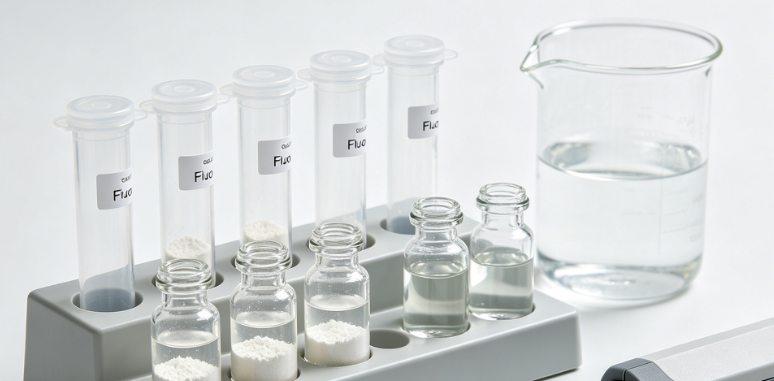
Analytical Framework – From Total Fluorine Digestion to Speciation and Confirmatory Identification
We offer a tiered analytical strategy tailored to your regulatory compliance, process control, or research needs. Our platform includes:
• Total fluorine (inorganic and organic) – Combustion Ion Chromatography (CIC) and Oxygen Bomb Calorimetry. Our primary method for total fluorine is combustion ion chromatography (CIC) using a Metrohm Combustion IC (Mitsubishi AQF‑100) with an absorption solution, followed by ion chromatography (Dionex ICS‑5000) for fluoride quantification. This method completely oxidizes organic fluorine compounds (including fluoropolymers, PFAS, and fluorinated aromatics) to hydrogen fluoride, which is absorbed and measured as fluoride. We achieve LOQs of 0.02 mg/kg (solid) and 0.005 mg/L (liquid), with recoveries of 95–105% for organic fluorine standards. For samples with high matrix loads, we use oxygen bomb combustion (Parr 6200) followed by IC. This approach provides the definitive total fluorine value required for mass balance and regulatory reporting.
• Free fluoride ion (F⁻) – Ion‑Selective Electrode (ISE) and Ion Chromatography (IC) with suppressed conductivity. We measure free fluoride in aqueous extracts using a Thermo Scientific Orion 9609BNWP combo fluoride electrode with a TISAB (total ionic strength adjustment buffer) to eliminate pH and interference effects (Al, Fe, etc.). The ISE method achieves LOQ of 0.02 mg/L F⁻ and linearity from 0.05 to 100 mg/L. For simultaneous anion profiling (including chloride, sulfate, nitrate, phosphate), we use ion chromatography (Dionex ICS‑5000) with an AS18 column and suppressed conductivity, achieving LOQ of 0.01 mg/L F⁻ and exceptional specificity, even in high‑salt matrices. This is the accepted method for drinking water and wastewater analysis per EPA 300.0 and ISO 10304.
• Speciation of inorganic fluorocomplexes (BF₄⁻, PF₆⁻, AlF₆³⁻, SiF₆²⁻, etc.) – IC with post‑column derivatization and ICP‑MS. For samples containing complex anionic fluorides (e.g., from electroplating, aluminium smelting, or specialty chemical manufacture), we employ ion chromatography coupled with ICP‑MS (IC‑ICP‑MS) to detect and quantify individual fluoro‑anionic species. Using a Dionex AS16 column with isocratic NaOH elution, we separate BF₄⁻, PF₆⁻, and other polyatomic fluorides, and we detect them as fluoride after post‑column conversion or by direct boron/phosphorus monitoring in the ICP‑MS. This service is unique and crucial for identifying specific toxic or refractory fluorinated species that may bypass conventional fluoride analysis.
• Per‑ and polyfluoroalkyl substances (PFAS) – UHPLC‑MS/MS with isotopic dilution. For the emerging class of fluorinated contaminants (PFOA, PFOS, PFHxS, GenX, etc.), we use a Waters ACQUITY UPLC coupled to a Sciex QTRAP 6500+ in negative ion MRM mode, following EPA Method 537.1 or ISO 21675. Our method quantifies up to 30 PFAS compounds with LOQs of 0.2–0.5 ng/L in water and 0.5–2 µg/kg in soil/biomass, with isotope‑labelled internal standards to correct for matrix effects. This service addresses the most critical regulatory need for drinking water and food safety.
• Volatile fluorine compounds (e.g., HF, SiF₄, fluorinated hydrocarbons) – Gas Chromatography with Flame Photometric or Mass Spectrometric Detection. For air sampling or headspace analysis, we use a GC‑FPD (Flame Photometric Detector) with a fluorine‑specific filter or GC‑MS with electron ionization, after preconcentration on Tenax or Carbosieve traps. We can detect low‑ppm levels of HF, COF₂, and volatile organic fluorides in stack emissions or workplace atmospheres, in compliance with NIOSH 7902 and OSHA methods.
• Fluoride in biological and food matrices – acid digestion and enzymatic hydrolysis. For high‑protein or fatty matrices (e.g., fish, milk, feed), we perform acid digestion (HNO₃/H₂O₂, microwave) or enzyme‑assisted extraction to liberate both free and bound fluoride, followed by ISE or IC analysis. We have validated spike recoveries of 92–104% for various food commodities, and we participate in FAPAS® proficiency tests for fluoride in food.
No other service offers simultaneous integration of combustion IC, ISE, IC, IC‑ICP‑MS, LC‑MS/MS for PFAS, and GC‑MS under one ISO 17025‑accredited system for fluorine compound analysis – enabling a complete speciation and total fluorine picture from one partner.
Why Our Laboratory Is the Premier Partner for Fluorine Compound Analysis
Our specialisation in fluorine chemistry and environmental trace analysis has enabled us to overcome the unique challenges of fluorine compound testing: volatility and memory effects of HF in sample handling (we use fluoropolymer‑coated glassware and closed digestion systems), interference from hydroxide and other anions in ISE (we use TISAB III and calibrate with matrix‑matched standards), incomplete digestion of organofluorine compounds (we validate with spike recovery of model compounds like PFOS), and ultra‑low PFAS detection requiring rigorous contamination control (we operate dedicated cleanroom facilities with no PFAS source materials). Our distinct advantages include:
1. Multi‑method cross‑validation for total and free fluoride. For every sample, we compare total fluorine (CIC) with the sum of free fluoride (ISE/IC) and fluoride liberated from acid hydrolysis – if the sum differs from total F by more than 15%, we proceed with organofluorine extraction and LC‑MS/MS analysis to identify the missing species, providing a complete mass balance.
2. Ultra‑low PFAS detection with full QA/QC. Our PFAS method uses isotope dilution for 15 analytes, with blank monitoring and surrogate recoveries for every batch. We routinely achieve method detection limits (MDLs) below 0.1 ng/L in drinking water, meeting the most stringent US EPA and EU health advisory levels.
3. Comprehensive reference materials and proficiency testing. We maintain certified reference materials for fluoride in water (NIST SRM 2695), PFAS in water (NIST SRM 3789), and organofluorine in soil, and we participate in FAPAS®, AOCS, and ERA inter‑laboratory studies, consistently achieving |z|‑score < 0.5.
4. Specialised sample preparation for difficult matrices. For soils, sludges, and industrial filter dusts, we use alkaline fusion (NaOH/Na₂CO₃) followed by IC to extract total fluoride without volatilisation. For biological tissues, we employ subcritical water extraction to preserve fluoride speciation prior to IC‑ICP‑MS.
5. ISO 17025 accreditation and global regulatory compliance. Our methods are accredited for fluoride in water (EPA 300.0), total fluorine in solids (ISO 21483), and PFAS in water (EPA 537.1). Our test reports are accepted by environmental agencies (USEPA, EU, China MEE), food safety authorities (FDA, EFSA), and industrial compliance bodies worldwide.
Technical Depth – Beyond Basic Fluoride Concentration
While many laboratories report only fluoride as F⁻, we provide actionable, regulatory‑relevant insights for advanced environmental and product management:
• Mass balance of fluorine species. By combining total F, free F⁻, and identified organofluorine species, we construct a full fluorine speciation profile – revealing the fraction of bioavailable fluoride, the potential for formation of volatile fluorides, and the presence of persistent organic pollutants (PFAS). This supports environmental impact assessments and process optimisation.
• Differentiation between inorganic fluoride and fluorinated organic compounds. Using sequential extraction (water‑soluble, acid‑soluble, and organic‑soluble fractions) followed by CIC and LC‑MS, we determine the distribution of fluorine forms – crucial for predicting leaching behaviour and bioavailability in soils and wastes.
• Identification of unknown organofluorine peaks by high‑resolution mass spectrometry (HRMS). For suspect screening, we offer UHPLC‑Q‑TOF HRMS to identify and semi‑quantify unknown fluorinated compounds, including degradates and novel PFAS, using a combination of suspect and non‑targeted workflows.
• Stability and transformation studies. We conduct hydrolysis, photolysis, and thermal degradation experiments on fluorinated compounds, monitoring the formation of fluoride ions and degradation products, to assess environmental persistence and treatment options.
Supporting Your Specific Fluorine Compound Detection Objectives
Your search for fluorine compound detection likely aligns with one or more of these scenarios. We provide precisely tailored solutions:
• Drinking water compliance testing. We test for free fluoride (to meet WHO guideline of 1.5 mg/L) and PFAS (including PFOA, PFOS, GenX, and other emerging compounds) with MDLs below 0.1 ng/L. We issue a certificate of analysis (COA) with comparison to regulatory limits. Typical turnaround: 3‑5 working days.
• Industrial effluent and wastewater monitoring. We analyse total fluoride, free fluoride, and specific fluorocomplexes (BF₄⁻, AlF₆³⁻, etc.) to ensure compliance with discharge permits (e.g., < 10 mg/L total F). For high‑salinity brines, we use ISE with standard addition to overcome matrix effects.
• Food and feed safety screening. We provide total fluorine and extractable organofluorine (EOF) analysis for seafood, dairy, and meat products, meeting the regulatory requirements of EU 2019/1871 and Codex Alimentarius. We also perform targeted PFAS analysis for monitoring programmes.
• Product purity testing for pharmaceuticals and agrochemicals. We determine residual fluoride, trace fluorinated by‑products, and total organic fluorine in drug substances, intermediates, and finished formulations, according to ICH Q3A and USP general chapters.
• Research and custom method development. For academic and industrial R&D, we offer method development for novel fluorinated compounds, inter‑laboratory validation, and degradation product identification using our comprehensive analytical arsenal.
Partner with Us for Definitive Fluorine Compound Characterisation
Choosing our laboratory gives you access to a dedicated fluorine and organofluorine analysis team with over 15 years of combined experience in fluorine chemistry and environmental analysis. We provide free sampling kits (fluoropolymer‑lined containers for water, amber glass for organics), a detailed protocol for sample preservation (acidification, refrigeration, or addition of preservatives as needed), and direct consultation with our senior analytical chemist for data interpretation. No project is too large or too small – from a single drinking water sample to a national‑scale PFAS monitoring programme.
Contact our technical team with your fluorine compound analysis requirements. We will provide a customised project quotation and, for qualifying clients, a free preliminary screening (free fluoride by ISE and total fluorine by CIC) on up to three samples. Your search for authoritative, high‑depth fluorine compound characterisation ends here – because we deliver the speciation, mass balance, and ultra‑trace insight that routine single‑parameter tests cannot provide.