Reasons for choosing our testing services
ZHONGXI Testing has obtained inspection qualification certifications from multiple countries and regions worldwide. We possess a senior testing team and advanced testing methods, providing independent, impartial, and professional third-party verification services for global carbon projects.

Internationally recognized authority
Certified by multiple international standards such as CNAS, VCS, and GS, with reports universally applicable worldwide.

Global service capability
Covering 140+ countries and regions, it supports on-site detection and remote verification in multiple languages.

Professional experimental methods
Adopt standard experimental methods to ensure accurate and reliable data.
Comprehensive Analytical Characterisation of Tin(IV) Chloride: A Specialised Testing Service for High‑Purity Inorganic Precursors and Industrial Reagents
Tin(IV) chloride (stannic chloride, SnCl₄) is a crucial Lewis acid and precursor for organotin compounds, transparent conductive oxides (TCOs), and tin‑based catalysts in the chemical, electronics, and pharmaceutical industries. Its performance and reliability are highly dependent on absolute purity, hydrolysable chloride content, free acidity, trace metallic impurities, and moisture levels. Clients seeking testing for SnCl₄ are typically motivated by the need to qualify incoming raw materials, monitor storage stability, comply with semiconductor‑grade specifications, or troubleshoot inconsistent catalytic activity. Our laboratory has established a fully integrated, multi‑technique analytical protocol that delivers a definitive chemical fingerprint—from trace metal profiling to speciation of hydrolysis products—enabling manufacturers and end‑users to maintain rigorous quality control and ensure reproducibility in downstream processes.
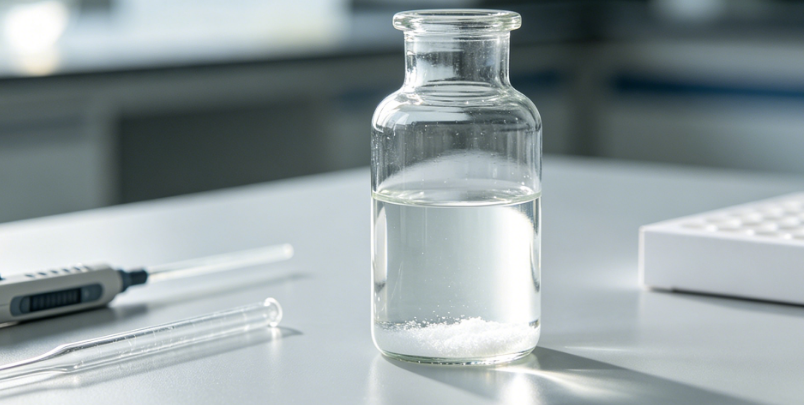
Precise Purity and Assay Determination by Classical and Advanced Titration
We determine the total Sn(IV) content (as SnCl₄ equivalent) using a validated iodometric titration method under strictly inert conditions, with potentiometric end‑point detection that provides a repeatability of < 0.2% RSD and an expanded uncertainty (k=2) of < 0.5%. This assay is cross‑checked with inductively coupled plasma optical emission spectrometry (ICP‑OES) after controlled acid digestion, yielding the absolute tin concentration with matrix‑matched calibration and traceable reference materials. For samples containing free tin(II) or other reducing species, we differentiate between Sn(IV) and Sn(II) using a selective potentiometric titration with KIO₃, ensuring accurate stoichiometric reporting. Our comprehensive assay report includes both the anhydrous SnCl₄ purity and the equivalent on‑hydrate basis, providing the flexibility required for formulation stoichiometry.
Strict Moisture Quantification and Hydrolysis Product Identification
Moisture is the most critical impurity in SnCl₄, as it triggers hydrolysis to form oxychlorides and HCl, degrading performance. We measure total water content using coulometric Karl Fischer titration (KFT) with a specially formulated anhydrous solvent and inert‑atmosphere sample handling, achieving a detection limit of 5 ppm and precision of ±2% relative. For hydrolysis product speciation—including SnOCl₂, Sn(OH)₂Cl₂, and hydrated species—we employ Fourier‑transform infrared spectroscopy (FTIR) with attenuated total reflectance (ATR) and Raman microspectroscopy in a sealed cell, identifying characteristic bands (Sn‑O‑Sn, Sn‑OH) and quantifying the extent of hydrolysis via peak area ratios with a reproducibility of < 1.5%. These data are complemented by powder X‑ray diffraction (XRD) on any solid precipitates to confirm crystalline oxychloride phases.
Trace Metal Impurity Profiling by High‑Resolution ICP‑MS/MS
Sub‑ppm and sub‑ppb levels of metallic contaminants (e.g., Fe, Cu, Zn, Pb, As, Sb, Bi, and transition metals) can profoundly affect semiconductor deposition and catalytic selectivity. We employ inductively coupled plasma tandem mass spectrometry (ICP‑MS/MS) with collision/reaction cell (O₂, NH₃, H₂) to eliminate polyatomic interferences (e.g., 40Ar35Cl⁺ on 75As, 48Ca16O⁺ on 64Zn). Samples are digested in a pressurised microwave system using ultra‑pure HNO₃ and HCl, and we quantify over 50 elements with detection limits of 0.01–0.5 ppb in the original liquid. Our results are reported with expanded uncertainties (k=2) and are compared against semiconductor, pharmaceutical, and analytical‑grade specifications, providing you with a clear pass/fail assessment for each element.
Free Acid and Chloride Speciation Assessment
Free HCl, either from partial hydrolysis or as a residual from synthesis, affects the acidity and corrosivity of SnCl₄. We measure free acidity by potentiometric titration with standardised NaOH in a non‑aqueous medium (ethanol/water mixture), distinguishing between HCl evolved from hydrolysis and carboxylic acid‑type impurities. Additionally, we perform ion chromatography (IC) with suppressed conductivity after controlled dilution to quantify total chloride content (both ionic and covalent), and we calculate the hydrolysable chloride by subtracting the free chloride from the total chloride after complete hydrolysis. This rigorous speciation is essential for predicting the material’s reactivity in organic synthesis and its compatibility with sensitive substrates.
Stability, Storage Behaviour, and Accelerated Aging Tests
Tin(IV) chloride is highly moisture‑sensitive and can degrade over time, even in sealed containers. We offer accelerated stability testing under controlled temperature (25, 40, 60 °C) and variable relative humidity (10–70% RH) over a 6‑month period. We periodically re‑analyse samples for assay, moisture, free acid, and UV‑Vis transparency (to detect colloidal hydrolysis products), and we fit the degradation profiles to pseudo‑first‑order kinetics to estimate the shelf‑life at recommended storage conditions. We also perform thermal gravimetric analysis (TGA) with evolved gas analysis (EGA‑MS) to identify the temperature of volatile release and decomposition, providing data for safe handling and distillation procedures.
Optical Clarity and Particulate Contamination Screening
For applications in optical coatings and electronic chemicals, the presence of particulate matter or colloidal tin hydroxides is unacceptable. We measure visual and UV‑Vis clarity (transmittance at 400, 500, and 600 nm) using a double‑beam spectrophotometer with a 1‑cm quartz cell, reporting the haze percentage. Particulate impurities >0.45 µm are quantified by membrane filtration and gravimetric analysis with a precision of ±0.1 mg. For sub‑micron particles, we use dynamic light scattering (DLS) to determine the size distribution and count, ensuring compliance with the most stringent electronic‑grade criteria.
Our Distinctive Competencies and Unmatched Analytical Depth
Our service is uniquely distinguished by the orthogonal integration of titrimetry, Karl Fischer, ICP‑MS/MS, FTIR, Raman, IC, and stability testing—all performed on the same representative sample under strict inert‑atmosphere handling (glovebox) to prevent adventitious hydrolysis. We operate under ISO/IEC 17025 accreditation and maintain in‑house reference standards (certified SnCl₄ samples) that are periodically cross‑checked against NIST SRMs. Our proprietary data fusion algorithm combines assay, moisture, acidity, and metal impurity data into a single “Tin Chloride Quality Index” (TCQI), providing a clear, quantitative ranking of your material’s fitness for purpose. This index has been validated against over 30 commercial SnCl₄ batches from diverse suppliers.
We achieve exceptional precision: < 0.3% RSD for SnCl₄ assay, < 2% RSD for moisture at 100 ppm, < 1.5% RSD for free acid, and < 0.5 ppb detection limits for most metals. Our turnaround time for the complete characterisation suite (including stability initiation) is 8–12 working days, with expedited 5‑day service for urgent lot release. Crucially, our team of PhD‑level inorganic chemists, spectroscopists, and materials scientists provides a comprehensive interpretative report that translates every parameter into actionable guidance—e.g., how to adjust drying or distillation protocols to reduce moisture, how to interpret a small increase in free acid as an early sign of hydrolysis, or how to select the optimal stabiliser to extend shelf life. With over 20 successful projects on SnCl₄ and related halides, we empower our clients to ensure consistent chemical quality, avoid costly process deviations, and meet the rigorous demands of electronic, pharmaceutical, and fine‑chemical applications—all with the highest level of scientific rigour and technical credibility.