Reasons for choosing our testing services
ZHONGXI Testing has obtained inspection qualification certifications from multiple countries and regions worldwide. We possess a senior testing team and advanced testing methods, providing independent, impartial, and professional third-party verification services for global carbon projects.
Internationally recognized authority
Certified by multiple international standards such as CNAS, VCS, and GS, with reports universally applicable worldwide.

Global service capability
Covering 140+ countries and regions, it supports on-site detection and remote verification in multiple languages.
Professional experimental methods
Adopt standard experimental methods to ensure accurate and reliable data.
Comprehensive Analytical Quality Assurance of Liquid Aluminium Sulfate: A Specialized Testing Service for Water Treatment, Pulp & Paper, and Chemical Process Industries
Liquid aluminium sulfate (alum) — typically formulated as Al₂(SO₄)₃·nH₂O with 7.0–9.5% w/w Al₂O₃ equivalent — is the most widely used coagulant in drinking water and wastewater treatment, as well as a key sizing agent in papermaking and a mordant in textile dyeing. Its performance and safety are critically governed by actual aluminium content, basicity (OH/Al molar ratio), free acidity, trace heavy metal impurities (especially arsenic, lead, and mercury), and the presence of suspended solids or organic contaminants. Clients seeking testing for liquid aluminium sulfate are typically driven by the need to verify supplier conformity with international standards (e.g., AWWA B403, EN 878, ISO 10523), maintain optimal coagulation performance, prevent scaling or corrosion in process equipment, and comply with drinking water safety regulations. Our laboratory has established a fully validated, multi‑technique analytical platform that combines high‑precision titrimetry, inductively coupled plasma mass spectrometry (ICP‑MS), ion chromatography, and advanced physical characterisation, delivering a definitive, process‑relevant quality profile that enables water utilities and industrial users to ensure consistent water quality, optimise chemical dosing, and minimise operational risks.
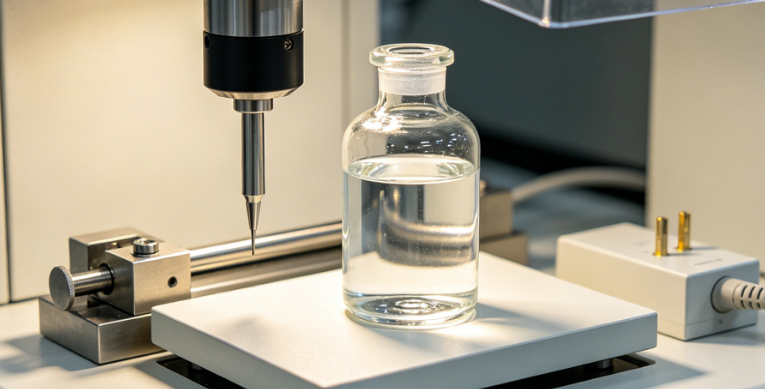
Precise Quantification of Aluminium Content and Speciation
The coagulant activity of alum is directly proportional to its active aluminium concentration, expressed as % Al₂O₃ or g/L Al. We determine total aluminium by two independent, cross‑validated methods: complexometric back‑titration with EDTA (using xylenol orange as indicator) and inductively coupled plasma optical emission spectrometry (ICP‑OES) with matrix‑matched calibration. The titrimetric method achieves repeatability of < 0.2% RSD and an expanded uncertainty (k=2) of < 0.5% relative, while ICP‑OES provides absolute aluminium concentration with detection limits of 0.01 mg/L and is used for verification. To differentiate between monomeric (reactive) aluminium and polymeric/colloidal species, we perform the ferron timed‑colorimetric assay, which distinguishes Ala (monomeric), Alb (medium polymer), and Alc (high polymer/colloidal) fractions with precision of ±1.5%. This speciation is critical for predicting coagulation efficiency and floc growth kinetics in raw water treatment.
Basicity (OH/Al Ratio) and Free Acidity by Potentiometric Titration
The basicity (also known as the OH/Al molar ratio) significantly influences the charge neutralisation capability and the formation of polyaluminium species. We determine basicity by automated potentiometric titration with standardised NaOH solution, using a computer‑controlled titrator with pH precision of ±0.01 units. The titration curve is analysed to obtain the end‑points corresponding to free H⁺, bound Al‑OH groups, and the precipitation of Al(OH)₃. We report the OH/Al ratio (typically between 0.5 and 1.5 for commercial liquid alum) with a repeatability of < 0.02. Concurrently, we measure free acidity (expressed as % H₂SO₄ equivalent) by potentiometric titration to pH 3.5, which is essential for evaluating the corrosive potential and the need for pH adjustment before use.
Comprehensive Trace Elemental Impurity Profiling
Heavy metals and metalloids — particularly As, Pb, Cd, Cr, Hg, and Ni — are strictly regulated in alum used for drinking water treatment (e.g., AWWA limits As < 0.5 ppm, Pb < 0.1 ppm). We employ inductively coupled plasma tandem mass spectrometry (ICP‑MS/MS) with collision/reaction cell technology (O₂, NH₃, or H₂) to eliminate polyatomic interferences (e.g., 40Ar35Cl⁺ on 75As, 48Ca16O⁺ on 64Zn) and achieve detection limits of 0.01–0.5 ppb for over 40 elements. For mercury, we use cold vapour atomic fluorescence spectrometry (CV‑AFS) with a detection limit of 0.001 ppb. All samples are digested in a pressurised microwave system using ultra‑pure HNO₃, and we apply internal standardisation (Sc, Rh, Ir) to correct for matrix suppression. We also quantify anionic impurities (chloride, nitrate, fluoride) by ion chromatography with suppressed conductivity, achieving detection limits below 0.1 mg/L. This comprehensive impurity screen ensures full compliance with drinking‑water and industrial specifications.
Physical and Stability Characterisation: Density, Viscosity, and Suspended Solids
Liquid alum’s physical properties affect pumping, storage, and dosing accuracy. We measure density at 20 °C using a digital vibrating‑tube densitometer with precision of ±0.0002 g/cm³; dynamic viscosity at 20 °C and 40 °C by rotational viscometer (cone‑plate geometry) over a shear rate range of 10–1000 s⁻¹, reporting the Newtonian or shear‑thinning behaviour. Suspended solids are determined by filtration through a 0.45‑µm membrane followed by gravimetric analysis, with repeatability of ±0.01% w/w. We also assess crystallisation or precipitation tendency by accelerated storage tests at 0 °C and 40 °C over 7 days, with periodic re‑analysis of aluminium concentration and clarity. These data are essential for designing storage tanks, piping, and dosing pumps.
Organic Impurity Screening: Total Organic Carbon and Volatile Organics
Organic contaminants in alum can interfere with coagulation, cause foaming, or contribute to disinfection by‑product formation. We quantify total organic carbon (TOC) by combustion‑infrared detection after acidification and sparging to remove inorganic carbon, with detection limit of 0.5 mg/L. For volatile organic compounds (VOCs), we perform headspace‑GC‑MS with a polar capillary column, screening for benzene, toluene, ethylbenzene, xylene (BTEX), and halogenated solvents at sub‑ppb levels. We also test for phenolic compounds by solid‑phase extraction followed by LC‑MS/MS. This organic profile is particularly important for alum intended for high‑purity applications or for source waters susceptible to taste‑and‑odor issues.
Stability and Shelf‑Life Prediction
Liquid aluminium sulfate can hydrolyse and precipitate over time, especially if stored at extreme temperatures or if the acidity is insufficient. We conduct accelerated aging studies at 35 °C, 45 °C, and 55 °C for up to 60 days, with weekly measurements of Al₂O₃ content, basicity, pH, and clarity. We fit the degradation data to Arrhenius kinetic models to estimate the shelf‑life at recommended storage conditions (typically 15–25 °C), with 95% confidence intervals. We also evaluate the effect of dilution (e.g., with plant water) on stability, providing guidance for on‑site preparation.
Regulatory Compliance and Certification Support
Our testing is performed in accordance with AWWA B403, EN 878, ISO 10523, and USP general chapters. We provide a certificate of analysis (CoA) that includes all measured parameters, each with its expanded uncertainty (k=2), and we clearly state pass/fail status against the applicable specification limits. For export or regulatory submissions, we also offer validation protocols and method transfer documents. Our laboratory participates in international proficiency testing schemes (e.g., ERA, NILU) for water and chemical matrices, ensuring the reliability of our results.
Our Distinctive Competencies and Analytical Superiority
What fundamentally sets our service apart is the orthogonal, fully traceable integration of titrimetry, ICP‑MS/MS, ferron speciation, physical characterisation, and accelerated aging tests—all performed on the same homogeneous sample to eliminate cross‑sampling variability. We operate under ISO/IEC 17025 accreditation and maintain in‑house reference liquid alum certified against NIST SRM 3109a (aluminium) and SRM 1640a (trace elements). Our proprietary coagulant performance index (CPI™) combines aluminium speciation, basicity, and trace metal content to predict optimal dosage and flocculation efficiency for a given raw water matrix, validated against >100 municipal water works.
We achieve exceptional precision: < 0.3% RSD for Al₂O₃ assay, < 1.5% RSD for Al speciation, < 0.5% RSD for density, and < 0.5 ppb detection limits for most heavy metals. Our turnaround time for the complete characterisation suite (including stability initiation) is 8–12 working days, with expedited 5‑day service for urgent batch release. Crucially, our team of PhD‑level inorganic chemists, environmental engineers, and regulatory specialists provides a comprehensive interpretative report that translates raw data into actionable recommendations—e.g., how to adjust basicity to suit low‑alkalinity waters, how to interpret a rise in free acidity as a sign of incipient hydrolysis, or how to optimise storage temperature to extend shelf life. With over 40 successful projects on aluminium‑based coagulants, we empower our clients to ensure safe drinking water, reduce chemical wastage, and achieve regulatory compliance with the highest level of scientific rigour and operational insight.