Reasons for choosing our testing services
ZHONGXI Testing has obtained inspection qualification certifications from multiple countries and regions worldwide. We possess a senior testing team and advanced testing methods, providing independent, impartial, and professional third-party verification services for global carbon projects.

Internationally recognized authority
Certified by multiple international standards such as CNAS, VCS, and GS, with reports universally applicable worldwide.

Global service capability
Covering 140+ countries and regions, it supports on-site detection and remote verification in multiple languages.

Professional experimental methods
Adopt standard experimental methods to ensure accurate and reliable data.
Comprehensive Pecan Shell Biochar Testing – Full Physicochemical and Functional Characterisation for Environmental and Agricultural Applications
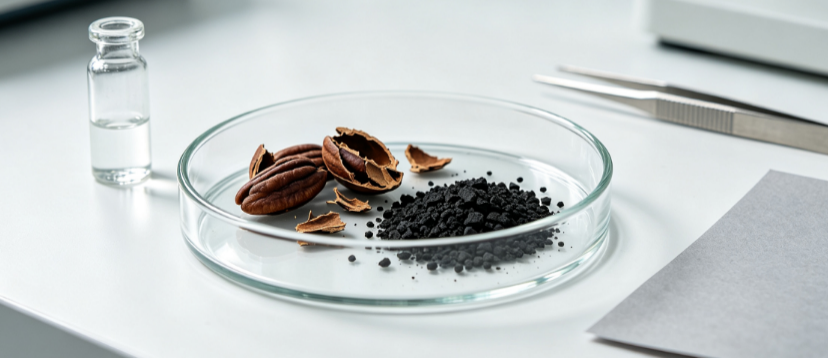
Pecan shell biochar, derived from the pyrolysis of agricultural waste, has emerged as a promising multifunctional material for soil amendment, heavy metal remediation, organic pollutant adsorption, and carbon sequestration. However, the performance of pecan shell biochar is critically dependent on its pyrolysis temperature, residence time, particle size distribution, surface chemistry, and mineral content – parameters that are highly variable and often inadequately characterised by routine proximate analysis. Our pecan shell biochar testing service provides a comprehensive, multi‑technique evaluation that goes far beyond basic ash and volatile matter determination, delivering a molecular‑scale understanding of carbon structure, functional group availability, porosity, and environmental stability. This enables you to optimise production conditions, predict field performance, and meet regulatory or certification requirements with confidence.
Who Needs Pecan Shell Biochar Testing and Why?
Customers seeking biochar characterisation typically include agricultural product developers formulating soil conditioners, environmental consultants assessing remediation potential for contaminated sites, biochar producers needing quality control and process optimisation, and academic researchers investigating structure‑property relationships. Common pain points include inconsistent adsorption capacities between batches, unknown heavy metal leaching risks, poor understanding of long‑term stability in soil, or inability to correlate production parameters with performance. Our service addresses these by providing quantitative metrics for specific surface area, pore size distribution, surface functional groups (acidic/basic), cation exchange capacity (CEC), and resistance to oxidative degradation – all under simulated environmental conditions.
Our Advanced Testing Framework – From Bulk Composition to Nanoscale Architecture
We employ a hierarchical, modular approach that systematically characterises pecan shell biochar across multiple scales, from elemental composition to nanotexture and surface reactivity. Each tier is integrated with state‑of‑the‑art instrumentation to produce a holistic performance profile.
1. Proximate and Ultimate Analysis with Inorganic Element Profiling
We perform Thermogravimetric Analysis (TGA) under inert and oxidising atmospheres to determine moisture, volatile matter, fixed carbon, and ash content with high precision (ASTM D1762‑84 adapted). Ultimate analysis (C, H, N, S, O) is conducted using a high‑temperature combustion CHNS/O analyser with thermal conductivity detection. For inorganic constituents, we use ICP‑OES and ICP‑MS after microwave‑assisted acid digestion to quantify macro‑ and micronutrients (Ca, Mg, K, P) as well as potentially toxic elements (Pb, Cd, As, Cr, Ni) – critical for regulatory compliance (e.g., IBI, EBC standards). We also perform X‑ray fluorescence (XRF) mapping to assess elemental distribution at the particle level.
2. Surface Area and Porosity Assessment (Textural Characterisation)
Pecan shell biochar's adsorptive capacity is governed by its porous structure. We measure specific surface area (BET), total pore volume, and pore size distribution using nitrogen adsorption at 77 K (up to 0.995 relative pressure) and, for wider pore ranges, mercury intrusion porosimetry (macropores) and CO₂ adsorption at 273 K (ultramicropores). We apply non‑local density functional theory (NLDFT) models to resolve pore geometries, and we calculate t‑plot external surface area and micropore volume to distinguish between surface and internal contributions. For quality control, we provide comparative benchmarking against reference biochars (e.g., wood‑based or rice‑husk) under identical conditions.
3. Surface Chemical Functionality and pH/Surface Charge
The abundance of oxygen‑containing groups (hydroxyl, carboxyl, carbonyl, lactone) dictates cation exchange, metal complexation, and pH buffering. We use Boehm titration to quantify acidic and basic surface groups, complemented by FT‑IR spectroscopy with attenuated total reflectance (ATR) and solid‑state ¹³C CP/MAS NMR to identify aromaticity, aliphatic character, and functional group distribution. The point of zero charge (pHPZC) is determined via potentiometric mass titration, and we measure cation exchange capacity (CEC) using the ammonium acetate (pH 7) and barium chloride methods – both essential for predicting nutrient retention and metal sorption behaviour.
4. Stability and Environmental Persistence Testing
Biochar's long‑term carbon sequestration potential requires resistance to abiotic and biotic oxidation. We conduct accelerated oxidative aging using H₂O₂ (3–30%) and thermal treatments (70–200 °C in air) to simulate natural weathering, with periodic re‑characterisation of surface area and functional groups. We also perform respirometry tests (CO₂ evolution over 90 days) to estimate the mineralisation rate in soil‑like media, providing a half‑life estimate for carbon persistence. Furthermore, we assess hydrophobicity via water drop penetration time (WDPT) and water holding capacity to evaluate hydrological impact.
5. Contaminant Leaching and Environmental Safety
Using our column leaching apparatus (EPA Method 1314) and batch equilibrium tests (EPA 1312), we simulate rainwater or acidic conditions to quantify the release of heavy metals, PAHs, and dioxins. We analyse leachates by GC‑MS/MS for organic pollutants and ICP‑MS for metals, and we evaluate polycyclic aromatic hydrocarbon (PAH) content in the biochar itself via Soxhlet extraction followed by GC‑MS – a mandatory parameter for premium biochar certification (EBC, IBI).
6. Advanced Imaging and Micro‑Spatial Analysis
For direct visualisation of pore architecture and mineral distribution, we employ scanning electron microscopy (SEM) with energy‑dispersive X‑ray spectroscopy (EDX) mapping, as well as transmission electron microscopy (TEM) for nanopore observation. We also use X‑ray micro‑computed tomography (µ‑CT) to reconstruct 3D pore networks and quantify tortuosity, which is directly relevant to fluid flow in packed beds or soil matrices.
7. Adsorption Performance Testing for Target Pollutants
Ultimately, the biochar's function is validated through adsorption isotherms and kinetics for relevant contaminants (e.g., Cu²⁺, Pb²⁺, Cd²⁺, methylene blue, phenol, or phosphate). We perform batch adsorption experiments under controlled pH, ionic strength, and temperature, fitting data to Langmuir, Freundlich, Sips, and Dubinin–Radushkevich models to estimate maximum capacity (qₘₐₓ) and binding energy. Kinetic data are analysed using pseudo‑first‑order, pseudo‑second‑order, and intra‑particle diffusion models to identify rate‑limiting steps. We also conduct competitive adsorption with mixed metal solutions to simulate real wastewater scenarios.
Our Distinctive Advantages – Why Choose Us for Pecan Shell Biochar Testing?
Our laboratory is uniquely equipped to handle the complexity of lignocellulosic biochars. We operate a comprehensive suite of interconnected instruments including a TGA‑FTIR‑MS system for real‑time evolved‑gas analysis, a high‑field solid‑state NMR (600 MHz) with variable‑temperature probes, and a fully automated BET/porosimeter with 12 sample ports for high‑throughput texture analysis. We also maintain dedicated biological safety cabinets for soil incubation studies, ensuring Sterility and reproducibility.
Our team comprises environmental chemists, material scientists, and agronomists with extensive experience in biochar production and application. We do not merely provide raw data; we offer interpretative guidance – for example, correlating O/C and H/C ratios (from ultimate analysis) with expected stability, or linking surface acidity (from Boehm titration) to metal adsorption selectivity. We also provide custom pyrolysis simulation (via our micropyrolyser‑GC/MS) to predict the effect of different temperature ramps on final biochar properties.
All testing follows ISO/IEC 17025 principles, and our reports include measurement uncertainty budgets and reference material validation (e.g., NIST standard biochar). We can tailor the test matrix to your specific certification scheme (IBI, EBC, or USDA) and provide a compliance summary for regulatory submissions.
Deliverables – A Complete Characterisation Dossier
Your final report will be organised into clear, actionable sections:
Section 1 – Fundamental properties: Proximate/ultimate data, ash composition, pHPZC, CEC, and elemental (ICP) profiles with comparison to established quality benchmarks.
Section 2 – Textural parameters: BET surface area, micropore volume, mesopore distribution, NLDFT pore size reports, and mercury porosimetry data (if requested).
Section 3 – Surface chemistry: Boehm titration results, FT‑IR and NMR spectral assignments, and functional group quantification (mmol/g).
Section 4 – Stability and leaching: Carbon mineralisation rates, H₂O₂ oxidation resistance, and leachate concentrations for all regulated contaminants.
Section 5 – Adsorption performance: Isotherm parameters, kinetic rate constants, and competitive adsorption data, with suggested operating pH and contact time.
Section 6 – Imaging and 3D structure: SEM/EDX micrographs, TEM images, and µ‑CT derived porosity and tortuosity values.
All raw data (spectra, chromatograms, thermograms) are provided in open formats (JCAMP, CSV, TIFF) for further analysis.
Industries and Applications Served
Our testing service supports agricultural input suppliers developing customised biochar‑based soil amendments, water treatment companies exploring biochar as a low‑cost adsorbent, waste‑to‑energy facilities evaluating co‑product quality, and environmental consultancies performing site‑specific risk assessments. We also assist policy and regulatory bodies in establishing standards for biochar quality, and research institutions in publishing high‑impact studies requiring rigorous characterisation.
How to Initiate a Testing Project
Our engagement process is straightforward and collaborative:
1. Initial consultation: We discuss your biochar source, production parameters, target application, and specific concerns (e.g., metal leaching, adsorption efficiency, or certification).
2. Customised proposal: We design a test plan with modular add‑ons and provide a fixed price and timeline – typically 3–4 weeks for a full characterisation suite (expedited options available).
3. Sample submission: We supply clear instructions for sample size (typically 100–200 g), packaging, and shipping (ambient, with desiccant if needed).
4. Testing and progress updates: We run the assays and share preliminary results at key milestones, allowing you to request additional analyses if new questions emerge.
5. Final report and interpretive review: You receive the comprehensive dossier, followed by a 60‑minute virtual meeting to discuss findings, answer questions, and recommend next steps – whether for process optimisation, field trial design, or regulatory submission.
We handle all materials with care, and strict confidentiality is maintained under a standard non‑disclosure agreement. Your intellectual property and data are never used for other purposes.
Conclusion – Unlock the Full Potential of Your Pecan Shell Biochar with Rigorous, Multi‑Scale Testing
Pecan shell biochar offers a sustainable, high‑performance solution for environmental and agricultural challenges, but its success hinges on a thorough understanding of its physicochemical and functional properties. Our pecan shell biochar testing service delivers the scientific depth and engineering relevance required to make informed decisions – from production tuning to field application and regulatory compliance. With a unique blend of advanced analytics, environmental simulation, and expert interpretation, we provide the clarity you need to transform waste biomass into a valuable, reliable product.
Contact our biochar characterisation specialists today to discuss your project and receive a tailored proposal. We are committed to advancing your biochar quality and performance.