Reasons for choosing our testing services
ZHONGXI Testing has obtained inspection qualification certifications from multiple countries and regions worldwide. We possess a senior testing team and advanced testing methods, providing independent, impartial, and professional third-party verification services for global carbon projects.

Internationally recognized authority
Certified by multiple international standards such as CNAS, VCS, and GS, with reports universally applicable worldwide.

Global service capability
Covering 140+ countries and regions, it supports on-site detection and remote verification in multiple languages.

Professional experimental methods
Adopt standard experimental methods to ensure accurate and reliable data.
Luminous Efficiency Testing Services for LEDs, OLEDs, Lasers, and Luminescent Materials
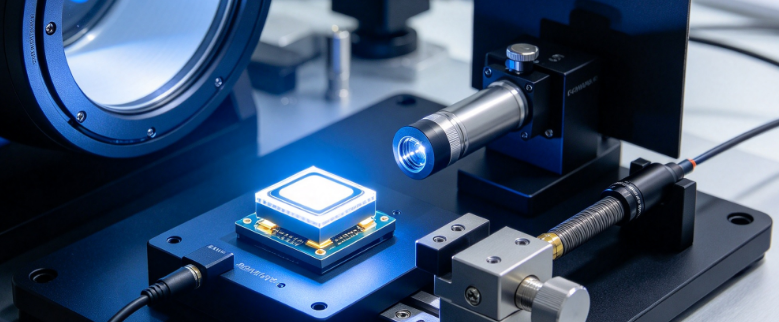
Customers searching for luminous efficiency testing typically need to qualify emitters, benchmark suppliers, optimize epitaxial or packaging processes, validate new materials, investigate efficiency droop, or correlate optical performance with device reliability. Our service is designed for this purpose. We provide quantitative, traceable, and application-relevant measurement of luminous efficiency, quantum efficiency, and radiometric performance so that customers can make confident engineering, sourcing, and production decisions.
Why Luminous Efficiency Testing Is Requested
Luminous efficiency is a direct indicator of energy conversion quality in light-emitting devices and materials. Low or unstable efficiency can originate from defects, poor carrier confinement, non-radiative recombination, optical absorption, thermal quenching, current crowding, or packaging losses. Our luminous efficiency testing service helps customers detect these issues before they affect final product performance, energy consumption, or lifetime. Typical objectives include incoming quality control, supplier qualification, process development, failure analysis, reliability validation, and yield improvement.
Emitters and Materials We Characterize
We test a wide range of light-emitting devices and materials, including LEDs, micro-LEDs, OLEDs, laser diodes, quantum-dot emitters, phosphors, perovskite materials, organic emitters, display backlights, and lighting modules. Sample types range from bare epi wafers, chips, and packages to fully assembled luminaires and display panels. We support small-area emitters, single devices, arrays, and large modules and can design inspection programs for R&D samples, pilot lots, and high-volume production.
Absolute Quantum Efficiency and Radiometric Metrology
Accurate efficiency measurement requires absolute radiometric calibration. We use integrating sphere systems, spectroradiometers, calibrated photodiodes, and imaging colorimeters to measure total radiant flux, luminous flux, spectral power distribution, and absolute quantum efficiency. Our capabilities include absolute external quantum efficiency measurement, photoluminescence quantum yield determination, and low-level emission detection with high signal-to-noise ratio. Calibration is traceable to national metrology institutes, and measurement uncertainty is documented for defensible decision-making.
Internal Quantum Efficiency, Light Extraction Efficiency, and Wall-Plug Efficiency
Internal quantum efficiency, light extraction efficiency, and wall-plug efficiency are critical for understanding where losses occur. We combine temperature-dependent photoluminescence, rate-equation analysis, angle-resolved emission measurements, and electrical characterization to estimate internal quantum efficiency and light extraction efficiency. We measure wall-plug efficiency from electrical input power to optical output power across wide current and voltage ranges. This allows customers to separate material-limited efficiency from device-design-limited efficiency and to identify the dominant loss mechanisms.
Electroluminescence and Photoluminescence Characterization
Electroluminescence and photoluminescence provide complementary views of radiative and non-radiative processes. We perform steady-state and time-resolved photoluminescence, electroluminescence mapping, transient electroluminescence, and time-resolved photoluminescence lifetime measurements. Our time-resolved capabilities cover picosecond to millisecond lifetimes, enabling analysis of carrier dynamics, defect-related recombination, and energy transfer. We also support variable-temperature measurements from cryogenic conditions to elevated temperatures for activation energy and quenching analysis.
Temperature, Current, and Time-Dependent Efficiency Analysis
Efficiency is rarely constant under real operating conditions. We characterize efficiency as a function of drive current, temperature, duty cycle, and aging time. Measurements include light-current-voltage sweeps, efficiency droop analysis, thermal quenching, transient response, and long-term degradation. We quantify efficiency roll-off, thermal droop, and time-dependent efficiency decay with high resolution and repeatability. These data are essential for automotive, display, lighting, and high-power applications where stable efficiency is required.
Spectral, Color, and Angular Performance
Luminous efficiency cannot be fully understood without spectral and angular context. We measure spectral power distribution, peak wavelength, full width at half maximum, color coordinates, correlated color temperature, color rendering index, and color gamut coverage. We perform angular luminous intensity and color measurements across polar and azimuthal angles to evaluate emission uniformity and color shift. Spatial mapping of luminance, chromaticity, and efficiency is available for wafers, chips, packages, and modules.
Failure Analysis and Degradation Mechanisms
When efficiency drops, identifying the root cause requires more than optical measurement. We combine electroluminescence imaging, optical microscopy, scanning electron microscopy with energy-dispersive X-ray spectroscopy, focused ion beam preparation, transmission electron microscopy, secondary ion mass spectrometry, and thermal analysis. We correlate efficiency loss with structural defects, contamination, contact degradation, and material aging. This integrated approach provides high-confidence root-cause conclusions and corrective-action recommendations.
Data Reporting, Uncertainty, and Standards Alignment
Our reports are designed for engineering, quality, and management teams. Deliverables can include absolute efficiency values, spectral data, angular maps, temperature-dependent curves, current-dependent efficiency plots, lifetime data, and supplier comparison summaries. We provide actionable data with traceable calibration protocols and pass or fail criteria aligned with relevant industry standards such as CIE, IEC, ISO, and VESA. Measurement uncertainty, repeatability, and reproducibility are documented for each test method.
Our Advantages in Luminous Efficiency Testing
Our core advantage is the integration of multiple high-end optical, electrical, thermal, and material characterization platforms within one coordinated workflow. We combine integrating sphere photometry, spectroradiometry, imaging colorimetry, time-resolved photoluminescence, electroluminescence mapping, variable-temperature measurement, and failure analysis. We do not merely measure efficiency; we quantify losses, map non-uniformity, classify degradation modes, and relate them to material and process conditions. Our team supports custom inspection protocols, fast turnaround, confidential sample handling, and scalable programs for R&D, pilot lines, and mass production. With calibrated instruments, traceable standards, and experienced engineers, we help customers reduce uncertainty, accelerate qualification, and improve product performance.
Applications and Industries We Support
Our luminous efficiency testing services support general lighting, display backlights, micro-LED displays, OLED displays, automotive lighting, visible-light communication, optical sensors, medical imaging, horticultural lighting, and advanced research. We serve epitaxial wafer suppliers, chip makers, package houses, display manufacturers, material suppliers, and research institutions. Whether the goal is incoming quality control, supplier benchmarking, new product introduction, reliability validation, or failure analysis, we provide the depth of inspection needed to make technically sound decisions.
Request Luminous Efficiency Testing Services
To begin, customers can provide emitter type, material system, size, drive conditions, suspected loss mechanisms, and relevant acceptance criteria. Based on these inputs, we design a targeted testing plan that balances absolute radiometric measurement, spectral and angular analysis, temperature-dependent characterization, and statistical reporting. We can build a customized luminous efficiency testing program that meets demanding technical specifications and production timelines. Contact us to discuss sample submission, measurement resolution, reporting format, and turnaround requirements.